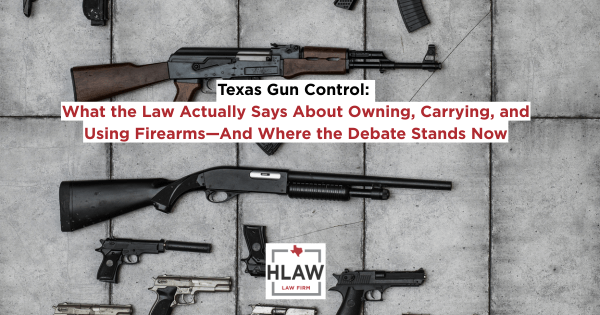
Texas Gun Control: Understanding state laws on owning, carrying, and using firearms—and how today’s gun-control debate shapes the rights of Texas gun owners. Presented by HLAW Law Firm.
Texas has some of the nation’s most permissive gun laws—but there are still bright-line rules about who may possess a gun, where you can carry, how you must carry, and when force (including deadly force) is justified. Recent court rulings and new legislation have also shifted the ground under both gun-rights and gun-safety advocates. This guide breaks it all down in plain English.
1) The Legal Backdrop: The Second Amendment & Recent Supreme Court Cases
- Bruen (2022): The Supreme Court held that when the Second Amendment covers conduct, the government must justify restrictions by showing they fit the nation’s historical tradition—often called the “text, history, and tradition” test. This ruling reshaped challenges to gun laws nationwide.
- Rahimi (2024): The Court upheld the federal ban on firearm possession by people subject to qualifying domestic-violence restraining orders (18 U.S.C. § 922(g)(8)), emphasizing that disarming those who pose a credible threat is consistent with historical tradition.
- Cargill (2024): The Court struck down ATF’s administrative bump-stock ban, holding bump stocks are not “machineguns” under the federal statute—leaving regulation of these devices to Congress or the states.
These decisions influence how Texas laws are interpreted and what new measures are likely to survive in court.
2) Who Can and Cannot Possess a Firearm in Texas
- General rule: If you are not prohibited by state or federal law, you may possess firearms.
- Felony convictions: A person convicted of a felony generally cannot possess a firearm. After five years from release from confinement, parole, or probation, limited possession only at the person’s residence may be allowed; possession elsewhere remains illegal.
- Family-violence & protective orders: Federal law bars possession while you’re subject to certain domestic-violence restraining orders; Rahimi confirms that ban’s constitutionality. Texas law also restricts possession after certain family-violence findings.
3) Carrying Handguns: Permitless Carry vs. License to Carry (LTC)
Permitless (“constitutional”) carry
Since September 1, 2021, most adults 21+ who may lawfully possess a handgun can carry it—openly in a holster or concealed—without a state license. There are still many exceptions (see “Prohibited Places” below).
18–20-year-olds: Following Firearms Policy Coalition v. McCraw, Texas no longer enforces the 21+ carry limit solely based on age; DPS now accepts 18–20-year-old applicants for LTC and acknowledges the ruling in its guidance. (Young adults must still be otherwise eligible under state and federal law.)
Why many Texans still get an LTC
The LTC program remains in effect and offers real advantages: streamlined carry in certain contexts, interstate reciprocity, and practical benefits in stops or travel. DPS maintains an official list of LTC benefits.
4) Where Guns Are
Prohibited
(Even if You Can Otherwise Carry)
Texas Penal Code § 46.03 lists “places weapons prohibited.” Highlights include schools, polling places, courts, secured airport areas, 51% alcohol-sales establishments, amusement parks, hospitals/nursing facilities (with required notices), and more—subject to detailed exceptions/defenses. Violations can be serious felonies in some settings. Always check the statute before you go.
Newer “46.03 sign” notices: Covered locations may post a § 46.03-specific sign at entrances that eliminates certain defenses for accidental carry in prohibited places. If you see it, don’t carry past it.
5) Private Property & Signs: Texas Penal Code 30.05, 30.06, 30.07 (What They Mean)
Private owners can restrict handguns on their property through specific notice:
- Texas Penal Code §30.05 (Criminal Trespass) “No guns” notice: Bars people (especially those without an LTC) from entering/remaining with a firearm if proper notice is given.
- Texas Penal Code §30.06: “No concealed handguns by license holders.” Applies to LTC holders carrying concealed.
- Texas Penal Code §30.07: “No openly carried handguns by license holders.” Applies to LTC holders carrying openly.
To be enforceable, these notices must follow statutory format/placement. If you receive oral notice, you must depart or disarm—even if the sign is imperfect. (When in doubt, leave and call us before you risk an arrest.)
6) How You May Carry: The “Unlawful Carrying” Rules
Texas Penal Code §46.02 governs unlawful carrying of weapons, including handguns in vehicles and on-person. Key points include holster requirements for open carry, restrictions while committing other crimes, and special rules for carry inside your vehicle or on your own property. Violations can escalate quickly depending on location and circumstances.
7) Self-Defense, Defense of Others, & Defense of Property (When Force Is Justified)
Texas Penal Code Chapter 9 spells out when force—and deadly force—is justified.
- Self-defense (Texas Penal Code §9.31): Force is allowed if you reasonably believe it’s immediately necessary to counter another’s unlawful force. Texas has no general duty to retreat if you meet statutory conditions.
- Deadly force (Texas Penal Code §9.32): Allowed if you meet § 9.31 and you reasonably believe it’s immediately necessary to stop unlawful deadly force or certain serious violent felonies (e.g., aggravated robbery). Presumptions may apply in home/vehicle/business intrusion scenarios.
- Defense of others (Texas Penal Code §9.33): You can use force (including deadly force) to protect another if they would have the same right of self-defense and your belief is reasonable.
- Property (Texas Penal Code §§ 9.41–9.42): Force may stop trespass or interference with property; deadly force is narrow—limited to specific nighttime crimes and other strict conditions. These cases are fact-sensitive and heavily scrutinized. Call a lawyer before you make statements.
8) State Preemption: Why Cities & Counties Can’t Add Their Own Gun Codes
Texas preempts most local gun regulation. Municipalities and counties generally cannot regulate the possession, carry, storage, transfer, or registration of firearms (and now explicitly, air guns, archery equipment, knives, ammunition, and explosives). Recent legislation in 2025 (SB 2284) further clarified and expanded these limits.
There are limited carve-outs (e.g., regulating discharge at outdoor ranges; narrow subdivision rules), but the default is broad state control.
9) Red-Flag (ERPO) Policies: Where Texas Stands
Texas does not have a red-flag law—and in June 2025 lawmakers passed an “Anti-Red Flag Act” (SB 1362) that blocks courts and local officials from using or enforcing ERPO-style orders under state law and resists enforcement of most federal or out-of-state ERPOs. (Separate protective-order laws and federal prohibitions for domestic-violence orders still apply.)
10) The Ongoing Policy Debate in Texas
- Gun-rights advocates emphasize self-defense and constitutional protections, backing permitless carry, preemption, and resistance to ERPOs; they cite Bruen and Cargill as guardrails against expansive regulation.
- Gun-safety advocates continue to push for measures like universal background checks and ERPOs, noting strong polling support among Texans post-Uvalde—though the Legislature has largely moved in the opposite direction.
Expect continued litigation and incremental statutory tweaks. When laws change, the details (age thresholds, signage, prohibited places, defenses) matter.
11) Practical Tips for Texans
- Know the signs and the setting. If you see a § 46.03 prohibited-place sign or a 30.05/30.06/30.07 notice—or you’re orally told not to carry—don’t carry past it.
- Vehicle carry vs. public carry. The rules are different; ensure holster compliance and avoid any conduct that could elevate a simple stop into an arrest.
- Consider an LTC. Reciprocity, training, and practical benefits still matter—especially when traveling or interacting with law enforcement.
- After any defensive display or use of force: call counsel first. Chapter 9 defenses are technical and fact-intensive.
12) How Our Firm Helps
Navigating Texas gun laws is not just about quoting statutes—it’s about protecting your rights while reducing your legal risk. Whether you were stopped while carrying, face a 46.03 or 30.05/30.06/30.07 charge, need counsel after a defensive incident, or want compliant policies for your business or church, we’re here.
Free, confidential consultation: If you’re facing a firearm-related investigation or charge—or you simply want clarity before you carry—call us. We’ll review your facts, assess exposure under Penal Code §§ 46.02, 46.03, 46.04 and Chapter 9, and map a strategy to protect your freedom. (The earlier we engage, the more options we have.)
Statutes & Key References (select)
- Texas Penal Code Ch. 46 (Weapons); §§ 46.02–46.05, § 46.03 (prohibited places), § 46.04 (unlawful possession by felon).
- Texas Penal Code Ch. 30 (Trespass): §§ 30.05, 30.06, 30.07.
- Texas Penal Code Ch. 9 (Justification): §§ 9.31–9.33, 9.41–9.42.
- DPS: LTC Benefits & FAQs (including 18–20 guidance).
- Texas State Law Library Gun-Law Guides (updated frequently).
- Preemption: Local Gov’t Code § 229.001 (cities) & Ch. 236 (counties), as updated; SB 2284 (2025).
- SCOTUS: Bruen (2022); Rahimi (2024); Cargill (2024).

 When you think about the Christmas season, you probably think about family time, presents, good food, and celebration. We think about those things too, but as criminal defense attorneys, we also think about the reasons that some of our clients get arrested during the holiday season. For this article, we took a look at the last 8 years of holiday season arrests (for clients that we represented) and compiled an (anecdotal) list of the top 5 reasons that folks get arrested during the Christmas/New Year’s season. Our goal is that this list will serve as a warning, so that your holiday season can be filled with the good stuff, rather than jail, bail, and calls to our office. Here goes:
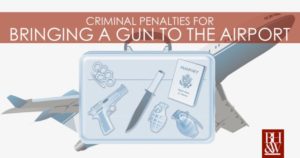 We love our guns in Texas. After all, those licensed to carry a handgun can now choose to conceal the handgun or wear it on their hip like in the old west. But carrying a handgun comes with its risks. Many places are designated as “off limits” for handguns. Chief among them is the airport. And everyday, well-meaning folks forget about their trusty handgun when they pack their bags and head to DFW International Airport or Love Field, only to be reminded by a less-than-friendly TSA agent as they attempt to pass through security. In fact, Texas is the #1 state for airport gun seizures in the country (and DFW International Airport leads the way in Texas).