

What is the Lautenberg Amendment?
 The Lautenberg Amendment to the Gun Control Act enacted in the Fall of 1996 provides that those with a conviction for a misdemeanor crime of domestic violence cannot use, possess, or transport a firearm or ammunition.
Senator Frank Lautenberg was the chief sponsor of this amendment. The purpose behind this amendment is to keep firearms out of homes where a domestic violence relationship exists. Lautenberg presented it with the idea that domestic violence and firearms are a deadly combination and enacting this amendment would lessen the likelihood of a victim to die during a domestic violence episode. 142 Cong Rec S 11872. Additionally, since there was already a firearm ban in place for felony convictions, this Amendment combats the devastating loophole that previously allowed persons with misdemeanor convictions of domestic violence to fall through the cracks and be permitted to own firearms. United States v. Hayes, 555 U.S. 415.
When Does the Lautenberg Amendment Apply?
The Lautenberg Amendment will not have any impact until a person has a misdemeanor conviction of domestic violence. 18 U.S.C. § 922(g)(9). That is, a misdemeanor that
“has, as an element, the use or attempted use of physical force, or the threatened use of a deadly weapon, committed by a current or former spouse, parent, or guardian of the victim, by a person with whom the victim shares a child in common, by a person who is cohabiting with or has cohabited with the victim as a spouse, parent, or guardian, or by a person similarly situated to a spouse, parent, or guardian of the victim.”
18 U.S.C. § 921(33).
A defendant will not be considered convicted unless they were represented by an attorney or “knowingly and intelligently” waived that right and the case was prosecuted at a jury trial or the defendant “knowingly and intelligently” waived that right by a guilty plea or otherwise properly waived that right. Id.
If you have been charged with a qualifying misdemeanor conviction, the amendment has no impact on you until you have received a final conviction. However, if you are subject to a protective order, the Gun Control Act and the State of Texas separately provide that you cannot use, possess, or transfer firearms. 18 U.S.C. § 922(d)(8); Tex. Fam. Code § 85.022(b)(6); Tex. Pen. Code § 46.04(c).
In Texas, if you have disposed of your case through deferred adjudication, which is not a final conviction, and you successfully complete the deferred adjudication, the amendment will not impact you since the statute requires a conviction. 18 U.S.C. § 921(33). Additionally, the conviction element of this statute will not be satisfied if the conviction is expunged, set aside, or the defendant has been pardoned. Id.
What Impact Does the Lautenberg Amendment Have on the Military Defendant?
Prior to the Lautenberg Amendment, 18 U.S.C. § 925(a)(1) provided a military and law enforcement exception to the Gun Control Act. The Lautenberg Amendment contains no similar exception.
What this means for the military defendant that gets a conviction is that his service could be compromised since they can no longer use, possess, or transfer a firearm. This conviction can impact their ability to re-enlist, cause a transfer to a military occupational specialty (MOS) that doesn’t require the handling of firearms, and affect the ability to be deployed. Many servicemembers that receive a domestic violence conviction will be processed for administrative separation.
According to the Supreme Court, What Cases are Considered Misdemeanor Convictions of Domestic Violence?
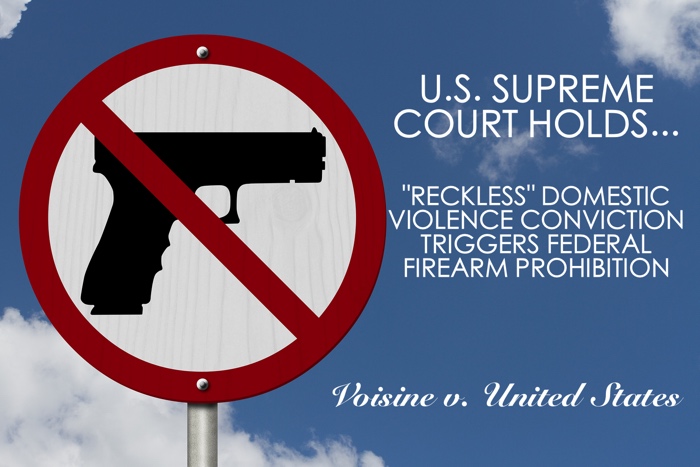
In Voisine v. United States, the Supreme Court clarified that the federal firearm ban under the Lautenberg Amendment applied to every case where the underlying conduct was an act of domestic violence, regardless of whether the state court made an affirmative finding of domestic violence (or family violence in Texas). This means that persons with misdemeanor convictions anywhere from a Class C simple assault* to a Class A assault with or without a domestic violence finding are banned from using, possessing and transferring firearms if their victim was one with whom they had a domestic relationship.
Voisine v. United States dealt with two domestic violence-related cases from Maine where both defendants’ previous convictions were based on reckless conduct, not intentional or knowing conduct. Thus, they argued that the Lautenberg Amendment didn’t apply to them. The Supreme Court ruled that the firearm ban did apply to them for two reasons:
- Reckless use of force is use of force the same as if it was intentional or knowing; and
- The legislative history and plain language of the statute lead to such a conclusion.
Looking to the statutory definition of an applicable misdemeanor conviction provided above, there is no specific mental state required. The definition provides that the Amendment applies to any misdemeanor under federal, state, or tribal law that was committed by a person through use of physical force against a victim with whom they have a domestic relationship.
*Class C is the same level as a traffic ticket.
Texas Specific Firearm Bans for Domestic Violence Convictions
In Texas, a person who has been convicted of a misdemeanor involving family violence cannot possess or transfer a firearm or ammunition for 5 years after they are released from confinement or after they have completed and been released from community supervision following the conviction. Tex. Pen. Code § 46.04(b).
The Texas Family Code defines family violence as “an act by a member of a family or household against another member of the family or household that is intended to result in physical harm, bodily injury, assault, or sexual assault or that is a threat that reasonably places the member in fear of imminent physical harm, bodily injury, assault, or sexual assault.” Tex. Fam. Code § 71.004. Additionally, under Section 22.01 of the Texas Penal Code an assault involving the person’s family or household occurs if the person causes bodily injury to another, threatens a person with “imminent bodily injury,” or causes physical contact with someone that they know or should know would find “offensive or provocative.” From these definitions you can see that a misdemeanor conviction of domestic violence in Texas expands the qualifying convictions beyond those that qualify under the Lautenberg Amendment.
If a person is convicted of a misdemeanor offense of family violence the court must notify them that it is against the law for them to possess or transfer firearms or ammunition. Tex. Code Crim. Proc. art. 42.0131. Additionally, if a defendant decides to enter a plea of guilty or nolo contendere for a misdemeanor involving family violence the court must, before accepting the plea, admonish the defendant with the following:
“If you are convicted of a misdemeanor offense involving violence where you are or were a spouse, intimate partner, parent, or guardian of the victim or are or were involved in another, similar relationship with the victim, it may be unlawful for you to possess or purchase a firearm, including a handgun or long gun, or ammunition, pursuant to federal law under 18 U.S.C. Section 922(g)(9) or Section 46.04(b), Texas Penal Code. If you have any questions whether these laws make it illegal for you to possess or purchase a firearm, you should consult an attorney.”
Tex. Code Crim. Proc. Art. 27.14.
Texas law does not require the defendant to surrender firearms or ammunition once the possession is prohibited. Neither does Texas law specifically authorize or require the removal of firearms or ammunition from the scene of a domestic violence incident.
In short, Texas law provides a prohibition of gun possession for five years after release from confinement or probation in more circumstances than under the Lautenberg Amendment. However, if your conviction is also a qualifying conviction under the Lautenberg Amendment then your right to possess a firearm is indefinitely prohibited. If you find yourself in that situation your only option to restore your firearm rights is to request a full pardon and restoration of civil rights in your pardon paperwork.
Are You Currently FacingDomestic Violence Assault Charges in Tarrant County?
Whether you have already been convicted or are currently facing charges of assault it is extremely important to know the heavy consequences that are attached to convictions where the underlying conduct is considered domestic violence. There are many misconceptions out there on whether federal firearm ban applies to a specific assault case. It is important that you know for a fact whether it applies to you so that you don’t risk violating federal law. If you are facing charges for an offense involving family violence under Texas law, contact our criminal defense team and schedule a free consultation to discuss and determine what consequences you are facing and whether the federal and/or Texas firearm ban applies to you.
 Voisine v. United States