
Tag

CHL

License to Carry Handgun LTC CHL

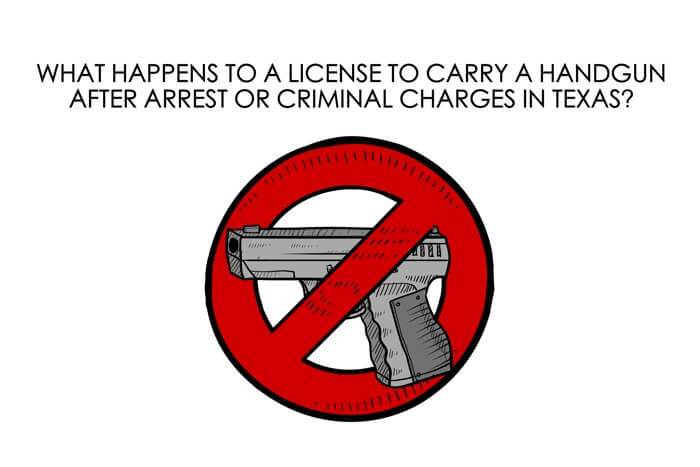
License to Carry a Handgun After Arrest or Criminal Charge in Texas

By Weapons Charges

License to Carry Handgun LTC CHLThere are many consequences for persons arrested and charged with a crime in Texas.  One of the often overlooked considerations is whether and to what extent a criminal accusation impacts one’s authorization to carry a weapon with a License to Carry (LTC), formerly a Concealed Handgun License (CHL). The reality of gun possession in today’s political climate is that the restrictions are many and increasing.

Texas has very specific guidelines regarding qualifications for obtaining a License to Carry a Handgun. But, what most do not realize is that there are also strict regulations in place while a person possesses that license – especially if a person is arrested and charged with a crime.

What happens to my License to Carry or CHL if I’m arrested and charged with a crime?

Texas Government Code 411.187 spells out the scenarios that require the Texas Department of Public Safety (DPS) to suspend one’s LTC or CHL. In regards to criminal charges, the department SHALL suspend an LTC if the license holder is charged with the commission of:

  • a Class A or Class B Misdemeanor;
  • an offense under Section 42.01 of the Texas Penal Code (Disorderly Conduct); or
  • any Felony offense.

In addition, a person’s LTC or CHL will be suspended if a person is arrested for any offense involving family violence or disorderly conduct and is subject to an active protective order.

How long will my License to Carry be suspended if I’m arrested and charged with a crime?

Unfortunately, the law is clear that the suspension will remain in place until the dismissal of the charges or for the duration of the protective order (in a family violence case.) Texas Government Code 411.187(c)(3).

What happens to my LTC or CHL if I’m convicted of the charge?

If you are convicted of any felony or of the offense of “Unlawful Carrying of a Handgun by a License Holder,” your license to carry a handgun will be revoked permanently. Texas Government Code 411.186 (3) & (4).

If you are convicted of a class A or class B misdemeanor, your license will remain suspended and you will only be able to re-apply for a new LTC when you once again meet the initial eligibility requirements.

A person is eligible for a LTC if they have not, in the five years preceding the application, been convicted of a Class A or Class B misdemeanor or disorderly conduct. What this essentially establishes is a 5-year waiting period from the time of your conviction to the time when you can apply again for your handgun license.

What about being convicted of offenses involving family violence?

Offenses involving family violence carry more significant consequences. If you are convicted of a Class C, Class B or Class A misdemeanor involving family violence, then Federal Law prohibits you from owning or possessing a firearm. Also, under Federal Law, even a plea to deferred adjudication constitutes a conviction and bars a person from owning or possessing a firearm. Because of this, a conviction for any misdemeanor involving family violence would prohibit you from ever being eligible to obtain your concealed handgun license in Texas. See Texas Government Code 411.172 (a) (9).


Locked and Loaded: What You Need to Know About Texas’ New Open Carry Laws

By Open Carry

Texans love their guns and many folks in Texas are excited about the new “Open Carry” laws that were passed this year. Some people imagine a wild west where handguns are worn on the hips of everyone in town. Other are terrified that gun-related incidents will increase. Well, the new open carry laws do not come without their rules.

With the passage of House Bill 910, beginning January 1, 2016, Texans in possession of a concealed carry license (CHL) will be allowed to openly carry a holstered handgun. While “open carry” sounds simple enough, there is much more to it. This article explains some of the rules that Texans need to know if they plan to openly carry a handgun in 2016.

Who is eligible to openly carry a handgun?

Only CHL holders may open carry. Subchapter H of Chapter 411 of the Texas Government Code sets out the basic requirements for a person to be eligible to apply for a handgun license and openly carry a firearm.

To open carry in Texas, a person MUST:

1) Be a legal resident of the State of Texas for the preceding six months before applying for his or her handgun license;
2) Be at least 21 years of age*;
3) Have never been convicted of a felony;
4) Not be charged with the commission of:
• Class A or B Misdemeanor or equivalent offense
• the offense of Disorderly Conduct or equivalent; or
• a felony offense;
5) Not be a fugitive from justice for a felony, Class A or B Misdemeanor or equivalent offense;
6) Not be a chemically dependent person;
7) Not be incapable of exercising sound judgment with respect to the proper use and storage of a handgun;
8) Have not, in the prior five years before applying, been convicted of a Class A or B Misdemeanor or equivalent offense or of the offense of Disorderly Conduct or equivalent offense;
9) Be fully qualified under applicable federal and state law to purchase a handgun;
10) Have not been finally determined to be delinquent in making child support payments or collected by the attorney general;
11) Have not been finally determined to be delinquent in the payment of taxes or other money collected by the State;
12) Not be currently restricted under a court protective order or subject to a restraining order affecting the spousal relationship, other than a restraining order solely affecting property interests;
13) Have not, in the 10 years preceding the date of application, been adjudicated as having engaged in delinquent conduct violating a penal law of the grade of felony; or
14) Have not made any material misrepresentation, or failed to disclose any material fact, in an application submitted pursuant to Section 411.174. (Perjury).

*The age restriction is lowered down to 18 for honorably discharged military veterans who meet all other qualifications.

What types of firearms can be openly carried in Texas?

Currently, under Texas Penal Code Section 46.03, a person cannot carry, either openly or by concealment, a handgun unless that person is on the person’s own premise or inside of a motor vehicle that is owned or under the person’s control (the weapon must still be concealed if carried in a vehicle under 46.03 (a-1)). There is no language in Texas Penal Code 46.03 regarding firearms other than handguns. Therefore, there are no laws prohibiting openly carrying rifles and shotguns (subject to the “where” restrictions to be addressed below). The exception to Texas Penal Code 46.03 is that the provision doesn’t apply to those in possession of a license issued under Subchapter H, Chapter 411 of the Texas Government Code.

In addition to carrying a concealed handgun under Subchapter H, the new House Bill 910 now grants the opportunity for Texans in possession of a concealed carry to openly carry a holstered “handgun.” A “handgun” is defined by Texas Penal Code 46.01 (5) as “any firearm that is designed, made or adapted to be fired by one hand.” Shotguns can be openly carried now in addition to holstered handguns as long as a person is in possession of a license granted under Subchapter H, Chapter 411 of the Texas Government Code.

How can handguns be openly carried?

Use a holster. Under Texas Penal Code 46.15(b) (6), a person carrying a valid CHL may carry a handgun either in a concealed manner or in a shoulder or belt holster. Under these new provisions, if the handgun is carried any other way, a person would be unlawfully carrying the handgun.

Where can handguns be openly carried?

In general, even if a person possesses a CHL, Texas Penal Code 46.03 strictly prohibits the carrying of a handgun or firearm from the following places:
1) School or educational institutions;
2) An election site during regular or early voting;
3) Government or court offices;
4) At a racetrack;
5) Airports (in the restricted section); or
6) Within 1,000 feet of premises of an execution site on the day of an execution.

In addition to the locations listed above, Texas Penal Code 30.06 prohibits individuals, and creates a criminal offense of trespass, for those who hold a license to carry a handgun when notified that their presence on the property with a handgun is expressly forbidden. To provide notice, a property owner must display written notice on the property that specifically complies with the notice requirements of Texas Penal Code 30.06.

With the new Open Carry law, those that wish to prohibit others from carrying a handgun on their premises, must also post a notice in accordance with section 30.07 of the Texas Penal Code.  This notice is in addition to the 30.06 sign.

Conclusion

The term “open carry” has been loosely thrown around as new legislation has been debated and ultimately passed regarding openly carrying handguns. It is important to remember that “open carry” isn’t a free-for-all regarding handguns. “Open Carry” is still highly regulated and a person considering openly carrying a handgun should be familiar with all of these new laws and regulations, so that they do not end up needing our services.

Luke Williams is a criminal defense attorney with Barnett Howard & Williams PLLC in Fort Worth, Texas.

Barnett Howard & Williams PLLC
500 Main Street, Suite 610
Fort Worth, Texas 76102
bhwlawfirm-staging.kgencec7-liquidwebsites.com