
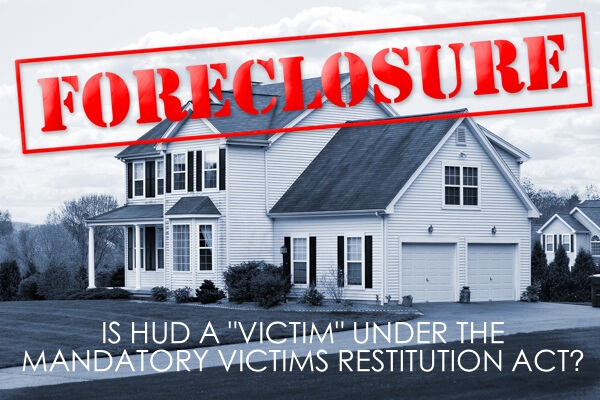
Definition of “Victim” under the MVRA, leaves HUD out in the Cold | Who Qualifies for Relief Under the Mandatory Victims Restitution Act?
 United States v. Benns (5th Circuit, 2016) is a case regarding the Mandatory Victims Restitution Act (MVRA). In this case, the US Court of Appeals for the Fifth Circuit held that HUD is not a victim of the defendant’s crime, even though the HUD was out a considerable amount of money after defendant forged a credit application. Read more about USA v. Benns below.
Anxious Couple Seeks Help for Mortgage Default
Desperate for relief from a mortgage in arrears, Michael and Brenda Arnold conveyed ownership rights of their Arlington home to Rickey Benns. At the time of the conveyance, Benns agreed to rent the home and pay the mortgage from the profits made from future tenants. The mortgage loan, held by Bank of America and insured by the United States Department of Housing and Urban Development (“HUD”), remained in the Arnold family’s name. Unfortunately, Benns reneged on his agreement and failed to pay off the mortgage, triggering foreclosure proceedings against the Arnolds, unbeknownst to them.
Looming Foreclosure Leads to Desperate Acts of Forgery
In an attempt to prevent foreclosure of the property, Benns secretly tried to refinance the property. Benns forged Arnolds’s signatures on loan modification documents and used a false pay stub to trick the bank into believing the Arnolds were creditworthy and still owned the property. After the application was denied by the bank, the property was eventually foreclosed on and sold below market value. Because Bank of America’s mortgage was insured by HUD, HUD paid the bank $54,906.59—the difference between what HUD paid Bank of America following foreclosure and the later sale price of the property.
A Plea is Entered and Restitution is Ordered
Benns plead guilty to one count of making false statement on a credit application, a violation of 18 U.S.C. § 1014. Upon entering the guilty plea, Benns “accepted the accuracy of a factual resume prepared by the government…author[izing] restitution to the victims of the community…includ[ing] restitution arising from all relevant conduct, not limited to that arising from the offense of conviction alone.” Benns was sentenced to twenty-seven months imprisonment, five years of supervised release, and ordered to pay restitution, totaling $544,602.42, under the federal Mandatory Victims Restitution Act (“MVRA”). Benns appealed to the United States Court of Appeals for the Fifth Circuit, arguing that HUD was not a victim of his convicted offense.
What is the Mandatory Victims Restitution Act (“MVRA”)?
The MVRA requires district courts to order restitution payments to crime victims during sentencing. 18 U.S.C. § 3663A. Under federal law, a victim is defined as, “a person directly and proximately harmed as a result of the commission of an offense for which restitution may be ordered.” Id. Typically, restitution is limited to losses arising from underlying conduct of a defendant’s offense of conviction. Hughley v. United States, 495 U.S. 411, 412-13 (1990); United States v. Espinoza, 677 F.3d 730, 732 (5th Cir. 2012); United States v. Maturin, 488 F.3d 657, 660-61 (5th Cir. 2007). To be a considered a victim under the MVRA, a person or organization must “suffer a foreseeable loss as a result of the conduct underlying the convicted offense.” Id. The government must establish, by a preponderance of the evidence, direct or proximate causation between the conduct underlying the offense and the actual loss suffered by the victim. United States v. Reese, 998 F.2d 1275, 1282 (5th Cir. 1993).
The Big Issue: Is HUD really a victim of Benns’s forgery scheme?
The United States Court of Appeals for the Fifth Circuit must determine whether HUD was a victim of Benn’s convicted offense. If the Court finds that HUD was a victim, then HUD will receive restitution under the MVRA. If the Court finds that HUD was not a victim, then Benns’ restitution award, which was imposed by the district court, could be amended or vacated altogether.
The Court of Appeals for the Fifth Circuit Weighs In with a Surprising Twist
Here, the Court weighs the argument made by the government against the facts of the case. The government argues that HUD’s loss was a direct result of Benn’s false credit application because the filing of the application itself delayed the foreclosure, which resulted in HUD selling the property at a loss. However, the Court states that the government did not produce evidence that the false credit application resulted in a delay, or that such a delay resulted in a greater loss for HUD than if HUD had sold the property any sooner than it actually did. The Court holds, because of the lack of evidence connecting the false credit application with the loss incurred by HUD, HUD is not to be considered a “victim” under the MVRA and, accordingly, cannot receive an award of restitution. “Benns was indicted and pleaded guilty to one count of filing a false credit application…it therefore does not follow that the behavior underlying Benn’s offense was the cause of HUD’s loss.”
Restitution could have only been awarded had the government established a direct or proximate causation between Benn’s false credit application and HUD’s loss when HUD sold the property at a foreclosure auction. The Court says the government failed to do so. Even though HUD was out $54,906.59, the Court does not consider HUD to be a victim of Benn’s convicted offense and vacates the restitution award.