Skip to main contentHome » REASONABLE DOUBT
Visuals Can Help Explain the Burden of Proof During Voir Dire and Trial.
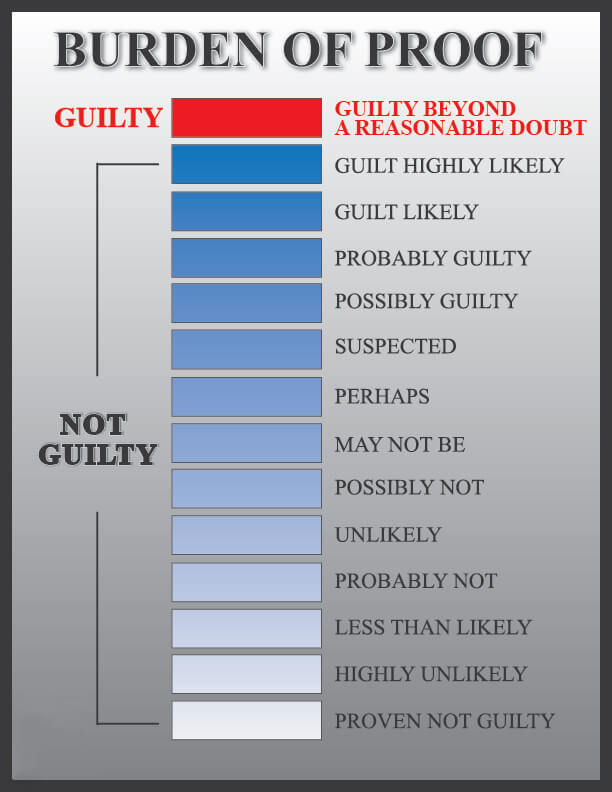
One of the goals of every criminal trial lawyer during jury selection (voir dire) is to educate the venire panel on the various burdens of proof. More specifically, criminal trial lawyers must explain the meaning of “Beyond a Reasonable Doubt.” It is critical that the jury understand that Beyond a Reasonable Doubt is the highest standard known to the law and that if there is any reasonable doubt the jury must return a verdict of Not Guilty.
Explaining the Burden of Proof in Modern Times
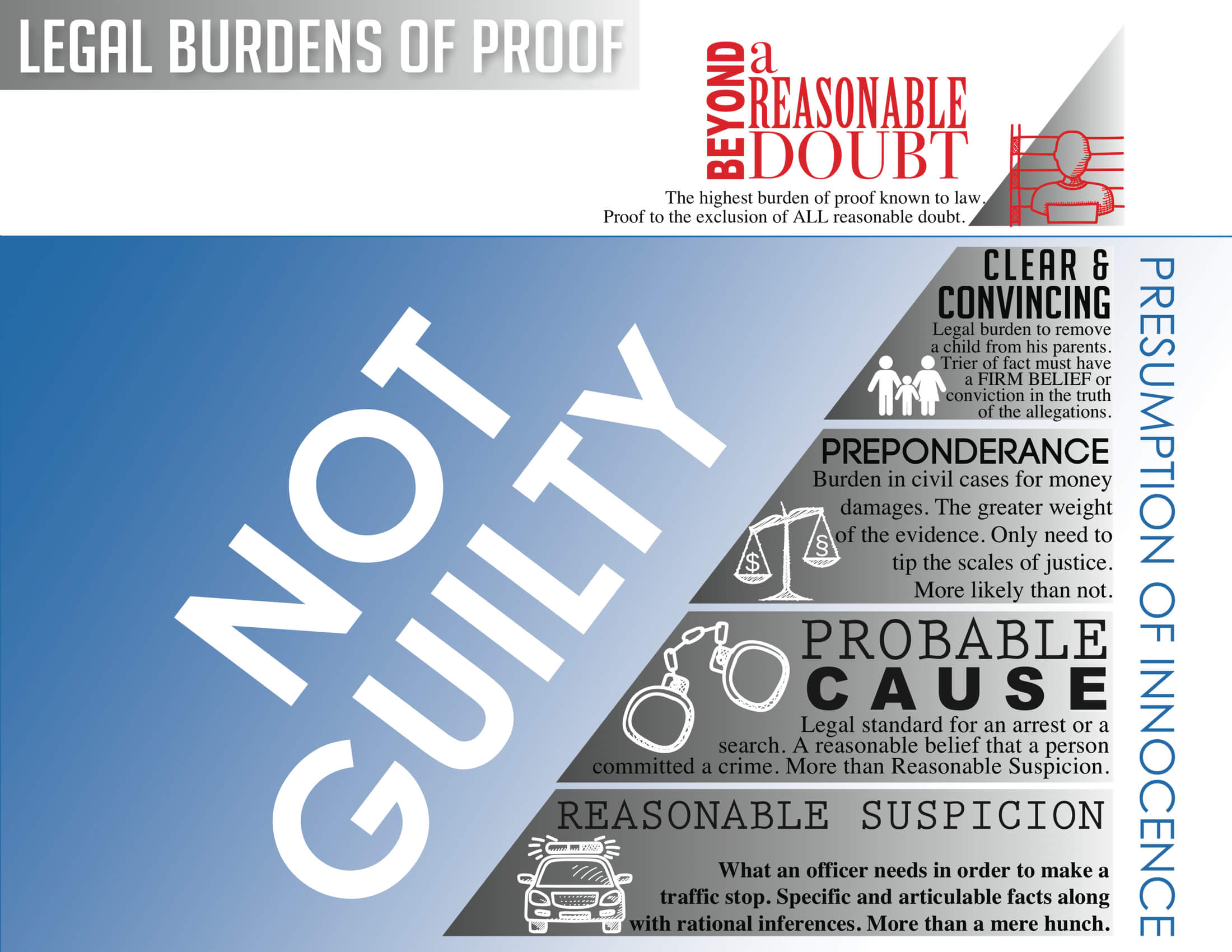
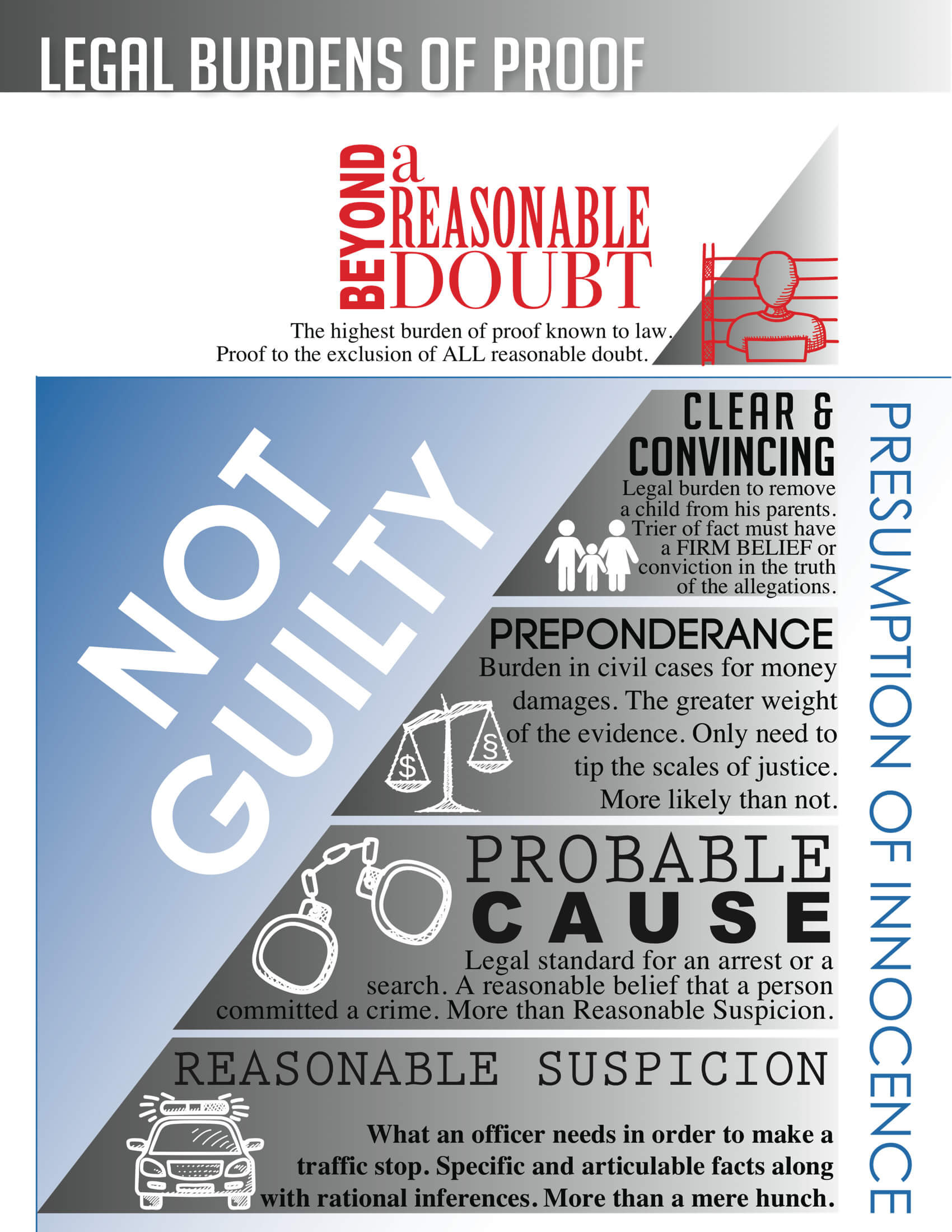
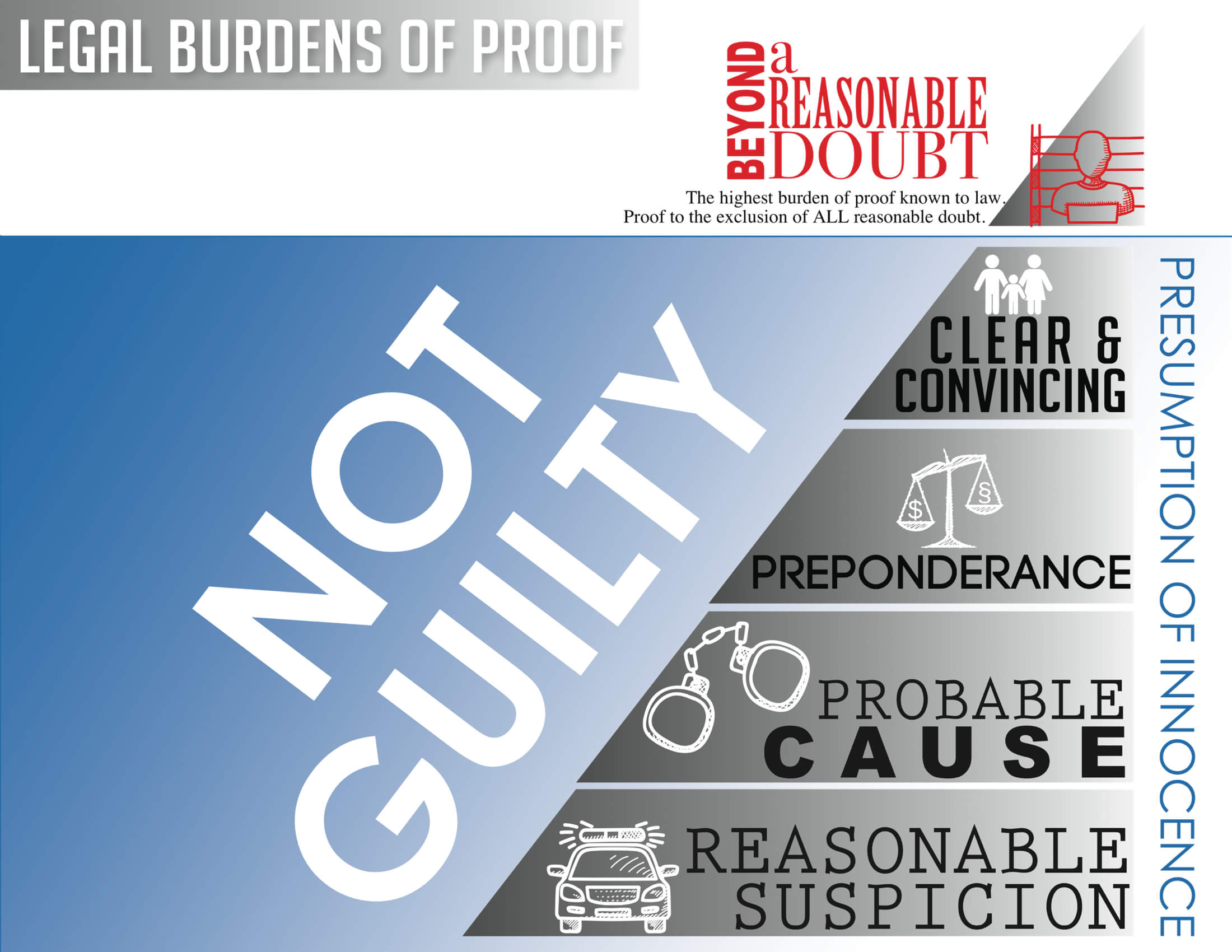
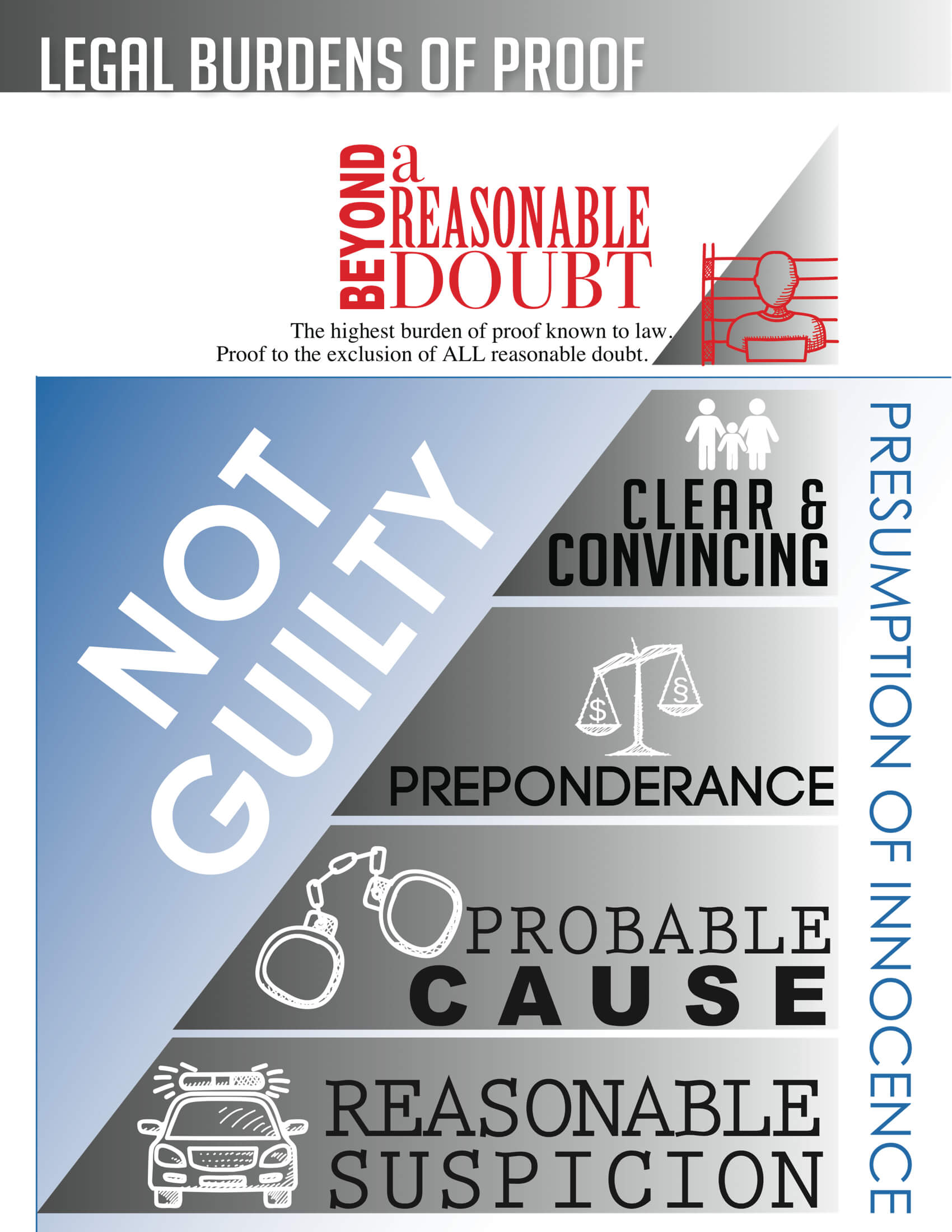
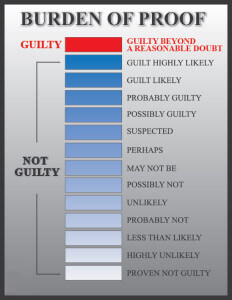
With the technologically-immersed culture in which we live, there is no doubt that our jury pool has a much lower attention span. Lawyers, who in times past could speak to the jury and teach them about the burden of proof, must now show them. Whether we use PowerPoint slides, Posters, or other media, a jury can better digest our argument if it is reinforced by media. Our criminal trial lawyers considered this and came up with the following graphics to portray the various burdens of proof. We use these images during jury selection and during argument to educate the jury and reinforce the importance of the burden of proof and the presumption of innocence.
Burden of Proof Images. Free to Download and Use in Trial.
We have provided our burden of proof images and slides below for you to use if you want. If you click on the image, you will see the full-size, high resolution version (depending on your screen size). You’ll notice that there are two versions (one vertical and one landscape). We’ve found that the landscape version is better as a PowerPoint slide. You’ll also notice that we have removed the explanations of the burdens of proof on one set of images. This is so that you can explain the burdens in your own words rather than ours (it is also a cleaner, less busy version). Again, feel free to use these slide if you like them, or use them as inspiration to create your own.
*If you decide use these images on your website, please provide a link back to this page as the original content. Thanks.
Criminal Defense Attorneys – Fort Worth, Texas
Barnett Howard & Williams is a boutique criminal defense firm in Fort Worth, Texas. Our attorneys handle all felony and misdemeanor cases in Tarrant County and some surrounding areas. If you are under investigation or if you have been charged with a crime, you need a proven team of criminal defense lawyers to fight for you in the courtroom. Contact our firm today for a Free consultation of your criminal defense matter at (817) 993-9249.

FORT WORTH
Primary Location
930 W. 1st St., Suite 202
Fort Worth, TX 76102
817.993.9249
KELLER
*By Appointment Only
101 Quest Court
Keller, Texas 76248
817.482.6770
beyond reasonable doubt, beyond a reasonable doubt, what is reasonable doubt, without reasonable doubt
Understanding the Standard of Beyond a Reasonable Doubt
The standard of "beyond a reasonable doubt" is the highest burden of proof in the legal system, primarily used in criminal trials. It requires that jurors feel a high level of certainty about the defendant's guilt before convicting them. This standard is crucial because it protects against wrongful convictions, ensuring that the prosecution meets a stringent threshold before depriving an individual of their liberty.
In practice, this means that if there is any reasonable doubt regarding the defendant's guilt, the jury must acquit. This concept emphasizes the presumption of innocence and places the burden squarely on the prosecution. Understanding this standard is vital for both jurors and defendants, as it shapes the entire trial process and the decisions made within the courtroom.
How Visual Aids Enhance Jury Understanding
Visual aids, such as charts and infographics, play an essential role in helping jurors grasp complex legal concepts, including the burden of proof. By presenting information visually, attorneys can simplify intricate ideas, making them more accessible to jurors who may not have a legal background. This approach can significantly improve juror comprehension and retention of critical information during trials.
For instance, using a clear and concise burden of proof chart during jury selection can help jurors visualize the different standards of proof and their implications. This method not only enhances understanding but also engages jurors more effectively, leading to more informed deliberations. As a result, visual aids can be a powerful tool in advocating for justice and ensuring fair trials.
Resources for Legal Professionals on Burden of Proof
Legal professionals seeking to deepen their understanding of the burden of proof can access a variety of resources tailored for their needs. These resources include webinars, legal textbooks, and online courses that cover the nuances of burden of proof standards, particularly "beyond a reasonable doubt." Such educational materials are invaluable for attorneys looking to refine their trial strategies and improve their courtroom presentations.
Additionally, many legal organizations offer workshops and seminars focusing on effective jury communication and the use of visual aids. By participating in these programs, lawyers can learn best practices for explaining complex legal concepts to jurors, ultimately enhancing their advocacy skills and improving outcomes for their clients.
Common Misconceptions About Reasonable Doubt
There are several misconceptions surrounding the concept of reasonable doubt that can lead to confusion among jurors. One common myth is that reasonable doubt means absolute certainty; however, this is not the case. Jurors are not required to be 100% certain of a defendant's guilt but must only believe that the evidence presented leaves them with no reasonable doubt about the defendant's culpability.
Another misconception is that reasonable doubt is a vague or ambiguous standard. In reality, it is a well-defined legal principle that demands jurors consider the evidence thoroughly and impartially. Educating jurors on these misconceptions is crucial, as it helps them fulfill their role in the justice system more effectively, ensuring fair and just outcomes in criminal cases.
beyond reasonable doubt, beyond a reasonable doubt, what is reasonable doubt, without reasonable doubt
Understanding the Standard of Beyond a Reasonable Doubt
The standard of "beyond a reasonable doubt" is the highest burden of proof in the legal system, primarily used in criminal trials. It requires that jurors feel a high level of certainty about the defendant's guilt before convicting them. This standard is crucial because it protects against wrongful convictions, ensuring that the prosecution meets a stringent threshold before depriving an individual of their liberty.
In practice, this means that if there is any reasonable doubt regarding the defendant's guilt, the jury must acquit. This concept emphasizes the presumption of innocence and places the burden squarely on the prosecution. Understanding this standard is vital for both jurors and defendants, as it shapes the entire trial process and the decisions made within the courtroom.
How Visual Aids Enhance Jury Understanding
Visual aids, such as charts and infographics, play an essential role in helping jurors grasp complex legal concepts, including the burden of proof. By presenting information visually, attorneys can simplify intricate ideas, making them more accessible to jurors who may not have a legal background. This approach can significantly improve juror comprehension and retention of critical information during trials.
For instance, using a clear and concise burden of proof chart during jury selection can help jurors visualize the different standards of proof and their implications. This method not only enhances understanding but also engages jurors more effectively, leading to more informed deliberations. As a result, visual aids can be a powerful tool in advocating for justice and ensuring fair trials.
Resources for Legal Professionals on Burden of Proof
Legal professionals seeking to deepen their understanding of the burden of proof can access a variety of resources tailored for their needs. These resources include webinars, legal textbooks, and online courses that cover the nuances of burden of proof standards, particularly "beyond a reasonable doubt." Such educational materials are invaluable for attorneys looking to refine their trial strategies and improve their courtroom presentations.
Additionally, many legal organizations offer workshops and seminars focusing on effective jury communication and the use of visual aids. By participating in these programs, lawyers can learn best practices for explaining complex legal concepts to jurors, ultimately enhancing their advocacy skills and improving outcomes for their clients.
Common Misconceptions About Reasonable Doubt
There are several misconceptions surrounding the concept of reasonable doubt that can lead to confusion among jurors. One common myth is that reasonable doubt means absolute certainty; however, this is not the case. Jurors are not required to be 100% certain of a defendant's guilt but must only believe that the evidence presented leaves them with no reasonable doubt about the defendant's culpability.
Another misconception is that reasonable doubt is a vague or ambiguous standard. In reality, it is a well-defined legal principle that demands jurors consider the evidence thoroughly and impartially. Educating jurors on these misconceptions is crucial, as it helps them fulfill their role in the justice system more effectively, ensuring fair and just outcomes in criminal cases.