
 The short answer is Yes. According to both local and federal courts, what you say during a butt-dial phone call can potentially be used against you in court. In Texas, a hearsay exception makes those overheard statements admissible. In the federal system, these calls are viewed as having no reasonable expectation of privacy—since you did not take simple precautions to avoid this kind of situation, you cannot expect someone on the receiving end of the call not to repeat what they heard.
Are Butt-Dials in Texas Admissible as Court Evidence?
Under Texas law, statements made during an accidental butt-dial are likely admissible and the speaker likely has no reasonable expectation of privacy in those statements. Typically, repeating something in court that you heard someone else say outside of court is not allowed—it is referred to as hearsay and is considered inadmissible in a court of law. But, as with everything, there are hearsay exceptions that, in certain circumstances, allow someone to testify about something they heard someone else say. So, it should not be too surprising that a recent case found that butt-dials fall into one of the many hearsay exceptions.
Templeton v. State involved a felony assault family violence case in which the victim’s father received a butt-dial call from the victim and overheard defendant Templeton make incriminating statements about the assault, which the father then repeated in court. The Templeton court likened butt-dial statements to the requirements of Texas Rules of Evidence 801(e)(2)(A), commonly known as the admission of a party-opponent. Under this rule, a statement is not considered hearsay if it is a statement made by the person whom it is then offered against. In Templeton’s case, that meant that the statements he made on the butt-dial, which were overheard and then repeated by the victim’s father, could be used against him in court where he was the defendant. These statements do not have to be against the interests of the speaker when they are made in order for them to be admissible, rather, the requirement is that the statements be offered as evidence against the speaker/defendant.
Templeton sets the bar rather low in terms of the work it takes to get these kinds of phone calls in. Essentially, any Texas defendant who accidentally butt-dials someone faces the possibility that anything they say—whether they know someone is listening or not, or whether it is against their interest or not—can be repeated in court so long as it is used as evidence against them. The phrase “be careful what you say” could not ring more true. While a majority of butt-dials result in the overhearing of harmless conversations (your comments about who you saw at Trader Joe’s and the gossip you exchange with your friends are not likely to be subjects of court cases), it is important to know that anything you say on those calls has the potential to be repeated in court.
Butt Dials in the Federal System: Do I Have a Reasonable Expectation of Privacy?
Somewhat unsurprisingly, the sentiment that what someone said during a butt-dial can be used against them extends beyond just Texas and into the Federal system as well. In another recent case, Huff v. Spaw, the Sixth Circuit Appeals Court addressed butt-dials in two contexts: the traditional context in which a call is accidentally made and someone on the other end overhears and perhaps even documents or records the calls, and instances in which a butt-dial is made and the listener records the conversation the caller has with a third-party while in a hotel room.
The judge in Huff determined that in the first instance, there is no privacy claim. Essentially, according to the federal courts, it is the duty of every cell phone owner to make sure that their phones are secure. The court points out the commonality of cell phones and their use. There is no expectation of privacy (and therefore no claim) when someone fails to take simple measures to secure their phone and accidentally shares their activities or statements while using an everyday cell phone. As far as precautions go, the biggest one is to lock your phone. From there, there are a number of apps available to help prevent butt-dialing.
As to the second issue, the judge determined that there was a reasonable expectation of privacy, so that part of the case was remanded to the lower court for reconsideration. The key difference between these two issues was the fact that Bertha Huff, with whom James Huff spoke to in her hotel room. Bertha’s part of the conversation, in the judge’s opinion, was protected by a reasonable expectation of privacy because she did not make the butt-dial—as far as she was concerned, all she was doing was speaking to her husband in the comfort of her hotel room.
What Can You do to Protect Your Privacy?
No matter what type of phone you have, the first line of defense in preventing butt-dials and protecting your privacy is to lock your phone. From there, there are a number of other settings you can change that make butt-dialing less likely.
For iPhone users, adding a passcode (or touch/face I.D.) provides an additional layer of protection for users. If you are prone to butt-dialing, you can take it a step further, allowing your phone to auto-lock quickly (Settings –> Display & Brightness –> Auto-Lock). For iPhone users with models that still have the home button, it might be smart to also disable tap-to-wake (Settings –> Accessibility –> Touch –> Tap to Wake).
There are precautions for Android users too! Begin by setting a passcode. To turn off the tap to wake feature on these phones, go to Settings –> Display –> Lock Screen Display –> Double-Tap to Check Phone. To change the time it takes for these phones to auto-lock, go to Settings –> Security –> gear lock icon next to Screen Lock.
If you really want to go above and beyond, there are some apps available for certain phone users to download. If you take all these precautions and still end up in a situation where what you said on a butt-dial is being used against you, consult an attorney to discuss the best plan of action.
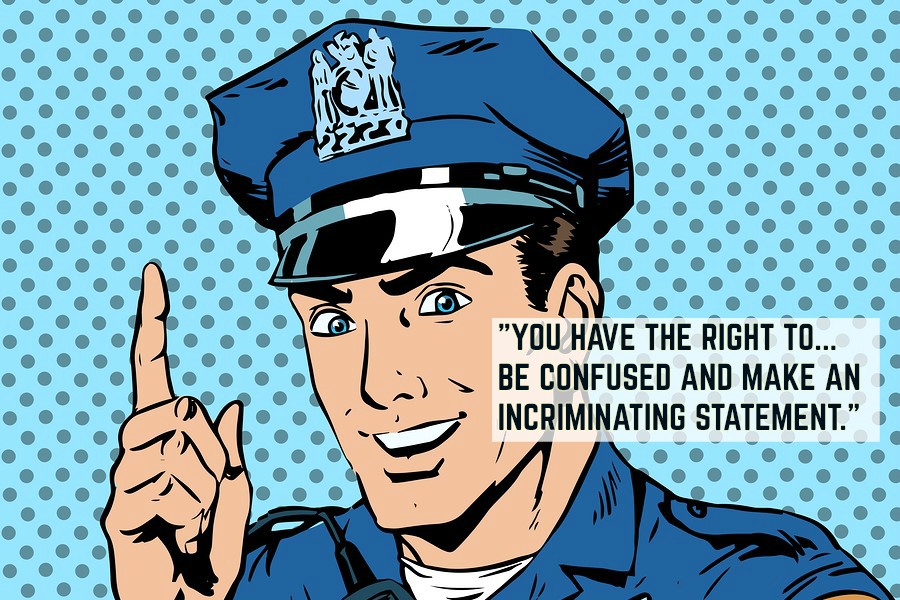
 We all know that the police must read the Miranda warnings before they question someone that is under arrest. But what does that look like in a practical sense? Can the officer read the Miranda warnings like the side effect warnings in a prescription drug commercial, where we can’t understand them? Or does he have to read them slowly, ensuring that the person being questioned fully understands each provision? This issue recently came up in