
Skip to content
Tag

Wrongful Death

Page 1 of 11 · 51 articles

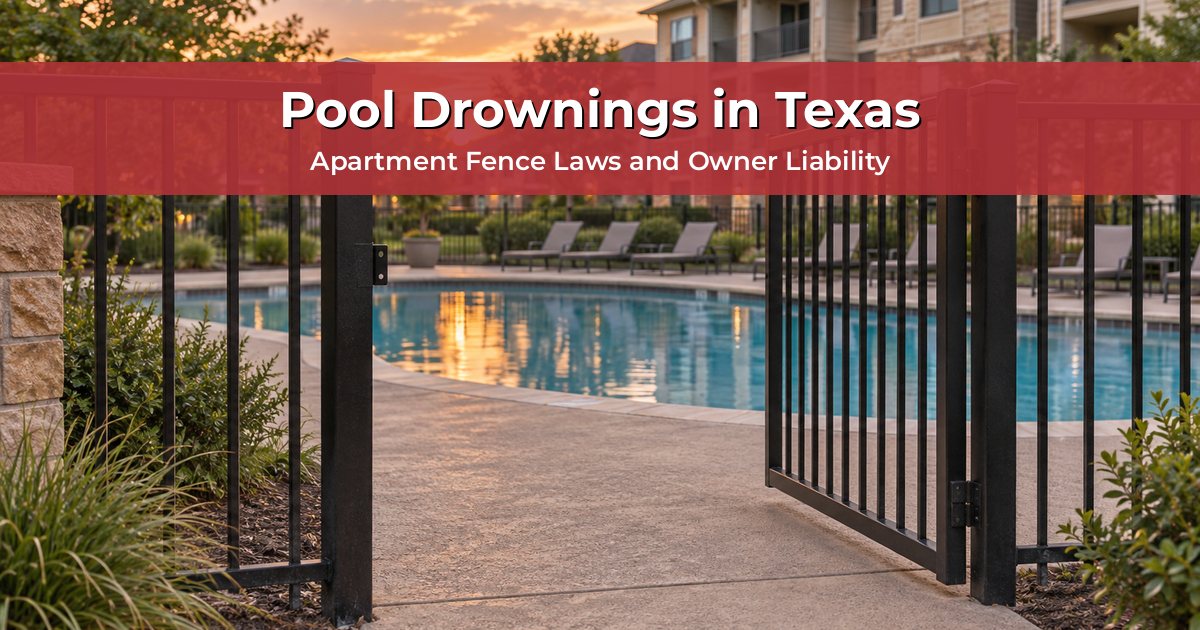
Apartment complex swimming pool with a partly open black metal safety gate at sunset in Texas

Pool Drownings and Injuries in Texas: Apartment Fence Laws, Owner Liability, and Your Rights

By Luke A. Williams · Personal Injury

Short answer: When a child or adult drowns or is seriously injured in a swimming pool in Texas, the property owner may be liable if it failed to use reasonable care, and apartment complexes and property owners associations face specific statutory duties. Chapter 757 of the Texas Health and Safety Code requires those owners to fully enclose their pools with a fence at least 48 inches high, use self-closing and self-latching gates, and inspect the enclosure and gates at least once every 31 days. Violations can support claims for actual damages and, in some cases, punitive damages.

Apartment complex swimming pool with a partly open black metal safety gate at sunset in Texas

Every summer, Texas families hear about children drowning in backyard, apartment, and community pools. Many of those tragedies are preventable, and when they happen because a gate would not latch, a fence was broken, or a pool was left accessible without supervision, Texas law may hold the property owner responsible.

At Howard Lotspeich Alexander & Williams, PLLC (HLAW), our Fort Worth personal injury lawyers represent injured people and families in Tarrant, Dallas, Denton, Collin, Johnson, and Parker counties. This guide explains who can be liable for a pool drowning or injury in Texas, what the apartment pool fencing law requires, how the rules differ for guests and trespassing children, and what families should do after an incident.

Key Takeaways

  • Drowning remains a serious risk for Texas children. The Texas Department of Family and Protective Services (DFPS) reported 68 child drownings in Texas in 2026 as of September 17, 2026, and states that drowning "is a leading cause of accidental death for kids under the age of five" (DFPS Child Drownings).
  • Apartments and HOAs must fence their pools. The owner of a multiunit rental complex with a pool, or a property owners association that owns, controls, or maintains a pool, "shall completely enclose the pool yard with a pool yard enclosure" at least 48 inches high (Tex. Health & Safety Code § 757.003).
  • Gates must close and latch on their own. Pool gates must have "a self-closing and self-latching device" and open outward away from the pool (§ 757.004).
  • Monthly inspections are required. Covered owners must inspect enclosures, gates, and self-closing and self-latching devices "no less than once every 31 days," and that duty "may not be waived under any circumstances" (§ 757.009).
  • The statute creates a damages claim. A tenant, association member, or other person may sue for actual damages caused by noncompliance, and for punitive damages when the harm was caused by intentional, malicious, or grossly negligent conduct (§ 757.012).
  • Trespassing children may still be protected. Under the attractive nuisance doctrine adopted by the Supreme Court of Texas, an owner may be liable for harm to trespassing children caused by an artificial condition in certain circumstances (Texas Utilities Electric Co. v. Timmons, Tex. 1997).

How Common Are Pool Drownings in Dallas-Fort Worth?

DFPS tracks child drownings statewide by county and location. Its 2026 figures, updated September 17, 2026, list child drownings in Tarrant, Dallas, Denton, Collin, and Johnson counties, including deaths in backyard pools, apartment pools, a community pool, and a pond (DFPS Child Drownings). The agency notes that toddlers are especially at risk, that children are most likely to drown during the summer, and that "it only takes a few minutes for a child to drown."

Those numbers count only children. Adults are also injured and killed in pool incidents, including diving injuries, slip and fall injuries on pool decks, drain and equipment injuries, and drownings at hotels, gyms, and private parties.

Who Can Be Liable for a Pool Drowning or Injury in Texas?

Depending on the facts, potentially responsible parties can include:

  • Apartment complex owners and management companies, which have specific statutory duties under Chapter 757
  • Property owners associations (HOAs) that own, control, or maintain community pools
  • Homeowners who host guests or whose pool is accessible to neighborhood children
  • Hotels, gyms, water parks, and clubs that operate pools for customers
  • Pool maintenance companies that service gates, drains, or equipment
  • Manufacturers of defective pool drains, covers, gates, latches, or alarms

Claims involving equipment failures may also raise product liability issues. Our page on defective products explains how those claims work.

What Does Texas Law Require for Apartment and HOA Pools?

Chapter 757 of the Texas Health and Safety Code sets detailed rules for pool yard enclosures at multiunit rental complexes and pools owned, controlled, or maintained by property owners associations. A "multiunit rental complex" means two or more dwelling units under common ownership or management on the same or adjacent lots, and includes condominium projects. A "pool" includes a permanent swimming pool, wading pool, or hot tub or spa over 18 inches deep (§ 757.001).

The table below summarizes key requirements.

Requirement What the statute says
Full enclosure The owner or association "shall completely enclose the pool yard" (§ 757.003(a))
Minimum height At least 48 inches, measured from the ground on the side away from the pool (§ 757.003(b))
Gaps under the fence Openings under the enclosure may not allow a 4-inch sphere to pass (§ 757.003(c))
Chain link Prohibited for new pool yard enclosures built after January 1, 1994 (§ 757.003(f))
Climbing aids Permanent equipment or structures may not be placed so they are readily available for climbing over the fence (§ 757.003(i))
Gates Must be self-closing and self-latching, lockable, and open outward away from the pool (§ 757.004(a))
Latch height Generally at least 60 inches above the ground, with limited exceptions (§ 757.004(b)-(c))
Inspections At least once every 31 days for enclosures, gates, and self-closing and self-latching devices (§ 757.009(c))

The owner must also "exercise ordinary and reasonable care to inspect, maintain, repair, and keep in good working order" the enclosures, gates, and latching devices within its control (§ 757.009(a)). In many apartment drowning cases, the key evidence is a gate that did not close or latch, or a fence with a gap a child could get through.

Can You Sue an Apartment Complex Under the Pool Fencing Law?

Yes. Section 757.012 allows "a tenant of an owner of a multiunit rental complex, a member of a property owners association, a governmental entity, or any other person or the person's representative" to bring an action against the owner or association for failing to comply with Chapter 757. Available remedies include:

  1. A court order requiring the owner or association to comply
  2. Actual damages resulting from the failure to comply
  3. Punitive damages if the actual damages were caused by the owner's or association's "intentional, malicious, or grossly negligent actions"
  4. Actual damages, and if appropriate punitive damages, even when the owner was technically in compliance, if it "was consciously indifferent to access being repeatedly gained to the pool yard by unauthorized persons"
  5. A civil penalty of up to $5,000 if the owner fails to comply within a reasonable time after written notice from a tenant or association member

That fourth item matters. An apartment complex cannot simply point to a code-compliant fence if it knew people were repeatedly getting into the pool area and did nothing. Our guide to punitive damages in Texas explains the general proof requirements for exemplary damages.

The pool statute often works alongside other apartment safety duties. For example, our article on negligent security at DFW apartment complexes covers a property owner's duty to protect residents from foreseeable criminal acts.

What if the Injury Happened at a Private Home or Business Pool?

Outside Chapter 757, most pool claims are premises liability claims. The Supreme Court of Texas has explained that "negligence and premises liability claims thus are separate and distinct theories of recovery, requiring plaintiffs to prove different, albeit similar, elements" (United Scaffolding, Inc. v. Levine, Tex. 2017).

For an invitee, such as a paying hotel guest or a gym member, the property owner owes a duty to make safe or warn against concealed, unreasonably dangerous conditions of which it knew or reasonably should have known. To recover, the injured person generally must show that:

  • The owner had actual or constructive knowledge of the condition
  • The condition was unreasonably dangerous
  • The owner did not exercise reasonable care to reduce or eliminate the risk
  • That failure proximately caused the injury

Examples include a broken drain cover, a missing depth marker, a deck that stays slick with algae, or an inoperable gate the owner knew about. Our page on slip and fall injuries covers how those premises claims are often proven.

Social guests and the open-and-obvious rule

The duty owed can change depending on why the person was on the property. Texas also recognizes that an owner generally has no duty to warn about dangers that are open and obvious to a reasonably careful person, though exceptions exist. Because these rules can decide a case, the specific facts of how the person came to be at the pool matter.

Can a Property Owner Be Liable When a Child Wanders Into a Pool?

Sometimes. Ordinarily, "the only duty a premises owner or occupier owes a trespasser is not to injure him willfully, wantonly, or through gross negligence" (Texas Utilities Electric Co. v. Timmons). But Texas recognizes an exception for young children, called the attractive nuisance doctrine. In Timmons, the Supreme Court of Texas applied Restatement (Second) of Torts § 339, under which an owner may be liable for physical harm to trespassing children caused by an artificial condition if:

  1. The owner knows or has reason to know children are likely to trespass where the condition exists
  2. The owner knows or has reason to know of the condition and realizes or should realize it involves an unreasonable risk of death or serious bodily harm to children
  3. The children, because of their youth, do not discover the condition or realize the risk
  4. The utility of maintaining the condition and the burden of eliminating the danger are slight compared with the risk to children
  5. The owner fails to exercise reasonable care to eliminate the danger or otherwise protect the children

Timmons involved a 14-year-old who climbed an electric transmission tower, and the court held the doctrine did not apply in that case. The doctrine is most often argued for young children who cannot appreciate the danger, which is why the age of the child and how easily the pool could be reached are often central issues.

What Damages Can Families Recover?

Damages depend on whether the person survived and on who brings the claim:

  • Non-fatal injuries. Near-drowning incidents can cause brain injuries that require lifelong care. An injured person, or a parent on a child's behalf, may seek medical expenses, future care, lost earning capacity, pain, and impairment. Texas courts must approve many settlements for minors, as explained in our guide to minor injury settlements in Texas.
  • Fatal drownings. The surviving spouse, children, and parents may bring a wrongful death claim, and the estate may bring a survival claim. Our guide to survival claims vs. wrongful death claims explains the difference.
  • Punitive damages. Under § 757.012, punitive damages are available against a noncompliant apartment owner or association if the harm was caused by intentional, malicious, or grossly negligent conduct.

Deadlines are short. Most Texas injury and wrongful death claims must be filed within two years, with special rules for minors. See our article on time limits for personal injury claims.

What Should You Do After a Pool Drowning or Injury?

  1. Get emergency care and follow medical advice. Near-drowning injuries can worsen after the person seems fine.
  2. Photograph the scene. Document the gate, latch, fence, gaps, nearby furniture that could be climbed, signage, and the pool deck as soon as it is safe.
  3. Note who was responsible for the pool. Write down the apartment complex, management company, HOA, or business that operates the pool.
  4. Ask for maintenance and inspection records. Chapter 757 requires monthly inspections, so a lawyer can request those records and repair logs.
  5. Preserve video and witnesses. Many complexes and businesses have cameras that record over footage quickly.
  6. Avoid recorded statements to insurers before talking with a lawyer.

Frequently Asked Questions

How tall does an apartment pool fence have to be in Texas?

At least 48 inches, measured from the ground on the side away from the pool, under Health and Safety Code § 757.003(b). Some cities may require greater height if their ordinances were in place on January 1, 1994 (§ 757.010(c)).

Do apartment pool gates have to lock automatically?

They must have a self-closing and self-latching device, hardware that allows them to be locked by padlock or a key, card, or combination lock, and they must open outward away from the pool (§ 757.004(a)).

How often must an apartment complex inspect its pool gates?

No less than once every 31 days, under § 757.009(c). That inspection duty cannot be waived.

Does Chapter 757 apply to single-family homes?

The definition of multiunit rental complex excludes a single-family home or adjacent single-family homes that are not part of a condominium project. Claims involving private backyard pools usually proceed under general premises liability rules, though local ordinances may also apply.

Can I sue if my child got into a neighbor's pool without permission?

Possibly. A trespasser is generally owed only a duty not to be injured willfully, wantonly, or through gross negligence, but the attractive nuisance doctrine may apply to young children in certain circumstances.

Can a tenant force an apartment complex to fix a broken pool gate?

Yes. Section 757.012 allows a tenant to seek a court order requiring compliance and, after written notice and a reasonable time to comply, a civil penalty of up to $5,000.

What if the drowning was at a city pool?

Claims against government entities are governed by the Texas Tort Claims Act and have strict notice requirements and damages limits. Talk with a lawyer quickly if a public pool is involved.

Talk With a Fort Worth Pool Injury Lawyer

Pool drownings and injuries are devastating, and the evidence that explains what went wrong, like a faulty gate or missing inspection records, can disappear quickly. If your family was affected by a pool incident anywhere in Dallas-Fort Worth, HLAW can review what happened and explain your options. Call (817) 993-9249 or contact us online for a free consultation.

This article provides general information about Texas law and is not legal advice. Reading it does not create an attorney-client relationship. Every case depends on its specific facts, and past results do not guarantee a similar outcome. Laws change, so consult a licensed Texas attorney about your situation.
Read full article
White sympathy lilies, reading glasses and envelopes on a side table in a quiet Texas living room at dusk, illustrating survival and wrongful death claims

Survival Claims vs. Wrongful Death Claims in Texas: Who Can Sue, What Each Covers, and the Deadlines

By Luke A. Williams · Personal Injury

Short answer: When someone dies because of another person's negligence in Texas, the law usually allows two separate claims. A survival claim under Texas Civil Practice and Remedies Code § 71.021 belongs to the person who died and recovers the losses he or she suffered before death, such as conscious pain, medical bills, and lost earnings, with the recovery passing to the estate. A wrongful death claim under § 71.002 belongs to the surviving spouse, children, and parents and compensates them for their own losses from the death.

White sympathy lilies, reading glasses and envelopes on a side table in a quiet Texas living room at dusk, illustrating survival and wrongful death claims

Families who lose someone in a crash on I-35W, a trucking collision on I-20, or a workplace accident in Dallas-Fort Worth often hear the phrase "wrongful death" and assume it covers everything. It does not. Texas treats the losses the person suffered before death and the losses the family suffers after death as two different legal claims, brought by different people, with different damages and different rules about who receives the money.

At Howard Lotspeich Alexander & Williams, PLLC (HLAW), our Fort Worth personal injury lawyers represent families in Tarrant, Dallas, Denton, Collin, Johnson, and Parker counties. This guide explains what a Texas survival claim is, how it differs from a wrongful death claim, who can bring each one, and the deadlines that apply.

Key Takeaways

  • The injury claim does not die with the person. A personal injury cause of action "does not abate because of the death of the injured person," and it "survives to and in favor of the heirs, legal representatives, and estate of the injured person" (Tex. Civ. Prac. & Rem. Code § 71.021).
  • Survival damages are the decedent's own losses. The Supreme Court of Texas has said the damages recoverable "are those which he himself sustained while he was alive" (Austin Nursing Center, Inc. v. Lovato, Tex. 2005).
  • Wrongful death damages are the family's losses. A wrongful death action is "for the exclusive benefit of the surviving spouse, children, and parents of the deceased" (§ 71.004).
  • The estate usually brings the survival claim. In general, only the estate's personal representative has capacity to bring a survival claim, although heirs may do so in limited circumstances (Lovato).
  • Both claims can be brought together. Texas has long recognized that "two separate and distinct causes of action may arise where injuries wrongfully inflicted result in death" (Landers v. B. F. Goodrich Co., Tex. 1963).
  • Deadlines are short. Wrongful death suits generally must be filed within two years of the death (Tex. Civ. Prac. & Rem. Code § 16.003).

What Is a Survival Claim in Texas?

A survival claim is the injured person's own personal injury lawsuit, continued after his or her death. Texas Civil Practice and Remedies Code § 71.021 provides that a cause of action "for personal injury to the health, reputation, or person of an injured person does not abate because of the death of the injured person or because of the death of a person liable for the injury." The suit "may be instituted and prosecuted as if the liable person were alive" (§ 71.021).

The Supreme Court of Texas described the claim this way in Austin Nursing Center, Inc. v. Lovato: "The survival action, as it is sometimes called, is wholly derivative of the decedent's rights. The actionable wrong is that which the decedent suffered before his death" (Austin Nursing Center, Inc. v. Lovato).

Put simply, the survival claim asks what the person who died could have recovered if he or she had lived long enough to file the case.

How Is a Survival Claim Different From a Wrongful Death Claim?

The Texas Wrongful Death Act creates a separate cause of action. A person is liable "for damages arising from an injury that causes an individual's death if the injury was caused by the person's or his agent's or servant's wrongful act, neglect, carelessness, unskillfulness, or default" (§ 71.002(b)). That claim compensates the family members for what they lost because of the death.

The table below summarizes the main differences.

Issue Survival claim (§ 71.021) Wrongful death claim (§ 71.002)
Whose claim is it? The person who died The surviving spouse, children, and parents
What losses does it cover? Losses the decedent suffered before death Losses the family suffers because of the death
Who usually files? The estate's personal representative (or heirs in limited cases) The spouse, children, or parents, or one of them for all
Where does the money go? To the estate, then to heirs or under the will Divided among the beneficiaries as the jury finds
Can siblings benefit? Possibly, if they are heirs or will beneficiaries No, siblings are not listed beneficiaries

Both claims depend on the same basic proof that the defendant's negligence or wrongful conduct caused the injury. Because the two claims share that foundation, they are usually filed in the same lawsuit.

What Damages Can Be Recovered in a Texas Survival Claim?

Because the survival claim belongs to the person who died, the damages are limited to losses he or she sustained between the injury and death. In Landers v. B. F. Goodrich Co., the Supreme Court of Texas described the estate's recovery as including "medical and funeral expenses, property damage, physical pain and suffering, and other damage sustained by the decedent prior to his death" (Landers v. B. F. Goodrich Co.).

Common survival damages include:

  • Conscious physical pain and mental anguish the person experienced before death
  • Medical expenses for treatment between the injury and death
  • Lost earnings between the injury and death
  • Property damage, such as damage to the person's vehicle
  • Funeral and burial expenses, if not recovered in the wrongful death claim

Funeral expenses can be claimed in either action, but not twice. The court in Landers held that they may be recovered by the heirs or legal representatives "provided the defendant will not be subjected thereby to a double recovery," and Lovato notes that funeral expenses may be recovered in a survival action "if they were not awarded in a wrongful death action."

Medical expense evidence follows the same rules as any Texas injury case. Recovery is generally limited to amounts actually paid or incurred, and providers may assert liens against the recovery. Our guide to hospital liens and injury settlements explains how those liens work.

Why conscious pain matters

A survival claim for pain and suffering depends on evidence that the person was conscious after the injury. Records from first responders, emergency room notes, witness statements, and the time between the crash and death often become central evidence. When death was instantaneous, the survival claim may be limited to items like funeral expenses and property damage, while the wrongful death claim carries most of the family's damages.

What Damages Can Families Recover in a Wrongful Death Claim?

Wrongful death damages compensate each beneficiary for his or her own losses. In Moore v. Lillebo, the Supreme Court of Texas defined two of the most important categories. Mental anguish is "the emotional pain, torment, and suffering that the named plaintiff would, in reasonable probability, experience from the death of the family member." Companionship and society are "the positive benefits flowing from the love, comfort, companionship, and society the named plaintiff would, in reasonable probability, experience if the decedent lived" (Moore v. Lillebo, Tex. 1986).

The court also said a jury may consider the relationship between the family members, their living arrangements, any extended absences, the harmony of family relations, and common interests and activities. Other wrongful death damages can include lost financial support and loss of inheritance. The jury may award damages "in an amount proportionate to the injury resulting from the death," divided "in shares as found by the jury in its verdict" among the beneficiaries who are alive at that time (§ 71.010).

For a deeper look at those damages, see our page on wrongful death claims. If the death resulted from gross negligence, such as a crash caused by a heavily intoxicated driver, exemplary damages may also be available, as explained in our guide to punitive damages in Texas.

Who Can Bring a Survival Claim in Texas?

The general rule is that the estate brings the claim. The Supreme Court of Texas has stated: "In general, only the estate's personal representative has the capacity to bring a survival claim" (Austin Nursing Center, Inc. v. Lovato). A personal representative is usually an executor named in a will and appointed by the probate court, or an administrator appointed when there is no will.

There is a limited exception. "Heirs at law can maintain a survival suit during the four-year period the law allows for instituting administration proceedings if they allege and prove that there is no administration pending and none [is] necessary," citing Shepherd v. Ledford, 962 S.W.2d 28 (Tex. 1998).

Lovato also shows why getting this right matters. In that case, the daughter filed the survival suit within the limitations period but was not appointed administrator of her mother's estate until after limitations expired. The court held that the defect in her capacity "was later cured by her appointment as the estate's administrator." Families should not rely on that kind of cure. Opening the estate early, often in the probate courts of Tarrant, Dallas, Denton, or Collin County, avoids the issue.

Who Can Bring a Wrongful Death Claim in Texas?

Only three groups benefit from a Texas wrongful death claim: "the surviving spouse, children, and parents of the deceased" (§ 71.004(a)). Any of them may bring the action, or one or more may bring it for the benefit of all (§ 71.004(b)). Siblings, grandparents, and other relatives are not listed beneficiaries.

If none of the eligible family members files within three calendar months after the death, the executor or administrator "shall bring and prosecute the action unless requested not to by all those individuals" (§ 71.004(c)).

What Is the Deadline to File a Survival or Wrongful Death Claim?

The deadlines are related but not identical.

  1. Wrongful death. Suit must be brought "not later than two years after the day the cause of action accrues," and the cause of action "accrues on the death of the injured person" (§ 16.003(b)).
  2. Survival. The survival claim is the decedent's own personal injury claim, which generally carries a two-year limitations period that began when the injury occurred (§ 16.003(a)).
  3. Effect of death. The death of a person in whose favor there may be a cause of action "suspends the running of an applicable statute of limitations for 12 months after the death," but if an executor or administrator qualifies before then, limitations begins to run again at the time of qualification (§ 16.062).

Claims against government entities can have much shorter notice deadlines. Our guide to time limits for personal injury claims in Texas covers those exceptions. Because these rules interact, families should not wait to talk with a lawyer.

What Should a Family Do After a Fatal Accident?

  1. Request the crash report and medical records. Records showing the time of injury, consciousness, and treatment are key to the survival claim.
  2. Keep receipts. Save medical bills, funeral and burial invoices, and records of who paid them.
  3. Talk to a lawyer about opening the estate. A probate filing may be needed for the survival claim, even if there was a will.
  4. Do not give recorded statements to the at-fault party's insurer before getting legal advice.
  5. Preserve evidence. Vehicles, phones, dash camera video, and workplace records can be lost if no one asks for them to be preserved.

Frequently Asked Questions

Can a family file both a survival claim and a wrongful death claim?

Yes. Texas recognizes that two separate causes of action may arise when a wrongful injury causes death. They are usually filed together in the same lawsuit, with the estate's representative bringing the survival claim and the family members bringing the wrongful death claim.

Who receives the money from a survival claim?

The recovery flows to those who would have received it had the decedent obtained it immediately before death: his or her heirs, legal representatives, and estate. In practice, it passes under the will or, if there is no will, under Texas inheritance law.

Can a brother or sister recover after a sibling's death?

Siblings are not wrongful death beneficiaries under § 71.004. A sibling may benefit from a survival claim only if he or she is an heir or a beneficiary under the will.

Is there a survival claim if death was instant?

There may still be a survival claim for items like funeral expenses and property damage. Damages for conscious pain and suffering require evidence that the person was aware of the injury before death.

Do we need to open a probate case?

Often, yes. In general, only the estate's personal representative can bring a survival claim. Heirs may sue without administration only if they prove no administration is pending and none is necessary.

What if no family member files the wrongful death case?

If no eligible family member files within three calendar months after the death, the executor or administrator must bring the action unless all of the eligible family members ask the representative not to.

Can parents recover when an adult child dies?

Yes. Parents are listed wrongful death beneficiaries under § 71.004, and the Supreme Court of Texas in Moore v. Lillebo allowed parents of an adult son to seek damages for mental anguish and loss of companionship.

Talk With a Fort Worth Wrongful Death Lawyer

Losing a family member is hard enough without sorting out estates, insurers, and deadlines. If someone you love died because of another person's negligence anywhere in Dallas-Fort Worth, HLAW can explain how the survival and wrongful death claims fit together and what steps to take next. Call (817) 993-9249 or contact us online for a free consultation.

This article provides general information about Texas law and is not legal advice. Reading it does not create an attorney-client relationship. Every case depends on its specific facts, and past results do not guarantee a similar outcome. Laws change, so consult a licensed Texas attorney about your situation.
Read full article
Empty jury box in a wood-paneled Texas courtroom with a male trial attorney at the lectern, illustrating punitive damages in Texas

Punitive Damages in Texas: Gross Negligence, the Damages Cap, and the Drunk-Driver Exception

By Luke A. Williams · Personal Injury

Short answer: Texas law calls punitive damages "exemplary damages," and they are awarded to punish a defendant, not to compensate the injured person. To recover them, an injured person must prove by clear and convincing evidence that the harm resulted from fraud, malice, or gross negligence, and the jury must be unanimous on both liability and amount. Most awards are capped at the greater of $200,000 or two times economic damages plus up to $750,000 in noneconomic damages, but the cap does not apply when the claim is based on felony conduct such as intoxication assault or intoxication manslaughter by a drunk driver.

Empty jury box in a wood-paneled Texas courtroom with a male trial attorney at the lectern, illustrating punitive damages in Texas

Most personal injury cases are about making the injured person whole: medical bills, lost wages, pain, and the other losses a crash or fall causes. Some cases involve conduct so dangerous that Texas allows a jury to go further and punish the wrongdoer. A driver who gets behind the wheel after a night of heavy drinking, or a company that knowingly sends workers into an extreme hazard, may face that kind of claim.

At Howard Lotspeich Alexander & Williams, PLLC (HLAW), our Fort Worth personal injury lawyers represent injured people and families in Tarrant, Dallas, Denton, Collin, Johnson, and Parker counties. This guide explains when punitive damages are available in Texas, what "gross negligence" actually means, how the statutory cap works, and why drunk-driving cases are treated differently.

Key Takeaways

  • Punishment, not compensation. Texas defines exemplary damages as damages "awarded as a penalty or by way of punishment but not for compensatory purposes," and the term includes punitive damages (Tex. Civ. Prac. & Rem. Code § 41.001).
  • Higher proof is required. The injured person must prove fraud, malice, or gross negligence by clear and convincing evidence, and ordinary negligence is not enough (§ 41.003).
  • The jury must be unanimous. Exemplary damages may be awarded only if the jury is unanimous on both liability for and the amount of those damages (§ 41.003(d)).
  • Most awards are capped. The cap is the greater of $200,000 or two times economic damages plus noneconomic damages up to $750,000 (§ 41.008(b)).
  • Drunk drivers are an exception. The cap does not apply to claims based on intoxication assault or intoxication manslaughter, and for those two offenses the statute does not require proof that the conduct was knowing or intentional (§ 41.008(c)).
  • Companies are judged by their own conduct. A corporation is liable for punitive damages only when the gross negligence is attributable to the corporation itself (Mobil Oil Corp. v. Ellender, Tex. 1998).

What Are Punitive (Exemplary) Damages in Texas?

Compensatory damages pay for the harm a person suffered. Texas splits them into two groups. Economic damages cover measurable financial losses such as medical expenses and lost earnings. Noneconomic damages cover losses like physical pain, mental anguish, disfigurement, and impairment. Our guide to what a personal injury case is worth in Texas walks through those categories in detail.

Exemplary damages are different. Chapter 41 of the Texas Civil Practice and Remedies Code states that exemplary damages "are neither economic nor noneconomic damages" (§ 41.001). They exist to punish conduct and to deter others from doing the same thing. That purpose explains why the law makes them harder to get than ordinary damages and why a jury can consider facts, like a defendant's net worth, that would not matter in a normal damages calculation.

Two threshold rules apply before any punitive award can stand. First, exemplary damages may be awarded only if damages other than nominal damages are awarded (§ 41.004(a)). In plain terms, the injured person must first prove real harm. Second, a claimant who elects to have a recovery multiplied under another statute cannot also collect exemplary damages for the same harm (§ 41.004(b)).

What Does a Texas Injury Victim Have to Prove to Get Punitive Damages?

Under § 41.003(a), exemplary damages may be awarded only if the claimant proves by clear and convincing evidence that the harm resulted from one of three things:

  1. Fraud, which the statute defines as fraud other than constructive fraud.
  2. Malice, meaning "a specific intent by the defendant to cause substantial injury or harm to the claimant."
  3. Gross negligence, which is the basis for most punitive damages claims in car wreck, trucking, workplace, and premises cases.

The burden is demanding. "Clear and convincing" means proof that "will produce in the mind of the trier of fact a firm belief or conviction as to the truth of the allegations sought to be established" (§ 41.001(2)). The statute also says this burden "may not be shifted to the defendant or satisfied by evidence of ordinary negligence, bad faith, or a deceptive trade practice" (§ 41.003(b)).

Proving that a driver ran a red light or was looking at a phone usually establishes ordinary negligence. Proving gross negligence requires evidence about what the defendant knew and chose to do anyway.

What Is Gross Negligence Under Texas Law?

Texas defines gross negligence as an act or omission that has two parts (§ 41.001(11)):

  • An objective part. Viewed objectively from the defendant's standpoint at the time, the conduct "involves an extreme degree of risk, considering the probability and magnitude of the potential harm to others."
  • A subjective part. The defendant "has actual, subjective awareness of the risk involved, but nevertheless proceeds with conscious indifference to the rights, safety, or welfare of others."

The Supreme Court of Texas has explained both parts. In Medina v. Zuniga, the court said an extreme risk is "not a remote possibility of injury or even a high probability of minor harm, but rather the likelihood of serious injury to the plaintiff" (Medina v. Zuniga, Tex. 2019). For the subjective part, the court said "the plaintiff must show that the defendant knew about the peril, but his acts or omissions demonstrate that he did not care." In that case, the court held there was no evidence supporting the objective component and rendered judgment that the plaintiff take nothing on her gross negligence claim.

That outcome shows how carefully Texas courts review these findings. A serious injury alone does not prove gross negligence. The question is whether the conduct itself created a likelihood of serious harm and whether the defendant actually knew it.

Common examples of conduct that may support a gross negligence claim

Every case depends on its facts, but gross negligence claims in Dallas-Fort Worth injury cases often involve evidence like:

  • A driver who chose to drive while heavily intoxicated
  • A trucking company that kept a driver on the road after learning of repeated safety violations
  • An employer that knew about a specific, serious hazard and sent workers into it anyway
  • A property owner who knew about a dangerous condition that had already injured people and did nothing

How Much Can a Jury Award? The Texas Punitive Damages Cap

Texas caps most exemplary damages awards. Under § 41.008(b), exemplary damages awarded against a defendant may not exceed the greater of:

  • Option 1: two times the amount of economic damages, plus an amount equal to any noneconomic damages found by the jury, not to exceed $750,000; or
  • Option 2: $200,000.

To make that calculation possible, the jury must determine economic damages separately from other compensatory damages (§ 41.008(a)).

Example Economic damages Noneconomic damages Option 1 (2x economic + noneconomic up to $750,000) Maximum exemplary award
Smaller case $20,000 $30,000 $70,000 $200,000 (the floor applies)
Moderate case $100,000 $500,000 $700,000 $700,000
Large case $724,456.60 $900,000 $1,448,913.20 + $750,000 $2,198,913.20

The third row is not hypothetical. In a Denton County wrongful death case involving a worker killed at a landfill, a jury awarded $724,456.60 in economic damages, $900,000 in noneconomic damages, and $10,000,000 in exemplary damages. The trial court applied the cap and entered judgment for $2,198,913.20 (Waste Management of Texas, Inc. v. Dodd, Tex. App.-Fort Worth 2025). As discussed below, the Fort Worth Court of Appeals later reversed the gross negligence finding entirely.

Why Are Drunk-Driving Crashes Treated Differently?

Section 41.008(c) lists felonies that remove the cap. Most of them, such as murder, aggravated assault, and certain theft offenses, lift the cap only "if the conduct was committed knowingly or intentionally." Two offenses on the list are expressly excluded from that knowing-or-intentional requirement: Penal Code § 49.07 (intoxication assault) and § 49.08 (intoxication manslaughter) (§ 41.008(c)).

That matters in Dallas-Fort Worth, where intoxicated-driver crashes on I-30, I-35W, Loop 820, and US-75 cause catastrophic injuries every year. When the claim against a drunk driver is based on conduct described as intoxication assault or intoxication manslaughter, the statutory cap on exemplary damages does not apply. The injured person still has to meet the clear and convincing standard and win a unanimous jury, but the jury is not limited by the § 41.008(b) formula.

A drunk-driving case can also involve other defendants. If a bar or restaurant served an obviously intoxicated customer who then caused a crash, the injured person may have a separate claim against the business. Our guide to Texas dram shop laws and drunk driving explains how those claims work.

Can You Get Punitive Damages From a Trucking Company or Employer?

Yes, but the rules are stricter. In Mobil Oil Corp. v. Ellender, the Supreme Court of Texas held that "a corporation may be liable in punitive damages for gross negligence only if the corporation itself commits gross negligence" (Mobil Oil Corp. v. Ellender, Tex. 1998). Because a company acts only through people, Texas courts look at whether:

  • The company authorized or ratified an agent's gross negligence
  • The company was grossly negligent in hiring an unfit agent
  • The gross negligence was committed by a "vice principal," such as a corporate officer, a person with authority to hire, direct, and fire employees, or a manager in charge of a department or division

The Dodd case shows how this plays out. The Fort Worth Court of Appeals concluded "that the record lacks evidence to show that Dodd's death was caused by grossly negligent acts or omissions attributable to Waste Management" and rendered judgment that the widow take nothing on her gross negligence claim (Waste Management of Texas, Inc. v. Dodd). The court found the evidence did not show that the supervisor involved qualified as a manager under the jury charge.

For injured people, the lesson is practical. A punitive damages claim against a company depends on evidence about who knew what inside the company: safety records, internal emails, prior incidents, training files, and testimony from decision-makers. That evidence must be identified and preserved early.

Are Punitive Damages Available in a Texas Wrongful Death Case?

Yes. The Texas Wrongful Death Act provides that when "the death is caused by the wilful act or omission or gross negligence of the defendant, exemplary as well as actual damages may be recovered" (Tex. Civ. Prac. & Rem. Code § 71.009). The same Chapter 41 standards apply, including the clear and convincing burden, jury unanimity, and the cap unless an exception applies. Our page on wrongful death claims explains who can bring these cases and what damages are available.

Families may also have related claims. A spouse or child of a person who survives with serious, permanent injuries may have a loss of consortium claim, which is a compensatory claim separate from any punitive award.

How Does a Jury Decide the Amount of Punitive Damages?

The trial can be split into two phases

On a defendant's motion, the court must hold a bifurcated trial (§ 41.009). In the first phase, the jury decides liability for compensatory and exemplary damages and the amount of compensatory damages. Only if exemplary liability is established does the jury move to a second phase to decide the amount of exemplary damages. This keeps evidence like a defendant's net worth out of the first phase.

The jury considers specific factors

Under § 41.011(a), the jury must consider evidence, if any, relating to:

  • The nature of the wrong
  • The character of the conduct involved
  • The degree of culpability of the wrongdoer
  • The situation and sensibilities of the parties concerned
  • The extent to which the conduct offends a public sense of justice and propriety
  • The net worth of the defendant

Subject to the cap, whether to award exemplary damages and how much is within the jury's discretion (§ 41.010(b)).

Appellate courts must explain their review

When a Texas court of appeals reviews a punitive damages finding or amount, it must state its reasons in a written opinion that addresses the evidence "with specificity" (§ 41.013(a)). That requirement is one reason these awards receive close attention after trial.

What Should You Do If You Think Punitive Damages Apply?

If you were hurt by a drunk driver or by conduct that seemed reckless rather than careless, these steps help protect the claim:

  1. Get the police report and any criminal case number. An intoxication-related arrest or charge may bear on whether the cap exception applies.
  2. Preserve evidence quickly. Ask a lawyer to send preservation letters for dash camera footage, vehicle data, company records, and bar receipts.
  3. Do not give recorded statements to the other side's insurer before getting legal advice.
  4. Track every economic loss. Because the cap formula is based on economic damages, complete medical and wage records can affect the maximum exemplary award.
  5. Watch the deadline. Most Texas personal injury claims must be filed within two years. Our guide to time limits for personal injury claims in Texas covers the rules and exceptions.

Frequently Asked Questions

Are punitive damages and exemplary damages the same thing in Texas?

Yes. Texas statutes use the term "exemplary damages," and § 41.001 states that the term includes punitive damages. Both refer to damages awarded to punish, not to compensate.

Is ordinary negligence ever enough for punitive damages?

No. Section 41.003(b) states that the burden of proof cannot be satisfied by evidence of ordinary negligence. The injured person must prove fraud, malice, or gross negligence by clear and convincing evidence.

What is the minimum cap on punitive damages in Texas?

The cap is never lower than $200,000. Under § 41.008(b), the maximum is the greater of $200,000 or two times economic damages plus noneconomic damages up to $750,000.

Does the cap apply if a drunk driver hit me?

Not when the claim is based on conduct described as intoxication assault or intoxication manslaughter. Section 41.008(c) removes the cap for those offenses without requiring proof that the conduct was knowing or intentional. You still must prove gross negligence by clear and convincing evidence.

Does the jury have to agree unanimously?

Yes. Exemplary damages may be awarded only if the jury is unanimous on both liability and the amount, and the court must instruct the jury on that requirement (§ 41.003(d)-(e)).

Can I get punitive damages without any actual damages?

No. Section 41.004(a) allows exemplary damages only if damages other than nominal damages are awarded.

Can a family recover punitive damages after a fatal crash?

Yes. Section 71.009 allows exemplary damages in a wrongful death case when the death is caused by a willful act or omission or gross negligence of the defendant.

Talk With a Fort Worth Personal Injury Lawyer

Punitive damages claims turn on evidence about what a defendant knew and chose to do, and that evidence can disappear quickly. If you or a family member was seriously injured by a drunk driver, a reckless company, or other dangerous conduct anywhere in Dallas-Fort Worth, HLAW can review the facts and explain the options. Call (817) 993-9249 or contact us online to schedule a consultation.

This article provides general information about Texas law and is not legal advice. Reading it does not create an attorney-client relationship. Every case depends on its specific facts, and past results do not guarantee a similar outcome. Laws change, so consult a licensed Texas attorney about your situation.
Read full article
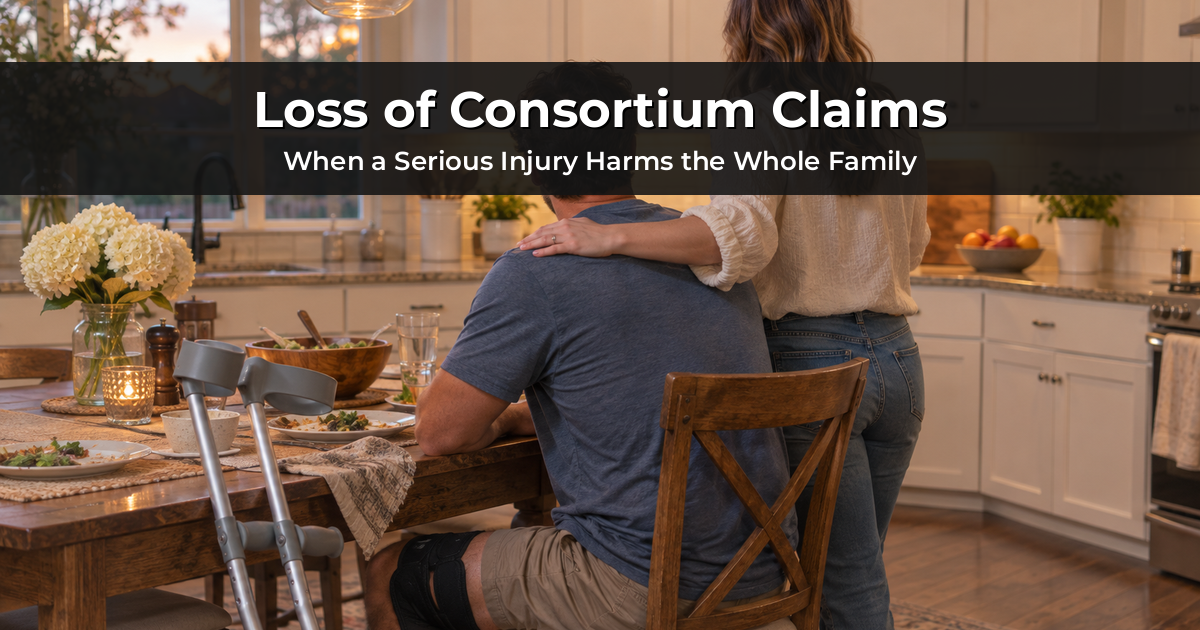
Injured man with a knee brace and crutches at a family dinner table as his wife rests a hand on his shoulder

Loss of Consortium in Texas: When Spouses and Children Can Recover After a Serious Injury

By Luke A. Williams · Personal Injury

Short answer: In Texas, a loss of consortium claim allows the spouse or child of a seriously injured person to recover damages for the harm the injury caused to their own relationship, such as lost affection, companionship, comfort, and emotional support. The Supreme Court of Texas recognized the claim for spouses in 1978 and for children of a parent with serious, permanent, and disabling injuries in 1990. However, Texas does not allow parents to recover for loss of consortium when a child is injured but survives, and because the claim is derivative, the injured person's own share of fault reduces or bars it.

Injured man with a knee brace and crutches at a family dinner table as his wife rests a hand on his shoulder

When someone is badly hurt in a crash on I-35W, a fall at a store, or a workplace accident in Dallas-Fort Worth, the injured person is not the only one who suffers. A spouse may lose a partner's companionship and help. A child may lose a parent's ability to play, teach, and be present. Texas law recognizes some of these losses, but the rules are specific, and many families do not know the claim exists until it is too late to raise it.

At Howard Lotspeich Alexander & Williams, PLLC (HLAW), our Fort Worth personal injury lawyers represent injured people and their families in Tarrant, Dallas, Denton, Collin, Johnson, and Parker counties. This guide explains who can bring a loss of consortium claim in Texas, what it covers, how it is valued, and the limits that often decide these cases.

Key Takeaways

  • Spouses can recover. In Whittlesey v. Miller, the Supreme Court of Texas held "that either spouse has a cause of action for loss of consortium" arising from an injury caused to the other spouse by a third party's negligence (Whittlesey v. Miller, Tex. 1978).
  • Children can recover when a parent is seriously injured. In Reagan v. Vaughn, the court held "that children may recover for loss of consortium when a third party causes serious, permanent, and disabling injuries to their parent" (Reagan v. Vaughn, Tex. 1990).
  • Parents of an injured child generally cannot. Texas does not recognize a common law claim for a parent's loss of consortium resulting from a non-fatal injury to a child (Roberts v. Williamson, Tex. 2003).
  • The claim is derivative. The defenses that bar all or part of the injured person's recovery have the same effect on the consortium claim, including the injured person's percentage of fault (Reagan v. Vaughn).
  • It is a noneconomic damage. Texas law lists "loss of consortium" among noneconomic damages, which matters for caps in medical malpractice cases (Tex. Civ. Prac. & Rem. Code §41.001; §74.301).
  • Deaths follow different rules. When an injury is fatal, family members' claims for loss of companionship generally proceed under the Texas Wrongful Death Act (Tex. Civ. Prac. & Rem. Code ch. 71).

What Is Loss of Consortium in Texas?

"Consortium" refers to the intangible benefits of a close family relationship. In Whittlesey, the Supreme Court of Texas explained that consortium "can generally be defined to include the mutual right of the husband and wife to that affection, solace, comfort, companionship, society, assistance, and sexual relations necessary to a successful marriage." The court added that the definition "primarily consists of the emotional or intangible elements of the marital relationship" (Whittlesey v. Miller).

In other words, a loss of consortium claim is not about medical bills or lost paychecks. It compensates a family member for the harm to the relationship itself: the spouse who can no longer share activities, travel, or intimacy with a partner, or the child whose parent can no longer coach, comfort, or guide them the way they once did.

The court also noted that in Texas, spousal consortium "does not include the 'services' rendered by a spouse to the marriage." Household services, such as a spouse's lost ability to do chores, can be handled differently, so it is important to discuss with your lawyer how each type of loss is presented.

Who Can Bring a Loss of Consortium Claim in Texas?

Texas law draws clear lines about which relationships qualify when the injured person survives.

Relationship Injured person survives Key authority
Spouse of injured person Yes, a claim is recognized Whittlesey v. Miller (1978)
Child of injured parent Yes, if the parent's injuries are serious, permanent, and disabling Reagan v. Vaughn (1990)
Parent of injured child No common law claim for a non-fatal injury Roberts v. Williamson (2003)
Siblings, unmarried partners, other relatives Generally not recognized Texas common law

Spouses

A spouse's claim is the most common type. Whittlesey involved a wife whose husband was injured in a car accident, and the court held that either spouse may bring the claim. The court also held that a settlement signed by the husband did not end the wife's claim, because there was "no showing that the husband had the authority to enter into a settlement on behalf of his wife" (Whittlesey v. Miller). That is one reason the spouse's claim should be identified and resolved together with the injured person's claim.

Children of an injured parent

Under Reagan, the child may recover non-pecuniary damages for "loss of the parent's love, affection, protection, emotional support, services, companionship, care, and society." The court declined to limit the claim to minor children, noting that adult children may also recover, while leaving it to the jury to consider the child's age in setting damages. On rehearing, the court explained that when the facts are disputed, the jury must first find that the parent's injury "was a serious, permanent, and disabling injury" before deciding consortium damages (Reagan v. Vaughn).

When the child is a minor, any settlement of the child's claim generally requires court approval. Our guide to settling a child's injury claim in Texas explains that process.

Parents of an injured child

In Roberts v. Williamson, the Supreme Court of Texas decided whether Texas recognizes "a common law cause of action for a parent's loss of consortium resulting from a non-fatal injury to a child," and it declined to recognize one (Roberts v. Williamson). Parents of a seriously injured child may still have other claims, such as for medical expenses they paid, but a separate claim for the lost relationship is not available when the child survives.

How Is a Loss of Consortium Claim Proven?

Because the claim is derivative, the family member must first prove that the defendant is legally responsible for the injured person's injuries. In Reagan, the court said the plaintiff "must show that the defendant physically injured the child's parent in a manner that would subject the defendant to liability" (Reagan v. Vaughn).

Then the family member must show how the injury changed the relationship. Evidence often includes:

  1. Testimony from the spouse or child about the relationship before and after the injury.
  2. Testimony from friends, relatives, coworkers, or clergy who saw the change.
  3. Medical evidence of the injured person's limitations, prognosis, and permanency.
  4. Photos, videos, and records showing shared activities, trips, coaching, or hobbies before the injury.
  5. Counseling or mental health records, where relevant, showing the strain on the family.

Juries often respond to concrete, specific examples rather than general statements. A spouse who describes no longer being able to go on morning walks, dance at a family wedding, or share the work of raising children can help the jury understand the loss. Our article on emotional distress and PTSD claims discusses similar proof for the injured person's own mental anguish.

How Much Is a Loss of Consortium Claim Worth?

There is no formula. The jury decides an amount based on the evidence. For children, Reagan listed factors including "the severity of the injury to the parent and its actual effect upon the parent-child relationship, the child's age, the nature of the child's relationship with the parent, the child's emotional and physical characteristics, and whether other consortium giving relationships are available to the child" (Reagan v. Vaughn; see also Reeder v. Allport, Tex. App. 2007).

For spousal claims, similar considerations often matter: the length and quality of the marriage, how severe and permanent the injury is, and how much the couple's daily life has changed.

Several legal rules can limit what a family actually recovers:

  • Comparative fault. Under Texas's proportionate responsibility statute, a claimant "may not recover damages if his percentage of responsibility is greater than 50 percent," and otherwise damages are reduced by that percentage (Tex. Civ. Prac. & Rem. Code §§33.001, 33.012). For consortium claims, Reagan held that "any percentage of negligence attributable against the parent" will reduce the child's recovery.
  • Medical malpractice caps. Loss of consortium is a noneconomic damage under §41.001. In health care liability claims, Chapter 74 limits noneconomic damages against physicians and providers to $250,000 for each claimant, with separate limits for health care institutions (Tex. Civ. Prac. & Rem. Code §74.301).
  • Insurance limits. In many DFW car wreck cases, the at-fault driver's policy limits are the practical ceiling, and the injured person and family members may be sharing the same limited coverage.
  • Workers' compensation. In Reed Tool Co. v. Copelin, the court held that a wife's negligence-based consortium claim against her husband's employer was barred where the husband was covered by workers' compensation (Reed Tool Co. v. Copelin, Tex. 1980). Claims against other at-fault parties, such as a negligent driver, may remain.

For a broader look at valuation, see what your personal injury case may be worth.

Is Loss of Consortium Different From a Wrongful Death Claim?

Yes. The cases above involve people who survive their injuries. When a person dies, the surviving spouse, children, and parents may bring a wrongful death action, which Texas law says is "for the exclusive benefit of the surviving spouse, children, and parents of the deceased" (Tex. Civ. Prac. & Rem. Code §71.004). In Sanchez v. Schindler, the Supreme Court of Texas held that parents may recover for loss of companionship and society and mental anguish for the wrongful death of a child (Sanchez v. Schindler, Tex. 1983).

So while parents cannot recover consortium damages for a child who survives, they may recover for loss of companionship if the child dies. Learn more on our wrongful death practice page.

Who Owns the Money From a Consortium Claim?

The consortium claim belongs to the family member, not the injured person. Under the Texas Family Code, a spouse's separate property includes "the recovery for personal injuries sustained by the spouse during marriage, except any recovery for loss of earning capacity during marriage" (Tex. Fam. Code §3.001). In Reed Tool, the court described the wife's intentional consortium claim as her "separate property claim." How settlement funds are characterized can matter in later family law issues, so it is worth discussing with counsel when a settlement is divided.

How Long Do You Have to File?

Most Texas personal injury claims must be filed within two years under Civil Practice and Remedies Code §16.003, and a spouse's consortium claim is typically brought alongside the injured spouse's claim within that period. For minors, §16.001 provides that the time a person is "younger than 18 years of age" is generally not included in the limitations period (Tex. Civ. Prac. & Rem. Code ch. 16). Different deadlines and notice rules may apply to claims against governmental entities and health care providers. See our guide to time limits for personal injury claims in Texas.

Frequently Asked Questions

Can I sue for loss of consortium if my husband or wife was hurt in a car accident?

Yes, Texas recognizes a spouse's claim when a third party's negligence injured the other spouse. You must show the defendant is liable for your spouse's injuries and prove how the injury harmed your marriage.

Does the injury have to be permanent for a spouse's claim?

Reagan expressly requires serious, permanent, and disabling injuries for a child's claim. For spouses, the severity and duration of the injury strongly affect the value of the claim, and minor, short-term injuries often support little or no consortium recovery. Talk with a lawyer about your specific facts.

Can my adult children bring a loss of consortium claim?

Possibly. In Reagan, the Supreme Court of Texas declined to limit the claim to minor children, while noting that the jury may consider the child's age in setting damages. The parent's injuries must still be serious, permanent, and disabling.

Can I recover loss of consortium if we are engaged but not married?

Texas generally limits spousal consortium to legally married spouses. A valid common law marriage under Texas law may qualify, but that must be proven.

Will my fault in the accident affect my spouse's consortium claim?

Yes. Because the claim is derivative, the injured person's percentage of responsibility reduces the family member's recovery, and if the injured person is more than 50 percent at fault, the claim may be barred.

Does the insurance company have to pay loss of consortium separately?

Consortium is a separate claim, but it is usually paid from the same liability policy as the injured person's claim. When coverage is limited, how the money is divided among family members becomes an important part of the settlement.

Talk to a Fort Worth Personal Injury Lawyer

A serious injury affects the whole family. Identifying every claim, including a spouse's or child's loss of consortium, helps ensure the family's losses are presented together and not left out of a settlement.

Call HLAW at (817) 993-9249 or contact us online for a free consultation about a serious injury in Dallas-Fort Worth.

This article is for general informational purposes only and is not legal advice. Reading it does not create an attorney-client relationship. Laws change, and every case depends on its specific facts.

Read full article
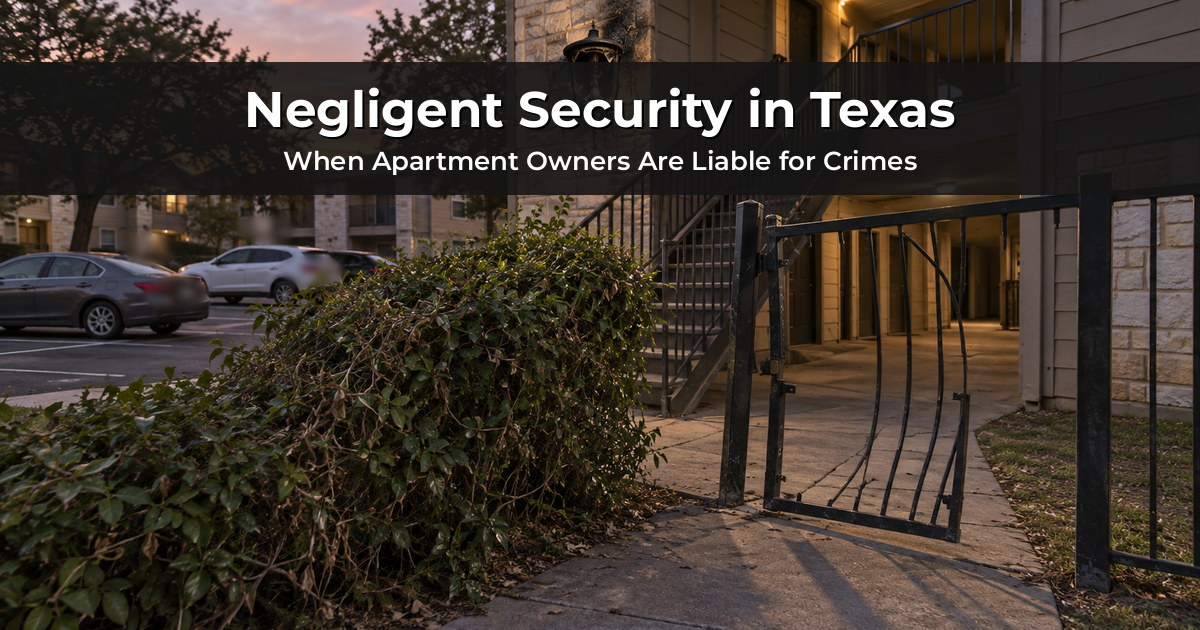
Apartment complex walkway at dusk with a broken pedestrian gate, overgrown hedge, and dim stairwell lighting

Assaulted at a DFW Apartment Complex? When Texas Landlords Are Liable for Negligent Security

By Luke A. Williams · Personal Injury

Short answer: In Texas, an apartment owner can be held liable when a tenant or guest is assaulted, robbed, or otherwise hurt by a criminal on the property, but only in limited situations. Generally, the owner must have known or had reason to know of an unreasonable and foreseeable risk of that kind of crime, usually shown by similar prior crimes on or near the property, and must have failed to take reasonable steps to reduce it. Separately, the Texas Property Code requires landlords to provide specific locks and security devices and to rekey units between tenants. These claims are generally subject to a two-year deadline to file suit.

Apartment complex walkway at dusk with a broken pedestrian gate, overgrown hedge, and dim stairwell lighting

Being attacked where you live is frightening, and it is natural to ask whether the property should have done more. Broken gates, dark parking lots, missing deadbolts, and repeated break-ins that management ignored can all be part of a negligent security claim. Texas law, however, sets demanding rules for these cases, and the details matter.

At Howard Lotspeich Alexander & Williams, PLLC (HLAW), our Fort Worth personal injury lawyers represent injured people and families throughout Tarrant, Dallas, Denton, Collin, Johnson, and Parker counties. This guide explains how negligent security claims work in Texas, what the Texas Supreme Court requires, and what evidence tends to matter most.

Key Takeaways

  • The general rule favors property owners. The Texas Supreme Court has said that "generally, a premises owner has no duty to protect invitees from criminal acts by third parties," with an exception when the owner "knows or has reason to know of a risk of harm to invitees that is unreasonable and foreseeable" (Del Lago Partners v. Smith, Tex. 2010).
  • Prior crimes usually drive foreseeability. Courts weigh five Timberwalk factors: proximity, recency, frequency, similarity, and publicity of prior crimes (Timberwalk Apartments v. Cain, Tex. 1998).
  • Foreseeable is not enough by itself. In a 2017 case involving a shooting in an apartment visitor lot, the Texas Supreme Court held that a risk must be "both foreseeable and unreasonable," which also weighs the burden of preventing it (UDR Texas Properties v. Petrie).
  • Texas law requires specific security devices. Without a tenant having to ask, a rental dwelling must have window latches, a doorknob lock or keyed dead bolt, sliding door pin locks and bars or handle latches, and a keyless bolting device and door viewer on each exterior door (Tex. Prop. Code §92.153).
  • Locks must be rekeyed between tenants. Landlords must rekey key, card, or combination devices within seven days after each tenant turnover (Tex. Prop. Code §92.156).
  • The criminal's share of fault counts. A defendant can ask the jury to assign responsibility to the attacker, even an unknown "John Doe," which can reduce what the property owner pays (Tex. Civ. Prac. & Rem. Code ch. 33).
  • Two years is the usual deadline. Personal injury suits generally must be filed "not later than two years after the day the cause of action accrues" (Tex. Civ. Prac. & Rem. Code §16.003).

What Is a Negligent Security Claim in Texas?

A negligent security claim is a type of premises liability case. The injured person argues that the owner or manager of a property failed to use reasonable care to protect people on the property from a foreseeable crime, and that this failure was a cause of the injury.

These claims often arise from:

  • Assaults or robberies in apartment parking lots, breezeways, stairwells, and laundry rooms
  • Break-ins and home invasions where locks were missing, broken, or never rekeyed
  • Attacks through broken or propped-open access gates
  • Shootings or assaults at complexes with a known history of similar violence
  • Assaults in hotels, parking garages, bars, and retail centers

The person who committed the crime is always responsible for it. A negligent security claim asks a different question: whether the property owner also carries part of the responsibility because it ignored a risk it knew about or should have known about.

When Is a Texas Apartment Owner Responsible for a Crime on the Property?

Texas courts start from the rule that a property owner is generally not responsible for the criminal acts of others. Liability turns on whether the owner owed a legal duty in the situation, and that depends heavily on foreseeability.

The Timberwalk foreseeability factors

In Timberwalk Apartments, Partners, Inc. v. Cain, a Texas Supreme Court case involving the sexual assault of an apartment tenant, the court explained that "foreseeability of an unreasonable risk of criminal conduct is a prerequisite to imposing a duty of care" on someone who owns or controls premises (Timberwalk). Courts consider "whether any criminal conduct previously occurred on or near the property, how recently it occurred, how often it occurred, how similar the conduct was to the conduct on the property, and what publicity was given the occurrences."

Factor What courts look at Examples of helpful evidence
Proximity Crimes on the property or in its immediate vicinity Police reports for the complex address and adjacent properties
Recency How recently prior crimes happened Incidents in the months before the attack
Frequency How often crimes occurred A pattern of repeated incidents in a short period
Similarity Whether prior crimes put the owner on notice of the specific danger Prior assaults, robberies, or break-ins, not just minor property crimes
Publicity Whether the owner knew or should have known Tenant complaints, incident reports, emails to management, news coverage

The court added that these factors "must be considered together." It also explained that prior crimes do not need to be identical: a string of assaults and robberies can make other violent crimes foreseeable, while unreported crimes that no one knew about are not evidence of foreseeability. Courts have also said that property owners have no duty to regularly check criminal records for their area, though widely publicized crimes can show knowledge (Jai Jalaram v. LeRibeus, Tex. App. 2006).

The risk must also be unreasonable

In UDR Texas Properties v. Petrie (2017), a visitor was robbed and shot in the knee in the public visitor parking lot of a Texas apartment complex. The Texas Supreme Court reversed a judgment for the visitor and explained: "We have consistently said that a risk must be both foreseeable and unreasonable to impose a duty on a property owner" (UDR Texas Properties v. Petrie). Because the visitor offered no evidence about the burden of preventing or reducing the risk, the court rendered judgment for the complex.

The practical lesson is that a strong case needs two kinds of proof: evidence that the crime was foreseeable, and evidence that reasonable, available steps (such as repairing a gate, fixing lighting, or responding to repeated reports) could have reduced the risk.

When danger is imminent

Foreseeability can also come from what is happening in the moment. In Del Lago Partners v. Smith, the court upheld a verdict against a resort bar that "had actual and direct knowledge that a violent brawl was imminent between drunk, belligerent patrons and had ample time and means to defuse the situation" (Del Lago). The court stressed that the duty "arose not because of prior similar criminal conduct but because it was aware of an unreasonable risk of harm at the bar that very night," and that it was not announcing a general rule.

What Security Devices Must Texas Landlords Provide?

Separate from the general negligence rules, Subchapter D of Chapter 92 of the Texas Property Code sets specific security device requirements for residential rentals (Tex. Prop. Code ch. 92).

Under §92.153, unless an exception applies, and without a tenant having to ask, a dwelling must have:

  1. A window latch on each exterior window
  2. A doorknob lock or keyed dead bolt on each exterior door
  3. A sliding door pin lock on each exterior sliding glass door
  4. A sliding door handle latch or security bar on each exterior sliding glass door
  5. A keyless bolting device and a door viewer on each exterior door

Other key rules include:

  • Rekeying: Under §92.156(a), security devices operated by a key, card, or combination must be rekeyed at the landlord's expense "not later than the seventh day after each tenant turnover date."
  • Repairs: Under §92.158, a landlord must repair or replace a security device on request or notice that it is inoperable.
  • Timing: Under §92.161, repair and rekeying requests are presumed due within seven days, but within 72 hours if the tenant told the landlord about an unauthorized entry in the unit, an attempted or actual entry in another unit in the past two months, or a crime of personal violence at the complex in the past two months.

If a landlord does not comply with §92.153 or §92.156(a), §92.164 lets a tenant seek remedies including actual damages. The statute's attorney's fee provisions do not apply in suits for personal injuries or wrongful death. In practice, a missing or broken required lock is often powerful evidence in a broader negligence claim, especially when the tenant reported it in writing.

How Does the Attacker's Fault Affect the Claim?

Texas uses proportionate responsibility. Under Chapter 33 of the Civil Practice and Remedies Code, the jury assigns a percentage of responsibility to each claimant, defendant, settling person, and designated "responsible third party" (Tex. Civ. Prac. & Rem. Code §33.003).

That matters in negligent security cases because:

  • The attacker can be on the verdict form. Even if the attacker was never identified, §33.004(j) allows a defendant to designate an unknown person as a responsible third party if it timely pleads facts showing a reasonable probability that the person's act was criminal.
  • A defendant generally pays only its own share. Under §33.013(a), a liable defendant is generally responsible for its own percentage, unless its share is greater than 50 percent, in which case it is jointly and severally liable under §33.013(b)(1).
  • The injured person's own fault can reduce or bar recovery. Under §33.001, a claimant cannot recover if his or her percentage of responsibility is greater than 50 percent. Our guide to how fault works in Texas personal injury cases explains these rules in more detail.

What Evidence Matters in a DFW Negligent Security Case?

Because these cases turn on what the owner knew before the attack, evidence often disappears quickly. Useful evidence can include:

  • Police call and incident records for the complex and nearby properties, often obtained through public information requests to the local police department
  • Management records such as incident reports, tenant complaints, work orders for gates, lights, and locks, and emails or portal messages
  • Your lease and any lease addenda, including security device and crime-related notices
  • Photos and video of broken gates, burned-out lights, damaged locks, or overgrown landscaping, taken as soon as possible
  • Surveillance video, which many properties record over within days or weeks
  • Security contracts and patrol logs, if the property used a guard or courtesy officer service
  • Witness information from neighbors who reported prior problems

A prompt written request to preserve video and records can be important. Insurance carriers for apartment owners often investigate quickly; our article on insurance adjuster tactics in Fort Worth explains what to watch for.

What Should You Do After Being Assaulted at an Apartment Complex?

  1. Get to safety and call 911. A police report documents the crime and its location.
  2. Get medical care right away, and keep records of every visit. Injuries such as head trauma and emotional harm may not be fully apparent at first.
  3. Report the incident to management in writing and keep a copy.
  4. Photograph the scene, including gates, lighting, locks, and doors, before repairs are made.
  5. Write down what you remember and the names of anyone who saw what happened or reported earlier problems.
  6. Avoid giving recorded statements to the property's insurer before getting legal advice, and be careful about what you post on social media.
  7. Talk with a lawyer early, so evidence can be requested before it is lost and the two-year filing deadline is protected.

If a loved one was killed in a crime at a property, the family may have a wrongful death claim. See our wrongful death practice page.

Frequently Asked Questions

Can I sue my apartment complex if I was robbed in the parking lot?

Possibly. You would generally need to show that the complex knew or should have known of an unreasonable and foreseeable risk of that kind of crime, often through similar prior crimes on or near the property, and that it failed to take reasonable steps that would have reduced the risk. Each case depends on its facts.

Does a single prior crime make an attack foreseeable?

Usually not by itself. The Texas Supreme Court has said that "the complete absence of previous crimes, or the occurrence of a few crimes over an extended time period, negates the foreseeability element," while a significant number of crimes in a short time strengthens it (Timberwalk). The more similar the prior crimes, the fewer may be needed.

Is a broken gate or burned-out light enough to win a case?

Not on its own. A broken gate or dark area can be important evidence that reasonable precautions were not taken, but Texas courts also require proof that the crime was foreseeable and that the risk was unreasonable. Written reports to management about the problem can strengthen the claim.

Can guests and visitors bring negligent security claims?

Yes, guests and other invitees can bring these claims. The visitor in Petrie was in a complex's visitor lot. The same foreseeability and unreasonableness rules apply.

Does it matter that the attacker was never caught?

A claim can proceed even if the attacker is unknown. The defendant may ask to designate the unknown person as a responsible third party under §33.004(j), and the jury may then assign that person a percentage of responsibility.

How long do I have to file a negligent security lawsuit in Texas?

Generally two years from the date of the injury under §16.003. Exceptions can apply, such as for minors, so it is best to get advice promptly.

Do these rules apply to hotels, bars, and stores too?

Yes. The Timberwalk foreseeability factors are applied to many kinds of commercial property, and Del Lago involved a resort bar. Our article on parking lot and sidewalk injuries in Texas covers other premises claims.

Talk to a Fort Worth Premises Liability Lawyer

Negligent security cases are fact-intensive and often hard-fought. Early investigation into prior crimes, complaints, and repairs can make a significant difference.

Call HLAW at (817) 993-9249 or contact us online for a free consultation about an injury at a Dallas-Fort Worth apartment complex or other property.

This article is for general informational purposes only and is not legal advice. Reading it does not create an attorney-client relationship. Laws change, and every case depends on its specific facts.

Read full article

Speak with a Fort Worth attorney

Call (817) 993-9249 or send us a message to discuss your case.