When Is Weaving Within a Lane Reasonable Suspicion for a Traffic Stop?
 James Leming was convicted of DWI after erratic driving alarmed fellow motorists to call police. On January 20, 2012, a citizen filed a report of a “swerving Jeep” and Officer Manfred Gilow responded. As the dashboard camera confirmed, the Jeep traveled thirteen miles under the speed limit; Gilow followed the Jeep for several miles. Officer Gilow observed the Jeep, “drifting [within the] lane to the left [with] tires on the stripes… back to the right, almost hit[ting] the curb twice.”
Officer Gilow said he did not stop the Jeep immediately because the heavy traffic made a traffic stop unsafe at the time. He wanted to wait until the Jeep approached “the 3000 block because I knew there’s parking lots where he could pull over [safely].” Gilow justified the warrantless stop under the Community Caretaking Exception, “due to the …[low] speed…and…swerving, it was an indication that the driver [was] somehow either distracted or physically not able to operate [his] motor vehicle carefully.”
Eventually, the officer pulled Leming over, noting on the police report, the smell of liquor. Though Leming denied drinking, he said he had taken some prescription pills. Officer Gilow conducted field sobriety tests and placed Leming under arrest for DWI.
Read the full opinion in Leming v. State.
Leming’s DWI Trial and Motion to Suppress the Stop
Before the trial began, Leming filed a motion to suppress the traffic stop, which was denied. At trial, Leming pled guilty to and was convicted of DWI. Because Leming had two prior DWI convictions (a felony under Texas law), the court assessed punishment at ten years’ imprisonment. Tex. Penal Code § 49.09(b)(2).
The Sixth Circuit Court of Appeals reversed the trial court’s ruling, holding that the trial court should have granted the motion to suppress. Leming v. State, 454 S.W.3d 78 (Tex. App.—Texarkana 2014). The Sixth Circuit concluded that Gilow lacked reasonable suspicion to detain Leming for the offense of failure to maintain a single lane under Section 545.0600(a) of the Texas Transportation Code. The court reasoned “in order for it to have been unlawful, the encroachment must have been made unsafely; [here,] there was no real danger of his colliding with another vehicle in an adjacent lane.” The State’s Prosecuting Attorney petitioned the Court of Criminal Appeals for discretionary review, arguing that the citizen’s report coupled with Officer Gilow’s observations were sufficient for reasonable suspicion that Leming was driving the Jeep under the influence.
The Issue Before the Texas Court of Criminal Appeals Regarding the Traffic Stop
The Court of Criminal Appeals had to determine whether a driver must BOTH fail to maintain a single lane AND not change lanes without checking to assure the maneuver can be accomplished safely, before it may be said that a driver has committed an offense. Such an offense would rise to the level of reasonable suspicion for a constitutionally-sound traffic stop.
What Does the Texas Transportation Code Say About Driving Within a Single Lane?
Section 545.060(a) states that “an operator on a roadway divided into two or more clearly marked lanes for traffic (1) shall drive as nearly as practical entirely within a single lane; and (2) may not move from the lane unless that movement can be made safely.”
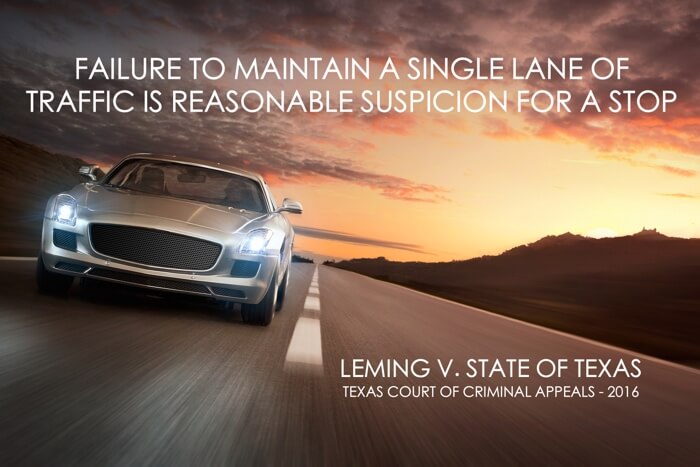
The CCA Holds that a Driver Must Maintain a Single Lane AND Must not Leave the Lane Unless it is Safe.
The CCA explains that the fact that both the requirement to stay within a single lane as for as practical and the prohibition to not leave that lane unless it is safe to do so, originally appeared in the same subsection of the statute, does not indicate that the Legislature intended that both must be violated before an offense has occurred. Rather, the CCA believes that the Legislature intended a violation of EITHER part of the statute constitutes separately actionable offenses.
The CCA says that Officer Gilow knew from personal observations, as well as from the citizen’s report, that Leming had some sort of trouble maintaining a steady driving pattern while traveling under the speed limit. “That was sufficient information to justify a temporary detention to investigate whether Leming had actually failed at some point to remain in his dedicated lane of traffic as far as it was practical to do so under the circumstances—it matters not whether that failure was unsafe.” Further, Officer Gilow had an objectively reasonable basis to suspect Leming of driving under the influence.
As a matter of principle, the CCA notes, “it [would be] counterproductive and contrary to common sense to set the reasonable suspicion bar for DWI so high that law enforcement must hesitate to investigate such hazardous driving for fear that the stop will later be invalidated.” In a Concurring Opinion, Judge Richardson adds, “I believe [the community caretaking exception] provided justification for the officer’s stop, where, a reasonable police officer—given the totality of the circumstances-would believe [someone] is in need of help.” Dissenting, Judge Keasler stated, “this is a close case…the majority reaches the wrong result by misconstruing the statute and finds reasonable suspicion on the basis of a single insufficient articulable fact.” Judge Newell also dissented in this case.