Tag

Breath Test

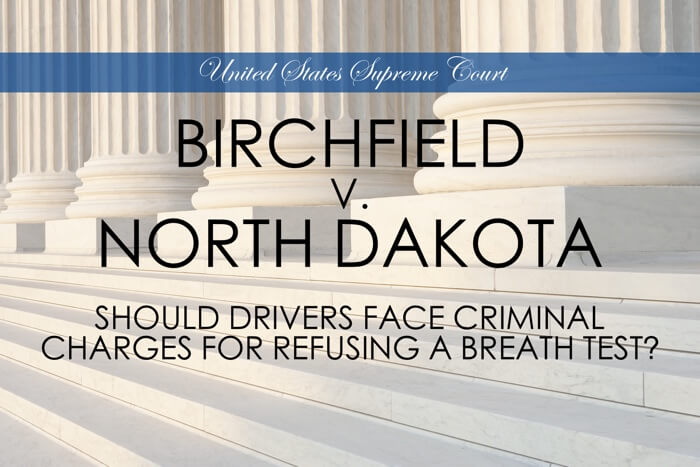
Birchfield v. North Dakota Supreme Court Breath Test

Criminal Penalties for Refusing a Breath Test—Are They Coming to Texas?

By DWI

Can Texas Charge a Person with a Crime for Refusing a Breath or Blood Test During a DWI Stop?

In Texas, when a person refuses to provide a breath or blood specimen when being arrested for alleged drunk driving offense, their driver’s license is typically suspended. But, can a state have a law that additionally makes it a crime to refuse a breath or blood test? In Birchfield v. North Dakota, the United States Supreme Court held that a state can attach a criminal penalty to those that refuse to submit to a warrantless breath test but they cannot for those that refuse to submit to a warrantless blood test.

In a previous blog post we discussed the oral arguments that took place in this case and briefed the three cases facing the court, Birchfield , Bernard and Beylund.  Birchfield had been criminally prosecuted for refusing a warrantless blood draw; Bernard had been criminally prosecuted for refusing a warrantless breath test; and Beylund, while not criminally prosecuted for refusing a test, submitted to a blood test after the officer told him the law required it. Birchfield v. North Dakota 579 U.S. ____ (2016).

U.S. Supreme Court Issues Opinion in Birchfield Upholding Criminal Penalty for Breath Test Refusal (But Not Blood)

SUPREME COURT DECISION – Birchfield v. North Dakota

First, the Court determined whether warrantless breath and blood tests were proper searches incident to arrest for drunk driving. The Court held that since “breath tests are significantly less intrusive than blood tests” and in most cases adequately serve law enforcement interests, the Fourth Amendment permits a warrantless breath test but not blood test as a search incident to arrest for drunk driving.

Next, the Court addressed the argument that when making the decision to drive on a public road, drivers are deemed to have given consent to submit to a blood test. Applying the Fourth Amendment reasonableness standard, the Court held that “motorists cannot be deemed to have consented to submit to a blood test on pain of committing a criminal offense.” Birchfield, 579 U.S. ____ (2016).

Finally, the Court applies these legal conclusions to the three cases.  In Birchfield, the Court held that the judgment affirming his conviction must be reversed because the warrantless blood draw was not a justified search incident to arrest and he was thus, threatened with an unlawful search. In Bernard, the Court held that Bernard had no right to refuse the breath test because it was a proper search incident to arrest. In Beylund, the Court vacated the judgment and remanded the case to the state court to reconsider Beylund’s consent given the partial inaccuracy of the officer’s statement that “the law required it.”

In conclusion, the Supreme Court held that States may enact laws that attach criminal penalties to the refusal to submit to a breath test but they may not enact such laws that will apply to refusal to submit a blood test. So what does this mean for Texas? Well, while we do not currently have laws in place that attaches a criminal penalty to refusal of a breathalyzer, the State could enact a law that makes it a crime to refuse to provide a warrantless breath test incident to arrest of drunk driving.
Birchfield v. North Dakota Supreme Court Breath Test

Should Drivers Face Criminal Charges for Refusing a Breathalyzer Test?

By DWI

SCOTUS Hears Oral Argument in Birchfield v. North Dakota

Birchfield v. North Dakota Supreme Court Breath TestOn April 20, 2016, the Supreme Court of the United States (“SCOTUS”) heard oral arguments in Birchfield v. North Dakota, a case that consolidates Birchfield with Bernard v. Minnesota and Beylund v. Levi, where the SCOTUS will determine whether the government may, without a warrant, make it a crime for a motorist to refuse to take a blood-alcohol test. Currently, thirteen states make it a crime to refuse any form of drunk-driving tests (breathalyzer, field sobriety, etc.). Birchfield comes on the heels of the 2013 Missouri v. McNeely case, where the SCOTUS held that if police have time, they should get a warrant before taking an invasive test of a suspected drunk driver. Let’s take a look at each consolidated case to understand the big issue before the Supreme Court.

Case #1: Birchfield v. North Dakota

In Birchfield, motorist Danny Birchfield drove his car off of a North Dakota road and subsequently failed a field sobriety test and a preliminary breath test, given by the state highway patrol. At that point Birchfield was arrested, told he had to take another more invasive chemical test, and informed of North Dakota’s implied consent rule. In North Dakota, any individual who operates a motor vehicle on any public or private road in the state is deemed to have consented to a chemical test for alcohol in the blood stream. Birchfield refused to submit to any further testing and was charged with both DUI and Failure to Submit to chemical testing. Birchfield filed several appeals, arguing that North Dakota’s implied consent law is unconstitutional under the 4th Amendment of the United States Constitution. Birchfield is opposed to “refusal” being a crime all by itself.

Read the brief in Birchfield here.

Case #2: Bernard v. Minnesota

In Bernard, police confronted a man who smelled of alcohol on a public boat ramp and asked him to consent to field sobriety tests. Bernard consented to a breathalyzer test after being told of the criminal penalties for refusal. Under Minnesota’s implied consent law, it is a criminal offense for a driver who has been arrested on probable cause for driving while impaired to refuse a chemical test. Minnesota argues that a warrantless breath search is constitutional under the “search incident to an arrest” doctrine. On the other hand, Bernard argues that a breathalyzer is not a valid search incident to an arrest because the search does nothing to further officer safety or to preserve evidence.

Read the brief in Bernard here.

Case #3: Beylund v. Levi

In Beylund, law enforcement observed a car driving erratically and stopping in the middle of the road. The police asked defendant Beylund to consent to chemical testing. At trial, Beylund argued that the test imposed an unconstitutional condition on his driver’s license.

Read the brief in Beylund here.

The Big Issues—Implied Consent or Criminalization of a Constitutional Right?

The highest court will determine whether in the absence of a warrant, a state can make it a crime, in and of itself, for a person to refuse to take a chemical test (blood, breath and urine) to detect the presence of alcohol in the blood? The Supreme Court will likely be examining the following questions to determine the answer to that question:

  • When drivers obtain a driver’s license from a state agency, does a driver impliedly consent to invasive chemical testing to detect the presence of alcohol?
  • Is refusing an invasive chemical test criminal in and of itself?
  • Do citizens have the constitutional right to refuse an invasive chemical test without penalty?
  • Do states have a compelling interest in protecting public roadways from drunk driving so that they may order chemical testing for suspected drunk drivers even without a warrant?
  • Can a government benefit (such as driving on public roadways) be conditioned upon search requirements, even if the search is an invasive chemical test?

Precedent Case: Missouri v. McNeely

Driving While Intoxicated and invasive chemical testing are not new topics to the SCOTUS. In 2013, the Court heard Missouri v. McNeely. Defendant McNeely had been arrested for DUI after failing field sobriety tests. He refused to take a breathalyzer, so law enforcement transported him to a hospital where his blood was removed against his will. After several appeals and suppression hearings, McNeely was heard by the SCOTUS. Chief Justice Sonia Sotomayor reiterated that a blood draw “is an invasion of bodily integrity that implicates the most personal and deep-rooted expectations of privacy.” Although the SCOTUS noted that from time to time cases may arise that will allow for a warrantless blood alcohol test, the Court ultimately held, “in drunk driving investigations, the natural dissipation of alcohol in the bloodstream does not constitute an exigency in every case sufficient to justify conducting a blood test without a warrant.”

What Will the Supreme Court Say About Warrantless Breath Tests?

Several national organizations, such a Mothers Against Drunk Driving (see the MADD brief here) and the American Civil Liberties Union (read the ACLU brief here), have filed amicus “friends of the court” briefs for this case arguing for and against the constitutionally of implied consent laws. In the past decade, 112,998 people have been killed in alcohol-impaired driving crashes. With grim statistics underpinning many of the individual states’ implied consent laws, will the Supreme Court overturn or add to McNeely? It will be very interesting to see how the SCOTUS squares this case with the precedent case law and which legal theory they will select to reach a conclusion.