
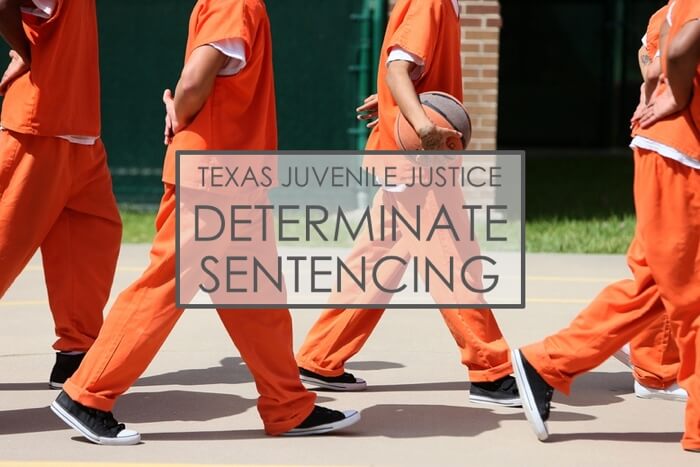
Determinate Sentencing Can Extend the Life of a Texas Juvenile Case
 In the Texas juvenile justice system, a juvenile court has jurisdiction over a youthful offender if he or she is under the age of 17 at the time an offense is committed. The punishment for an offense typically can only last until a juvenile’s 19th birthday. We are often asked, “What happens if the juvenile is convicted of a serious offense? Is it possible for the court to impose a sentence that extends beyond the juvenile’s 19th birthday?” That is where Determinate Sentencing comes in. This post explains what Determinate Sentencing means and how it can impact a juvenile case.
What is Determinate Sentencing in Texas Juvenile Law?
Determinate sentencing creates a hybrid system whereby juveniles who have been adjudicated for severe criminal offenses are given a sentence that begins in the Texas Juvenile Justice Department (“TJJD”) and can potentially be transferred to the Texas Department of Criminal Justice (“TDCJ”) for a term of up to forty years.
Who requests a Determinate Sentence?
The prosecution has sole discretion as to whether to seek a determinate sentence. If the prosecutor decides to pursue a determinate sentence, he or she must file a petition indicating a child engaged in delinquent conduct with the court. Then, the prosecutor must present that petition to the grand jury for approval. If the petition is approved, then it becomes a determinate sentence case. However, if the petition is denied by the grand jury, the State’s only recourse would be to pursue the case as normal.
If a juvenile is adjudicated of a determinate sentence, then the judge or jury can assess an appropriate disposition, or punishment, in accordance with the determinate sentence range of punishment. This range is up to 40 years for a capital felony, first degree felony or an aggravated controlled substance felony, up to 20 years for a second degree felony, and up to 10 years for a third degree felony. Misdemeanors and state jail felonies are not eligible for determinate sentence under the Determinate Sentence Act.
Once the prosecutor’s request for a determinate sentence has been granted by the grand jury, he or she retains the power to later waive determinate sentencing so long as this occurs before the juvenile has been adjudicated. This often occurs in the course of plea negotiations, when the prosecutor offers an indeterminate sentence in exchange for the juvenile’s acceptance of the plea.
For indeterminate disposition, only the judge may assess punishment. However, for determinate sentence cases, the juvenile may choose either the judge or jury to assess disposition. If the juvenile would like the jury to decide punishment, he or she must file a written request with the judge prior to voir dire.
To what offenses can Determinate Sentencing apply?
Section 53.045 of the Texas Family Code provides a list of offenses that are eligible for determinate sentencing. Those offenses include:
- habitual felony conduct;
- murder;
- capital murder;
- manslaughter;
- aggravated kidnaping;
- sexual assault;
- aggravated sexual assault;
- aggravated assault;
- aggravated robbery;
- injury to a child, elderly individual or disabled individual;
- felony deadly conduct involving discharging a firearm;
- certain offenses involving controlled substances;
- criminal solicitation;
- indecency with a child;
- criminal solicitation of a minor;
- attempted murder or attempted capital murder;
- arson, if bodily injury or death is suffered by any person by reason of the commission of the arson;
- intoxication manslaughter, and criminal conspiracy.
What is the impact of a Determinate Sentence?
A juvenile who has been adjudicated of a determinate sentence will either be sentenced to placement in the TJJD or placed on probation. In each case, the juvenile court retains jurisdiction over the juvenile up until the juvenile turns eighteen or nineteen. For crimes committed before September 1, 2011, the juvenile remains in the juvenile system until his or her eighteenth birthday.
Juveniles who receive probation can be on probation for up to 10 years, which may extend past the time the juvenile reaches adulthood. When a juvenile on determinate sentence probation ages out of the juvenile system, the probation automatically expires unless the prosecutor requests a transfer hearing prior to the juvenile’s nineteenth birthday. If a transfer hearing is requested and held, the juvenile judge will decide whether to transfer the juvenile into the custody of an adult criminal court. If the request for transfer is granted, the county’s adult probation department would supervise the juvenile for the remainder of his or her probation.
The alternative to probation is for a juvenile to be sentenced to TJJD with the possibility of transfer to TDCJ. In this situation, the judge or jury imposes a sentence of a set number of years that may extend past the age of adulthood. A juvenile is required to complete a minimum length of stay at TJJD. Once he or she has completed that minimum length of stay, TJJD can parole the juvenile, if they choose. For those juveniles who are unable to complete their minimum length of stay prior to aging out of the juvenile system or who are not participating in TJJD programs or progressing satisfactorily towards rehabilitation, TJJD can request a transfer hearing. The transfer hearing, if requested, must be heard by the original juvenile judge who heard the case and it must take place prior to the juvenile’s 19th birthday. After hearing evidence at the hearing, the judge will then decide whether the youth should be transferred to adult prison to complete his or her sentence or whether the youth can be safely released on parole without putting the public safety at risk.
Texas Juvenile Crimes Defense Attorneys | Free consultation
Contact the Texas juvenile defense attorneys at Barnett Howard & Williams PLLC for a FREE consultation of your juvenile case. It is best to contact an attorney at the outset of a juvenile case. Do not wait until after you have attended a meeting with the district attorney. Call today!


 It seems like all I write about anymore is the Court of Criminal Appeals reversing a Court of Appeals case and siding with the State. Well, this post is no different.