Skip to main contentTexas Boating Accidents: Who’s Liable When Things Go Wrong on the Water?
Home » NEWS » Texas Boating Accidents: Who’s Liable When Things Go Wrong on the Water?

Boating accidents on Texas lakes and rivers can lead to serious injuries. Our attorneys explain who may be liable and how to protect your rights.
Boating is a favorite pastime across Texas — from the shores of Eagle Mountain Lake and Possum Kingdom Lake to the Gulf Coast. But when fun on the water turns into tragedy, victims and their families often face serious injuries, costly medical bills, and tough legal questions about who is responsible.
Under Texas law, boating accident liability can be complex, involving state boating regulations, general negligence principles, and in some cases, criminal statutes for intoxicated operation. Here’s what you need to know if you’ve been involved in a recreational accident on Texas lakes, rivers, or coastal waters.
Texas Boating Laws at a Glance
The Texas Parks and Wildlife Department (TPWD) enforces state boating laws found primarily in Texas Parks & Wildlife Code, Chapter 31. These laws govern everything from boat registration to safety equipment requirements. For accident liability, key provisions include:
- Operating a Vessel in a Negligent or Reckless Manner – Under Tex. Parks & Wild. Code § 31.099, it is an offense to operate a boat in a way that endangers the life, limb, or property of another person. This includes excessive speed, unsafe turns, or creating hazardous wakes.
- Boating While Intoxicated (BWI) – Similar to driving a car, operating a boat while intoxicated is prohibited under Tex. Penal Code § 49.06. A person is considered intoxicated if they have a blood alcohol concentration (BAC) of 0.08% or more, or if they lack the normal use of mental or physical faculties due to alcohol or drugs. BWI is a criminal offense that can also form the basis for civil liability.
- Duty to Render Aid and Report Accidents – Under Tex. Parks & Wild. Code § 31.104, boat operators involved in an accident must stop, render aid, and exchange information. § 31.105requires reporting any accident involving death, disappearance, or injury requiring more than first aid to TPWD within 48 hours, and property damage over $2,000 within 30 days.
Civil Liability for Boating Accidents
When a boating accident occurs, victims may bring a personal injury or wrongful death claimunder Texas negligence law. To establish liability, you must generally prove:
- Duty of Care– The boat operator owed passengers and others on the water a duty to operate safely.
- Breach of Duty– The operator violated that duty, for example by speeding, failing to maintain a proper lookout, or boating while intoxicated.
- Causation– The breach directly caused the accident and resulting injuries.
- Damages– You suffered measurable harm (medical expenses, lost wages, pain and suffering, etc.).
Who Can Be Held Liable?
Boating accident claims often involve multiple responsible parties:
- The Boat Operator – If the operator acted negligently or recklessly, they may be directly liable.
- The Boat Owner – Even if they weren’t driving, an owner who negligently entrusted the vessel to an incompetent or intoxicated operator can be held liable under the doctrine of negligent entrustment.
- Marinas, Rental Companies, or Tour Operators – Businesses that rent or charter boats can be liable for negligent maintenance, failure to provide safety instructions, or renting to unqualified or intoxicated individuals.
- Other Negligent Parties – Liability may extend to other boaters whose actions contributed to the collision or to manufacturers of defective equipment under Texas product liability law(Tex. Civ. Prac. & Rem. Code Chapter 82).
Boating While Intoxicated: Civil and Criminal Consequences
BWI is not only a criminal offense but strong evidence of negligence in a civil claim. A conviction can support a finding of negligence per se, meaning the violation of the statute is presumed to be negligent if it caused the injuries.
In cases involving gross negligence—conduct showing conscious indifference to the rights or safety of others—Texas law allows for exemplary damagesunder Tex. Civ. Prac. & Rem. Code § 41.003.
Common Boating Accident Scenarios in Texas
- Collisions between two vessels
- Boat striking a dock, swimmer, or fixed object
- Falls overboard leading to drowning
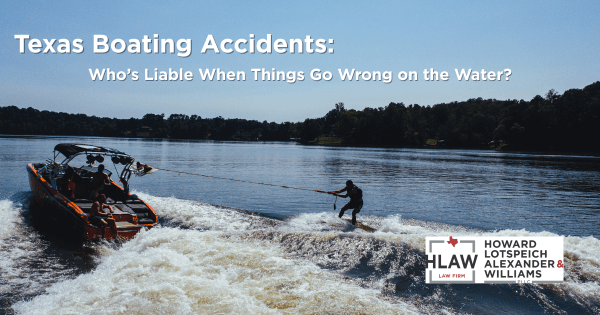
- Water skiing or tubing accidents
- Mechanical failure due to poor maintenance
- Accidents caused by intoxicated or inexperienced operators
Steps to Take After a Boating Accident
- Seek Medical Attention Immediately– Even minor injuries can worsen if untreated.
- Report the Accident– Follow the reporting requirements under Texas law.
- Gather Evidence– Take photos, collect witness statements, and preserve any available video (including GoPro or cell phone footage).
- Avoid Giving Recorded Statements to Insurers– Consult a lawyer first.
- Contact a Texas Boating Accident Attorney– An attorney can investigate, identify liable parties, and pursue full compensation.
Bottom Line
Texas boating accident cases blend elements of personal injury law, maritime safety regulations, and sometimes criminal law. Whether your accident happened on Lake Texoma, the Brazos River, or along the Gulf Coast, identifying the responsible parties and proving negligence is key to recovery.
If you or a loved one has been injured in a boating accident, Howard, Lotspeich, Alexander & Williams, PLLCcan help you navigate the legal waters and fight for the compensation you deserve. We offer free consultations and case evaluations and we don’t get paid unless you do. If you or a friend or family member has been seriously injured in a boating accident, contact us for a free consultation.

boating accident lawyer, fort worth boat accident lawyer, boat accident lawyer, boat accident attorney, boating accident attorney, fort worth boating accident lawyer
Understanding Boating Accident Liability in Texas
In Texas, the liability for boating accidents can be attributed to various parties based on the circumstances surrounding each incident. This includes operators, owners, and even passengers, depending on their actions leading up to the accident. Understanding these nuances is crucial for victims seeking compensation, as establishing who is liable can significantly impact the outcome of a legal claim.
For instance, if a boat operator was negligent by not adhering to safety regulations or was under the influence of alcohol, they could be held responsible for any injuries that occur as a result. Additionally, if a rental company failed to maintain their vessels or ensure safety protocols were followed, they may also share liability. This complex web of potential liability underscores the importance of consulting with an experienced attorney to navigate these waters.
The Role of Insurance in Boating Accident Claims
Insurance plays a vital role in the aftermath of a boating accident, as it can provide financial support for victims facing medical bills and other expenses. Many boat owners carry liability insurance, which can cover damages caused by their actions while operating a vessel. Understanding how insurance policies work in relation to boating accidents is essential for victims seeking compensation.
For example, if a victim is injured due to another boater's negligence, they may file a claim against that boater's insurance policy. However, the process can be complicated by factors such as policy limits and exclusions. Furthermore, victims should be aware of their own insurance coverage, which may provide additional support in the event of an accident. Consulting with a knowledgeable attorney can help victims effectively navigate these insurance matters.
Common Misconceptions About Boating Accident Liability
There are several misconceptions surrounding liability in boating accidents that can lead to confusion for victims and their families. One common myth is that only the boat operator can be held liable for an accident, which overlooks the responsibilities of boat owners and other parties involved. Understanding these misconceptions is crucial for anyone involved in a boating incident.
For instance, many people believe that if a passenger was not actively operating the boat, they cannot be held liable for an accident. However, if a passenger encourages reckless behavior or fails to report unsafe conditions, they may also bear some responsibility. By addressing these misconceptions, victims can better understand their rights and pursue appropriate legal action.
How to Choose the Right Attorney for Your Boating Accident Case
Selecting the right attorney is a critical step for victims of boating accidents seeking legal recourse. A knowledgeable attorney with experience in personal injury and boating laws can help ensure that victims receive fair compensation for their injuries. When choosing an attorney, victims should consider factors such as experience, track record, and familiarity with local laws.
For example, an attorney who specializes in boating accidents will have a deeper understanding of the specific regulations and liabilities involved in such cases. They can provide valuable insights into the legal process and help gather necessary evidence to support a claim. Victims should also look for attorneys who offer free consultations, allowing them to assess their options without financial pressure.
boating accident lawyer, fort worth boat accident lawyer, boat accident lawyer, boat accident attorney, boating accident attorney, fort worth boating accident lawyer
Understanding Boating Accident Liability in Texas
In Texas, the liability for boating accidents can be attributed to various parties based on the circumstances surrounding each incident. This includes operators, owners, and even passengers, depending on their actions leading up to the accident. Understanding these nuances is crucial for victims seeking compensation, as establishing who is liable can significantly impact the outcome of a legal claim.
For instance, if a boat operator was negligent by not adhering to safety regulations or was under the influence of alcohol, they could be held responsible for any injuries that occur as a result. Additionally, if a rental company failed to maintain their vessels or ensure safety protocols were followed, they may also share liability. This complex web of potential liability underscores the importance of consulting with an experienced attorney to navigate these waters.
The Role of Insurance in Boating Accident Claims
Insurance plays a vital role in the aftermath of a boating accident, as it can provide financial support for victims facing medical bills and other expenses. Many boat owners carry liability insurance, which can cover damages caused by their actions while operating a vessel. Understanding how insurance policies work in relation to boating accidents is essential for victims seeking compensation.
For example, if a victim is injured due to another boater's negligence, they may file a claim against that boater's insurance policy. However, the process can be complicated by factors such as policy limits and exclusions. Furthermore, victims should be aware of their own insurance coverage, which may provide additional support in the event of an accident. Consulting with a knowledgeable attorney can help victims effectively navigate these insurance matters.
Common Misconceptions About Boating Accident Liability
There are several misconceptions surrounding liability in boating accidents that can lead to confusion for victims and their families. One common myth is that only the boat operator can be held liable for an accident, which overlooks the responsibilities of boat owners and other parties involved. Understanding these misconceptions is crucial for anyone involved in a boating incident.
For instance, many people believe that if a passenger was not actively operating the boat, they cannot be held liable for an accident. However, if a passenger encourages reckless behavior or fails to report unsafe conditions, they may also bear some responsibility. By addressing these misconceptions, victims can better understand their rights and pursue appropriate legal action.
How to Choose the Right Attorney for Your Boating Accident Case
Selecting the right attorney is a critical step for victims of boating accidents seeking legal recourse. A knowledgeable attorney with experience in personal injury and boating laws can help ensure that victims receive fair compensation for their injuries. When choosing an attorney, victims should consider factors such as experience, track record, and familiarity with local laws.
For example, an attorney who specializes in boating accidents will have a deeper understanding of the specific regulations and liabilities involved in such cases. They can provide valuable insights into the legal process and help gather necessary evidence to support a claim. Victims should also look for attorneys who offer free consultations, allowing them to assess their options without financial pressure.