

Tag

CBD

Christmastime Arrests Texas

Top 5 Reasons for Arrests During the Christmas Holiday Season

By Criminal Defense

Christmastime Arrests TexasWhen you think about the Christmas season, you probably think about family time, presents, good food, and celebration. We think about those things too, but as criminal defense attorneys, we also think about the reasons that some of our clients get arrested during the holiday season. For this article, we took a look at the last 8 years of holiday season arrests (for clients that we represented) and compiled an (anecdotal) list of the top 5 reasons that folks get arrested during the Christmas/New Year’s season. Our goal is that this list will serve as a warning, so that your holiday season can be filled with the good stuff, rather than jail, bail, and calls to our office. Here goes:

5. Shoplifting

Many retailers slash their prices and offer steep discounts in the weeks leading up to Christmas and even bigger discounts after Christmas, but we have yet to see any retailer offer the “five finger discount” for their merchandise. Regardless, we see plenty of shoplifting cases during the Christmas season, making it our #5 reasons that people get arrested during Christmas. Depending on the regular price value of the item (not the discounted price), shoplifting theft charges can range from misdemeanors to felonies. Learn more about Theft law in Texas here.

4. Package Theft

In a similar vein to shoplifting, our #4 reason for holiday arrests is package theft. Many shoppers choose the convenience of online shopping and have their Christmas purchases delivered right to their front door. Some people see this as an easy target, following behind UPS or FedEx trucks to steal those would-be Christmas gifts from the front porch. However, with the increase in doorbell cameras, it is getting easier to catch the porch pirates in the act. Further, some law enforcement agencies have begun using dummy packages to bait thieves into getting caught. Package theft can range from a misdemeanor to a felony depending on what unknown treasure lay inside the brown box.

3. Air Travleing Trouble (Guns, Drugs, and Intoxication)

Going to visit grandma can require air travel for many families. This means that thousands more people than usual flood through DFW Airport between Thanksgiving and New Year’s. It matters not from where these travelers hail. From Maryland to Oregon to France, if a person is arrested at DFW Airport, their case will be filed in Tarrant County, Texas and they will have to travel back to DFW to attend court. During the holidays, we see a surge in airport arrests when people bring items into the airport that are not allowed or when folks over indulge during a layover. Specifically, we see the following airport arrests:

Even if the state from which a traveler is coming has legalized marijuana and the state to which they are traveling has legalized marijuana, if they are caught possessing marijuana in the airport, they will be arrested and charged. The combination of airport gun arrests, airport drug arrests, and airport public intox arrests make these types of cases our #3 reason for holiday arrests.

2. Assault Family Violence

In the movie Christmas Vacation, Clark Griswold showed an enormous amount of restraint when his extended family pushed him to the limit (especially Cousin Eddie), but not everyone is blessed with such a cool head. Christmas time brings added stressors into the family environment that can sometimes lead to verbal or physical altercations between family members, so much so, that these arrests rank at #2 in our book. Depending on the nature of the assault, a domestic violence arrest can be charged as a misdemeanor or a felony. Learn more about Family Violence under Texas law.

1. Driving While Intoxicated

With all of the Christmas and New Year’s parties and the increase in No Refusal Weekends, it is not hard to guess that DWI arrests are #1 on our list. Driving While Intoxicated in Texas can range from a misdemeanor (if it is a first or second offense) to a felony (if there is a child in the car or if the person arrested has been convicted of DWI twice in the past). Our advice is to plan ahead and do not even take your car to a Christmas party when you plan to drink. Catch a ride from a friend or take an Uber or Lyft. That would be a lot cheaper than hiring an attorney and a lot less hassle too. Learn more about Texas DWI law here.

We Hope You Never Need Us, But We’re Here if Your Do.

We wish you a very merry Christmas and a happy New Year. As always, we hope you never need us to represent you or one of your loved ones for a criminal offense. This is even more true during the Christmas season. Hopefully this list will help you avoid trouble that looms during the holiday season. If you do happen to need us, we are only a phone call away at (817) 993-9249.
Texas CBD Legal 2019

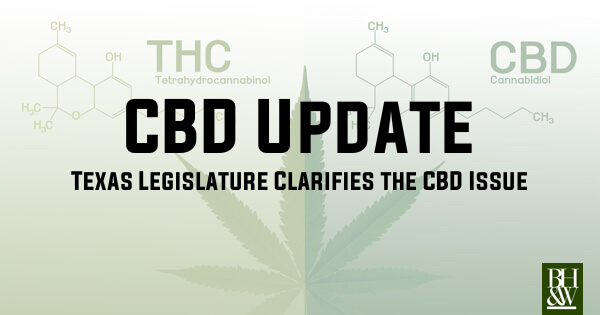
CBD Update: Texas Legislature Clarifies the CBD Issue

By Drug Crimes

Gov. Greg Abbott has now signed House Bill 1325 into law, clarifying the legality of hemp-derived, low THC CBD products in Texas.

Texas CBD Legal 2019On June 10, 2019, Gov. Abbot signed HB 1325 which modified sections of the Texas Agriculture Code and sections of the Texas Health and Safety Code.

The first major modifications come by way of the Texas Agriculture Code. The code now defines and legalizes “hemp” and establishes a legal production plan for the regulation of hemp and hemp-based products.

The Definition of Hemp

“Hemp” is now defined in in Section 121.001 0f the Texas Agriculture code as

“the plant Cannabis sativa L. and any part of that plant, including the seeds of the plant and all derivatives, extracts, cannabinoids, isomers, acids, salts, and salts of isomers, whether growing or not, with a delta-9 tetrahydrocannabinol [THC] concentration of not more than 0.3 percent on a dry weight basis.”

This definition is essentially the previous definition of marijuana under the Health and Safety Code but now isolates plants that contain less than .3% THC as being legal “hemp”.

By providing a clear definition of “Hemp” including plants or products that contain .3% THC or less, the legislature has resolved the issue that previously existed making the possession of any amount of THC regardless of it’s origin a felony level offense in Texas.

The Texas Agriculture Code has also been amended to establish a legal production plan for the regulation and sale of hemp and hemp-based products. The Code now establishes a licensing process for businesses looking to grow or sale hemp products.

New Rules for Peace Officers

The amendments to the Code also now give powers and duties to Peace Officers who come into contact with hemp regard to determining whether a plant or substance is marijuana or hemp. Under Sec. 122.358 of the Texas Agriculture Code, a peace officer may now inspect and collect a reasonable sized sample of any material from the plant Cannabis sativa L. found in a vehicle to determine the THC concentration of that material. Unless the officer has probable cause to believe the plant material is marijuana, the peace officer may not seize the plant material or arrest the person transporting the plant material. This would include hemp-derived CBD oil containing .3% THC.

In regards to the Health and Safety Code, HB 1325 has amended the code to exclude hemp (and more importantly the THC in hemp) as defined by Section 121.001 from the definition of a Controlled Substance. The bill also now specifically excludes hemp as defined by Section 121.001 (and the THC in hemp) from the definition of “Marijuana” in Section 481.002 (26) of the Health and Safety Code.

House bill 1325 has significantly clarified the previously confusing state of the law concerning CBD products in Texas. We advise those that are selling, buying or possessing CBD products to read the text of the bill for more details.

https://legiscan.com/TX/text/HB1325/id/2026154/Texas-2019-HB1325-Enrolled.html

CBD Oil Legal Texas

Is CBD Oil Legal in Texas? Perhaps, But it Must Fit These Qualifications

By Drug Crimes

What is CBD Oil?

CBD Oil Legal TexasCBD Oil, which is short for cannabidiol oil, is a cannabinoid extract that is alleged to have the health benefits of cannabis (e.g. pain relief, easing of inflammation, anxiety management and the treatment of epilepsy) without the psychoactive effects of marijuana. CBD Oil is sold as a supplement in marijuana dispensaries, nutrition stores, and even as an additive in smoothies. While the popularity of CBD Oil is growing substantially, the product remains unregulated by the U.S. Food and Drug Administration, leading to wide discrepancies in the product’s ingredients and quality. The variety of ingredients and compounding methods may have significant ramifications for consumers depending on Federal and state law and the interpretation of those laws by state law and health code enforcement agencies.
Is CBD Oil Legal Under Federal Law?

Yes, if it is produced within federal guidelines.

As of December 20, 2018, the Fed Gov has legalized hemp that has a tetrahydrocannabinol (THC) concentration of no more than 0.3% by removing it from Schedule I of the controlled substances act. States and Indian Tribes may regulate the production of Hemp by submitting a plan to the USDA. This bill also makes hemp producers eligible for the federal crop insurance program and certain USDA research grants.

With the passing of the new 2018 Farm Bill, hemp and hemp-derived products have been officially removed from the purview of the Controlled Substances Act, such that they are no longer subject to Schedule I status. Meaning that so long as CBD is extracted from hemp and completely pure (with less than 0.3% THC on a dry weight basis of THC, something the DEA doubts is possible) and grown by licensed farmers in accordance with state and federal regulations, it is legal as a hemp product.

However, in 2016 the Drug Enforcement Agency released an administrative ruling considering CBD Oil to be a Schedule One drug, comparable to heroin, peyote and LSD, operating on the theory that it is extracted from the same parts of the Cannabis sativa plant that contain THC, the active ingredient of marijuana. CBD consumers and manufacturers assert that CBD can also be extracted from the non-intoxicating parts of the Cannabis sativa plant that produce hemp, however, a recent 9th Circuit decision affirmed the DEA’s authority to classify CBD Oil as within their administrative purview.2

For CBD Oil to be considered legal in the Federal system under the DEA’s guidelines it must “consist[] solely of parts of the cannabis plant excluded from the CSA definition of marijuana.” In the definition of marijuana given by the Controlled Substances Act, the “mature stalks of such plant, fiber produced from such stalks, oil or . . . any other . . derivative, mixture, or preparation of such mature stalks” are excluded from the definition. Presently the DEA considers an extraction process using only the parts of the cannabis plant that are excluded from the CSA definition of marijuana to be “not practical.” This is because the extraction process used would “diminish any trace amounts of cannabinoids that end up in the finished product.”

Is CBD Oil Illegal Under the Laws of the Various Individual States?

Yes, CBD is legal, but not in all states.

At the state level, CBD Oil is considered legal in the states where marijuana is legal for recreational use (Alaska, California, Colorado, DC, Maine, Massachusetts, Nevada, Oregon, Vermont). Twenty-nine states have made marijuana legal for medical use in various quantities and CBD is also considered legal under those state laws, irrespective of the THC content of the source of the oil. In states that have not decriminalized marijuana, CBD Oil is also likely illegal.

Is CBD Oil Legal In Texas?

NO, unless you fall within the qualifications set by the Compassionate Use Act.

If you are prescribed the use of medical CBD oil and use ‘low-THC” CBD, then the use is legal. Texas has legalized marijuana for medical use only, but only in a very narrow set of circumstances. The Compassionate Use Act of 2015 authorizes the prescription of “low-THC cannabis,” defined as having no more than 0.5% THC for patients diagnosed with intractable epilepsy and entered into the state-maintained “compassionate-use registry.”3 The Act requires prescription by two physicians however, it is currently illegal under federal law for a physician to “prescribe” marijuana. Under a 2000 court ruling, it is legal for physicians to “recommend” marijuana to their patients but the language of the Compassionate Use Act calls for a prescription, setting up a conflict with Federal law.4 Additionally, to qualify for the medical use of CBD, the patient must have tried two FDA-approved drugs and found them to be ineffective. There are currently three dispensaries licensed by Texas to sell qualifying products to authorized consumers.

If you do not fall within the qualifications set by the Compassionate Use Act, then possession of CDB oil containing any amount of THC is against Texas law. The State definition of marijuana closely tracks the Federal definition. The Texas Health and Safety Code defines marijuana as “the plant Cannabis sativa . . . and every compound, manufacture, salt, derivative, mixture, or preparation of that plant or its seeds.” The Code excludes “the mature stalks of the plant or fiber produced from the stalks [and] a compound, manufacture, salt, derivative, mixture, or preparation of the mature stalks, fiber, oil.” Texas does not currently have legislation allowing for the cultivation of hemp, though industrial hemp derived from the mature stalks of the Cannabis sativa plant may be sold and consumed.

What is the Penalty for Possession of CBD Oil in Texas?

In Texas, if you possess CBD oil with any trace of THC, you could be charged with a Felony for Possession of a Controlled Substance in Penalty Group 2, which (depending on the weight in grams) can carry a range of punishment from 180 days in a state jail facility up to 20+ years in prison and a fine not to exceed $10,000. Several of our clients have been arrested for possessing CBD oil after officers performed a field test and discovered that yielded a positive result for THC.

If the CBD oil does not contain any THC, is it currently a Schedule V substance not in any penalty group. Possession of CBD with no THC can be charged as a Class B Misdemeanor with a punishment range of 0 – 180 days in jail and a fine up to $2,000.

What To Look For In CBD Oil In Texas

CBD Oil made from the mature stalks of the Cannabis sativa plant are likely in conformity with both Federal and Texas State law. Consumers seeking to purchase CBD Oil in Texas should look for a product advertised as being the product of “industrial hemp” or “mature hemp.” Products advertised as containing “THC” or “CBD Oil” should be avoided because of potential conflict with State and Federal laws.

  • Texas consumers with intractable epilepsy may seek to join the Compassionate Use Registry and get a prescription for CBD Oil containing less than 0.5% THC from an authorized dispensary.
  • Physicians should be mindful that “prescribing” CBD Oil to Texas residents under the Compassionate Use Act may fall into conflict with existing Federal law.
  • Retailers that are not one of the three state-authorized dispensaries authorized by the Compassionate Use Act should take care to carry only products that do not advertise themselves as containing CBD Oil but instead focus on being the product of industrial hemp.

Where Can I Purchase CBD Oil with 0% THC?

While there are many CBD oil stores popping up all over Texas, we have found one near our office that sells CBD Oil with 0% THC in it. They test it to confirm the THC content so that you can be sure of what you are getting. Visit Your CBD Store at https://yourcbdstorekeller.com to learn more or purchase their CBD products online. But remember that even though many agencies are not choosing to arrest or prosecute for  zero THC CBD oil, the Tarrant County DA’s office is still filing these cases if a person is arrested.

Sources:

  1. H.R.2642 – 113th Congress (2013-2014): Agricultural Act of 2014.
  2. Hemp Industries Association v. USDEA, No. 17-70162
  3. SB339  Texas Compassionate Use Program
  4. Conant v. McCaffrey  WL 1281174
Marijuana Texas CBD Oil Legal

Not Up in Smoke Yet: Marijuana Laws in Texas 2018

By Drug Crimes

Marijuana Texas CBD Oil LegalYou have seen it on the news…yet another state has legalized marijuana. It seems as if weed is everywhere, surely Texas has jumped on the bandwagon and legalized it too! Our firm receives calls from people all the time who all say the same thing; they thought marijuana was legal now. Not in Texas.



Current Marijuana Laws in Texas

Despite having been legalized in other states, possessing even a small amount of marijuana is a crime in Texas. The Texas Health and Safety Code says it is illegal for a person to knowingly or intentionally possess a usable quantity of marijuana. How much marijuana a person has in their possession will affect the level of severity of the offense.

  • Up to 2 0z– Class B Misdemeanor, punishable by up to 180 days in jail and up to a $2,000 fine
  • 2oz to 4oz– Class A misdemeanor, punishable by up to 1 year in jail and a $4,000 fine
  • 4oz to 5lbs– State Jail Felony, punishable by 180 days to 2 years in jail and up to a $10,000 fine
  • 5lbs to 50lbs– 3rd Degree Felony, punishable by 2 to 10 years in jail and up to a $10,000 fine
  • 50lbs to 2000lbs– 2nd Degree Felony, punishable by 2 to 20 years in jail and up to a $10,000 fine
  • More than 2000lbs– 1st Degree Felony, punishable by 2 to 99 years in jail and up to a $50,000 fine

Proposed Texas Laws Relating to Marijuana

Texas failed to pass any new marijuana legislation in 2017, but proponents of legalized marijuana are hopeful for the 2019 legislative session. House Bill 2107 was proposed during the 2017 session, co-authored by 78 House members. The bill would have expanded the Compassionate Use Act to include Texans dealing with medical issues other than intractable epilepsy. While the bill narrowly missed being brought to a vote, it showed there was bipartisan support for such a bill, and legislators remain optimistic marijuana reform will happen in 2019.

Medical Marijuana in Texas

The Texas Compassionate Use Act was signed by Governor Greg Abbot in 2015. The Act allows for individuals with intractable epilepsy to have access to CBD oil, a low THC cannabis oil. The bill prohibits smoking marijuana. Critics of the law say it is unworkable, as it requires a doctor to “prescribe” marijuana rather than recommend it as they do in other states where medical marijuana is legal. Under current federal law, a doctor “prescribing” marijuana could be open to sanctions, while one recommending the use is not. Another issue is that the ratio of THC to CBD that is allowed under the law is not potent enough to help some patients. There is potential for changes to be made to the Act during this legislative session, with proponents of the Act looking to broaden the scope and make access easier for patients.

THC Oil in Texas (Wax, Dabs, Marijuana Concentrate)

Possessing THC (tetrahydrocannabinol) oil in Texas is considered a more serious crime than simply possessing marijuana. Over the last few years, vaping THC oil, which is a concentrated version of the mind-altering component of marijuana, has become popular. Under Texas law, THC oil or wax is considered a concentrate and possessing it is a felony criminal offense.

  • Less than 1 Gram– State Jail Felony
  • 1 Gram to 4 Grams– Third Degree Felony
  • 4 to 400 Grams– Second Degree Felony
  • 400 grams or more – First Degree Felony

The law considers THC oil and wax to be in a different penalty group that marijuana, due to the higher level of THC, and consequences are much harsher. So while a typical small amount of marijuana could be punishable as a misdemeanor, even a very small amount of THC oil can be punishable as a felony. This is a common misconception that we often see in our THC oil cases. The user believes that a low amount is a misdemeanor, much like a low amount of marijuana. Not so. Every THC oil case is a felony.

Edible THC in Texas

The use of THC oil in edibles can be very serious. When weighing the amount of a controlled substance, the Texas Health and Safety Code includes all adulterants and dilutants in the total weight. Popular THC laced edibles like gummy candy and brownies will be weighed in their entirety, and can result in very serious felony charges.

CBD Oil in Texas

Cannabidiol oil (CBD Oil) is made from cannabis, but is non-psychoactive. CBD oil that is made from industrial hemp is currently legal in Texas. Recently, shops selling CBD oil products have been popping up all over the metroplex, with promises the product can relieve pain and anxiety. The Texas Department of State Health Services has begun to crack down on retailers selling food products made with CBD oil, claiming they have the power to regulate any food product that contains CBD oil.

But not all CBD oil is legal. If there is any trace of THC in the CBD oil, the user could face prosecution for misdemeanor Possession of a Controlled Substance (Not in a Penalty Group).

Synthetic Marijuana in Texas

K2, or Spice, is a synthetic form of marijuana that is created by spraying natural herbs with chemicals meant to mimic the effects of marijuana. Synthetic Marijuana is illegal in Texas, and carries the same punishment as marijuana.

Selective Prosecution for Marijuana Offenses in Texas

Several counties across the state, including Dallas, Bexar, and Harris, have implemented a marijuana cite and release program whereby folks are not being arrested for low-level possession charges. Other counties have diversion programs for first-time or low level offenders. You should check with a knowledgable attorney in your local area to learn more about the diversion programs available.

In Tarrant County, depending on the circumstances of the case, a marijuana offender may qualify for the Deferred Prosecution Program (DPP) or the First Offender Drug Program (FODP). Again, you should check with an attorney to determine whether you might be eligible to participate in either program.

Conclusion

Regardless of whether you disagree with what the law should be in regard to marijuana in Texas, it is currently illegal to use or possess. If you are arrested for possession of marijuana, you may qualify for a diversion program that will ultimately allow you to get your record fully expunged. Contact one of our attorneys today if you have pending marijuana charges in Tarrant County. We will be happy to discuss your options and defend your case.