
Tag

Drug-Sniffing Dog

Bus Driver Consent Search Wise 2017

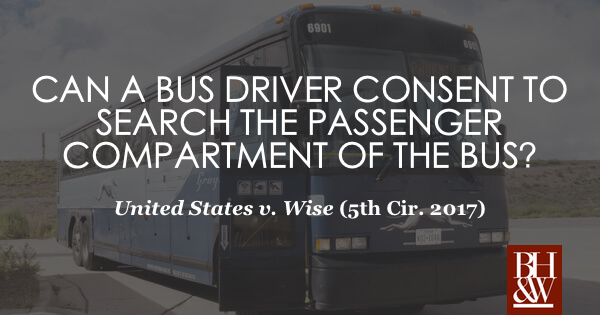
Can a Bus Driver Give Consent to Search the Passenger Compartment?

By Search & Seizure

The Case of the Not Too “Wise” Bus Passenger

United States v. Wise, 877 F.3d 209 (5th Cir. TX 2017)

Bus Driver Consent Search Wise 2017FACTS: In this case, police officers were conducting bus interdictions at a Greyhound bus stop. After a certain bus stopped, the driver got off the bus and the officers approached him requesting consent to search the passenger cabin of the bus. The bus driver consented to a search and two experienced narcotics officers in plain clothes boarded the bus. The officers did not block the exit or otherwise obstruct any of the passengers from departing the bus. One officer walked to the back of the bus while the other officer remained at the front.

The officer at the front of the bus noticed a man who was pretending to be asleep. The officer found this suspicious, because in his experience, criminals on buses often pretended to be asleep to avoid police contact. The officer walked past the “sleeping” man and turned around. The sleeping man (named Morris Wise) then turned to look back at officer, revealing that he was not asleep after all. The officer then approached Wise (now awake) and asked to see his bus ticket. Wise gave the officer a bus ticket, bearing the name “James Smith.” The officer had a hunch that James Smith was a fake name. The officer then asked Wise if he had any luggage with him on the bus. Wise said yes and motioned to the luggage rack directly above his head.

Wise then gave the officers consent to search the duffle bag in the overhead compartment. The officers did not find any contraband in the duffle bag. The officers also noticed a backpack near Wise and asked if the backpack belonged to him. Wise denied ownership of the backpack. The officers then asked the other passengers about the backpack and no one claimed it, so the officers removed the backpack at the bus driver’s request.

Outside the bus, a trained police canine alerted to the backpack. The officers then cut a small lock off the backpack, searched it, and found seven brick-type packages that appeared to contain cocaine.

The officers then went back onto the bus and asked Wise if he would mind getting off the bus to speak to the officers. Wise complied with the officers’ request and got off the bus. The officers asked Wise if he had any weapons, which he denied that he had any weapons, and then they asked him to empty his pockets.

From his pockets, Wise gave the officers his ID card with bearing the name “Morris Wise” and a lanyard with several keys attached to it. Not surprisingly, one of the key opened the lock that the officers had to cut off of the backpack (that Wise said was not his). The officer then arrested Wise, and the government charged him with several drug-related offenses.

Motion to Suppress the Search as the Fruits on an Illegal “Checkpoint Stop”

Wise filed a motion to suppress the evidence as a violation of his 4th amendment right against unreasonable searched and seizures. The district court held that the officers’ conduct in searching the bus constituted an unconstitutional checkpoint stop. In addition, the district court held that the bus driver did not voluntarily consent to the officers’ search of the luggage compartment where the backpack was located. As a result, the district court suppressed all evidence the officers seized after the stop.

The government appealed to the Fifth Circuit Court of Appeals.

First, the court held that the district court incorrectly characterized the officers’ bus interdiction as an unconstitutional checkpoint. The court noted that the Supreme Court’s cases involving checkpoints involve roadblocks or other types of conduct where the government initiates a stop to interact with motorists. In this case, the officers did not require the bus driver to stop at the station. Instead, the driver made the scheduled stop as required by his employer, Greyhound. In addition, the officers only approached the driver after he had disembarked from the bus, and the driver voluntarily agreed to speak with them. The court concluded that the interaction between the officers and the driver was better characterized as a “bus interdiction.”

Second, although Wise had a reasonable expectation of privacy in his luggage, the court held that as a passenger, Wise did not have a reasonable expectation of privacy in the luggage compartment of the commercial bus. As a result, the court concluded that Wise had no standing to challenge the officers’ search of that compartment, to which the bus driver consented.

Third, the court held that the officers did not seize Wise, within the meaning of the Fourth Amendment, when they approached him, asked to see his identification, and requested his consent to search his luggage. Instead, the court concluded that Wise’s interaction with the officers was a consensual encounter because a reasonable person in Wise’s position would have felt free to decline the officers’ requests or otherwise terminate the encounter.

Finally, the court held that Wise voluntarily answered the officer’s questions, voluntarily emptied his pockets, and voluntarily gave the officer his identification and keys.


Dangerous Weapon Enhancement

Federal Sentence Enhanced for Presence of Dangerous Weapon Even Though the Defendant Had No Knowledge of the Weapon

By Sentencing

Should a defendant charged with possession of drugs be punished for a “dangerous weapon” found at the scene of the drug trafficking and owned by a co-conspirator, when he did not know about the gun in the first place?

Dangerous Weapon EnhancementThe Federal Fifth Circuit Court of Appeals thinks so.  See the Court’s opinion in United States v. Guerrero.

On September 5, 2012, police were investigating a ranch in McAllen, Texas as a possible stash house for drug-trafficking. Officers observed Adrian Rodriguez-Guerrero coming and going from the ranch along with three other men in a caravan. When the officers stopped the caravan, “because the vehicles appeared weighed down,” a dog alerted to the presence of drugs. The police found “boxes of limes with bundles of marijuana concealed among the limes.” The defendants subsequently consented to a search of the McAllen ranch. (I’m always left wondering why people, especially those in possession of drugs, consent to a search.) “There the [police] found…clothing…a loaded shotgun and 125 shotgun shells…plastic cellophane, limes, packing tape…lime boxes, latex gloves, a large scale, and several bundles of marijuana.” In a written statement accepting responsibility, Rodriguez-Guerrero said he was hired to do landscaping at the residence, but was asked to “load the marijuana into a truck at the [ranch]…acknowledg[ing] the [ranch] as a stash house [for drugs].”

Conspiracy to Possess and Distribute Marijuana Enhanced for Possession of a Dangerous Weapon

At trial, he pled guilty to conspiracy to possess with intent to distribute 100 kilograms or more of marijuana, receiving a “guidelines-range sentence of 104 months” imprisonment and four years of supervised release. His sentence included a two-level enhancement for possession of a dangerous weapon—the shotgun found at the McAllen ranch. The district court noted, “[the Court] is not finding Rodriguez-Guerrero possessed the shotgun; rather, it was reasonably foreseeable…that there would be a weapon involved in…the… drug trafficking crime.” The district court added, “the shotgun was a tool of the trade and it [is] reasonably foreseeable to [Rodriguez-Guerrero] that there would have been a weapon, especially [to] a person with the experience that he has in drug trafficking.” Rodriguez-Guerrero appeals to the Fifth Circuit Court of Appeals, stating that there was no evidence to support a finding that either he or a co-conspirator possessed the shotgun—possession which lengthened his prison sentence.

U.S. Federal Sentencing Guidelines Application When a Dangerous Weapon is a “Tool of the Trade”

The United States Sentencing Guidelines Manual provides a two-level sentencing enhancement if “a dangerous weapon was present, unless it is clearly improbable that the weapon is connected with the offense.” U.S.S.G. § 2D1.1(b)(1), cmt. n.11(A). “The government must prove weapon possession by a preponderance of the evidence…[and can do so] by showing a temporal and spatial relationship of the weapon, the drug trafficking activity, and the defendant.” United States v. Zapata-Lara, 615 F.3d 388-90.

Here, the Fifth Circuit Court reasons, the McAllen ranch was a stash house for drug-trafficking, used to “package and transport marijuana.” The ranch was a warehouse to store and move drugs, not a residence “in which drugs were also stored.” Next, several bundles of marijuana were found in the ranch’s master bathroom, making it “plausible [the Court reasons] to find that either Rodriguez-Guerrero or another co-defendant accessed the master bedroom, where the shotgun was found.” Further, the rounds of ammunition suggest that the gun was connected with the drug trade. Lastly, the gun and rounds of ammunition were found on the same day that police observed Rodriguez-Guerrero and the co-defendants at the ranch.

The Court concludes that the “facts identified by the [district] court plausibly establish a temporal and spatial relationship between the weapon, the drug-trafficking activity, and Rodriguez-Guerrero.” The purpose of the sentencing enhancement is to punish because of increased danger and violence when drug traffickers possess weapons. U.S.S.G. § 2D1.1(b)(1), cmt. n.11(A). “The mere fact that a weapon cannot be attributable to any specific drug trafficker does not decrease the danger of violence.” Even though Rodgriguez-Guerrero may not have possessed shotgun, or that he may not have known about the shotgun is irrelevant. The Court states, “there was [sufficient] evidence to support that the weapon must have been possessed by one of the conspirators in furtherance of the conspiracy.”

In short, the Court says that establishing the “temporal and spatial” relationship is enough for possession in these types of drug trafficking cases; and, possession of a weapon could lead to enhanced, or increased prison sentences in federal courts.

No Solicitors or Drug-Sniffing Dog!

By Warrantless Search

The Legality of Drug-Sniffing Dog Searches

Let’s face it, nobody really likes uninvited guests on their front porch, unless, of course, it is the time of year when the Girl Scouts are selling cookies or little trick-or-treat monsters are out and about.  Aside from that, I’m not too keen on having people drop by unannounced, especially if that person is trying to investigate a crime or conduct a search and seizure.

The United States Supreme Court recently considered a case involving an unannounced (and unwelcome) furry visitor to a man’s front porch.  The question presented was this:  Is a dog sniff at the front door of a suspected drug house by a trained narcotics detection dog a Fourth Amendment “search” requiring probable cause?

In a 5-4 decision authored by Justice Scalia, the Supreme Court said YES, the use of the drug-sniffing dog was an unreasonable search.

Florida v. Jardines, 133 S. Ct. 1409 (2013)-  In 2006, the Miami-Dade Police Department received an unverified tip that marijuana was being grown in the home of respondent Joelis Jardines.  One month later, police took a drug-sniffing dog to Jardines’s front porch, where the dog gave a positive alert for narcotics.  Officers obtained a search warrant, which revealed marijuana plants inside the home.  Jardines was charged with trafficking in cannabis.

At trial, Jardines moved to suppress the marijuana plants on the ground that the canine investigation was an unreasonable search.  The trial court granted the motion but the Florida Third District Court of Appeal reversed.  On a petition for discretionary review, the Florida Supreme Court quashed the decision of the Third District Court of Appeal and approved the trial court’s decision to suppress, holding that the use of the trained narcotics dog to investigate Jardines’s home was a Fourth Amendment search unsupported by probable cause, rendering invalid the warrant based upon information gathered in that search.

The Supreme Court of the United States granted certiorari, limited to the question of whether the officers’ behavior was a search within the meaning of the Fourth Amendment.  The Court held that the front porch of a home is part of the home itself for Fourth Amendment purposes.  While custom typically permits a visitor to approach the home “by the front path, knock promptly, wait briefly to be received, and then leave,” it does not allow a visitor to engage in investigative activity such as bringing a trained drug dog on the porch and allowing it to sniff around for incriminating evidence.  Therefore, the government’s use of trained police dogs to investigate the home and its immediate surroundings was a “search” within the meaning of the Fourth Amendment.

To learn more about Police Canine Training, check out our friend and trainer Steve Scott at Scott’s Police K9 in North Texas.

Another Dog Scent Lineup Case Overturned

By Dog Scent Lineup

The Court of Criminal Appeals does not like dog scent lineup evidence.  While it has not come right out and declared such evidence categorically inadmissible (like polygraph evidence), it seems pretty close.  With each new dog scent lineup case, we learn how unreliable this type of evidence can be.

In Winfrey v. State, the CCA overturned a capital murder conviction wherein the evidence included a dog scent lineup.  The Court noted that the dog scent lineup along with the remainder of the evidence (all of it circumstantial) was only enough to raise a “suspicion of guilt,” but not enough to prove guilt beyond a reasonable doubt.  The CCA overturned the conviction as being legally insufficient.

*Anytime we have a case involving a drug dog, we employ an expert consultant to review the dog handling technique of the officer. One of the best drug dog experts in Steve Scott with Scott’s Police K9 LLC in Flower Mound, Texas.

Warrantless Search with GPS Device

By Warrantless Search

New Case from the 5th Circuit (Federal):  United States v. Andres, 2013 U.S. App. LEXIS 143 (5th Cir. Tex. Jan. 3, 2013)

Synopsis:  In December 2009, federal agents conducting an investigation into a large drug trafficking operation installed a GPS device underneath a pick-up truck, with a trailer attached to it, while it was parked on a public street after it had been loaded with twenty kilos of cocaine. Federal agents monitored the truck’s movements as it drove toward Chicago.

The agents contacted the Illinois State Police, gave them information about the truck, and told them they would like to have the drugs discovered during a traffic stop so they would not have to disclose the existence of a federal investigation. After being provided GPS information on the truck, a police officer saw it on an interstate highway and began to follow it.

The officer conducted a traffic stop on the truck for improper lane usage and improper lighting after he saw the trailer was swaying back and forth within its lane and its taillights were flickering.  After the officer wrote a warning ticket, he asked Appellant to get out of the truck so he could talk to him about the taillight problem.

After inspecting the electrical connection between the truck and trailer, the officer handed Appellant his clipboard so he could sign the ticket.  While Appellant was signing the ticket, the officer asked him where he was coming from.  Appellant told the officer he was coming from Joliet, but the officer knew this could not be possible based on the surveillance the officers had been conducting.  The officer also noticed that Appellant had begun to fidget and move his feet and arms around very nervously.  When the officer asked Appellant if he had any drugs in the truck, he said, “No” and then consented to a search with a drug dog.  The drug dog alerted and the officers found twenty kilos of cocaine hidden in the truck.

Appellant argued the drug evidence should have been suppressed because the initial traffic stop was a pretext and not based on any actual traffic offense.  Even if the traffic stop was valid, Appellant claimed the officer’s continued questioning and dog search were not reasonably related to the original reasons for the stop.

First, the court held the officer was justified in stopping Appellant based on the traffic violations he saw.  Second, the court held the officer’s continued seizure of Appellant after the reason for the initial traffic stop ended was supported by reasonable suspicion.  It was reasonable for the officer, who had stopped Appellant for a safety violation concerning his trailer, to ask him to get out of his truck to look at the trailer and discuss the problem.  In addition, the officer’s question, asking Appellant where he was coming from, occurred before the officer had finished dealing with the traffic offenses and did not extend the scope or duration of the stop. Appellant’s untruthful answer created reasonable suspicion that justified his continued detention, which ultimately led to the officer receiving consent to search the truck.

Appellant also argued the warrantless placement and use of the GPS device to monitor the movements of his truck violated the Fourth Amendment in light of the United States Supreme Court decision in U.S. v. Jones, decided in 2012. The Fifth Circuit Court declined to rule on whether warrantless GPS searches are per se unreasonable.  Even assuming a Fourth Amendment violation had occurred, the court held the evidence should not be suppressed in this case because in December 2009, it was objectively reasonable for agents in the Fifth Circuit to believe that warrantless GPS tracking was allowed under circuit precedent.

A Couple of Troubling Cases: Drug Dogs and Consent Searches

By Warrantless Search
The following cases were reported to me as “interesting cases,” but I would reclassify them as “troubling” (especially the second one).  We might just see these again sometime soon if the CCA decides to hear them.
 
Duration of traffic stop not unreasonable, despite officer’s remark that the purpose of checking passenger’s license was to “buy time” until the K-9 dog arrived.
Campbell v. State, 2012 WL 3201923 (Tex.App.-Tyler Aug 08, 2012) (NO. 12-11-00324-CR)
Quoting from the opinion: “Appellant contends that the true purpose of the stop ended when he was cleared of any outstanding warrants at 12:44 a.m. In his brief, Appellant points out that the evidence indicates that (1) the officers did not smell marijuana in the vehicle, (2) [officers] discussed that Appellant and [passenger] were calm, but that their demeanor might change when the K–9 unit arrived, and (3) [officer] remarked that [other officer] was just buying some time by talking to [passenger]….We initially note that [officer’s] remark concerning [other officer’s] ‘buying time’ is troubling.  But the trial court was not required to examine [the] statement in a vacuum.  The officers were justified in checking whether there were any outstanding warrants for [passenger]….The traffic stop may have concluded more quickly if the officers had requested information on outstanding warrants for Appellant and [passenger] at the same time.  But the officers were under no obligation to investigate the situation in any particular order.”
D’s consent to house search deemed “voluntary,” despite presence of twenty officers on D’s property and a police helicopter hovering overhead.
 
Schield v. State, 2012 WL 3228829 (Tex.App.-Hous. (1 Dist.) Aug 09, 2012) (NO. 01-11-00466-CR, 01-11-00467-CR)
Quoting from the opinion:  “‘An environment of few or many officers is significant in determining the validity of a consent to search,’ and the Court of Criminal Appeals ‘has been critical of consent given in the face of numbers of armed officers.’….We find this case distinguishable…Appellant was behind a tall privacy fence on his property when [officer] called and asked him to come to the front of the property….[I]n Lowery, one of the officers had a pistol drawn, and at least five officers were inside the apartment before the seventeen year-old gave verbal consent, but here only two officers, with no guns drawn, approached the middle-aged Appellant at his gate to ask for consent….Appellant further testified that none of the officers yelled at him and that he made small talk with the officers before they asked him to sign the consent form.”