
Tag

DWI

“There They Are Right There!” – A Defective Terry Stop

ByInvestigative Detention

The propriety of a Terry stop (a.k.a. investigative detention) can be, and often is, a hotly contested issue during pre-trial suppression hearings and on appeal.  I’ve written about the legal standard required for a Terry stop many times, but one can never get enough Terry law, so here it is again, complete with case citations, as recited by the 2nd District Court of Appeals (Fort Worth):

A temporary or investigative detention is a seizure.  Francis v. State, 922 S.W.2d 176, 178 (Tex. Crim. App. 1996); Josey v. State, 981 S.W.2d 831, 838 (Tex. App.—Houston [14th Dist.] 1988, pet. ref‘d).  An investigative detention occurs when an individual is encountered by a police officer, yields to the officer‘s display of authority, and is temporarily detained for purposes of an investigation.  Johnson v. State, 912 S.W.2d 227, 235 (Tex. Crim. App. 1995).  Because an investigative detention is a seizure, reasonable suspicion must be shown by the officer to justify the seizure.  State v. Larue, 28 S.W.3d 549, 553 n.8 (Tex. Crim. App. 2000).

An officer conducts a lawful temporary detention when he has reasonable suspicion to believe that an individual is violating the law. Ford, 158 S.W.3d at 492.  “[T]he police officer must be able to point to specific and articulable facts which, taken together with rational inferences from those facts, reasonably warrant that intrusion.”  Davis v. State, 947 S.W.2d 240, 242 (Tex. Crim. App. 1997) (quoting Terry v. Ohio, 392 U.S. 1, 21, 88 S. Ct. 1868, 1880 (1968)).  The articulable facts must show unusual activity, some evidence that connects the detainee to the unusual activity, and some indication that the unusual activity is related to a crime. Martinez, 2011 WL 2555712, at *2.  Articulable facts must amount to more than a mere inarticulate hunch, suspicion, or good faith suspicion that a crime was in progress. Crain v. State, 315 S.W.3d 43, 52 (Tex. Crim. App. 2010).

In State v. Kerwick, a recent case designated for publication by the 2nd COA, the Court was called upon to consider whether the trial court abused its discretion when it suppressed the evidence of a defendant’s warrantless arrest.  The arresting officer had been dispatched to the Stockyards after a brawl was reported outside a bar.  When he arrived, an unidentified person pointed at a group of people in a car and said “There they are right there.”  The car was pulling away when the officer approached on foot and ordered the driver to stop.  The driver was later arrested for DWI.

The Court of Appeals agreed with the trial court (or at least found that the ruling was not outside the reasonable zone of disagreement) that the officer did not have “reasonable suspicion” to justify the Terry stop when the only facts he had were that a brawl was reported and an unidentified person said “There they are.”

While I agree that the officer did not have reasonable suspicion to justify the stop in this case, I think this case really hinged on the trial court’s initial ruling.  The standard of review (abuse of discretion – outside the zone of reasonable disagreement) is very deferential and had the trial court ruled for the State, it would not be hard to imagine the appellate court upholding that ruling as well (with the exact same facts).  Perhaps an obvious observation on my part.
CCA Upholds DWI Search Warrant, Overturns Lower Courts

BySearch & Seizure

In a recent case, the Texas Court of Criminal Appeals, encourages trial judges to take off the hypertechnical blinders and consider the totality of the circumstances when reviewing the propriety of search warrants and their accompanying affidavits.

State v. Jed Jordan – (29 June 2011) Judge Womack writing for a unanimous court:

An affidavit for a DWI search warrant to search an accused’s blood began with a statement that the officer had “good reason to believe that heretofore, on or about the 6th day of June, 2008, [the suspect] did then and there commit [the offense of DWI.] The affidavit then went on to describe the specific conduct that the suspect exhibited that gave rise to the DWI arrest. However, when describing the conduct, the officer did not state that the conduct also occurred on the 6th of June, 2008. The magistrate issued the warrant and blood was drawn indicating that the suspect had, indeed, driven while intoxicated.

At trial, the court suppressed the results of the blood test, ruling that the DWI search warrant was deficient as it failed to allege the specific date and time the officer observed the conduct giving rise to the arrest. The 3rd District Court of Appeals (Austin) affirmed.

The CCA took the time in its opinion to distinguish prior caselaw on this subject and held:

The observations of driving and intoxication described in the second part of the affidavit were the elements of the offense alleged in the first part of the affidavit (where the time of the offense was alleged). Under the circumstances of this case, it was a reasonable inference that the observations occurred on the same day that the offense was alleged to have occurred. We therefore hold that the Court of Appeals erred in failing to consider the totality of the circumstances contained within the four corners of the affidavit in reviewing the magistrate’s basis for determining probable cause.

The CCA went on to do some “math for lawyers” that was apparently missing at the trial level:

We also find that the magistrate had a substantial basis for determining probable cause despite the failure of the affiant to specify that time of the stop. Because the warrant was issued on June 6th at 3:54 am, less than four hours could have elapsed between the observation of the offense, and the issuance of the warrant.

Calling on the trial court (and the 3rd Court below) to focus on the totality of the affidavit, the CCA remanded the case to the trial court, where, they might just have themselves a DWI trial after all.

Blood Draw by a Police Officer: Bridging a Supreme Court Gap

ByDWI

In Schmerber v. California, 348 U.S. 757 (1966), the U.S. Supreme Court held that a warrantless blood draw constitutes a search and seizure under the Fourth Amendment. The Court also laid out the two-part test for determining the legality of the search:

1) Whether the police were justified in requiring [the suspect] to submit to a blood test; and
2) Whether the means and procedures employed in taking [the suspect’s] blood respected relevant Fourth Amendment standards of reasonableness.

Schmerber, however, involved a blood draw performed by medical personnel at a hospital according to acceptable medical practice. In holding that the search was reasonable in that case, the Court conspicuously noted:

We are this not presented with the serious questions which would arise if a search involving use of a medical technique, even the most rudimentary sort, were made by other than medical personnel or in other than a medical environment – for example, if it were administered by police in the privacy of the stationhouse. To tolerate searches under these conditions might be to invite an unjustified element of personal risk of infection or pain.

Id. at 771-772 [emphasis added].

Well…what if a police officer draws the blood? At the stationhouse?

This happened in State v. Johnston.

A woman was arrested for suspicion of DWI and two Dalworthington Gardens officers drew her blood at the Dalworthington Gardens stationhouse. That the officers had a warrant did not convince the suspect to comply with the request to draw her blood. Ultimately, the officers had to strap her to a table using gauze to keep her still enough to draw her blood.

Although the officer that drew the blood was a prior EMT and had been certified by a local physician to draw blood, the trial court suppressed the blood evidence, finding that the search was unreasonable under Schmerber. Troubled by the fact that the officers did not ask the suspect for a general medical history before conducting the blood draw, the fact that the blood draw was not recorded, the fact that the suspect was restrained, and the fact that the department did not have any clear guidelines for using force during DWI blood draws, the 2nd District Court of Appeals (Fort Worth) agreed that the trial court appropriately suppressed the evidence.

The State appealed, arguing that the Court of Appeals’ interpretation was too narrow. The defendant also appealed, arguing that the Supreme Court intended a per se ban on police officers drawing blood from DWI suspects.

The Texas Court of Criminal Appeals began its analysis by recognizing that the “for the general population, the Supreme Court has determined that a blood test is a reasonable means in which to analyze an individual’s blood alcohol content.” And in this case, because there was no evidence that the suspect suffered from a medical condition that would have made another means of testing preferable, it was not unreasonable (under Schmerber) to draw the suspect’s blood.

The CCA also held that Chapter 724 of the Texas Transportation Code – the chapter that deals with the implied consent law and details who may draw a person’s blood – is inapplicable to a reasonableness determination in this case, because the officers had a warrant. The defendant argued that because a police officer is not listed as a person authorized to draw blood under Chapter 724, the blood draw was unreasonable.  Chapter 724, the CCA concluded, applies only in cases where there is no warrant.

Regarding the test for reasonableness, the CCA concluded that “the reasonableness of the manner in which a DWI suspect’s blood is drawn should be assayed on an objective, case-by-case basis in light of the totality of the circumstances. In this case, the totality of the circumstances indicate that the search was reasonable.

  •  The officer that drew the blood was a licensed EMT. (He had also been certified by a local physician, but the CCA didn’t care about that).
  • The Supreme Court (Schmerber) does not require that the draw be done in a hospital or clinic and several other jurisdictions agree.
  • The trial court concluded that the officers followed medically accepted procedures for drawing the blood.
  • The use of reasonable physical force to obtain a blood sample is permissible.

The CCA held that the blood draw performed at the stationhouse by the police officers was reasonable under the Fourth Amendment and Schmerber.   I would agree (in this case).  I wonder how many police officers (especially ones that deal regularly with DWI) are getting in line to get EMT certified now.

Trial Judge Shows Inflexible Attitude in Felony DWI Case

ByDWI, Sentencing

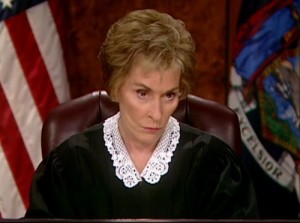
Judge in courtroom, displaying a serious expression, wearing a black robe with a white collar, with an American flag in the background, relevant to the discussion of inflexible judicial attitudes in felony DWI cases.In a felony DWI case, Gaal v. State, the defendant was set to plead guilty. When the time came for him to plead, however, he refused. The trial judge stated, “All right. We’re supposed to have a plea here today. It appears that [the defendant] does not want to plea. For the record, I will not accept any plea bargain in this matter, unless it’s for the maximum term of ten years.

The defendant later filed a motion to recuse the trial judge, contending that his statement that he would not accept a plea deal for less than the maximum, showed that he could not be fair and impartial. Another judge, at a recusal hearing, denied the request. On appeal, the 2nd District Court of Appeals (Fort Worth) held that appellant was denied due process by the trial judge’s statements and that the judge should have been recused.

The Court of Criminal Appeals now holds that the lower court got it all wrong. The CCA characterizes the trial judge’s statement not as a denial of due process.

The trial judge’s comment could quite logically and reasonably have been a short-hand rendition of a statement that it was time for the defendant to quit shilly-shallying because he has twice rejected favorable plea bargains…and was continuing to drink in violation of his bond conditions.

The CCA goes on:

A reasonable person, based on the totality of the circumstances, would translate the judge’s statements as, “I’m not going to reset this case for any more plea negotiations; we’re going to trial.”

And as the Court points out, a “defendant does not have an absolute right to enter into a plea bargain” and “the trial judge doesn’t have to take a plea bargain.”