
Tag

Violent Crimes

juvenile determinate sentencing texas

Texas Juvenile Law: What is Determinate Sentencing?

By Juvenile

Determinate Sentencing Can Extend the Life of a Texas Juvenile Case

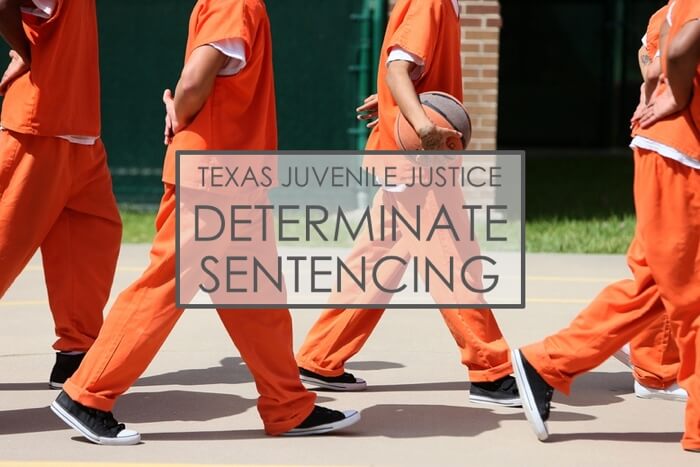
juvenile determinate sentencing texasIn the Texas juvenile justice system, a juvenile court has jurisdiction over a youthful offender if he or she is under the age of 17 at the time an offense is committed. The punishment for an offense typically can only last until a juvenile’s 19th birthday. We are often asked, “What happens if the juvenile is convicted of a serious offense? Is it possible for the court to impose a sentence that extends beyond the juvenile’s 19th birthday?” That is where Determinate Sentencing comes in. This post explains what Determinate Sentencing means and how it can impact a juvenile case.

What is Determinate Sentencing in Texas Juvenile Law?

Determinate sentencing creates a hybrid system whereby juveniles who have been adjudicated for severe criminal offenses are given a sentence that begins in the Texas Juvenile Justice Department (“TJJD”) and can potentially be transferred to the Texas Department of Criminal Justice (“TDCJ”) for a term of up to forty years.

Who requests a Determinate Sentence?

The prosecution has sole discretion as to whether to seek a determinate sentence. If the prosecutor decides to pursue a determinate sentence, he or she must file a petition indicating a child engaged in delinquent conduct with the court. Then, the prosecutor must present that petition to the grand jury for approval. If the petition is approved, then it becomes a determinate sentence case. However, if the petition is denied by the grand jury, the State’s only recourse would be to pursue the case as normal.

If a juvenile is adjudicated of a determinate sentence, then the judge or jury can assess an appropriate disposition, or punishment, in accordance with the determinate sentence range of punishment. This range is up to 40 years for a capital felony, first degree felony or an aggravated controlled substance felony, up to 20 years for a second degree felony, and up to 10 years for a third degree felony. Misdemeanors and state jail felonies are not eligible for determinate sentence under the Determinate Sentence Act.

Once the prosecutor’s request for a determinate sentence has been granted by the grand jury, he or she retains the power to later waive determinate sentencing so long as this occurs before the juvenile has been adjudicated. This often occurs in the course of plea negotiations, when the prosecutor offers an indeterminate sentence in exchange for the juvenile’s acceptance of the plea.

For indeterminate disposition, only the judge may assess punishment. However, for determinate sentence cases, the juvenile may choose either the judge or jury to assess disposition. If the juvenile would like the jury to decide punishment, he or she must file a written request with the judge prior to voir dire.

To what offenses can Determinate Sentencing apply?

Section 53.045 of the Texas Family Code provides a list of offenses that are eligible for determinate sentencing. Those offenses include:

  • habitual felony conduct;
  • murder;
  • capital murder;
  • manslaughter;
  • aggravated kidnaping;
  • sexual assault;
  • aggravated sexual assault;
  • aggravated assault;
  • aggravated robbery;
  • injury to a child, elderly individual or disabled individual;
  • felony deadly conduct involving discharging a firearm;
  • certain offenses involving controlled substances;
  • criminal solicitation;
  • indecency with a child;
  • criminal solicitation of a minor;
  • attempted murder or attempted capital murder;
  • arson, if bodily injury or death is suffered by any person by reason of the commission of the arson;
  • intoxication manslaughter, and criminal conspiracy.

What is the impact of a Determinate Sentence?

A juvenile who has been adjudicated of a determinate sentence will either be sentenced to placement in the TJJD or placed on probation.  In each case, the juvenile court retains jurisdiction over the juvenile up until the juvenile turns eighteen or nineteen.  For crimes committed before September 1, 2011, the juvenile remains in the juvenile system until his or her eighteenth birthday.

Juveniles who receive probation can be on probation for up to 10 years, which may extend past the time the juvenile reaches adulthood. When a juvenile on determinate sentence probation ages out of the juvenile system, the probation automatically expires unless the prosecutor requests a transfer hearing prior to the juvenile’s nineteenth birthday. If a transfer hearing is requested and held, the juvenile judge will decide whether to transfer the juvenile into the custody of an adult criminal court. If the request for transfer is granted, the county’s adult probation department would supervise the juvenile for the remainder of his or her probation.

The alternative to probation is for a juvenile to be sentenced to TJJD with the possibility of transfer to TDCJ. In this situation, the judge or jury imposes a sentence of a set number of years that may extend past the age of adulthood. A juvenile is required to complete a minimum length of stay at TJJD. Once he or she has completed that minimum length of stay, TJJD can parole the juvenile, if they choose. For those juveniles who are unable to complete their minimum length of stay prior to aging out of the juvenile system or who are not participating in TJJD programs or progressing satisfactorily towards rehabilitation, TJJD can request a transfer hearing. The transfer hearing, if requested, must be heard by the original juvenile judge who heard the case and it must take place prior to the juvenile’s 19th birthday. After hearing evidence at the hearing, the judge will then decide whether the youth should be transferred to adult prison to complete his or her sentence or whether the youth can be safely released on parole without putting the public safety at risk.

Texas Juvenile Crimes Defense Attorneys | Free consultation

Contact the Texas juvenile defense attorneys at Barnett Howard & Williams PLLC for a FREE consultation of your juvenile case. It is best to contact an attorney at the outset of a juvenile case. Do not wait until after you have attended a meeting with the district attorney. Call today!


Texas Police Protection Act

New Law To Increase Penalties for Violence Against Police Officers

By Legislative Update, Police Violence

Texas Governor, Greg Abbott, Proposes Police Protection Act, Which Would Stiffen the Punishment for Violence Against Law Enforcement

Texas Police Protection ActOn Monday, Governor Greg Abbott called on both citizens and Texas lawmakers to get behind his proposed Police Protection Act in the 2017 legislative session. “While our state and the nation continue to mourn the heroes lost in Dallas, it is time for us to unite as Texans to say no more,” says Governor Abbott. The proposed legislation will strengthen penalties against those who are convicted of crimes where police officers are the target. Just this month alone, five Dallas police officers have been fatally shot and nine others injured when a shooter targeted police following a public demonstration. This past weekend, three Baton Rouge police officers were gunned down by a shooter who was also targeting law enforcement officers.

The purpose of the Police Protection Act (the “Act”) is to “make clear to anyone targeting law enforcement officials that their actions will be met with severe justice.” Under the proposed Act, Governor Abbott will extend hate crime protections to law enforcement officers, increase criminal penalties for any crime in which the victim is a law enforcement officer, whether or not the crime qualifies as a hate crime, and create a culture of respect for law enforcement by organizing a campaign to educate young Texans on the value that law enforcement officers bring to their communities, among other provisions. “At a time when law enforcement officers increasingly come under assault simply because of the job they hold, Texas must send a resolute message that the State will stand by the men and women who serve and protect our communities,” says Governor Abbott.

Governor Abbott’s proposed Act would make the police a protected class, where penalties for those perpetrating crimes against law enforcement would be increased incrementally. For example, assaults on police officers could be reclassified from Class C felonies to Class B felonies, and so on. Further, the Act will support efforts by Texas State Senator, John Coryn, and his proposed “Back the Blue Act,” which makes it a federal crime to kill, attempt to kill, or aspire to kill a police officer.

In recent weeks, lawmakers in other states have also made legislative provisions that protect police in the wake of the officer-targeted shootings. In North Carolina, Governor Pat McCrory signed a bill into law this week that makes dashcam video and bodycam footage exempt from public record, except under narrow sets of circumstances. In May, Louisiana Governor John Bel Edwards signed the “Blue Lives Matter” bill into law that makes an assault on veterans, police officers, emergency responders, and firefighters a possible hate crime. Louisianans convicted of misdemeanor hate crimes against officers will be fined $500 and face an additional sentence of up to six months.

In Texas, word of Governor Abbott’s proposed Act is already gaining favorable ground. Grimes County Sheriff Donald Sewell emphatically states, “The Sheriff’s Association of Texas is very pleased to hear our Governor is behind an effort to protect peace officers across our state…and we support our Governor. We look forward to working with the Governor during the 2017 legislative session to pass these important protections.” Dallas Police Association President, Rob Pinkston, echoes Sewell, saying “The Dallas Police Association applauds Governor Abbott’s bold plan in response to the recent wave of attacks on police officers.”

About the violence on law enforcement, Governor Abbott tweeted, “Texas is saying no more,” and, “We must unite and strengthen our commitment to protect law enforcement.” Ray Hunt, President of the Houston Police Officer’s Association says, “Governor Abbott’s solution is the right approach for Texas law enforcement officers and the people of Texas who support them.” Texas lawmakers will review the Police Protection Act in the 2017 legislative session, which begins January 10, 2017.


Texas 3G Offenses and the Impact on Sentencing and Parole

By 3G Offenses

Article 42.12 Section 3(g), Texas Code of Criminal Procedure | 3G Offenses in Texas

A feature of the Texas Criminal Code that generates frequent questions is “3G offenses.” The offenses are called 3G offenses because they were codified in section (3)(g) of Article 42.12, Code of Criminal Procedure. The code has now been updated and the 3(g) offenses are listed in Texas Code of Criminal Procedure, Section 42A.054. As a practical matter, 3G offenses are generally considered more serious crimes. Many of the crimes are “aggravated” offenses, meaning that some circumstance makes the offense worse than the base offense.

The 3G offenses are:

  • Murder
  • Capital Murder
  • Murder in specific aggravating circumstances, such as murdering a victim under 10 years of age, murder while committing another felony, murdering more than one victim, murdering a law enforcement officer or fireman acting in their official capacity, murder for hire or retaliatory murder against a judge
  • Indecency with a child by contact
  • Aggravated kidnapping–Kidnapping with the intent to hold the victim for ransom or as a hostage or with the intent to sexually or physically abuse the victim
  • Aggravated sexual assault–Sexual assault in specific aggravating circumstances, such as a victim under 14 years of age, an elderly or disabled victim, using “date rape” drugs such as rohypnol or ketamine, causing serious bodily harm to the victim or another person, or attempting to kill the victim or another person in the course of the crime
  • Sexual Assault
  • Aggravated robbery–Robbery plus threat of bodily harm, exhibiting a deadly weapon or putting an elderly or disabled individual in fear of injury or death • Sexual assault
  • Injury to a child (if offense is first degree felony)
  • Sexual performance by a child under 18 years of age
  • Criminal solicitation for commission of a capital offense (if offense is first degree felony)
  • Compelling prostitution by force, threat, or fraud or, if the victim is less than 18 years of age, by any means
  • Trafficking of persons
  • Drug offenses committed within 1,000 feet of a school, youth center, or playground or on a school bus when the defendant has previously been convicted of a similar offense
  • Burglary with the intent to commit another felony
  • Any felony where a deadly weapon is used or exhibited during the commission of the crime or during the flight from the crime–Deadly weapon includes any firearm or other device designed to cause death or serious bodily injury or capable of doing so.

The important considerations for individuals convicted of a 3G offense are the implications for their sentencing and prospects for parole. Although the laws have changed over the years as various offenses have been added to the list, the current provisions apply to any crime committed on or after September 1, 2007.


Probation or Deferred Adjudication on 3G Offenses

Under the Code of Criminal Procedure, a judge cannot accept a plea bargain for straight probation (community supervision) on a 3G offense. A judge can, however, accept a plea bargain for deferred adjudication as long as the underlying sentence for the offense is 10 years or less. Deferred adjudication is similar to probation, except the judge defers a finding of guilt for the specified time of probation, and if the defendant successfully completes the probation, the charge is ultimately dismissed and no final conviction is entered on the defendant’s record.

If a defendant exercises his right to trial on a 3G offense and is found guilty, only the jury can give probation. When a jury gives probation at trial for a 3G offense, it is considered straight probation because a final conviction of guilt is entered on the defendant’s record.

Parole on 3G Offenses

Conviction for a 3G crime also affects an individual’s prospects for parole. For any other offense, parole eligibility occurs when time served plus time for good conduct equals the lesser of 15 years or one-fourth of the sentence. However, for a 3G offense, an individual is not eligible for parole until actual time served, with no allowance for good conduct credit, equals the lesser of 30 years or one-half of the original sentence. If the original sentence was for any period less than four years, the individual is not eligible for parole until actual time served of two years.

Free Consultation with an Experienced Fort Worth Criminal Defense Lawyer

If you have been charged with a 3G offense, you need to speak with a criminal defense attorney as soon as possible. Our attorneys have years of experience handling 3G offenses in Texas. Call our team today to set up a free consultation in our Fort Worth office. We will take the time to answer your questions and help you take the next steps to protect your liberty.