
Tag

White Collar Crime

Misapplication of Fiduciary Property Texas 32.45

Misapplication of Fiduciary Property in Texas | Texas Penal Code 32.45

By White Collar

Misapplication of Fiduciary Property—What is it?

Misapplication of Fiduciary Property Texas 32.45Misapplication of fiduciary property is a charge that is aimed at protecting beneficiaries of trusts, estates, receiverships and the like. Pursuant to Section 32.45 of the Texas Penal Code, a person commits the offense of misapplication of fiduciary property by intentionally, knowingly, or recklessly misapplying property he holds as a fiduciary in a manner that involves substantial risk of loss to the owner of the property. Tex. Penal Code Ann. § 32.45(b). “Substantial risk of loss” means a real possibility of loss. Casillas v. State, 733 S.W.2d 158, 163¬–64 (Tex. Crim. App. 1986). However, the possibility need not rise to the level of a substantial certainty (which is required for theft)—the risk of loss need only be more likely than not. Id.

Who is a “Fiduciary” Under Texas Law?

The penal code sets out four distinct groups that are considered fiduciaries pursuant to Section 32.45. These include:

  • A trustee, guardian, administrator, executor, conservator, and receiver;
  • An attorney in fact or agent appointed under a durable power of attorney;
  • An officer, manager, employee, or agent carrying on fiduciary functions on behalf of a fiduciary; or,
  • Any other person acting in a fiduciary capacity.

Id. at § 32.45(a)(1).

“Acting in a fiduciary capacity” is not defined in the penal code. However, the Texas Court of Criminal Appeals determined that because “fiduciary” has such a common meaning it should be construed according to its plain meaning. Berry v. State, 424 S.W.3d 579 (Tex. Crim. App. 2014).

The plain meaning of fiduciary means, “holding, held, or founded in trust or confidence.” More notably, a person who acts as a fiduciary is one “who has a duty, created by his own undertaking, to act primarily for another person’s benefit in matters connected with such undertaking.” Gonzalez v. State, 954 S.W.2d 98, 103 (Tex. App.—San Antonio 1997, no pet.). For example, courts have held that a person acts in a fiduciary capacity “when the business which he transacts, or the money or property which he handles, is not his or for his own benefit, but for the benefit of another person as to whom he stands in a relation implying and necessitating great confidence and trust on the one part and a high degree of good faith on the other part.” Gonzalez v. State, 954 S.W.2d 98, 103 (Tex. App.—San Antonio 1997, no writ).

Additionally, a person acting in a fiduciary capacity embraces any fiduciary, including a joint adventurer or partner. Coplin v. State, 585 S.W.2d 734 (Tex. Crim. App. 1979). This does not, however, include everyday business dealings. Berry, 424 S.W.3d at 584. The Court of Criminal appeals assume such transactions are entered into for a mutual benefit and, therefore, neither party is expected to act solely for the benefit of the other. Id.

What does it mean to “Misapply” Property?

The definition of “misapply” is fairly broad under the penal code. Pursuant to Section 32.45, a person who is a fiduciary misapplies property held as a fiduciary if the person deals property contrary to:

  • An agreement under which the fiduciary holds the property; or
  • A law prescribing the custody or disposition of the property.

Evidence that a defendant aided another person in misapplying property is sufficient, pursuant to the law of parties, to convict a defendant of misapplication of fiduciary property—even if the defendant did not personally handle the misapplied funds. Head v. State, 299 S.W.3d 414 (Tex. App.—Houston [14th Dist.] 2009, pet. ref’d). Furthermore, a defendant need not receive a benefit in order to misapply property. Talamantez v. State, 790 S.W.2d 33,37 (Tex. App.—San Antonio 1990, pet. Ref’d). Nor does it matter if a defendant donated the property to charity. Little v. State, 699 S.W.2d 316, 318 (Tex. App.—San Antonio 1985, no pet.).

Therefore, misapplication can occur by an omission or failure to act where a duty to act exists. Coleman v. State, 131 S.W.3d 303, 309-10 (Tex. App.—Corpus Christi 2004, pet. ref’d).

What does it take to Prove up an Agreement?

The government must prove the defendant knew of the agreement for misapplication to occur. Amaya v. State, 733 S.W.2d 168 (Tex. Crim. App. 1986). But, similar to “fiduciary,” Section 32.45 does not define “agreement.” Thus, the Court of Criminal Appeals construes agreement according to its plain meaning. Bynum v. State, 711 S.W.2d 321, 323 (Tex. App.—Amarillo 1986), aff’d, 767 S.W.2d 769 (Tex. Crim. App. 1989). To prove up an agreement, the State must be able to demonstrate a harmonious understanding or an arrangement, between two or more parties, as to a course of action. Id. Additionally, there is nothing in Section 32.45 that requires the agreement to be in writing or proved directly. Id.

Possible Defenses?

An effective defense to a charge of misapplication of fiduciary property is mistake of fact—otherwise negating the culpability required for the commission of the offense. Section 32.45 is designed to punish intentional, knowing or reckless misapplication of property. Thus, if it can be proved that the improper use or application of the property was the result of mere negligence, by mistake of fact, the statute will not apply. Other defense vary depending on the facts of the case.

What are the Penalties?

Texas has broad laws governing the use of property by a fiduciary. The charges can range from a Class C misdemeanor to a first-degree felony, based on the amount or value of property that is “misapplied.”

According to the Texas value ladder, an offense under this section is a:

  • Class C misdemeanor if the value of the property misapplied is less than $100;
  • Class B misdemeanor if the value of the property misapplied is $100 or more but less than $750;
  • Class A misdemeanor if the value of the property misapplied is $750 or more but less than $2,500;
  • State Jail Felony if the value of the property misapplied is $2,500 or more but less than $30,000;
  • Felony of the third degree if the value of the property misapplied is $30,000 or more but less than $150,000;
  • Felony of the second degree if the value of the property misapplied is $150,000 or more but less than $300,000; or
  • Felony of the first degree if the value of the property misapplied is $300,000 or more.

Id. at § 32.45(c).

Moreover, there is also an additional enhancement (to the next higher category) if it can be shown that the beneficiary was a person 65 years or older. § 32.45(d).

When Does Misapplication of Fiduciary Property Usually Occur?

This charge can arise in several different contexts. To name a few, misapplication of fiduciary property can occur:

  • When trustees misapply trust property;
  • When the holder of power of attorney makes a gift to herself;
  • When a business partner improperly diverts funds for personal use; or,
  • When an attorney misapplies a client’s funds.

These examples demonstrate that Section 32.45 covers many situations and may result in serious consequences. Thus, if you are under investigation or have been charged with the offense of misapplication of fiduciary property, it is necessary you seek help.

Misapplication of Fiduciary Property Defense Attorneys

Our criminal defense team handles Misapplication of Fiduciary Property cases in Tarrant County, Texas and surrounding areas. If you are under investigation for w financial crime or white collar offense, contact our firm today for a free case evaluation.
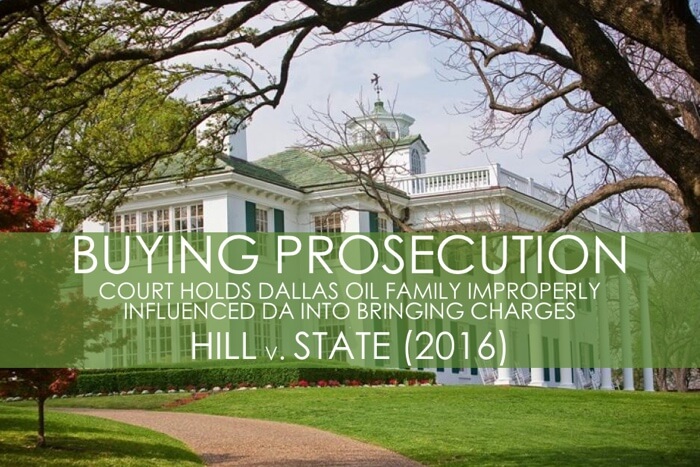

HL Hunt Mansion Dallas Hill v State

Dallas Oil Family’s Dismissal for Vindictive Prosecution Upheld on Appeal

By Criminal Defense, White Collar

How Far Does the Trial Courts Discretion Go in Determining Whether to Hold a Pretrial Evidentiary Hearing?

HL Hunt Mansion Dallas Hill v StateOn September 21st the Texas Court of Criminal Appeals issued a decision on the oil tycoon heir Albert Hill III’s criminal appeal. The question the Court faced was whether it was in the trial court’s discretion to conduct a pretrial evidentiary hearing on Hill’s motions to quash and dismiss based on prosecutorial vindictiveness. The Court determined that it was within the trial court’s discretion to conduct such a pretrial evidentiary hearing and that discretion was not limited by the defendant meeting “a certain threshold evidentiary requirement.”


Court Opinion: State of Texas v. Albert Hill (Tex. Crim. App. 2016)

The Facts | Trial Court Finds Dallas DA’s Actions Improper

Appellant Hill is the great-grandson of legendary Dallas oil billionaire H.L. Hunt and the events surrounding the indictment dealt with a multi-million dollar trust litigation between Hill and his father. Hill and his wife Erin were indicted in 2011 for making false and misleading statements in order to obtain a $500,000 mortgage from Omni American Bank. The indictment came shortly after Hill won in the trust litigation against his father. Prior to the indictment (but after Albert Hill’s victory in the trust litigation) Hill’s father’s attorney, Michael Lynn delivered a memo to the Dallas County District Attorney’s Office which alleged various offenses committed by Hill and his wife. Hill challenged these charges by filing a motion to quash the indictment and a motion to dismiss. Hill argued that the District Attorney, Craig Watkins, was under the influence of his disgruntled father as well as Lisa Blue Baron, one of Hill’s attorneys in the trust litigation case that had just filed a lawsuit against Hill seeking several million dollars in legal fees.

Some items of interest that the court noted were:

  • Lisa Blue Baron exchanged several phone calls and text messages with Watkins leading up to the indictment;
  • Michael Lynn’s law partner donated $48,500 to Watkins’ campaign prior to the indictment;
  • Lisa Blue Baron made a $100,000 donation to SMU LAW in Watkins’ honor after the indictment;
  • Lisa Blue Baron also held a fundraising event for Watkins’ campaign at her house and made a $5,000 donation to the campaign.

The trial court held an evidentiary hearing on Hill’s motions and granted both the motion to quash and the motion to dismiss.

The Court of Appeals Reversed the Trial Court’s Decision

The Fifth Court of Appeals reversed the trial court’s dismissals holding that the trial court “erred in conducting a hearing on Hill’s motion to dismiss.” The State argued that the trial court should not have held a pretrial evidentiary hearing because Hill failed to prove, with evidence, a prima facie case of prosecutorial misconduct and vindictiveness. The Court of Appeals stated that before a pretrial evidentiary can be held for a defendant claiming a violation of his constitutional rights, the defendant must “present facts sufficient to create a reasonable doubt about the constitutionality of his prosecution.” The Court of Appeals found that Hill did not sufficiently meet this standard.

The Court of Criminal Appeals Disagrees with the Court of Appeals, holds that Trial Courts Have Sound Discretion to Conduct a Pretrial Evidentiary Hearing

1. Article 28.01 – The CCA points to Article 28.01 in determining that the trial court had the discretion to hold a pretrial hearing on Hill’s motions to quash and suppress. Article 28.01 §1 provides that a trial court “may set any criminal case for a pre-trial hearing” and that some of things that the pre-trial hearing shall be to determine is the “pleadings of the defendant,’ ‘exceptions to the form or substance of the indictment,’ or discovery.’” Article 28.01 §1(1), (2), (4), (8). Additionally, while Article 28.01 does not expressly provide for an evidentiary hearing on a motion to dismiss like it does for a motion to suppress, the Court determined that it would be a misapplication of the rules of statutory construction to decide that oral testimony cannot be used in a pretrial hearing to resolve any other issue raised.

2. Case Law – The Court supported its Article 28.01 decision with the Court’s decision in Neal v. State which held that a defendant is required to “preserve a complaint of vindictive prosecution by filing a pretrial motion to quash and dismiss.” 150 S.W.3d 169. With that decision in mind the Court said “it would make no sense to limit the trial court’s discretion to hold an evidentiary hearing on such motion.”

The State pointed to federal case law that provided defendant must make a prima facie case that raised a reasonable doubt. However, these cases dealt with the issue of whether the trial court erred by denying a pretrial hearing. Thus, the Court stated that this case law is not on point in Hill’s case and thus are not controlling on this issue, and do not persuade the Court to hold otherwise.

Decision of the Criminal Court of Appeals | The Trial Court’s Discretion is Not Limited

The CCA determined that Article 28.01 has no limiting factor on the judge’s discretion to hold a pretrial evidentiary hearing based on any threshold evidentiary standard. Accordingly, the trial court did not err in conducting the pretrial evidentiary hearing in Hill’s case but instead acted within its bounds of sound discretion.

Court Sets Aside Fraud Conviction Based on the Meaning of One Common Word in the Statute

By Fraud

What does it mean to cause someone to fraudulently execute a document?

Roger and Aaron Liverman filed separate mechanic’s lien affidavits with the Denton County clerk, claiming that they had worked on Katheryn Payne’s home and had not been paid. The county clerk filed and recorded the liens, which is the customary practice. The mechanic’s liens were determined to be fraudulent, and the Livermans were charged with securing the execution of documents by deception. The Livermans were convicted and placed on community supervision.

On appeal, the court of appeals reversed the Livermans’ convictions. The State appealed to the Court of Criminal Appeals. Because the case turned on an interpretation of statutory language, the CCA reviewed the case de novo; in other words, rather than reviewing the reasonableness of the lower court’s decision, the CCA made its own independent decision based on the facts and the statute.

OpinionLiverman v. StateTexas Court of Criminal Appeals 2015

The language of the statute under which the Livermans were convicted states that a person commits a crime if, “with intent to defraud or harm any person, he, by deception causes another to sign or execute any document affecting property or service . . . .” The case before the CCA boiled down to three questions: (1) What does the term “execute” mean in the statute? If nothing was executed, there was no offense. (2) Did the Livermans’ action of filing the fraudulent liens meet the definition of execution? (3) Who actually executes a mechanic’s lien when it is filed? The offense involves deceptively causing “another” to sign or execute a document. If the clerk’s actions constituted execution, the Livermans might be guilty. If the Livermans executed the affidavits themselves by filing them, then they could not be convicted under the statute.

Arguments against Fraudulent Execution of a Document

The State and the Livermans put forward a number of arguments for their respective positions. The arguments involved comparing the “sign and execute” language of the statute with a related provision that uses the phrase “file and record;” consideration of the legislative intent and history when the statute was enacted; and which action actually perfected the liens. After reviewing the arguments and performing its own analysis, the CCA concluded:

(1) The term “execute” means more than just to sign a document and involves the broader act of bringing a document to its final, legally enforceable form.

(2) When the Livermans filed the affidavits with the clerk, the affidavits accomplished their role in perfecting the mechanic’s lien. Therefore, the act of filing the affidavits was equivalent to execution.

(3) Because Texas law requires the person claiming a mechanic’s lien to “file” the affidavit, then the Livermans did execute the affidavits by filing them. However, the CCA considered whether the clerk’s actions might also constitute execution. Although the county clerk is required by law to record or index a filed affidavit, the clerk’s failure to do so does not invalidate the lien. If the clerk’s action of recording or indexing can be omitted and the affidavit still be valid, then the clerk’s actions clearly did not “execute” the affidavits.

But, asked the Court, did the clerk “execute” the affidavits by accepting them when the Livermans filed them? The CCA answered in the negative. The statutory requirement to file the affidavit “with the county clerk” means that the clerk is simply the recipient of the filing and plays no role in its execution.

Because no action of the clerk executed the affidavits, the CCA held, the Livermans did not cause “another” to “execute” the documents as required for the offense of which they were convicted. The CCA agreed with the court of appeals, with the result of setting aside the Livermans’ conviction.

Many people will recall President Bill Clinton’s grand jury testimony in the Monica Lewinsky case. When asked why he wasn’t lying when the told his aides that there was nothing going on between him and Miss Lewinsky, the President said “[i]t depends on what the meaning of the word ‘is’ is.”

While many will find the President’s response amusing, a Criminal Defense Attorney in Fort Worth may see an opportunity. Although not nearly so salacious as the Monica Lewinsky affair, the Livermans’ case truly turned on what the meaning of the word “execute” is.

A Criminal Defense Attorney in Fort Worth will understand and appreciate the nuances of the statutory language and may succeed in acquittal by arguing that the law does (or does not) say what it seems to say.

The Wide Net of Forgery in Texas

By Forgery

To the average person, the offense of Forgery probably doesn’t sound like something that occurs on a regular basis. The term “forgery” usually conjures up the image of a shady artist carefully recreating some poor, unsuspecting victim’s signature and then passing themselves off using the victim’s identity. While an act like this most certainly would be forgery, the offense in Texas actually encompasses a broad range of activities and, because of that, it is much more common than most people realize.

The definition of forgery is laid out in Sec. 32.21(b), which states that,

a person commits an offense if he forges a writing with intent to defraud another.

Simple enough, right? Not quite. The simple definition of forgery begs multiple questions. For instance, what is the definition of “forge?” And, what is the definition of “writing?” This is where the net gets bigger.

The legislature defined “forge” in Sec. 32.21(1) to include a wide range of acts. These include altering, making, completing, executing, or authenticating any writing with the intent to defraud in addition to issuing, transferring, registering the transfer of, passing, publishing, or otherwise uttering a writing that is forged. What is a “writing” you ask? Well, the legislature decided to stretch the net even further by defining a writing as a printing or any other method of recording information as well as money, coins, tokens, stamps, seals, credit cards, badges, trademarks, symbols of value, right, privilege or identification.

Most forgery cases in Texas deal with the writing or passing of forged checks or fake currency. Occasionally, we see cases involving credit or debit cards charged as forgery (although there is another offense in the code more accurate to charge these types of offenses). While we see quite a few of these more common offenses involving checks, I can’t say that we’ve ever seen as case of forgery involving publishing a symbol of privilege with the intent to defraud.

But, as you can see the net is wide and I’m sure someplace, sometime one of those exotic forgery fishes will be caught up in the State’s tangled web.

Identity Theft in Texas

Girlfriend Destroys Expectation of Privacy in Identity Theft Case

By Identity Theft

Identity Theft in TexasAfter being convicted of aiding and abetting mail fraud and aggravated identity theft, Lonnie Oliver Jr., challenged his convictions on appeal, arguing that federal agents conducted an illegal search of the contents of a cardboard box that his girlfriend provided to them and that his statements to police officers were involuntary.


See the full opinion in United States v. Oliver  (5th Circuit, 2011)

Mr. Oliver left an unsecured cardboard box, which contained ample evidence of his identity theft operation, in the dining room of his girlfriend’s apartment. When agents interviewed his girlfriend, she gave them the box, but did not tell them she had already examined its contents.

Does a person have a Reasonable Expectation of Privacy in the contents of a box that was not kept private from his girlfriend?

The court held that the girlfriend’s prior search of the box destroyed Appellant’s reasonable expectation of privacy in it, and rendered the subsequent warrantless police search permissible under the Fourth Amendment. The court stated that the girlfriend’s search made the agents’ warrantless search permissible, regardless of whether the agents knew about it. The court cautioned that his holding was limited to the unique facts of this case and was not intended to expand significantly the scope of the private search doctrine.

Does a waiver of Miranda Right to remain silent need to be in writing?

Appellant also argued that incriminating statements he made to the agents during his custodial interrogation should have been suppressed, claiming that he had not waived his Miranda rights. After agents arrested Appellant, they advised him of his Miranda rights and provided him two forms. Appellant signed the first form acknowledging that he understood his rights, but he refused to sign the second form waiving those rights. Nevertheless, Appellant told the agents that he wished to answer their questions and he confessed to his role in a mail fraud and identity theft scheme.

The Court explained that suspect may waive his Miranda rights if the waiver is made voluntarily, knowingly and intelligently. The mere refusal to sign a written Miranda waiver does not automatically make subsequent statements by a defendant inadmissible. The court held that the circumstances surrounding Appellant’s arrest and interview established that Appellant’s waiver was voluntary, even though he refused to sign the wavier form. Specifically: (1) agents provided Appellant with a copy of the Miranda warning waiver form and read it aloud to him as he followed along, (2) Appellant expressly told the agents that although he would not sign the Miranda waiver form, he would discuss the fraud scheme, (3) Appellant never requested an attorney, (4) Appellant was articulate, coherent and not under the influence of alcohol or drugs, and appeared to understand what was going on, (5) Appellant clearly understood his rights since he signed the first form that acknowledged this, and he had extensive experience with the criminal justice system, and (6) Appellant was not coerced in any way during the interview.