
Tag

Community Caretaking

Community Caretaking Function Texas

Community Caretaking Function: Police May Stop without Reasonable Suspicion

By DWI

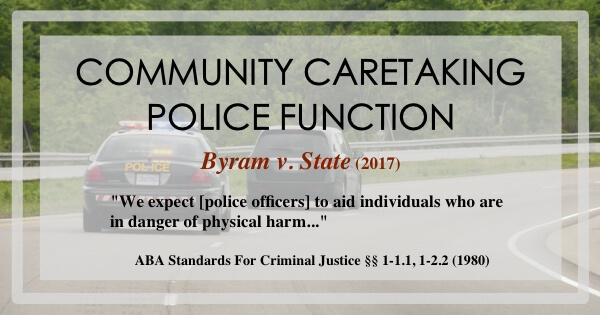
Community Caretaking Function TexasIn November of 2015, we wrote about State v. Byram, a DWI case out of Tarrant County. In Byram, the 2nd Court of Appeals held that a “hunched over” passenger in a vehicle was not enough to invoke the police “community caretaking” function to allow the police to initiate a traffic stop without reasonable suspicion of a violation.  The 2nd Court reversed the DWI conviction and remanded the case back to the trial court. The State appealed this decision to the Texas Court of Criminal Appeals, which issued its opinion today.

When May the Police Invoke the “Community Caretaking” Function to Make a Stop or Detention Without Reasonable Suspicion?

Byram v. State (Tex.Crim.App. 2017)

In this case, State argued that the police officer was engaged in his “community caretaking” function when he pulled the driver over. The State contends that this was a proper exercise of police authority and that the primary purpose of the stop need not be to investigate any alleged violation.

Reviewing the facts in the light most favorable to the trial court’s ruling (denying the suppression motion), the CCA agreed with the State and explained its view on the Community Caretaking function:

Local police officers frequently engage in “community caretaking functions,” totally divorced from the detection, investigation, and acquisition of evidence relating to the violation of a criminal statute. Cady v. Dombrowski, 413 U.S. 433, 441 (1973). “As part of his duty to ‘serve and protect,’ a police officer may stop and assist an individual whom a reasonable person—given the totality of the circumstances—would believe is in need of help.” Wright v. State, 7 S.W.3d 148, 151 (Tex. Crim. App. 1999). However, because the reasonableness of a community-caretaking seizure sprouts from its dissociation from the competitive enterprise of ferreting out crime, “a police officer may not properly invoke his community caretaking function if he is primarily motivated by a non–community caretaking purpose.” Corbin v. State, 85 S.W.3d 272, 276-277 (Tex. Crim. App. 2002).

The Court went on to lay out a two-step test for determining whether an officer may properly invoke his community-caretaking function:

  1. whether the officer was primarily motivated by a community-caretaking purpose; and
  2. whether the officer’s belief that the individual needed help was reasonable.”*

*The standard for reasonableness is no different when the officer stops a vehicle to check the welfare of a passenger rather than the driver. Wright, 7 S.W.3d at 151.

In this particular case, the CCA held, “[the officer] saw a woman in a precarious situation, and acted reasonably to help her by first asking whether she was okay, and then conducting a traffic stop when his
question went unheeded. This is the sort of ‘sound, commonsense police work that reason
commends, rather than condemns.'”


Community Caretaking Fort Worth

“Hunched Over” Passenger Not Enough Distress to Invoke the Community Caretaking Exception

By Criminal Defense, DWI

Community Caretaking Fort WorthWhile conducting a preventative patrol on the Fourth of July in 2013, a Fort Worth police officer stopped at a red light beside Cameron Byram’s vehicle. Both vehicles had the windows rolled down. The officer testified at trial that he noticed a female passenger in Byram’s car “hunched over…[and that he]…didn’t see any movement at all [from] the female.” The officer smelled alcohol coming from Byram’s car, and felt Byram was “not attending to the female passenger.” The officer shouted over to Byram, asking if she was alright, but Byram faced forward and drove away when the light turned green. Believing the female passenger needed medical attention, coupled with Byram’s actions “as an attempt to avoid contact with the police,” the officer stopped Byram’s car to conduct traffic stop. The officer checked on the passenger and called for medical attention, which she later refused. Next, the officer investigated and arrested Byram for driving while intoxicated (DWI). The officer testified that Byram had not committed a traffic offense, nor were there any technical violations on Byram’s car—he only stopped the car to perform a safety check.

Byram v. State (2nd Court of Appeals – Fort Worth, 2015)

***UPDATE – This case was REVERSED by the Texas Court of Criminal Appeals in 2017. See opinion.

After his motion to suppress the evidence for the DWI charge was denied, Byram entered a guilty plea. The trial court assessed punishment at ninety days in jail and a $750 fine, but suspended the sentence, placing him on community supervision for eighteen months. Byram appealed.

The issue before the Fort Worth Court of Appeals is whether the community caretaking exception to the Fourth Amendment applies to the facts of the case, or, whether the police officer had reasonable suspicion to stop Byram.

The Fourth Amendment provides a safeguard against unreasonable searches and seizures. U.S. Const. amend. IV; Wiede v. State, 214 S.W.3d 17, 24 (Tex. Crim. App. 2007). A warrantless arrest is considered unreasonable unless it fits into an exception, such as the community caretaking exception. Minnesota v. Dickerson, 508 U.S. 366, 113 S. Ct. 2130, 2135 (1993); Torres, 182 S.W.3d at 901. A search or seizure “is not unreasonable” when community caretaking is the goal, however, the exception is “narrowly applied” in the “most unusual of circumstances.” Wright, 7 S.W.3d at 152.

“Courts consider four non-exclusive factors in determining whether the officer’s belief that the defendant needed help was reasonable: (1) the nature and level of the distress exhibited by the individual; (2) the location of the individual; (3) whether or not the individual was alone or had access to assistance other than that offered by the officer; and (4) to what extent the individual, if not assisted, presented a danger to himself or others.” Corbin v. State, 85 S.W.3d 272, 277 (Tex. Crim. App. 2002).

First, the Court of Appeals concludes that the passenger did not exhibit distress. “The passenger did not appear to be in any great distress, she was located in a busy area of town where there were nearby hospitals, she was not alone [in the car], she was in public, and she did not appear to be a danger to herself or others.” Further, the Court of Appeals states, “We…cannot conclude that the…community caretaking exception, when applied to a hunched over passenger…indicates that the passenger presented a danger to herself or others.”

Second, the Court of Appeals determines that the officer lacked reasonable suspicion to be able to perform a safety check. “[While] we do not question the good faith of [the officer’s] subjective suspicion that Byram might have been involved in an alcohol-based offense…so long as consumption of alcohol is not illegal…permitting…investigation of persons for alcohol-based offenses solely on whether the odor of alcohol is present invites unwarranted police intrusions.” Byram’s traffic stop violated his Fourth Amendment rights.

Justice Sue Walker dissents, stating the passenger was exhibiting signs of distress because she “was not moving and appeared unconscious.” The passenger was also in a vehicle driven by a man “who appeared unconcerned about her well-being.” The passenger’s access to assistance was doubtful because Byram did not respond to the police officer’s question about her condition. Lastly, the passenger was a danger to herself because she appeared unresponsive and unable to ask for help. “Thus, all four factors…support the reasonableness of the officer’s belief that she needed assistance.”

Law enforcement officers must abide by local, state and federal procedural and substantive laws when conducting traffic stops and arrests. If you or a loved one is facing DWI charges or traffic violations, please contact our office today for a free consultation at (817) 993-9249.

Searching for Evidence or Community Caretaking?

By Community Caretaking

Handgun SearchUnited States v. McKinnon, 2012 U.S. App. LEXIS 7806, May 8, 2012

An officer stopped the car Appellant was driving because it had an expired registration sticker.  The officer arrested Appellant after he could not produce a valid driver’s license.  Based on the Houston Police Department’s (HPD) towing policy, the officer ordered the car to be towed.  During the “inventory search,” the officer found a handgun under the driver’s seat.  At trial, Appellant moved to suppress the handgun as being the fruit on an unlawful search in violation of the Fourth Amendment, arguing that:

[the officer’s] inventory search violated his Fourth Amendment rights because (1) the inventory search was merely a pretext for searching for evidence related to the burglaries that had recently taken place in the neighborhood where McKinnon was stopped; and (2) the inventory search was conducted pursuant to a policy that provided HPD officers with impermissible discretion in deciding when to tow a vehicle.

The trial court denied the motion.

The Supreme Court has recognized that the police may seize vehicles without a warrant in furtherance of their “community caretaking” function.  This usually occurs when officers impound damaged or disabled vehicles or vehicles that violate parking ordinances or impede the flow of traffic.  As long as an officer’s decision to impound a vehicle for community caretaking purposes is reasonable, it will not violate the Fourth Amendment.

Here, the court held that the officer’s decision to have the car towed was reasonable under the Fourth Amendment.  It was undisputed that the neighborhood in which the stop occurred had experienced a series of burglaries.  Although these were house burglaries, there was nothing to suggest that the vehicle would not have been stolen or vandalized if left parked and locked at the scene.  By impounding the car, the officer ensured that it was not left on a public street where it could have become a nuisance or where it could have been stolen or damaged.

In addition, while one of the passengers possessed a valid driver’s license, the car’s registration sticker was expired, so it could not have been lawfully driven away from the scene.  Finally, the HPD tow policy provides for the towing of vehicles when the owner is not able to designate a tow operator to remove the vehicle and no other authorized person is present.  The registered owner of the vehicle was not present to designate a tow operator and there was nothing to suggest that she had authorized either of the two passengers, who were present, to operate her car.

The Court further held that HPD’s inventory search policy was constitutional.  By its clear terms, the policy is consistent with preserving the property of the vehicle’s owner while ensuring that the police protect themselves against claims or disputes over lost or stolen property and protecting the police from danger.

Community caretaking…Hmmm.  Seems like alot of things could fit under that title.  I suppose that is the point.