
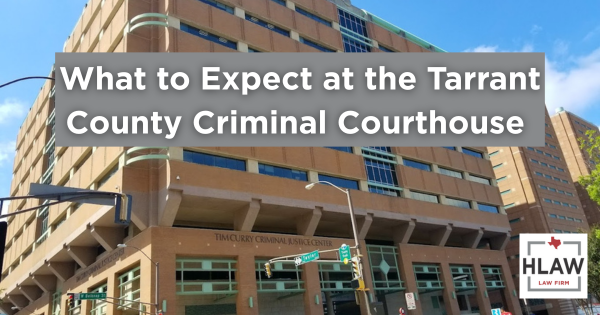
Understanding what to expect during your criminal court settings at the Tarrant County Courthouse can help reduce anxiety and prepare you for each step in the legal process.
When someone is facing criminal charges, after an arrest and getting out of jail, one of the next events that causes someone in this situation a good amount of anxiety is having to navigate through the often-foreign process of the criminal courts system. Knowing more about how this process works can ease your mind a bit and help you focus on the substance of what you and your attorney will work towards in your case.
This article aims to give you what you need to know and expect at the Tarrant County Criminal Courthouse and attending court settings.
Types of Court Settings
The Initial Appearance Court Setting (IA)
When a case has been filed by the District Attorney, a court is assigned to that case. In Tarrant County, the first thing that the court will do is set what is called an Initial Appearance (IA) court date. The sole purpose of the IA is for the court to determine what the status is of you being represented. The court is ordering you to come to the IA to either inform the court 1) whether you have an attorney or will be hiring one or 2) if you would like to apply for a court-appointed attorney. Typically, the court informs you of this setting via text message. Because most people are not familiar with what an IA is, they typically get concerned about having to go to court for this and assume that something more significant is going to take place in this setting. However, the IA is not a trial, and not a setting where anything other than addressing a person’s attorney situation is addressed.
The good news is that if you hire an attorney before this setting, then the attorney should enter a Letter of Representation with the court. Once the court receives that Letter of Representation, then the court will typically cancel that setting and reset the case to a later date to allow time for the attorney to obtain discovery and start working on your case.
The IA is a formal setting and if you receive notice to be at court and you haven’t retained an attorney, you must attend this setting. Important: For any setting notice that you receive from Tarrant County, you must be there unless notified otherwise by the court or your attorney. Failure to appear to court after being notified of a setting can and will result in a warrant being issued for failure to appear.
Routine Court Settings (Pre-Trial, Evidence Exchange, Motions Docket)
After the IA has either been rescheduled or held, then you should have an attorney (either by retaining one or by receiving court-appointed counsel). From that point, the court will set routine settings approximately every 30 days (although this time period varies depending on the size of the court’s dockets at a given time). Some courts have different names for these settings and will schedule them in different orders. In general though, regardless of whether the setting is called a pre-trial setting, evidence exchange, or even sometimes a motions docket, these settings all typically proceed in the same manner (explained below).
At all of these settings, the Judge, you, your attorney and the State’s prosecutor assigned to your case will be present for court. And, at any of these settings the case can be disposed of either by way of a dismissal or guilty plea. If a guilty plea is worked out, then you will go in front of the Judge with your attorney to formalize the plea and conclude the case. If a dismissal is obtained, then the prosecutor can file their Motion to Dismiss with the Judge on any of these settings as well. If further negotiations are going to be required and nothing is resolved, then the court will continue to move the case forward by resetting the case to the next setting to continue to give your attorney and the State an opportunity to resolve the case without having to set the case for trial.
Status Conference and Trial Settings
As the case moves through the order of settings, the court will not allow the case to simply be reset over and over again inevitably. In general, a case will be given around 3 settings before the Court sets the case for what is called a Status Conference setting. The Status Conference setting is regarded as the final setting before the case is set for trial and is the setting where the Court is looking for either the case to be pled out or set on a trial docket.
If the case is not either dismissed or pled, then the court will set the case for a Trial docket. The routine settings and status conference setting generally proceed in the same manner (explained below). The Trial Setting is unique and is the setting that most people think of as far as what Court looks like from what they’ve seen on television and movies.
Again, for all court settings that you receive notice of, you must be present or the court will issue a warrant for failure to appear. You should keep in close contact with your attorney regarding all settings to confirm the setting. Sometimes things do change, and your attorney should have a direct line to the court to be able to confirm that the setting is scheduled and to confirm that you will be required to come to court for that particular setting.
What To Expect at Court Settings
What to Expect at Routine Court Settings and Status Conferences
At routine court settings, there are generally 20-40 people set on the same docket (list of cases scheduled for that day) all at the same time. Some people have this idea that when they go to court it will just be them and their attorney alone in the courtroom with the prosecutor and Judge. However, this is far from the case. With up to 40 (sometimes even more) people all set at the same time on the same docket, the routine court settings are often extremely crowded and busy. Your notice for your setting will typically tell you that the setting is scheduled for 8:30 or 9:00 a.m. (this too can vary). Regardless of when the setting is scheduled for, the court’s text-message notice will usually tell you to be at court an hour to an hour and a half early. The reason for this is because (with the amount of people all coming at the same time to the courthouse for docket) parking and getting to your individual court on packed elevators can significantly delay you actually getting to your court. It’s good advice to follow that direction and come to court early. The primary reason you want to do this is because the Judge in the court will often call “roll” for everyone on the docket at exactly the time when court is scheduled for (think “roll-call” like when you were in school). In addition, almost every court has you check in with the bailiff (as you will see others doing) right when the courtroom doors open (and they often don’t open them until right before the scheduled start time). The court/bailiff will note what time you have arrived at court. Being late to court can also potentially result in you being taken into custody. So, get to your setting early and immediately go into the courtroom when the doors open and check in with the bailiff that will be sitting at his/her desk in the courtroom.
We often tell our clients that their most important job for these routine court settings is to be there and be there on time. Other than that, your attorney should be taking the lead from there and will inform you on what’s going on with the case and what to expect moving forward.
During these routine settings, everyone scheduled for court will sit in the audience-portion of the courtroom while their attorney’s are speaking with the prosecutors about the cases (either in the courtroom or in a room behind the courtroom). Your attorney will usually get you after they’ve spoken with the State and take you into the hall to update you on the case. Once that is done, your attorney will update the court with the status of the case and the case will either be reset or if a plea has been worked out your attorney will go over plea paperwork and talk to you about what happens next. If the case is just going to be reset, then your attorney should inform you of this and let you know when you can go.
All routine settings and even the Status Conference setting proceed in this same general manner. However, if you attend the Status Conference and don’t enter a plea on your case, then the case will be placed on a Trial Docket for a Trial setting explained below.
What Happens at a Tarrant County Trial Setting
If the case was not resolved (by way of a dismissal or plea) during one of the routine settings, then the case will be set for Trial. You should be maintaining good contact with your attorney after the Status Conference (if the case is set for trial), because the Trial setting means that your case very likely will be actually going to trial on that date.
While courts do typically set multiple cases for trial on the same date, you and your attorney should anticipate that your case will be going to trial on that date regardless. Your attorney will be in contact with the State to gauge a little more about whether you’re the #1 case on the docket or not. But, even if you’re not the #1 case on the trial docket that doesn’t mean that the cases set in front of you won’t all get pled out leaving your case to be up for trial.
Trial will proceed on the Trial Date by way of picking the jury, opening statements, presentation of evidence and closing statements. Trial can take a day for some simple misdemeanors or it can take weeks or even months (for capital felonies). Regardless, that process starts on the day of the Trial setting and continues until a verdict (and potential sentencing) occurs in the case.
Conclusion
If you’ve never been through the criminal justice system in Tarrant County, the prospect of “going to court” can be frightening and certainly foreign. But, knowing what to expect hopefully eases some of that anxiety. Ultimately, the best way to manage this stress is to retain an experienced attorney who has the knowledge, background and communication with you to keep you informed as to what to expect every step of the way.
At the HLAW law firm, we are committed to walking side-by-side with our clients and always being mindful of the stress you’re under when facing criminal charges. We take as much time as we need to make sure you’re fully informed every step of the way and to make sure you understand the process and what to expect.
If you’re facing criminal charges, contact the HLAW firm today for a free consultation to start getting prepared for your defense and to learn what more you might need to expect at the Tarrant County Criminal Courthouse.

 Texas law sets out the statute of limitations, the period during which formal charges must be brought against a defendant for most offenses. These time periods range from two years to over twenty years, and for some offenses there is no limitation period at all. The applicable limitation period depends on the particular offense that is alleged.