

Tag

Defenses

Self Defense Deadly Force in Texas

The Castle Doctrine: Understanding Self Defense in Texas

By Self-Defense

Know your Rights and Responsibilities Before Using Deadly Force for Self Defense in Texas

Self Defense Deadly Force in TexasYou may have heard about Texas Stand Your Ground Law or The Castle Doctrine.  These ideas refer to “standing your ground” in your “castle” against intruders by using deadly force to protect yourself.  But do you know when you can use force and what kind of force can be used? Understanding the Texas gun laws is incredibly important so that you know exactly what you can and cannot do when protecting yourself or your home, car, or business.

What exactly is the Castle Doctrine? When Can Deadly Force be used for Self Defense Purposes?

In Texas, Section 9 of the Texas Penal Code provides legal justifications for the use of force in a limited set of circumstances when a person has no duty to retreat. For example, a homeowner in his own home does not have a duty to retreat and may use deadly force to protect himself against an armed intruder. This would be the same for a business owner in his place of business and a truck driver in his own truck.

Texas law provides for a justifiable defense at trial when using deadly force if the person claiming self defense:

  1. Reasonably believed the deadly force was immediately necessary;
  2. Had a legal right to be on the property;
  3. Did not provoke the person against whom deadly force was used; and
  4. Was not engaged in criminal activity at the time the deadly force was used.

What is Considered Self Defense in Texas?

Self Defense will be a justifiable defense so long as the type of force used is reasonable and necessary in the moment to protect against an attacker. A person may use force against another when they reasonably believe it is immediately necessary to protect from another’s “use or attempted use of unlawful force.” A person may use deadly force in self defense under Section 9.31 of Texas Penal Code if he:

  • Knew the intruder unlawfully with force entered into his home, vehicle, or place of employment; or
  • Was being kidnapped; or
  • The intruder was attempting to sexually assault, rob, kidnap, or murder.

What is the Difference Between Deadly Force and Threat of Force?

Threat of force is when a person displays a weapon as a threat, showing that they will use deadly force to cause death or serious bodily injury if necessary. Texas Penal Code §9.04.  Threat of Force is a precursor to the use of Deadly Force.

For example, a landowner, on his property, sees a trespasser running towards him. If the landowner decides to turn in such a way to display his holstered, loaded gun which causes the trespasser to run off the property, Texas law says this is likely a justifiable threat of force.

When is Defense of Another Person Justifiable?

A person is justified in using force or deadly force to protect a third party if he believes intervention is immediately necessary and would be justified in using force or deadly force to protect himself against the unlawful force in the same circumstance.

However, use of force is not justified if in the use of force to protect a third party, the person gets the circumstances wrong and ends up seriously injuring or killing an innocent third party.

For example, a man sees his friend in a fight and intervene by using deadly force to protect his friend and kills the third party. The man did not realize that the third party was actually using force as self defense against his friend. In this situation, the man would not be able to use defense of others as a justification for killing the third party.

Protection of One’s Own Property

Under Texas Penal Code §9.42, a person may use deadly force against another to protect land or property if:

  1. He is the owner of the land;
  2. He reasonably believes using the force is immediately necessary to prevent arson, burglary, or robbery; and
  3. He reasonably believes that the land or property cannot be protected or recovered by any other means.

Know Your Rights and Responsibilities

In conclusion, while Texas law does have a few justifications for use of force and deadly force, the justifications are only proven in a very limited set of circumstances. Further, even if a person has a justification for using force, he may still be arrested and face trial. Additionally, even though an actor may have been justified in using force, he may still face civil litigation and penalties associated with the use of force against another.

Using force for self defense purposes is a serious response and should only be used in truly dangerous and threatening situations. Texas law makes it abundantly clear that those who use force will only be justified in doing so if they meet specific criteria, given the circumstances, and acted as a reasonable person would have under the same or similar circumstances.


Fort Worth Gun Crimes Defense Attorney
Rating: ★★★★★ 5 / 5 stars
Rated By Google User
“Absolutely amazing! It was comforting to know I had a Marine veteran defending my case.”


 

Defense of Third Party Defense of Others

Defense of Third Party Not Allowed in Fort Worth Domestic Violence Case

By Domestic Violence

Defense of Third Party Defense of OthersThis week, the Texas Court of Criminal Appeals released Henley v. State. In a 4-3 decision the divided court held that the defendant was not allowed to offer “defense of a third party” as a legal argument in his assault case, because it “was not material to, nor probative of, any fact that was of consequence to the determination of this action.”

Henley v. State (Tex. Crim. App. 2016)

Henley was Charged with Domestic Violence in Tarrant County and Offered a “Defense of Others” Argument at Trial

Mr. Henley was charged with misdemeanor assault causing bodily injury to a family member (domestic violence). Henley was alleged to have pulled his ex-wife out of her car by her hair, punched her in the face several times, and hit her head against the concrete driveway.

At trial, Henley asserted a “defense of others” defense, which is an extension of the traditional self-defense argument. The rationale he provided for this defense was that he did not think his ex-wife was a fit parent because her new husband had sexually and possibly physically assaulted the children. The mother’s new husband was not present during the altercation and did not pose any immediate threat, but Henley tried to argue nonetheless that he was defending his children from being exposed to a physically and sexually abusive environment.

The trial judge did not allow Henley to present the defense of others claim and he was convicted. The 2nd District Court of Appeal (Fort Worth) reversed the trial court, holding that Henley should have been allowed to present his defense. The State appealed to the Court of Criminal Appeals.

What is the Standard to Assert Defense of a Third Party?

To claim defense of a third person, a defendant must reasonably believe his intervention was immediately necessary to protect the third person from the threat of force.

The question in this case was not, “is defense of a third person an effective defense when considered by the jury?” Rather the question was “should the defendant be allowed to bring that defense at all under these facts?”

A Divided CCA Holds that the Trial Judge Did Not Err in Denying Henley the Ability to Raise Defense of a Third Person

The slim majority said no,. Henley should not be able to bring this defense because his aim was not to offer material or probative evidence, but rather to introduce evidence of how bad of a mother. Henley’s ex-wife is, and perhaps try to finagle a jury nullification. The majority saw Henley’s attempted defense as nothing more than an attempt to circumvent the judicial and evidentiary process and try to make an emotional appeal to the jury rather than a factual one.

The dissenting judges (Keller, Hervey, and Newell) argued that the defense should have been allowed because anything thing that is of consequence to the determination of the action more probable or less probable than it would be without the evidence should be deemed relevant and therefore admissible. Further, the question of whether Henley’s defense claims were reasonable belonged to the jury not the judge. It was the jury who should decide if Henley, in fact, acted reasonably on that day in question.

What are the Implications of this Holding for the Defense of Third Person Claim in Texas?

This case demonstrates that Defense of a Third Person is not as easy as simply claiming it. There must be evidence to show that the defense is reasonable. The evidence must show that the “intervention was immediately necessary to protect the third person from the threat of force” or it could be disallowed by the trial judge. The valid defense of others is still viable; as viable as it ever was. It simply must fit the facts.

Robbery Accomplice Texas

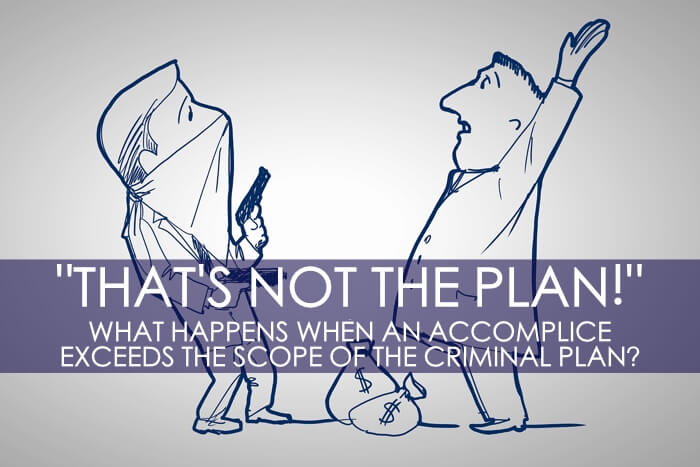
When a Criminal Accomplice Exceeds the Scope of the Agreed Plan

By Robbery

The Best Laid Plans of Mice and Men: What Happens When a Robbery Accomplice Goes Rogue?

Robbery Accomplice TexasDavis v. State (2nd COA, 2016)

Davis v. State is a case about two robberies— one a planned robbery of a convenience store, and the other of the customer inside the convenience store, a spur of the moment decision. What happens when accomplices to a well-planned robbery go “rogue” and commit additional crimes that are not part of the original plan?  Who is on the hook for their actions?

The Robbery That Didn’t Go According to Plan

Desmond Davis and two accomplices planned to rob a convenience store at night. Around 9:30pm, Davis entered the store alone and chatted with a customer. Moments later, two accomplices entered the store, pointing loaded guns at the cashier and the customer. The accomplices decided to rob the customer first, despite Davis’s instructions not to do so, “we just [came] for the store.” Davis jumped over the cash register and took money from the cash drawer. The customer dropped his cash to the floor and ran to the store’s restroom, locking the door behind him. The gunmen fled with the cash from the store and from the customer. Once the coast was clear, the store employee called 911 and locked the doors. The entire robbery was captured on a security camera. The three robbers split all of the cash among themselves after the robbery.

Shortly after Davis’s arrest, police obtained a confession after the detective told Davis, more or less, that not only could his confession be used for or against him, but that it could be used for or against him at trial. During the interrogation, the detective asked Davis to “man up” and give his side of the story, admitting his own guilt. Davis eventually made a written statement to law enforcement, admitting to his role in planning and carrying out the robbery. The interrogation and confession were captured on video.

The Case Goes to Trial – Davis is Tried for the Original Planned Robbery and the Unplanned Actions of his Cohorts

At trial, the jury convicted Davis on two counts of aggravated robbery with a deadly weapon—one count for the convenience store and one count for the customer. Davis was assessed a punishment of 30 years (for one count) and 15 years (for the other count) and a $1,000.00 fine for each count.

On appeal, Davis argued that his instructions to the accomplices not to rob the customer defeated the theft element of that robbery and thus, the record is insufficient to show his participation in the aggravated robbery of the customer specifically. Further, Davis argues that his confession was obtained under duress, in violation of the Texas Code of Criminal Procedure.

The issue before the Second Court of Appeals was to determine whether, in addition to the robbery of the store, Davis also participated in the robbery of the customer, and, whether Davis’s written confession obtained by police violated section 38.22 of the Texas Code of Criminal Procedure.

The Law in Texas – Robbery and Confessions

Robbery is an assaultive offense, where the assaultive conduct is the essence of the crime, not the theft in and of itself. Ex Parte Hawkins, 6 S.W.3d 554, 560 (Tex. Crim. App. 1999). In robbery prosecutions, the number of persons assaulted is at issue, not the number of thefts in one crime episode. Id.

Section 38.22 of the Texas Code of Criminal Procedure

When law enforcement securing a defendant’s written confession tells the defendant that the confession “could be used for or against him in court” or “for and against him in court” and that “they might go easy on him if he confessed,” the written confession becomes inadmissible because it violates section 38.22 of the Texas Code of Criminal Procedure. Sterling v. State, 800 S. W.2d, 513, 518-519 (Tex. Crim. App. 1990). Section 38.22 of the Code deals with admissibility of written confessions in court.

The Second Court of Appeals Affirms the Judgment of the Trial Court

Here, the robbers intended on stealing the money from the cash register when two of the gunmen pointed their weapons at an innocent customer and stole his money. Based on this alone, the Court says, the evidence is sufficient to support the jury’s determination “that [Davis] intended to steal the store’s money and that the [accomplices] threatened the customer while they were stealing money from the [store].” Further Davis and the accomplices shared all of the money stolen in that crime episode—there was no effort made to distribute the customer’s money to only the two accomplices. Davis participated in the store robbery. Even though he told his accomplices to not rob the customer, Davis still placed the customer in fear by waving firearms and by jumping over the counter to steal money out of the register.

Additionally, after the Court reviewed the interrogation tape, the Court “determined that the “officer told [Davis] that he had an opportunity to tell his side of the story and that he could be a man by admitting his guilt.” The officer never suggested to Davis that he would be helping his court case by admitting his guilt. The confession was, therefore, not obtained in violated of Section 38.22 of the Texas Code of Criminal Procedure.

The Court acknowledges that caselaw, such as James v. State, exists that holds that a “defendant who was merely present when his [accomplice] assaulted another was not guilty of robbery…because there was no evidence of a previous agreement to rob the [bystander],” such is not exactly the case here. James v. State, 161 S.W.2d 285, 286 (Tex. Crim. App. 1942). Davis saw the robbery of the customer taking place, and then decided to capitalize on the level of fear created to jump over the counter “and grab some money for himself.”

Who Has The Burden of Proof?

By Traffic Offenses

Does the State or the Defense have the Burden of Proof?

 – 14th Court of Appeals (Houston) 2011

Carlos Arias was observed speeding by a police officer and pulled over. Arias was unable to provide proof of financial responsibility (proof of insurance), when asked by the police officer. Arias went to trial in the municipal court of record and after the close of State’s case-in-chief, Arias claimed that there were statutory exceptions to the requirement to establish financial responsibility and that the State had not negated them.  He appealed his conviction to the County Criminal Court at Law.

Generally, when a penal statute includes an exception as part of the statute itself, the State must negate the existence of the exception in the indictment of the offense and prove beyond a reasonable doubt that the defendant or defendant’s conduct does not fall within the exception. Failing to negate an exception is the same as failing to allege an essential element of the offense and renders the indictment void. However, when an exception is in a separate section from the provision that states the offense, it is not essential for the State to negate the exception. This is different from an exception and called a defense, which must be raised by the defendant.

An “Exception” or a “Defense”

The key distinction is who has the burden of proof—an exception means the prosecution must prove beyond a reasonable doubt or the defendant should be acquitted; a defense means a defendant bears the initial burden to produce some evidence that supports the defensive theory. Once the defendant produces such evidence, the State then bears the ultimate burden of persuasion to disprove the defense beyond a reasonable doubt.  So, to be clear, the defense does not bear the “burden of proof,” but only a burden to produce some evidence of the defensive theory.  The burden then shifts to the state to disprove the defense.

The Court of Appeals found that no Texas court has determined whether the State must negate the exceptions to the financial responsibility requirement as an element of the offense or whether the exceptions are defenses that must be raised by the defendant. The Court of Appeals looked to the statute in the Transportation Code and decided if exceptions or defenses are listed. To do this they decided whether they are a necessary part of the definition or a description of the offense.

The Court first looks to the main code of “Requirement of Financial Responsibility.” They then found in a separate subsection, “Exceptions to Financial Responsibility,” which Arias relies on. The code only states that a person commits an offense if the person operates a motor vehicle in violation of the “Requirement of Financial Responsibility” section, but the exceptions are not mentioned.

The court finds that because they are not mentioned in the offense, the exceptions are therefore not a necessary part of the definition or description of the offense. This means that these are not exceptions that the State must negate, but merely defenses that the defendant has the option to bring evidence in to prove. Additionally, the State is not generally required to negate as an element of the offense matters “peculiarly within the knowledge of the defendant.” Here, these exceptions are things such as the character of the car, such as older than 25 years old. The court holds that under most circumstances, the defendant would be more likely than the State to know whether one of the exceptions applies.

This can be absolutely crucial for building your defense. An exception can get you acquitted if the State doesn’t prove beyond a reasonable doubt, whereas a defense is merely a chance to persuade the judge or jury. It appears that the key deciding factor is whether the “exceptions” are listed with the main code or are in a separate subsection.