Treatment without Labels: An Effective Program for Juveniles Charged with a Sex Crime in Tarrant County
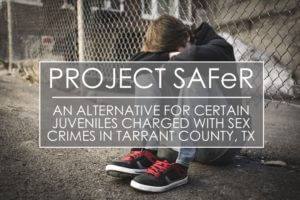 Imagine this: You receive a call out of the blue from a detective telling you that he is investigating your 11-year-old son for sexually touching your 6-year-old niece. How do you protect your young son who is being charged with Aggravated Sexual Assault of a Child? How do you choose between helping your son and helping your niece? Is there any way to get them both help without prosecuting your son? Will your son be labeled a sex offender for the rest of his life? Is there any way for your extended family to work this out?
While this may seem far-fetched, it happens more than you think. Fortunately, there is now a program in Tarrant County that can help without destroying the life of either child involved. It is called Project SAFeR.
What is Project SAFeR?
Project SAFeR (which stands for Safety and Family Resiliency) is a program in Tarrant County designed to help youth with problematic sexual behaviors who are between the ages of 7-12. There are three components to the program: legal, supervision, and counseling. The program, which started in July 2015, was created through a collaborative effort of Lena Pope Home, Alliance for Children, Tarrant County District Attorney’s Office, Child Protective Services (CPS), Tarrant County Juvenile Services, and local law enforcement. The purpose of the program is to help the victim, young juvenile, and their families deal with the problem in an effective way so that both children may go on to lead productive lives.
What is Problematic Sexual Behavior?
Problematic sexual behavior is that which is goes beyond what is normal sexual development for a child’s age. It usually involves children who are quite a bit different in age or who are not considered equals due to maturity, size, or other factors. A child with problematic sexual behaviors will act out on another child who is not a willing participant, either through the use of force, threats, bribery, or some other type of coercion or persuasion. Problematic sexual behaviors interfere with normal, nonsexual, childhood interests and behaviors, and usually continue even after a child’s behavior has been discovered and reprimanded.
The Legal Component of Project SAFeR
Because kids under the age of 10 cannot be prosecuted for their actions in Texas, children between the ages of 7-9 who have problematic sexual behaviors, can be referred to the counseling program but will not be required to participate in the diversion or supervision components. For these children, a parent can contact Lena Pope Home in Fort Worth at 817-255-2500 for help (see below for more specifics on the counseling component).
For children between the ages of 10-12, law enforcement and/or CPS will likely be involved to some extent. Many times, these cases will be referred to Tarrant County Juvenile Services and the Tarrant County District Attorney’s Office Juvenile Unit.
In order to be eligible to participate in the legal, or diversion, component of Project SAFeR, the charged juvenile must be between the ages of 10-12. If a juvenile is older than 12, he will be ineligible for the diversion program. Other eligibility requirements for the program are:
- A multi-disciplinary team must decide that the case is appropriate for inclusion in the program based on the totality of the circumstances. This team screens cases for the program while they are still being investigated by CPS and law enforcement.
- The victim’s family must agree to the charged juvenile being in the program. If the victim’s family does not agree, this alone will make the juvenile ineligible.
- A risk assessment, which will be completed by the counselors involved in the program, must show the charged juvenile to be at a low risk to reoffend.
If all of these requirements are met, a juvenile’s case will be filed with the court by the prosecutor. The child will appear before a juvenile court judge and must admit to committing the offense. The judge will make a finding that there is enough evidence to find the juvenile guilty of the offense, but the judge will instead withhold judgement on the issue of delinquency and order the child into Project SAFeR.
If the juvenile successfully completes the supervision and counseling components of the program, the prosecutor will dismiss the case. If, however, the child is kicked out of the program, then he will return to court and will be found delinquent at that time and then will proceed to the disposition, or punishment, stage of the case. A juvenile who successfully completes Project SAFeR will, as a condition of the program, be eligible to have his record sealed upon his 16th birthday.
The Supervision Component of Project SAFeR
The supervision component of Project SAFeR is provided by Tarrant County Juvenile Services. If the child is allowed into the program, he will be assigned a juvenile probation officer who is a part of the Juvenile Offender Unit. The term of supervision will be up to 6 months in length. During that time, the juvenile must complete the counseling component of the program as well as go to school, not commit any new offenses, and obey his parents/guardians. The probation officer will check in on the juvenile, as well as check with his counselor and parents, on a regular basis while in the program.
The Sexual Counseling Component of Project SAFeR
The counseling piece of the program is provided by Lena Pope Home at their Fort Worth location. Both the child charged and at least one caregiver will be required to attend all counseling sessions while in the program. The counseling is once a week (on Monday nights) for 18 weeks.
The juvenile will attend a child’s group at the same time that his caregiver is attending a parents’ group each week. The two groups will be learning the similar material at the same time. So, for instance, during the week that the juvenile is learning the sexual behavior rules, his parent will be learning how to enforce those sexual behavior rules in the home. In addition to learning about sexual behavior rules and appropriate relationships, those in the program will also learn communication skills and stress relief strategies. Both the juvenile and parent must demonstrate that they have learned and are implementing the information taught in order to successfully complete the program. The counseling is provided free of charge to those in the program.
Outcomes and Benefits of Project SAFer
While this program has only been in existence in Tarrant County for a little over a year, it has been implemented in other parts of the country for many years. The program in Omaha, Nebraska, recently completed a 10-year follow-up study on those juveniles who completed their program. They found that of those who successfully completed the program, less than 2% committed a new sexual offense. This is a much lower reoffending rate than traditional sex offending treatment programs.
The majority of those who have been accepted into the Tarrant County Project SAFeR program have graduated. Many of those parents have indicated that the information they learned in the program not only helped them handle their children’s sexual behavior problems, but it also taught them to be better parents in general. The techniques and strategies taught in the counseling component have also been instrumental in helping parents to communicate better and have better relationships with their children. It has brought these families closer together.
Project SAFeR is taking a whole new approach to treating children with problematic sexual behaviors. It starts with NOT labeling or treating them as sex offenders. It approaches the problem from a family-focused point of view and treats it as a serious problem that the family can get through together, as opposed to treating the juvenile as if he is a sex offender who is doomed for the rest of his life. If your child is between the ages of 10-12 and is facing prosecution for a sex crime in Tarrant County, ask your attorney about whether Project SAFeR is the right approach for you and your family.
About the Author
Christy Dunn is a writer and attorney licensed to practice in Texas. She was a prosecutor for 15 years. The last five years of her prosecutorial career was spent in the Juvenile Division of the Tarrant County District Attorney’s Office. She has tried over 20 juvenile cases in Texas and multiple certification hearings. She was part of the multidisciplinary team that created a Project SAFeR.

 When someone is charged with a criminal offense and is experiencing their first encounter with the criminal justice system, the process can be daunting. A first-time offender typically has two primary concerns: 1) Will I go to jail? and 2) Can I keep this offense from going on my record?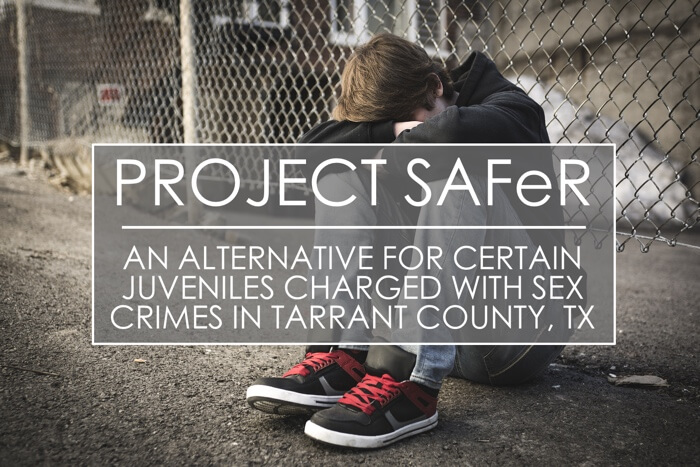

 Tarrant County has many