Tag

Lab Testing

Houston Crime Lab Scandal

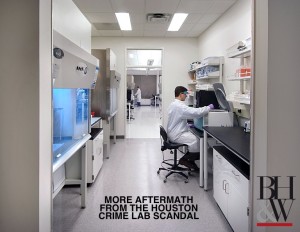
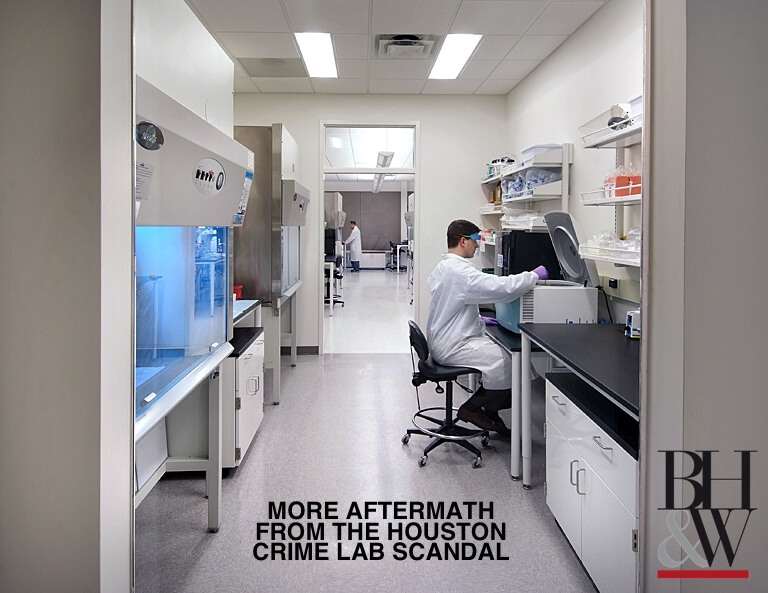
More Aftermath from the Houston Crime Lab Scandal

By Drug Crimes

CCA Says “No Relief” for Defendant Who Accepted Plea Deal, even though the Court Infers Defendant’s Lab Reports Were Falsified

Houston Crime Lab ScandalSee the CCA opinion in Ex Parte Barnaby 

Setting the Stage: The Houston Crime Lab Scandal

In January of 2012, the Texas Rangers investigated a Department of Public Safety (“DPS”) Crime Laboratory technician, Jonathan Salvador, for allegedly tampering with crime lab evidence. The Rangers questioned DPS technicians and reviewed evidence records, bringing information that pointed to Salvador’s mishandling of lab results to Harris County’s District Attorney’s office. However, after an extensive investigation, the grand jury did not indict the technician. Subsequently, the DPS Office of Inspector General issued a report, stating that Salvador “failed to properly follow laboratory protocols…misidentified substances, and dry-labbed [falsified] samples.” Following the report, Salvador was terminated from his position at the Houston Crime Lab.

The fallout from Salvador’s actions, “call…into question the veracity and reliability of many cases handled by Salvador…[and as a result courts have] granted relief on several writs of habeas corpus, finding that each case involved a presumptive violation of due process.” Ex Parte Turner, 394 S.W.3d 513 (Tex. Crim. App. 2013) (per curiam); Ex Parte Hobbs, 393 S.W.3d 780 (Tex. Crim. App. 2013) (per curiam). The Texas Court of Criminal Appeals (“CCA”) has since “retreated from a presumption that due process was violated in every Salvador case, [instead] requir[ing] a showing of falsity and materiality.” Ex Parte Coty, 418 S.W.3d 597, 605.

How to Demonstrate a Due Process Violation from the Houston Crime Lab Scandal

In order for a defendant to prove that due process has been violated, the defendant must show (1) falsity—that his evidence from the lab or lab report was falsified; and, (2) materiality—that such falsifications/false reports were material to the outcome of the guilty verdict. Ex Parte Weinstein, 421 S.W.3d 656, 665 (Tex. Crim. App. 2014).

Falsity

The defendant bears the initial burden of showing falsity; the CCA “has implemented a five-part protocol to be used when a [defendant] raises an inference of falsity.” Coty, 418 S.W.3d at 605.
A defendant shows falsity when:

  1. The technician in question is a state actor
  2. The technician has committed multiple instances of intentional misconduct in another case or cases;
  3. The technician is the same technician that worked on the [defendant’s] case;
  4. The misconduct is the type of misconduct that would have affected the evidence in the [defendant’s case]; and,
  5. The technician handled and processed the evidence in the [defendant’s] case within roughly the same period of time as the other misconduct.

Materiality

A defendant bears the burden of persuasion with regard to materiality. Id. at 606. Materiality of false evidence is measured by the impact it had on the defendant’s decision to plead guilty. Id. In cases involving plea agreements, the court examines the voluntariness of the plea—whether there is a reasonable likelihood that [the plea] affected the defendant’s decision to plead guilty, [but] not whether it affected the conviction or sentence. Id. The Court ponders questions like, “if the defendant had known that the lab reports were falsified, would he have plead guilty, or would he have gone to trial?” A plea, however, is not involuntary simply because a defendant does not correctly assess every relevant factor entering into his decision [to take the plea]. Ex Parte Evans, 690 S.W.2d 274, 277 (Tex. Crim. App. 1985); Brady v United States, 397 U.S. 742, 757 (1970). The CCA implies that the decision to “go to trial” is an indicator that the false evidence is indeed material; the decision to “take a plea deal” is a soft indicator that the false evidence is not material.

Applying this to Ex Parte Barnaby

On March 13, 2009, Kemos Marque Barnaby was stopped for a traffic offense. During the traffic stop, police smelled an odor of marijuana coming from inside the car. Barnaby was asked to exit the vehicle, and he consented to a pat-down search. With dashboard cameras rolling, a small plastic bag with white rocks, which tested positive for cocaine during a rapid field test, was found in Barnaby’s pants. The bag was delivered to the Houston Crime Lab, where Jonathan Salvador issued a drug analysis report, identifying the white rocks as cocaine. Instead of going to trial, Barnaby plead guilty to four separate offenses of possession of a controlled substance with intent to deliver in exchange for four concurrent fifty-year sentences. Barnaby appeals to the Court of Criminal Appeals, arguing that because of Salvador’s false report, his guilty plea was involuntary, and had an impact on his decision to take the plea deal.

Here, the Court examines falsity to determine whether due process was violated. Using the five-part falsity protocol, the Court says, (1) Salvador was a state actor; (2) Salvador had multiple instances of misconduct; (3) Salvador worked on Barnaby’s case; (4) Salvador’s misconduct is the type of misconduct that would have affected the evidence in Barnaby’s case; and, (5) Salvador handled Barnaby’s evidence in the same time period as the other misconduct at the Houston Crime Lab. The State conceded that Barnaby was able to raise the inference of falsity, and accordingly the Court infers that Salavador’s report in this case is false, carefully noting that an ‘inference of falsity’ is not an affirmative finding of a negative cocaine test result.

Next, the Court examines materiality to determine whether the false lab report was material to the decision to take a plea bargain and whether the value of the undisclosed information was outweighed by the benefit of accepting the plea offer. Ferrara v. United States, 456 F.3d 278, 294 (1st Cir. 2006). Here, the Court says that Barnaby, a habitual offender, was faced with four drug charges, on top of having two prior felony convictions, thus, enhancing sentencing guidelines ranging from 25 to 99 years imprisonment for each charge. On top of that, Barnaby was also charged with three additional charges of possession with intent to deliver in a drug-free zone, all of which were also enhanced to the habitual-offender statute. The plea resolved all four of those charges in exchange for four concurrent fifty-year sentences; “even if the falsity of the laboratory report had come to light…the State could have still prosecuted [Barnaby] for the three other [drug-free zone] cases. “[Barnaby’s] assertion that he would not have plead guilty had he known of the falsity of the laboratory report is unpersuasive in light of the benefit he received from the plea bargain.”

Even though the Court infers “that the laboratory report in [Barnaby’s] case was falsified, [the Court] finds that [such] falsity was not material to [Barnaby’s] decision to plead guilty,” adding that he received a benefit of a lighter prison sentence by choosing to take the plea deal. Accordingly, the Court of Criminal Appeals denies relief to Barnaby.

We’ve recently seen experienced drug lab problems in Fort Worth as well.  The problems have impacted countless drug and DWI cases in Tarrant County.  Any case that involves an outside crime lab must be scrutinized carefully by the criminal defense attorney.  While bad lab techniques (or technicians) might not mean an acquittal, but it could mean considerable relief for the defendant.


Court Rules Indigent Defendant Must Pay for Independent Drug Test

By Drug Crimes

Drug Crimes Can Come With Added Costs | Fort Worth Drug Crimes Defense Attorneys

In a pre-trial motion, Ehrke requested the trial court to provide for independent testing of the substance. Ehrke’s attorney argued that, because 1.6 grams was so close to the 0.99 gram for a lighter sentence, independent testing was justified.

The trial court agreed it was required to allow Ehrke’s counsel to inspect and examine the substance. However, because Ehrke did not demonstrate the need for the test or any reason why a second test would have different results, the judge denied the motion for independent testing. Ehrke’s counsel’s offer to secure payment for the testing did not change the judge’s decision.

The Court of Appeals agreed with the trial court. The court based its decision on Ehrke’s failure to show a particular need for independent testing or how an independent chemist would arrive at a different result.

On appeal to the Court of Criminal Appeals, the CCA identified two issues: (1) whether Ehrke had a right to inspection of the substance by an independent expert and (2) whether the state was required to pay for such an inspection.

The Court noted the Code of Criminal Procedure provided for a defendant to inspect evidence material to the state’s case, but only if the defendant showed good cause for a request to inspect evidence. However, courts had found inspection mandatory if the evidence is material to the defendant’s case.

The CCA said that in a controlled substance case, if the defendant asks to inspect the substance, the court must allow inspection because the substance will necessarily be material to the defense–no showing of good cause is required.

The CCA addressed the question of what an “inspection” entails. Obviously, simply looking at the substance, which is apparently all the trial court offered Ehrke’s counsel, would not determine either its substance or its weight. The Court stated that in a controlled substance case, the right to pay for an independent chemist to analyze the substance is absolute.

On the second issue, the CCA acknowledged an indigent defendant’s right to a court-appointed (read “court-paid”) expert but said the defendant has the burden to provide specific justification for appointment of the expert. In Ehrke’s case, the CCA said, no specific justification had been provided. Even though Ehrke’s counsel explained the rationale for his request, he did not provide any evidence to question the original analysis by the DPS chemist, did not explain how independent testing was required for his defense and did not provide information regarding the complexity of the testing. According to the CCA, an absolute right to state-funded independent testing would be too great a financial burden to the County; therefore, appointment of an expert is required only if there is some preliminary evidence of a significant issue of fact to justify the appointment.

The Court remanded the case to the trial court for proceedings on the first issue.

The bifurcated decision in this case is perplexing. The Court said chemical analysis of an alleged controlled substance will always be material to a defendant’s case and discarded the Code’s requirement of a showing of good cause, making the right to independent testing absolute.

However, in the second issue, the Court seems to have abandoned its notion of materiality for a standard of affordability. On the part of the defendant, the Court cited case law that the state is not required to provide an indigent defendant with everything a wealthier defendant might be able to afford. More importantly, the Court concluded the financial burden to the County of paying for independent chemical testing in all controlled substance cases would be too great.

Examples abound of wealthy defendants procuring a better defense than an indigent defendant.  However, if an issue is always material to an indigent defendant’s case to the point of making the right to independent testing absolute, it seems odd that the indigent defendant’s right can be defeated by fiscal concerns of the County, which is in a much better position to pay for testing.

Contact our Drug Crimes Defense Attorneys Today for a FREE Consultation of Your Case at (817) 993-9249

Our Fort Worth criminal defense attorneys are experienced in defending drug crimes cases, including possession, possession with intent to distribute, manufacture, and more. If you are under investigation or have a pending charge, don’t wait. Contact us today.

The Confrontation Clause and Testimony From a Supervising DNA Analyst

By Confrontation Clause

As Fort Worth criminal defense attorneys, we often encounter confrontation issues during trial. The Confrontation Clause of the Sixth Amendment gives a defendant the right to confront witnesses against him. This provision prevents admission of a “testimonial” statement–a formal statement similar to trial testimony–unless the person who made the statement can be cross-examined or is unavailable but was previously cross-examined (in a deposition, for example). In the absence of cross-examination, a criminal defense attorney in Fort Worth would object to admission of the statement as evidence.

In Paredes v. State, the Court of Criminal Appeals considered how the Confrontation Clause applies to DNA testimony based on computer-generated data obtained through batch DNA testing. During a robbery, two victims were shot and killed. Jovany Paredes asked Jessica Perez to wash the shirt he was wearing during the robbery. Instead, Perez gave the shirt to police, who sent it to a lab for DNA testing. DNA from blood on Paredes’s shirt matched one of the victims.

At trial, Robin Freeman, the lab director, explained that DNA testing involves four analysts. The fourth analyst interprets raw data from a computer to determine whether there is a DNA match. In Paredes’s case, Freeman herself compared the DNA profile from the blood stain to Paredes’s DNA profile. Freeman testified that she did not personally observe each of the analysts performing the first three steps but that any problem in the analysis would have been obvious. Freeman testified that the ultimate opinion was hers and that she was testifying regarding her opinion.

Paredes’s defense attorney objected, arguing that he was entitled to cross-examine the other analysts. The State said those analysts just took “physical stuff,” placed it into instruments and applied chemicals. Freeman, the State said, was the one who did the interpretation that was presented to the jury. The judge agreed with the State, and Paredes was convicted of capital murder.

The Court of Appeals affirmed, holding that Freeman’s testimony did not violate the Confrontation Clause. After the Court of Appeals decision, the CCA decided in Burch v. State that admission of a drug test lab report did violate the Confrontation Clause because the testifying witness stated that the report was a “surrogate” for the technician who performed the test. Paredes appealed based on Burch. The CCA vacated the Court of Appeals decision and remanded the case to consider whether Burch affected the decision in Paredes.

The Court of Appeals made the same decision the second time, distinguishing Paredes, where the lab director had knowledge of the tests used and conducted the crucial analysis, from Burch, where the testifying lab supervisor had not observed or performed any part of the drug test or its analysis. Because Paredes’ attorney had the opportunity to cross-examine the person who conducted the actual analysis that linked him to the crime, Paredes’ Confrontation Clause rights had not been violated.

Paredes appealed to the CCA again. The Court reviewed three U.S. Supreme Court cases involving forensic reports. In the first two cases, the Supreme Court had found the forensic reports inadmissible because only a “certificate of analysis” was presented as evidence and a testifying witness had not actually performed the test.

In the third case, a DNA case, an outside forensics specialist testified that the lab-created DNA profile matched the defendant’s DNA profile. The Supreme Court held that this evidence did not violate the Confrontation Clause.

Based on the Supreme Court cases (Melendez-Diaz and Bullcoming) and the decision in Burch, the CCA ruled against Paredes. The CCA relied on the fact that Freeman, the testifying witness, had actually performed the crucial analysis and had testified to her own conclusions. Further, the lab director had testified regarding the quality assurance system at the lab that would alert the director if the test were done improperly. The CCA also distinguished this case because Freeman had relied on raw, computer-generated data in reaching her conclusions, rather than relying on another analyst’s report. Because Paredes was given the opportunity to question Freeman regarding her opinion, the CCA held that his Confrontation Clause rights were not violated.

A Fort Worth criminal defense attorney whose client is facing forensic expert testimony will carefully consider Paredes. Challenges to DNA evidence may be more difficult, particularly if the testifying witness is the individual who actually translated the raw data into a conclusion regarding a DNA match. A criminal defense attorney in Fort Worth will carefully monitor the application of Paredes to cases with similar, yet different, facts.