
Tag

Robbery

Robbery Accomplice Texas

When a Criminal Accomplice Exceeds the Scope of the Agreed Plan

By Robbery

The Best Laid Plans of Mice and Men: What Happens When a Robbery Accomplice Goes Rogue?

Robbery Accomplice TexasDavis v. State (2nd COA, 2016)

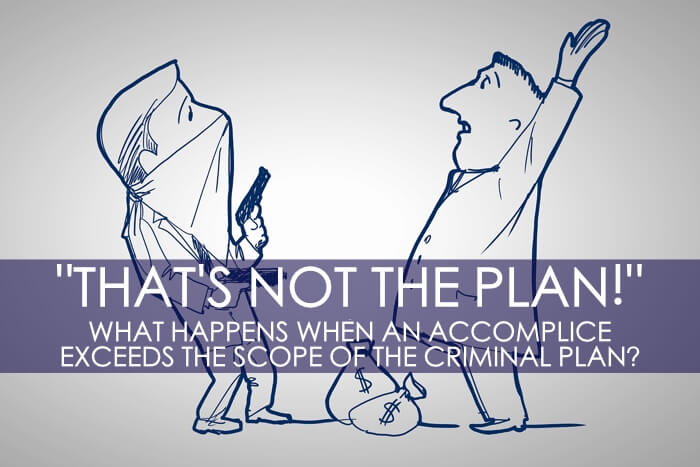
Davis v. State is a case about two robberies— one a planned robbery of a convenience store, and the other of the customer inside the convenience store, a spur of the moment decision. What happens when accomplices to a well-planned robbery go “rogue” and commit additional crimes that are not part of the original plan?  Who is on the hook for their actions?

The Robbery That Didn’t Go According to Plan

Desmond Davis and two accomplices planned to rob a convenience store at night. Around 9:30pm, Davis entered the store alone and chatted with a customer. Moments later, two accomplices entered the store, pointing loaded guns at the cashier and the customer. The accomplices decided to rob the customer first, despite Davis’s instructions not to do so, “we just [came] for the store.” Davis jumped over the cash register and took money from the cash drawer. The customer dropped his cash to the floor and ran to the store’s restroom, locking the door behind him. The gunmen fled with the cash from the store and from the customer. Once the coast was clear, the store employee called 911 and locked the doors. The entire robbery was captured on a security camera. The three robbers split all of the cash among themselves after the robbery.

Shortly after Davis’s arrest, police obtained a confession after the detective told Davis, more or less, that not only could his confession be used for or against him, but that it could be used for or against him at trial. During the interrogation, the detective asked Davis to “man up” and give his side of the story, admitting his own guilt. Davis eventually made a written statement to law enforcement, admitting to his role in planning and carrying out the robbery. The interrogation and confession were captured on video.

The Case Goes to Trial – Davis is Tried for the Original Planned Robbery and the Unplanned Actions of his Cohorts

At trial, the jury convicted Davis on two counts of aggravated robbery with a deadly weapon—one count for the convenience store and one count for the customer. Davis was assessed a punishment of 30 years (for one count) and 15 years (for the other count) and a $1,000.00 fine for each count.

On appeal, Davis argued that his instructions to the accomplices not to rob the customer defeated the theft element of that robbery and thus, the record is insufficient to show his participation in the aggravated robbery of the customer specifically. Further, Davis argues that his confession was obtained under duress, in violation of the Texas Code of Criminal Procedure.

The issue before the Second Court of Appeals was to determine whether, in addition to the robbery of the store, Davis also participated in the robbery of the customer, and, whether Davis’s written confession obtained by police violated section 38.22 of the Texas Code of Criminal Procedure.

The Law in Texas – Robbery and Confessions

Robbery is an assaultive offense, where the assaultive conduct is the essence of the crime, not the theft in and of itself. Ex Parte Hawkins, 6 S.W.3d 554, 560 (Tex. Crim. App. 1999). In robbery prosecutions, the number of persons assaulted is at issue, not the number of thefts in one crime episode. Id.

Section 38.22 of the Texas Code of Criminal Procedure

When law enforcement securing a defendant’s written confession tells the defendant that the confession “could be used for or against him in court” or “for and against him in court” and that “they might go easy on him if he confessed,” the written confession becomes inadmissible because it violates section 38.22 of the Texas Code of Criminal Procedure. Sterling v. State, 800 S. W.2d, 513, 518-519 (Tex. Crim. App. 1990). Section 38.22 of the Code deals with admissibility of written confessions in court.

The Second Court of Appeals Affirms the Judgment of the Trial Court

Here, the robbers intended on stealing the money from the cash register when two of the gunmen pointed their weapons at an innocent customer and stole his money. Based on this alone, the Court says, the evidence is sufficient to support the jury’s determination “that [Davis] intended to steal the store’s money and that the [accomplices] threatened the customer while they were stealing money from the [store].” Further Davis and the accomplices shared all of the money stolen in that crime episode—there was no effort made to distribute the customer’s money to only the two accomplices. Davis participated in the store robbery. Even though he told his accomplices to not rob the customer, Davis still placed the customer in fear by waving firearms and by jumping over the counter to steal money out of the register.

Additionally, after the Court reviewed the interrogation tape, the Court “determined that the “officer told [Davis] that he had an opportunity to tell his side of the story and that he could be a man by admitting his guilt.” The officer never suggested to Davis that he would be helping his court case by admitting his guilt. The confession was, therefore, not obtained in violated of Section 38.22 of the Texas Code of Criminal Procedure.

The Court acknowledges that caselaw, such as James v. State, exists that holds that a “defendant who was merely present when his [accomplice] assaulted another was not guilty of robbery…because there was no evidence of a previous agreement to rob the [bystander],” such is not exactly the case here. James v. State, 161 S.W.2d 285, 286 (Tex. Crim. App. 1942). Davis saw the robbery of the customer taking place, and then decided to capitalize on the level of fear created to jump over the counter “and grab some money for himself.”


Craigslist Crimes in Texas

Texas’ Online Crime Marketplace: Craigslist Crimes, Craigslist Stings, and Craigslist Thefts

By Computer Crimes, Theft

Craigslist-Related Crimes | New Crimes in the Digital Age

Craigslist Crimes in TexasGone are the days of flipping through your local newspaper’s classified section and circling your favorite ads. These days, Craigslist is the new classifieds of Fort Worth and Dallas. It is the one stop shop source to find a new car, truck, job, furniture, garage sale, or even a love interest. With the rise of Craigslist (and other online forums), there has also been an increase in criminal activity ranging from online scams to fraud and theft. Police stings based on advertisements from Craigslist are also common. Police have seen such a meteoric rise in these “Craigslist related crimes”, that many departments have established “safe exchange locations where transactions can occur under the watchful eye of local law enforcement.



Whenever people meet to engage in a transaction, crime can occur. These crimes can take place anywhere, whether you are in an urban or rural area, in the parking lot of the local shopping center, or even on your own front porch. Craigslist is easily accessible, and is increasingly used to create opportunities for one party to take advantage of another. It is essential to be vigilant whenever meeting up with anyone from the Internet.

Craigslist Criminal Investigations | Fort Worth, Texas

With the advent of Craigslist, law enforcement agencies have seen a few specific areas of criminal activity increase rapidly. These investigations into alleged crimes often facilitated by Craigslist include:

  • Craigslist Robbery: Increasingly, people will post ads on craigslist looking to buy or sell an expensive item, such as a cell phone, and when the other party arrives take either the item or the money by force. Avoid being a target by meeting buyers or sellers at a “safe exchange” location set up by the police department.
  • Craigslist Prostitution: Craigslist is full of ads looking for love, and both men and woman can get caught up in activity they may not have even realized was criminal until too late. Craigslist is used to source potential targets, and can result in charges from soliciting sex with a minor to soliciting sex for pay. Police departments are increasingly using Craigslist to set up sting operations to catch people trying to engage in prostitution.
  • Craigslist Drug Charges: Police are seeing an increase in advertisements for illegal drugs posted on Craigslist using code words. Engaging in a dialogue with someone posting one of these ads could lead police to believe you are involved in drug dealing or drug trafficking through ads placed on Craigslist.

Defending Craigslist-Related Criminal Cases

Defense of Craigslist-related criminal charges can be a very complex proposition, requiring legal counsel experienced in these types of matters and the technology it involves. Forensic Computer Specialists and other experts may be necessary to the investigation and protecting your constitutional rights. Seek counsel from experienced criminal defense attorneys at Barnett Howard & Williams PLLC, former prosecutors with an in-depth understanding of the criminal justice system and its applications in today’s Internet-oriented society.

Contact Our Fort Worth Craigslist Crimes Defense Attorneys Today!

At Barnett Howard & Williams PLLC, our attorneys understand how to investigate and defend against complex computer-related criminal charges, including Craigslist-related charges. To schedule a free consultation, contact us at our offices in Fort Worth, Texas, at 817-993-9249.


Barnett Howard & Williams PLLC
Rated 5.0 out of 5 based on
30 Google+ Reviews.

Fort Worth Court of Appeals Cheapens the Meaning of “Modus Operandi”

By Jury Trial

The general rule is that the defendant is to be tried only for the offense charged, not for any other crimes or for being a criminal generally. However, evidence of extraneous acts of misconduct may be admissible if (1) the uncharged act is relevant to a material issue in the case, and (2) the probative value of that evidence is not significantly outweighed by its prejudicial effect. Because the propensity to commit crimes is not a material fact in a criminal case, Texas Rule of Evidence 404(b) explicitly prohibits the admission of uncharged acts to prove conduct in conformity with a bad character.

Last week the 2nd District (Fort Worth Court of Appeals) considered the issue of modus operandi (i.e. criminal signature) in the case of Price v. State. In Price, the appellant had been convicted at trial of aggravated robbery after he was identified by a convenience store clerk as the African American man who entered the store armed with a crowbar and wearing a towel on his head demanding money from the cash register. The State offered evidence of other uncharged convenience store robberies as evidence of “identity” or modus operandi under Texas Rule of Evidence 404(b). Over appellant’s objection, the trial court allowed the evidence of the extraneous offenses to come in.

If you were to read only the majority opinion, you might agree that because the defense attempted to impeach the convenience store clerk on the issue of identity, the defendant opened the door to (i.e. made relevant) the evidence that there were three similar robberies done by a man in the local area. However, from Justice Dauphinot’s dissent, we learn that there was more to it than that.

Justice Dauphinot demands the majority to answer how it was that the defense opened the door to the issue of identity of when all the defense counsel did during his cross of the State’s witness was to repeat the questions that the prosecutor already asked. You see, the prosecutor in this case, in an effort to take the sting out the some of the weak points, raised the issue of identity during direct examination. How then, asks the dissenting Justice, can the prosecutor then rely on the issue of “identity” to survive a 404(b) objection to the admissibility of the extraneous offenses?

Justice Dauphinot also points out that mere “identity” is typically not enough to survive a 404(b) objection in cases like this. What the court should really be concerned with is modus operandi.

One of the main rationales for admitting extraneous-offense evidence is to prove the identity of the offender. Here, the theory of relevancy is usually that of modus operandi in which the pattern and characteristics of the charged crime and the uncharged misconduct are so distinctively similar that they constitute a ―signature. Usually, it is the accretion of small, sometimes individually insignificant, details that marks each crime as the handiwork or modus operandi of a single individual.

In this case, the majority noted that the offense at trial and the extraneous offenses were all committed by a black man. After all, how many black men can there possibly be in North Texas? The court further noted, without discussion, that the men in the extraneous offenses also wore a towel on his head. Lastly, the majority mentions that the man or men in the extraneous offenses carried a weapon. Not always a crowbar. In one offense the perpetrator carried a knife and in another he carried a steel pipe. To Justice Dauphinot, these facts are not markedly similar enough to indicate a modus operandi. In her opinion, the State did not meet its burden to show that that “the extraneous act has relevance apart from its tendency to prove character conformity.”

Aggravated Robbery Victim Not Be Present to Be Robbed

By Robbery

The Texas Court of Criminal Appeals released an opinion this month in a case where a man entered a convenience store brandishing a rifle. When the man looked around, however, he noticed that there wasn’t anyone in the store. The store clerk was in the back office watching the man on the security camera. When the clerk saw the man enter the store, he locked the office and called 911. Unable to open the cash register, the “robber” stole the clerk’s wallet and some money that was behind the counter. The “robber” never saw anyone inside the store.  Then he left.

The man was later charged with and convicted of Aggravated Robbery under Texas Penal Code Section 29.02, which provides in relevant part:

a person commits [robbery] if, in the course committing theft…and with intent to obtain or maintain control of the property, he intentionally or knowingly threatens or places another in fear of imminent bodily injury or harm.

Appellant argued that “because there was no evidence of interaction between him and [the victim], the evidence was legally insufficient to support a robbery conviction, and the conviction should be reformed to that of theft. Accordingly, the CCA was faced with a question of first impression in Texas:

Does the Offense of Aggravated Robbery Require Interaction Between the Accused and the Purported Victim?

Appellant contested that he could not intentionally or knowingly place a person in fear, if that person was unknown to him. A unanimous CCA disagreed, explaining that

‘knowingly’ does not refer to the defendant’s knowledge of the actual results of his actions, but knowledge of what results his actions are reasonably certain to cause. Using this definition, robbery-by-placing-in-fear does not require that a defendant know that he actually places someone in fear, or know whom he actually places in fear. Rather, it requires that the defendant is aware that his conduct is reasonably certain to place someone in fear, and that someone is actually placed in fear.

In this case, because Appellant brandished the rifle in the convenience store, the CCA held that his culpable mental state was not negated by the fact that the victim did not happen to be in his presence. In sum, the CCA answered the question presented in the negative.

The offense of Aggravated Robbery does NOT require interaction between the accused and the purported victim.

Read the full CCA opinion in Howard v. State.

Fort Worth
Criminal Defense Lawyer

Vote For Us