

Tag

Theft By Deception

Contractor Fraud Texas Tarrant

My Contractor Pulled a Houdini! Now what? | Construction Fraud Under Texas Law

By Fraud

Contractor Fraud Texas TarrantHave you sustained property damage in a powerful storm? If so, you probably had to call a contractor to do necessary repairs. It is sometimes customary in the construction industry for contractors to ask homeowners to pay for some of the work up front, and pay the remaining balance upon completion. Some contractors will ask you to fork over a hefty deposit to someone you do not know, yet you are trusting to get the job done. You are not alone. The good news is that most contractors will operate above the board. Even though social media reviews and ratings sites, such as Angie’s List, are sensible ways of vetting contractors and service providers in 2020, they cannot predict future white collar crimes perpetrated by individuals who are focused on scamming construction deposits out of desperate homeowners.

What Happens if Your Contractor is a Crook? | Construction Fraud in Tarrant County

What legal remedies are available to homeowners in Texas when a contractor pulls a Houdini, vanishing into thin air, cash in hand, without completing the repair work? Contractual breach is the most common civil cause of action. Generally, a contractual breach occurs when (1) there is an existing contractual agreement that is (2) performed (paid for) by one party, yet (3) the other party did not perform as agreed to, which (4) caused damages to the performing (paying) party. Material breach of a roofing contract may occur without intention, when a contractor takes too long to complete a project, or perhaps uses substandard materials, for example. This civil cause of action addresses the damages to the individual, but does not hold the wrongdoer accountable in a criminal court.

So what about those instances in which a scammer intentionally preys upon homeowners in the hopes of pocketing the cash and skipping town? Is this a criminal act?

Construction Fraud Prosecutions in Texas

Tarrant County, Texas has recently begun focusing prosecution efforts on contractor fraud. Homeowners in Tarrant County may call their local police agency to make an initial report. Additionally, homeowners may call the Tarrant County District Attorney’s White Collar Crime and Public Integrity Unit, created by Sharen Wilson, the District Attorney in Tarrant County. Wilson stated in a recent news article, “Construction fraud is a crime, and our citizens need to be protected from it.

When homeowners call the DA’s office, they will talk with a representative to see if the wrongdoing rises to the level of a complaint. If a complaint is filed, the DA’s office reviews the facts of the complaint for potential prosecutable offenses based on a variety of legal theories in criminal law. If the DA’s office finds elements of criminality, an investigation ensues which may result in criminal charges for the wrongdoer.

Construction Fraud Under the Texas Penal Code

The Texas Penal Code does not specifically provide a code section for construction or contractor fraud crimes. What are some of the legal theories and statutes the DA’s office is using to go after these home repair Houdinis? The Tarrant County DA’s office has prosecuted construction and roofing contractors who have absconded with the funds for misappropriation of fiduciary property, theft, insurance fraud, and elder financial abuse, to name a few.

Recently, the Tarrant County DA’s White Collar Crime Team prosecuted a man for theft from elderly victims. For his crimes, this man received three years in jail and an order to make restitution of $77,000.00 to his elderly victims. On multiple occasions, the man used aliases to approach homeowners in the mid-cities and Fort Worth areas, soliciting demolition and repair work. He accepted large sums of money, but never completed the work, or, did substandard work.

In January of 2019, another man pled guilty to Theft of $150,000- $300,000, for scamming 41 residents in the Arlington, North Richland Hills, and Mansfield areas, out of funds they paid him for roofing repairs. This man’s scheme involved sending employees door-to-door to sign customers up for repairs. The employees took checks from the victims, but the roofing work never began. As part of his plea agreement, the man was ordered pay the victims $230,000.00 in restitution.

Each of these types of cases is fact-specific and context-laden. Tarrant County has decided to take a strong stand against construction fraud. “We have made it a priority to put white-collar criminals on notice in Tarrant County—we will not tolerate scammers preying on our residents,” says Matt Smid, chief of the DA’s White Collar Crime Team. The county has also taken steps to provide the public with information regarding scams and fraud that is targeted at seniors. If you feel that you have been a victim of contractor fraud, you do have some options in Tarrant County.

Special Note to Attorneys who represent victims or perpetrators of constructions scams, implicating civil and criminal causes of action: Texas Disciplinary Rule of Professional Conduct 4.04(b) states that a lawyer shall not present, participate in presenting, or threaten to present criminal charges solely to gain advantage in a civil matter. According to the Texas Center for Legal Ethics, “giving notice required by law or applicable rules of practice, or procedure as a prerequisite to instituting criminal charges, does not violate the Rule, unless the underlying criminal charges were made without probable cause.

Craigslist Crimes in Texas

Texas’ Online Crime Marketplace: Craigslist Crimes, Craigslist Stings, and Craigslist Thefts

By Computer Crimes, Theft

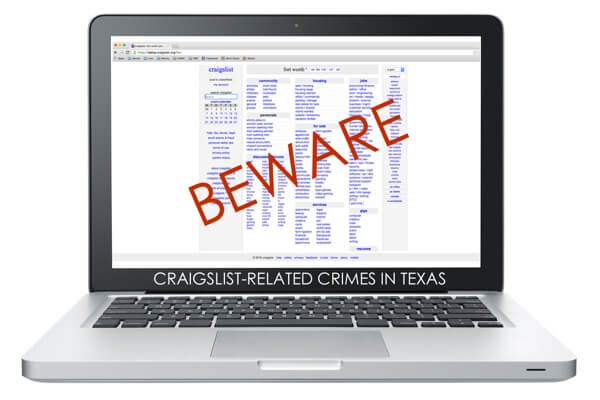
Craigslist-Related Crimes | New Crimes in the Digital Age

Craigslist Crimes in TexasGone are the days of flipping through your local newspaper’s classified section and circling your favorite ads. These days, Craigslist is the new classifieds of Fort Worth and Dallas. It is the one stop shop source to find a new car, truck, job, furniture, garage sale, or even a love interest. With the rise of Craigslist (and other online forums), there has also been an increase in criminal activity ranging from online scams to fraud and theft. Police stings based on advertisements from Craigslist are also common. Police have seen such a meteoric rise in these “Craigslist related crimes”, that many departments have established “safe exchange locations where transactions can occur under the watchful eye of local law enforcement.


Whenever people meet to engage in a transaction, crime can occur. These crimes can take place anywhere, whether you are in an urban or rural area, in the parking lot of the local shopping center, or even on your own front porch. Craigslist is easily accessible, and is increasingly used to create opportunities for one party to take advantage of another. It is essential to be vigilant whenever meeting up with anyone from the Internet.

Craigslist Criminal Investigations | Fort Worth, Texas

With the advent of Craigslist, law enforcement agencies have seen a few specific areas of criminal activity increase rapidly. These investigations into alleged crimes often facilitated by Craigslist include:

  • Craigslist Robbery: Increasingly, people will post ads on craigslist looking to buy or sell an expensive item, such as a cell phone, and when the other party arrives take either the item or the money by force. Avoid being a target by meeting buyers or sellers at a “safe exchange” location set up by the police department.
  • Craigslist Prostitution: Craigslist is full of ads looking for love, and both men and woman can get caught up in activity they may not have even realized was criminal until too late. Craigslist is used to source potential targets, and can result in charges from soliciting sex with a minor to soliciting sex for pay. Police departments are increasingly using Craigslist to set up sting operations to catch people trying to engage in prostitution.
  • Craigslist Drug Charges: Police are seeing an increase in advertisements for illegal drugs posted on Craigslist using code words. Engaging in a dialogue with someone posting one of these ads could lead police to believe you are involved in drug dealing or drug trafficking through ads placed on Craigslist.

Defending Craigslist-Related Criminal Cases

Defense of Craigslist-related criminal charges can be a very complex proposition, requiring legal counsel experienced in these types of matters and the technology it involves. Forensic Computer Specialists and other experts may be necessary to the investigation and protecting your constitutional rights. Seek counsel from experienced criminal defense attorneys at Barnett Howard & Williams PLLC, former prosecutors with an in-depth understanding of the criminal justice system and its applications in today’s Internet-oriented society.

Contact Our Fort Worth Craigslist Crimes Defense Attorneys Today!

At Barnett Howard & Williams PLLC, our attorneys understand how to investigate and defend against complex computer-related criminal charges, including Craigslist-related charges. To schedule a free consultation, contact us at our offices in Fort Worth, Texas, at 817-993-9249.


Barnett Howard & Williams PLLC
Rated 5.0 out of 5 based on
30 Google+ Reviews.
Theft By Deception Texas

Justice of the Peace Convicted of Theft By Deception for Use of Airline Voucher

By Theft

Theft By Deception?  County Official Uses Airline Flight Voucher (Purchased with Government Charge Card) to Buy a Plane Ticket for his Son.

Theft By Deception TexasIn Fernandez v. State, the Texas Court of Criminal Appeals considered the case of a Val Verde County Justice of the Peace who used an airline voucher for a flight that was unrelated to a government purpose.  The CCA discusses the offense of Theft by Deception in Texas, explaining what it means and what it doesn’t mean.  It is an interesting case because it seems so petty – the amount was only 300 dollars and some change.  Why didn’t the JP simply purchase a new ticket for his son?  Read more.

Travel Plans Arranged

James Fernandez was charged with “theft by deception” in 2012. Fernandez, serving as a Justice of the Peace in Val Verde County, wanted to travel to Orlando, Florida for a work-related conference in June of that year. After obtaining permission to travel to the conference and to use his government-issued credit card for airfare, Fernandez asked his office clerk to book the flight. The clerk made flight arrangements with Southwest Airlines.

Travel Plans Cancelled

Just before the conference, Fernandez became ill and cancelled his flight itinerary. Per Southwest Airlines’ refund policy, the airline issued a “refund-voucher” to Fernandez, in his name, valid for travel until February 2013. The refund-voucher was valued at $381.60, a dollar-for-dollar match to the amount originally paid for the ticket to Orlando.

In August, Fernandez asked his office clerk for the flight information from the cancelled Orlando trip. Once the clerk located the information, Fernandez told the clerk to give the flight reservation number to his son, Fernandez Jr.. The clerk complied.

Routine Audit Leads to an Investigation

During a routine review of the County’s flight budget, the County Auditor contacted Southwest, attempting to get a full refund of the flight. At that time the Auditor learned that the refund-voucher from the Orlando ticket had been used by Fernandez for a flight to Phoenix, Arizona in August. The auditor also learned that Phoenix flight incurred additional fees, fees that were not paid for by the county. Relying on Val Verde County’s policy that prohibits the use of county property for personal use, the auditor reported the transaction, triggering an investigation by the Attorney General.

Too Late to Repay, Fernandez Goes to Court

Soon after, Fernandez tried to pay for the airline voucher, but the auditor refused to accept his payment. Fernandez was charged with “theft by a public servant by way of deception.” At trial, Fernandez Jr. testified that his father had intended to repay the county, nevertheless, Fernandez was convicted—a conviction upheld by the Fourth Court of Appeals. Fernandez appealed to the Court of Criminal Appeals (“CCA”) for relief, arguing that State failed to prove he induced consent by way of deception at the time he misappropriated the government’s refund-voucher. The CCA must determine whether Fernandez committed “theft by deception” when he purchased online airfare for government-related travel with a government credit card, but canceled, using the refund-voucher for personal travel without “correcting the impression” that the refund-voucher would be used for future government-related travel.

What is Theft by Deception Under Texas Law?

Texas law defines theft as, “the unlawful appropriation of property with the intent to deprive the owner of the property.” Tex. Penal Code § 31.03(a). “Appropriation is unlawful if it is without the owner [of the property’s] effective consent.” Id. § 31.03(b)(1). Consent is defined as, “assent in fact, whether express or apparent,” and is “not effective if it is induced by deception or coercion.” Id. § 1.07(a)(11); §31.01(3)(A). Deception means, “failing to correct a false impression…fact that is likely to affect the judgment of another in the transaction, that the actor previously created…by words or conduct, and that the actor does not now believe to be true.” Id. § 31.01(1)(B). The burden of proof is on the State to prove “that the owner of the misappropriated property was induced to consent to its transfer because of a deceptive act of the defendant.” Geick v. State, 349 S.W.3d 542, 548 (Tex. Crim. App. 2011); Daugherty v. State, 387 S.W.3d 654, 659 (Tex. Crim. App. 2013).

The CCA Decides

Here, the CCA explains that “consent” is a key issue—that the initial consent Fernandez received from his office to use the government credit card to make the flight reservation was not the consent that is the basis of the conviction. Rather, it was the consent Fernandez obtained when he asked his clerk to send the information to his son, “because without the voucher number, Fernandez would have been unable to access the [information]” to book the flight to Phoenix. Further, the county, by way of its agent [the clerk], assented to the refund-voucher’s use because the agent gave the cancelled flight information to Fernandez and his son in August.

Moreover, the CCA says that the consent was obtained through deception. Fernandez established with his office that he would be attending a work-related conference in June, thus creating the impression that county funds were being used for a work-related purpose. Once the flight was cancelled, the refund-voucher that was issued is to be considered the county’s property, “just as the ticket to Orlando had been [considered county property].” Fernandez failed to correct the impression that he was using the ticket/refund-voucher for work-related travel, instead using the refund-voucher for personal travel without telling anyone in the Val Verde County’s business office. “By remaining silent, [Fernandez] left intact the impression he created…that the [refund-voucher] would be used for county-approved travel.” The CCA affirmed the decisions rendered by the trial and appeals courts.

Judge Johnson filed a concurring opinion that simplified the majority’s opinion. “When [Fernandez] failed to…tell the county….that he had not used the original ticket…and [did not] surrender the voucher, [Fernandez] failed to correct the impression of appropriate travel on county business that he had previously created.” This alone was the deception that is required to support the conviction.

_______

Barnett Howard & Williams PLLC is a criminal defense law firm in Fort Worth, Texas.  Our criminal defense attorneys handle all felony and misdemeanor offenses in Tarrant County and surrounding areas.  For more information about our attorneys, visit our Firm Profile page.