All Posts By

Brandon Barnett

Brandon Barnett is a partner and criminal defense attorney with Barnett Howard & Williams PLLC in Fort Worth, Texas. His law practice is exclusively focused on misdemeanor and felony criminal defense in Tarrant County and surrounding areas. He is also a military judge in the Marine Corps Reserve and a law professor at Texas A&M University School of Law.

Cell Phone Images Character Evidence

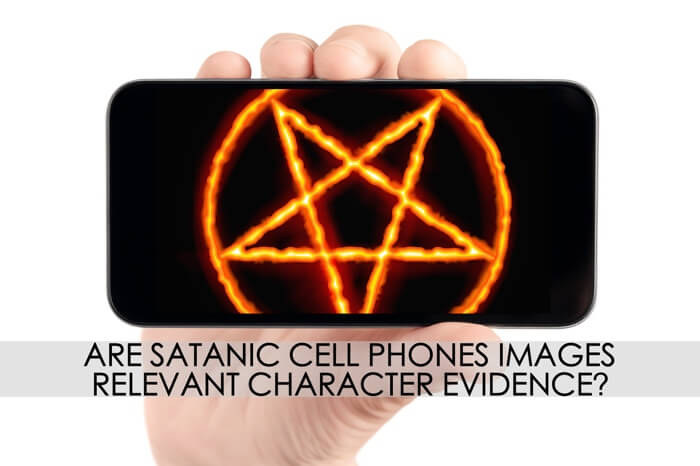
Satanic Cell Phone Images Admitted as Relevant Character Evidence

By Sentencing

Second Court of Appeals Holds that Satanic Cell Phone Photos Were Relevant Character Evidence in Punishment Phase for Attempted Capital Murder Case


Cell Phone Images Character EvidencePantoja v. State (2nd Court of Appeals – Fort Worth, 2016)

A Cocaine-Fueled Binge Leads to an Attack

During an alcohol and cocaine-fueled binge, nineteen-year-old Rigoberto Pantoja attacked a group of friends in Mansfield, Texas one evening in September of 2014. After watching the Floyd Mayweather fight, Pantoja began talking to himself. Eventually, he pulled a gun and fired two times, hitting Pantoja’s friend in the face. Pantoja put the gun to the head of a second friend, but when the gun would not fire, Pantoja pulled a knife, stabbing the friend three times. He also stabbed a third friend. All of the victims survived the injuries. Pantoja was arrested and charged with aggravated assault and attempted capital murder.

At trial, Pantoja pled guilty to the aggravated assault and attempted capital murder charges before a judge. Pantoja requested a jury for the punishment phase of his trial, asking that the jury grant him community supervision (probation). At the punishment phase, the State called twelve character witnesses; Pantoja’s defense counsel called four, including his father who was set to testify about Pantoja’s Catholic upbringing and religious way of life.

Just before the defense called Pantoja’s father to the stand, and out of the presence of the jury, the State indicated to the Court that it intended to cross-examine Pantoja’s father about satanic images found on Pantoja’s cell phone, confiscated the night he was arrested. The Judge told the State to proceed with calling witnesses and that “whenever you are ready to ask question [regarding the satanic photos], approach up here and then I’ll make a ruling at that time.” After that conversation, the jury returned to the courtroom.

Cross-Examination Regarding the Defendant’s Cell Phone Images

The defense called Pantoja’s father who testified to Pantoja’s good nature. He said that his son helped around the house and helped out with the family’s living expenses. Pantoja’s father also spoke of his son’s strong Catholic faith and upbringing. The defense admitted photos from the father of Pantoja’s first communion, photos of Pantoja’s bedroom with a Virgin of Guadalupe poster on the wall, and photos of Pantoja’s car depicting a rosary hanging from the rearview mirror. The State cross-examined Pantoja’s father, asking, “Were you aware that your son kept pictures of satanic worship on his cell phone?” The father responded, “no.”

The jury assessed Pantoja’s punishment at eighty years’ confinement for both offenses, denying Pantoja’s request for community supervision. Pantoja timely appealed to the Second Court of Appeals, arguing that the satanic photos shown to the jury were highly prejudicial, had no probative value whatsoever, did not establish a material fact that related to any element of his offenses, and ultimately were not relevant to his case and sentencing.

Did the Trial Court Err By Allowing the Satanic Images to Go Before the Jury?

The Second Court of Appeals had to determine whether the trial court should have stopped the State’s cross-examination of Pantoja’s father regarding the Satanic images found on Pantoja’s cell phone. Did the photos have relevance to the case under the Texas Rules of Evidence? If so, were the photos highly prejudicial to the jury?

The Texas Rules of Evidence

Relevancy

Article 37.07 of the Texas Code of Criminal Procedure states that, “evidence may be offered by the State and the defendant as to any matter the court deems relevant to sentencing, including…his character [and] an opinion regarding his character…” Tex. Code Crim. Proc. Ann. Art. 37.07, § 3(a)(1) (West Supp. 2015). Evidence is relevant to a punishment determination if that evidence will assist the fact-finder in tailoring an appropriate sentence. Henderson v. State, 29 S.W.3d 616, 626 (Tex. App.—Houston [1st Dist.]2000, pet. ref’d.

Community Supervision

When a defendant requests community supervision, a trial court may reasonably deem any character trait that pertains to the defendant’s suitability for community supervision to be a relevant matter for the sentencer to consider. Sims v. State, 273 S.W.3d 291, 295 (Tex. Crim. App. 2008).

Character Evidence and Opinion Testimony

When character evidence is admissible—as in a community supervision request during the punishment phase—such character traits may be proven by testimony in the form of an opinion. Tex. R. Evid. 405(a); Wilson v. State, 71 S.W.3d 346, 349-51 (Tex. Crim. App. 2002). An opinion witness is generally to be asked “did you know” questions. Id. at 350.

Cross Examination of Character Witnesses

On cross-examination of a character witness, inquiry may be made about specific incidents of a person’s conduct, subject to the following limitations. Id. at 351.

  1. The incident must be relevant to the character traits at issue. Burke v. State, 371 S.W.3d, 252, 261 (Tex. App.—Houston [1st Dist.] 2011, pet. ref’d, untimely filed).
  2. The alleged Bad Act must have a basis in fact. Id.
  3. Before the questions are asked, the foundation for asking the question should be laid outside of the jury’s presence, so that the judge will have an opportunity to rule on them. Id.

The Second Court of Appeals Finds No Error

Here, the Court says that the father’s testimony about Pantoja’s strict Catholic upbringing and religious faith constituted “opinion” character testimony. Additionally, the Court says, his testimony was relevant under the Texas Rules of Evidence, pertinent to the request made for community supervision, as “a sentencer might rationally want to take into account testimony of his good character and that he had a stable home life…and that he possess an indicia of a religious upbringing.”

Further, this character testimony was provided by the defense. Because the defense called the father as a character witness, the State had the right to cross-examine the father “through did-you-know questions” about Pantoja’s character. “The State had the proper predicate for it’s ‘did you know’ question by establishing outside the presence of the jury the factual basis for the specific instances of Pantoja’s conduct (the satanic cell phone photos).” The Court overruled Pantoja’s appeal, and affirmed the trial court’s judgment.

Robbery Accomplice Texas

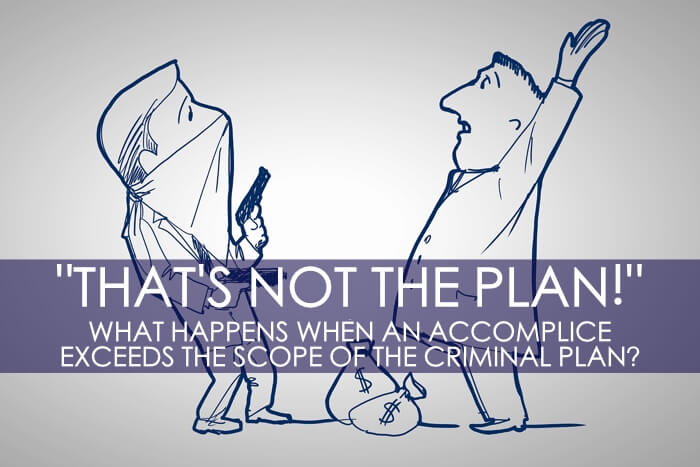
When a Criminal Accomplice Exceeds the Scope of the Agreed Plan

By Robbery

The Best Laid Plans of Mice and Men: What Happens When a Robbery Accomplice Goes Rogue?

Robbery Accomplice TexasDavis v. State (2nd COA, 2016)

Davis v. State is a case about two robberies— one a planned robbery of a convenience store, and the other of the customer inside the convenience store, a spur of the moment decision. What happens when accomplices to a well-planned robbery go “rogue” and commit additional crimes that are not part of the original plan?  Who is on the hook for their actions?

The Robbery That Didn’t Go According to Plan

Desmond Davis and two accomplices planned to rob a convenience store at night. Around 9:30pm, Davis entered the store alone and chatted with a customer. Moments later, two accomplices entered the store, pointing loaded guns at the cashier and the customer. The accomplices decided to rob the customer first, despite Davis’s instructions not to do so, “we just [came] for the store.” Davis jumped over the cash register and took money from the cash drawer. The customer dropped his cash to the floor and ran to the store’s restroom, locking the door behind him. The gunmen fled with the cash from the store and from the customer. Once the coast was clear, the store employee called 911 and locked the doors. The entire robbery was captured on a security camera. The three robbers split all of the cash among themselves after the robbery.

Shortly after Davis’s arrest, police obtained a confession after the detective told Davis, more or less, that not only could his confession be used for or against him, but that it could be used for or against him at trial. During the interrogation, the detective asked Davis to “man up” and give his side of the story, admitting his own guilt. Davis eventually made a written statement to law enforcement, admitting to his role in planning and carrying out the robbery. The interrogation and confession were captured on video.

The Case Goes to Trial – Davis is Tried for the Original Planned Robbery and the Unplanned Actions of his Cohorts

At trial, the jury convicted Davis on two counts of aggravated robbery with a deadly weapon—one count for the convenience store and one count for the customer. Davis was assessed a punishment of 30 years (for one count) and 15 years (for the other count) and a $1,000.00 fine for each count.

On appeal, Davis argued that his instructions to the accomplices not to rob the customer defeated the theft element of that robbery and thus, the record is insufficient to show his participation in the aggravated robbery of the customer specifically. Further, Davis argues that his confession was obtained under duress, in violation of the Texas Code of Criminal Procedure.

The issue before the Second Court of Appeals was to determine whether, in addition to the robbery of the store, Davis also participated in the robbery of the customer, and, whether Davis’s written confession obtained by police violated section 38.22 of the Texas Code of Criminal Procedure.

The Law in Texas – Robbery and Confessions

Robbery is an assaultive offense, where the assaultive conduct is the essence of the crime, not the theft in and of itself. Ex Parte Hawkins, 6 S.W.3d 554, 560 (Tex. Crim. App. 1999). In robbery prosecutions, the number of persons assaulted is at issue, not the number of thefts in one crime episode. Id.

Section 38.22 of the Texas Code of Criminal Procedure

When law enforcement securing a defendant’s written confession tells the defendant that the confession “could be used for or against him in court” or “for and against him in court” and that “they might go easy on him if he confessed,” the written confession becomes inadmissible because it violates section 38.22 of the Texas Code of Criminal Procedure. Sterling v. State, 800 S. W.2d, 513, 518-519 (Tex. Crim. App. 1990). Section 38.22 of the Code deals with admissibility of written confessions in court.

The Second Court of Appeals Affirms the Judgment of the Trial Court

Here, the robbers intended on stealing the money from the cash register when two of the gunmen pointed their weapons at an innocent customer and stole his money. Based on this alone, the Court says, the evidence is sufficient to support the jury’s determination “that [Davis] intended to steal the store’s money and that the [accomplices] threatened the customer while they were stealing money from the [store].” Further Davis and the accomplices shared all of the money stolen in that crime episode—there was no effort made to distribute the customer’s money to only the two accomplices. Davis participated in the store robbery. Even though he told his accomplices to not rob the customer, Davis still placed the customer in fear by waving firearms and by jumping over the counter to steal money out of the register.

Additionally, after the Court reviewed the interrogation tape, the Court “determined that the “officer told [Davis] that he had an opportunity to tell his side of the story and that he could be a man by admitting his guilt.” The officer never suggested to Davis that he would be helping his court case by admitting his guilt. The confession was, therefore, not obtained in violated of Section 38.22 of the Texas Code of Criminal Procedure.

The Court acknowledges that caselaw, such as James v. State, exists that holds that a “defendant who was merely present when his [accomplice] assaulted another was not guilty of robbery…because there was no evidence of a previous agreement to rob the [bystander],” such is not exactly the case here. James v. State, 161 S.W.2d 285, 286 (Tex. Crim. App. 1942). Davis saw the robbery of the customer taking place, and then decided to capitalize on the level of fear created to jump over the counter “and grab some money for himself.”

Warrantless Blood Draw DWI CCA

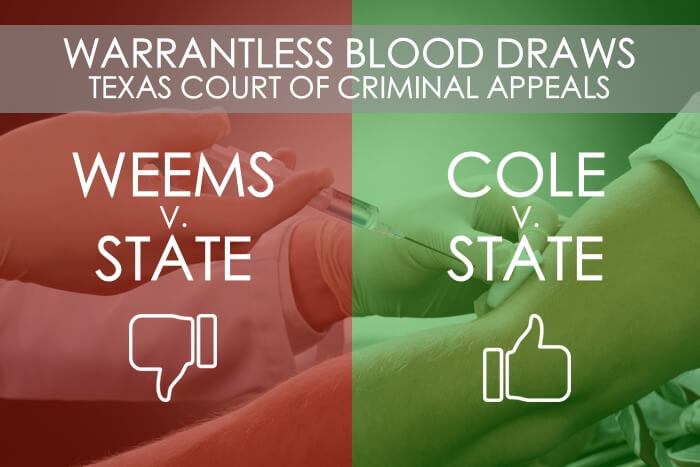
Two New Warrantless Blood Draw Opinions; Two Different Results

By DWI

CCA Reaches Different Conclusions in Two Separate Warrantless Blood Draw DWI Cases
Warrantless Blood Draw DWI CCAJust when we thought the warrantless blood draw issue was starting to reach firm footing in our appellate case law, the Texas Court of Criminal Appeals (CCA) throws a wrench into it. This week the CCA handed down a confounding set of opinions relating to warrantless blood draws in two separate DWI cases—Weems v. State and Cole v. State. Both cases dealt with drivers who were alleged to be intoxicated, both cases involved serious car accidents, both drivers suffered injuries, and, both cases presented law enforcement with the difficult decision to obtain blood samples without a warrant, as the body’s natural metabolic process threatened to destroy evidence over time that could have been used to charge and to prosecute the suspected intoxicated drivers. Procedurally, both Weems and Cole argue that the Texas Transportation Code § 724.012 is at odds with the Fourth Amendment and McNeely. Let’s take a look at the facts of each case and briefly review Texas law to reveal the reasoning behind the surprising conclusions reached by the CCA.

Weems v. State

A Night of Drinking Leads to a Car Accident

FACTS: Daniel Weems drank heavily at a bar for several hours one summer evening in June of 2011. Weems decided to drive home around 11:00pm, and on the way, his car veered off the road and flipped over, striking a utility pole. A passerby stopped to help, but saw Weems exit the car through his window. When asked if he was alright, Weems stumbled around saying that he was drunk. Noticing the smell of alcohol, the passerby called 911 and watched Weems run from the scene. When the first police officer arrived at midnight, Weems was found hiding under a parked car.

Law enforcement noted his bloodshot eyes, slurred speech, and inability to stand without assistance in the police report. Moments later, a second police officer came to the scene and arrested Weems on suspicion of driving while intoxicated (“DWI”). Law enforcement decided against conducting field sobriety tests because Weems suffered injuries and had “lost the normal use of his mental and physical faculties due to alcohol.” TEX. PENAL CODE § 49.01 (2)(A). Weems, however, refused a breathalyzer and a blood test, even after law enforcement informed him of the potential consequences (suspended license, etc.) for refusal. Emergency responders transported Weems to a nearby hospital because Weems complained of neck and back pain.

Arrest Leads to Warrantless Blood Draw

Weems was seen in the hospital’s trauma unit and the second police officer completed the form, requesting a blood draw, while the first police officer remained on duty, but on standby. Weems blood was taken at 2:30 am, over two hours post-arrest, with a result of .18—well above the .08 legal limit. Relying on the Supreme Court case Missouri v. McNeely, where the highest court held that the body’s natural metabolic processing of alcohol in the bloodstream does not create an exigency (emergency) such that an exception to the Fourth Amendment’s warrant requirement is created, Weems sought to have the results of the blood draw suppressed at trial. The trial court did not grant the suppression and jury found Weems guilty of felony DWI, sentencing him to eighty years’ imprisonment. On appeal, Weems argued that his Fourth Amendment rights were violated. Surprisingly, the Fourth Court of Appeals agreed with Weems, holding that in light of McNeely, Texas’s implied consent and mandatory blood draw schemes do not give way to warrant-requirement exceptions, and, that the record established at Weems’s trial did not support admitting the warrantless blood draw results under an exigency exception. The State appealed to the CCA.

Cole v. State

Fatal Car Crash Leads to Arrest

FACTS: On a December evening in 2011, Steven Cole drove his vehicle 110 miles per hour down a busy street, running a red light, and crashing into a pickup truck. The crash caused a large explosion and fire, killing the driver of the pickup truck instantly. When the first police officer arrived at the scene around 10:30pm, he saw Cole shouting for help because he was trapped in his truck in the fire’s path. Shortly thereafter, several police officers arrived and began putting out the multiple fires to secure the area for pedestrians and motorists.

Law enforcement would later testify that “from a law enforcement and safety perspective, they needed as many officers on the scene as they could possibly get” because the raging fires and continued explosions put the public in danger. When the crash occurred, the police were in the middle of a shift change which further complicated securing the scene, conducting the investigation and maintaining public safety. Cole was eventually rescued from his truck and was examined by EMTs, to whom Cole admitted that he had taken some meth. Because of the large debris field that spanned an entire block, fourteen police officers remained at the scene to collect evidence and secure the area, which pushed the limits of the small precinct’s manpower. The debris field was not fully cleared until 6:00am—almost eight hours after the crash. Because of the size of the debris field and dangerousness of the scene requiring multiple officers to secure, only one police officer accompanied Cole to the hospital.

Suspected Intoxication Leads to Warrantless Blood Draw

At the hospital, Cole was observed complaining of pain, but also, “tweaking” and shaking—potential symptoms of suspected methamphetamine intoxication. Under a directive from the superior officer on duty, the police officer arrested Cole at 11:38pm and asked Cole for consent to collect blood and breath samples. When Cole refused, the officer read the statutory consequences for failure to consent. Cole interrupted the officer several times to comment that he had not been drinking, rather, he had taken meth. The officer made a request to the hospital for a blood draw, which was done at 12:20am. The results confirmed that Cole’s blood contained amphetamine and methamphetamine.

Cole moved to suppress the evidence at trial, but the trial court overruled the motion. The jury convicted Cole of intoxication manslaughter, sentencing Cole to a life imprisonment. On appeal, the court of appeals held that the lower court erred in not suppressing Cole’s blood draw results because State v.Villarreal “foreclosed on the State’s reliance on the mandatory blood-draw provision found in the Texas Transportation Code, and that, the trial court record did not establish that an emergency (exigency) existed to justify the warrantless blood draw. Cole v. State, 454 S.W.3d 89, 103 (Tex. App—Texarkana 2014). The State appealed to the CCA.

Law Applicable to Warrantless Blood Draws

The Fourth Amendment

The Fourth Amendment to the United States Constitution provides, “the right of the people to be secure in their persons, houses, papers, and effects, against unreasonable searches and seizures, shall not be violated, and no Warrants shall issue, but upon probable cause.” U.S. CONT. amend. IV. McNeely informs that blood tests are Fourth Amendment searches that implicate a “most personal and deep-rooted expectation of privacy.” McNeely, 133 S. Ct. at 1558-59 (quoting Winston v. Lee, 470 U.S. 753, 760 (1985)). Case law has determined that “a warrantless search is reasonable only if it falls within a recognized exception.” State v. Villarreal, 475 S.W.3d 784, 796 (Tex. Crim. App. 2015), reh’g denied, 475 S.W.3d 817, (Tex. Crim. App. 2015) (per curiam).

One exception to the Fourth Amendment warrant requirement is a warrantless search performed to prevent imminent evidence destruction when there is no time to secure a warrant. Cupp v. Murphy, 412 U.S. 291, 296 (1973); McNeely, 133 S. Ct. at 1559. Whether law enforcement faces an emergency that justifies acting without a warrant calls for a case-by-case determination based upon the totality of the circumstances. Id. In order for courts to determine whether an emergency existed, courts must analyze the totality of the circumstances based on an objective evaluation of the facts reasonably available to law enforcement at the time of a search, and not based on 20/20 hindsight of the facts as they are known after the fact. Brigham City, Utah v. Stuart, 547 U.S. 398, 404 (2006); Ryburn v. Huff, 132 S. Ct. 987, 992 (2012)(per curiam).

Texas Transportation Code § 724.012

Texas Transportation Code § 724.012(a) states, “specimens of a person’s breath or blood may be taken if the person is arrested and at the request of [law enforcement] having reasonable grounds to believe the person was intoxicated while operating a motor vehicle.” § 724.012(b) states, “[Law enforcement] shall require the taking of a specimen of the person’s breath or blood…if the officer arrests the person [for DUI/DWI] and the person refuses the officer’s request to submit to the taking of the specimen voluntarily…[where] any individual has died…an individual other than the person has suffered serious bodily injury.”

The CCA Weighs In—What did the CCA Decide and How Did the Judges Reach The Decisions?

In both Weems and Cole, the Court of Criminal Appeals had to determine whether the warrantless blood draws were justified by exigent (emergency) circumstances under a totality of the circumstances review of the facts. It may be surprising that in one case the CCA upheld the legality of the blood draw and in the other case the CCA held that the blood draw was unlawful.  The charts below shed some light on the relevant facts of each case that the CCA reviewed to determine the holdings in each case. As you can see, the cases are quite similar, yet have some striking differences—differences that distinguished each case just enough for the CCA to arrive at opposite conclusions.

Totality of the Circumstances Analysis
Similarities Between Weems and Cole

WEEMS COLE
Refused consent to breath and blood tests. Refused consent to breath and blood tests.
Driver caused car crash. Driver caused car crash.
Driver injured in crash. Driver injured in crash.
Admitted to drinking during initial questioning. Admitted to using meth during initial questioning.
Moved to suppress evidence at trial. Moved to suppress evidence at trial.
Warrantless blood draw. Warrantless blood draw.
Law enforcement claimed “exigency/emergency” as reason for warrantless blood draw. Law enforcement claimed “exigency/emergency” as reason for warrantless blood draw.
Law enforcement concerned BAC would fall over time, destroying potential evidence. Law enforcement was concerned intoxication levels would fall over time, destroying potential evidence.

Totality of the Circumstances Analysis
Differences Between Weems and Cole

WEEMS COLE
Single-vehicle crash. Two-vehicle crash.
Small, rural road. Large, high-traffic intersection.
Two police officers, one who remained on “stand-by”. Entire police department tasked with maintaining and securing the exceedingly dangerous scene.
No deaths as a result of crash. One fatality as a result of crash.
Small debris field. Large “one block long” debris field.
Alcohol was the substance at issue. Meth was the substance at issue.
Alcohol has a ‘known’ dissipation time. Meth has a ‘lesser known’ dissipation time.
Police department’s manpower was not overwhelmed by the crash. Police department’s manpower pushed to the limits by the crash.
Nothing on the record to indicate Weems was going to receive pain medication that would impact the results of a blood test. Hospital was set to give narcotics to Cole because of pain, narcotics that could potentially impact the results of a blood test.

The CCA’s Holding in Weems – Warrantless Blood Draw Improper

In Weems v. State, the CCA concluded that the warrantless blood draw was NOT justified by exigent (emergency) circumstances. The CCA affirmed the holding of the court of appeals that said that § 724.012 of the Texas Transportation Code does not create an exigency exception to the Fourth Amendment and that the trial court did not establish on the record any facts to support a finding of an exigent circumstance. The CCA stated that law enforcement might have had a “temporal disadvantage,” however, the time frame from the crash to the time Weems was transported to the hospital was short and that the police officer who was on standby could have called a magistrate to obtain a warrant, “the hypothetically available officer could have secured a warrant in the arresting officer’s stead.”

Further, even though the hospital took two hours to obtain the sample, such a timeframe would not have been known beforehand by law enforcement, and thus is considered “hindsight.” Hindsight is not factored into the totality of circumstances analyses. Additionally, the police department’s manpower was not completely tied up with the details of Weems’s crash. Lastly, the CCA commented that law enforcement should have protocols in place to process and deal with blood draw warrants in cases where the suspected intoxicated driver is transported to the hospital with injuries, “the record does not reflect what procedures, if any, existed for obtaining a warrant when an arrestee is taken to the hospital.”

The CCA’s Holding in Cole – Warrantless Blood Draw Authorized

In Cole v. State, the CCA held that the trial record established circumstances rendering obtaining a warrant impractical and that the warrantless search was justified under the exigency exception to the Fourth Amendment’s warrant requirement. The case was reversed and remanded to the court of appeals.

The CCA said that the size and severity of the accident scene requiring several police officers to remain on the scene for public safety concerns, the large debris field that required accident investigators extended time to complete the investigation, the fact that someone died in the crash, and the fact that the dissipation rate for methamphetamine is not widely known among law enforcement the way alcohol dissipation in known, are reasons that come together to create a constellation of exigency under a totality of the circumstances analysis.

“Law enforcement was confronted with not only the natural destruction of evidence though natural dissipation of intoxicating substances, but also with the logistical and practical constraints posed by a severe accident involving a death and the attendant duties this accident demanded.” Further, because Cole complained of pain, law enforcement had a legitimate concern that any narcotic drugs administered would impact the outcome of a blood test, rendering the test ineffective for evidence in trial later on.

Justice Johnson did file a dissent in Cole, “I would hold that the circumstances and testimony at trial indicate that a warrant was required.” Justice Johnson says that someone on the police force could have obtained a warrant and had enough time to do so, “this was not a now or never situation that would relieve the state of its burden.”

Where do we go from here?

DNA Evidence Biological Testing

DNA Testing of Biological Evidence Under CCP 38.43

By DNA

Does a defendant charged with capital murder have an absolute right to have all of the biological evidence of the crime tested?

DNA Evidence Biological TestingTexas Code of Criminal Procedure, Section 38.43 deals with “Biological Evidence,” and outlines the rules and responsibilities for testing such evidence. In the mandamus case summary that follows, the relator (the defendant) is requesting that ALL of the biological evidence be tested, while the trial judge has ruled that only some testing is sufficient.

In Re Solis-Gonzalez (Tex. Crim. App. – Mandamus 2016)

A Triple Homicide and Hundreds of Evidence Samples

Luis Solis-Gonzalez was indicted by a grand jury for capital murder for the 2012 triple murder of his ex-wife, her daughter, and her companion. Before trial, the State moved for DNA testing of over 200 pieces of biological material that was collected at the scene. The trial court granted that the testing be done by the Texas Department of Public Safety forensics laboratory.

A few months later, after the lab had already tested a portion of the samples, the lab communicated to the trial court that testing all of the evidence would be a lengthy process, taking three years to complete. Because of such a delay, the trial court asked the defense to identify any specific articles of biological material that it wanted tested, along with reasons why that material should be tested.

At the pretrial hearing, the State asserted that testing each and every piece of the evidence was unnecessary because the testing that the lab had already completed was sufficient for trial. Solis-Gonzalez claimed that Article 38.43 of the Texas Code of Criminal Procedure created an “absolute right to have all evidence tested.” The trial court found that testing all of the biological evidence was unnecessary, as “Article 38.43 does not mandate that every piece of evidence seized by law enforcement in a capital murder case where the State is seeking the death penalty must be forensically analyzed.” Further, the trial court added, “the defense’s response [does] not legally support further delay of trial.”

Should the Trial Judge Have Ordered Tested of All Biological Evidence?

On a petition for a writ of mandamus, the CCA reviewed the case to determine whether Article 38.43 does, in fact, create an absolute right to have all biological evidence collected at a crime scene, especially when the death penalty is at stake.

Article 38.43 of the Texas Code of Criminal Procedure

Article 38.43(j) states, “if the State and the Defendant agree on which biological materials constitute biological evidence, the biological evidence shall be tested…if the State and the Defendant do not agree on which biological materials qualify as biological evidence, the State or the Defendant may request the court to hold a hearing to determine the issue.” The statute defines biological evidence as the contents of a rape kit, blood, semen, hair, saliva, skin tissue, finger nails, fingernail scrapings, bone, bodily fluids that might establish the identity of a suspect or exculpate (show the innocence of) a potential suspect.

Justice Delivered Swiftly, or Justice Delivered Meticulously?

Here, the CCA defers to the legislative policy rationale behind Article 38.43, saying, “it thus appears that the legislature granted discretion to the trial court to separate the evidentiary wheat from the chaff and prevent delay of the proceedings because of needless testing.” Like the CCA, the trial court stated the evidence submitted and analyzed was sufficient for trial in “substantial compliance with the [legislative] intent of the statute.” It appears that the intent behind the statute is to deliver justice swiftly, not meticulously by testing each and every single piece of biological evidence. Accordingly, the CCA affirmed the decision of the trial court, and denied relief to Solis-Gonzalez.

Texas Felony Habitual Offender True

A “True” Pleading to Felony Priors Lifts State’s Evidentiary Burden

By Probation Revocation

Texas Felony Habitual Offender TrueWhat happens when the State omits the year of an offense on a legal document presented before the court for a sentencing enhancement? Well, nothing, so long as the defendant pleads “true” to the priors and the enhancement itself is not improper, according to the latest holding from the Court of Criminal Appeals. The CCA revisits Roberson v. State to explain why it comes to this quirky conclusion.


See the CCA opinion in Hopkins v. State (Tex. Crim. App. 2016).

Defendant Pleads “True” to a Notice Pleading with Incomplete Information

Essie Hopkins was convicted for aggravated robbery for shooting his victim as he ran away with her wallet. During the punishment phase, the State pushed for an enhancement to his sentencing for more prison time under Texas’s habitual offender statute. In the original indictment, the State alleged that the defendant had a prior conviction for aggravated assault with a deadly weapon from 2003. Later, the State alleged in a notice pleading that the defendant had a second aggravated assault conviction, however, the State failed to include the year of the offense in the paperwork. When the State read the enhancement allegations into court record, Hopkins pled “true” to committing and being charged with the prior felonies. Hopkins’ mother also testified, citing knowledge of the two prior felony convictions—one occurring in 2003 and the other in 2009. The State did not provide evidence of the prior aggravated assaults.

On appeal, the Fifth Court of Appeals affirmed the lower court’s conviction, holding, “that [Hopkins’] plea of “true” to both enhancements was sufficient evidence to support a finding on those allegations.” Hopkins v. State, No. 05-14-00146-CR, 015 WL 3413582, *6 (Tex. App.—Dallas May 28, 2015, pet. granted) (mem. op.) (not published). Hopkins appealed to the Criminal Court of Appeals, arguing that because the wording in the notice pleading is not clear, the State was required to present evidence of the felony even though Hopkins pled “true.”

Texas Penal Code Sentencing Enhancement Laws

Under section 12.42(d) of the Texas Penal Code, a defendant’s punishment may be enhanced if “it is shown on the trial [record]…that the defendant has previously been…convicted of two felony offenses…the defendant shall be punished by imprisonment…for any term not more than 99 years or less than 25 years. TEX. PENAL CODE § 12.42(d); Jordan v. State, 256 S.W. 3d 286, 290-291 (Tex. Crim. App. 2008).

If the defendant pleads “true” to an enhancement paragraph, then the State is off the hook to prove up in court the enhancement allegations. Roberson v. State, 420 S.W.3d 832, 838 (Tex. Crim. App. 2013) (citing Mikel v. State, 167 S.W. 3d 556, 559 (Tex. App.—Houston [14th Dist.] 2005, no pet.))

The Court of Criminal Appeals Looks to Roberson v. State

In Roberson, the defendant was convicted of aggravated assault with a deadly weapon and was sentenced to 30 years in prison based on a “true” pleading to prior felony convictions. Id. Because the court record of that case did not affirmatively reflect that the enhancement was improper, the court held that the defendant’s “true” pleading relieved the State’s burden of proving up the felony convictions. Id. at 840. In Roberson, the court record also supported the enhancement allegations. Id.

The CCA stated, “[Hopkins] fail[s] to direct us to any record evidence affirmatively showing that the enhancements were improper, the record actually supports the enhancement allegations.” In sum, if a defendant pleads “true” to a sentencing enhancement during the punishment phase at trial, then the State is absolutely relieved of the evidentiary burden to prove the defendant actually committed and was convicted of the priors, so long as the enhancement itself is not improper.

Police Knock and Talk Danhach 2016

Knock and Talk Interview Still a Lawful Way for Police to Enter a Premises

By Theft

Police Knock and Talk Danhach 2016“Knock, knock!”

“Who is there?”

“The police and the FBI, may we come in please?”

There is a knock at the door. You look out your peep hole and see law enforcement. Do you have to open your door? If you open your door, do you have to let them in? What if they don’t have a warrant, but ask nicely and start talking to you? If you give consent to law enforcement to enter your home, can evidence seized be used against you in court later on?

This article is a summary of United States v. Danhach, a case recently decided in the US Court of Appeals for the 5th Circuit.

Evidence is Seized After Police Politely Ask If They Can Come Inside.

The Houston Police Department and the FBI had been investigating Sameh Danhach and his business associate for possible involvement in organized retail theft. As part of the investigation, law enforcement began surveilling a warehouse that Danhach had been seen entering on multiple occasions and to which a car used in stealing over-the-counter drugs and expensive baby formula had been linked. After several weeks of surveillance, law enforcement approached the warehouse and knocked on the door. Danhach’s business associate permitted the officers to enter, as surveillance cameras rolled capturing the entire conversation.

The officers saw trash bags full of merchandise and other indicators of stolen goods out in the open. Citing this evidence in a probable cause affidavit, law enforcement obtained a search warrant and seized the evidence for trial. Danhach was charged with conspiracy to transport stolen goods in interstate commerce and also with aiding and abetting the interstate transportation of stolen OTC medication and baby formula, violations of 18 U.S.C. § 371 and 18 U.S.C. § 2314, among other charges.

At trial, the jury found Danhach guilty on all counts and the judge sentenced him to 151 months in prison and a three year term of supervised release. Danhach appealed.

The Knock and Talk Procedure, the Plain View Doctrine and Consent Collide.

Courts have recognized the “knock and talk” technique as “a reasonable investigative tool when officers seek to gain an occupant’s consent to search or when officers reasonably suspect criminal activity.” United States v. Jones, 239 F.3d 716, 720 (5th Cir. 2001); Kentucky v. King, 563 U.S. 452, 469 (2011). Evidence may be cited in support of a search warrant if (1) law enforcement entered the area where the item was located; (2) the item was in plain view; (3) the incriminating nature of the item was immediately apparent; and (4) law enforcement had a lawful right of access to the item.” United States v. Jackson, 569 F. 3d 236, 242 (5th Cir. 2010).

However, if for some reason the “plain view” doctrine does not stand up to the facts of a case, then “consent to enter” may be an alternative argument, but “the government must demonstrate that there was effective consent that was given voluntarily by a party with actual or apparent authority.” United States v. Scroggins, 599 F.3d 433, 440 (5th Cir. 2010).

The Big Issue Before the Fifth Circuit was Whether Officers Lawfully Entered and Remained Inside of Danhach’s Warehouse While Conducting a “Knock and Talk” Interview.

Here, the Fifth Circuit agreed with the district court and affirmed judgment and sentencing, holding that law enforcement permissibly used the knock and talk technique. The Court pointed out that video surveillance is consistent with law enforcement’s account that consent was obtained before entering. Even after law enforcement entered, Danhach’s business associate gave them permission to walk around the warehouse. The stolen goods were in plain view and were immediately apparent and indicative of criminal activity. Based on this series of events, “even if any evidence cited in the warrant…was not covered by the plain-view doctrine, the record supports the conclusion that the agents asked for and received consent for a full search of the warehouse.” Danhach did not offer any evidence to show that the consent was coerced in any manner, nor did he offer any evidence that the items seized were not in plain view.

Consent to Search + Items of Criminality in Plain View = Probable Cause to Obtain a Warrant

In sum, law enforcement may ask to enter a premises without a warrant and if consent is obtained from a person who is “in charge” or who looks to be “in charge,” then that consent is sufficient according to the Fifth Circuit, citing previous cases. Once lawfully inside a dwelling or premises, if law enforcement officers see, in plain view, objects that are linked or are seemingly linked to a crime, then those items may be the basis of a warrant to seize the items and to conduct an even more extensive search.

Juvenile Sex Offender Conditions

Strict Monitoring of Juvenile Sex Offender Internet Usage is a “Heavy Burden,” says Fifth Circuit

By Sex Crimes

In United States v. Sealed Juvenile, the 5th Circuit Court of Appeals discusses how much oversight is too much when it comes to juvenile sex offenses.

Juvenile Sex Offender ConditionsPlease note: This article discusses sexual abuse of a child. Generally speaking, the reason the court system treats juveniles differently from adults is because of the hope of rehabilitation and restoration of the juvenile offender to society. With everything from school to job searching on the internet these days, should juvenile sex offenders be able to be on the internet? Is strictly monitoring a juvenile sex offender’s internet usage, down to the keystroke, an imposition on constitutional rights, or is society providing oversight to a juvenile defendant with the hope of rehabilitation?

A Juvenile Sexual Assault Occurs on a Military Base

While living with his family on a military base, a fifteen-year-old sexually assaulted a four-year-old. He was charged with violating 18 U.S.C. §§2241(c), 5032 (2012), “engaging in a sexual act with a person who had not attained the age of 12 years.” The juvenile defendant had a history of psychiatric illnesses, such as Oppositional Defiant Disorder and Bipolar disorder. He had a pattern of sending sexually explicit letters to classmates at school. Before sentencing the district court ordered a probation officer to render a special report, which concluded, “in the last year the juvenile’s problems transformed from being anger-oriented to being sexually-oriented.” In a plea agreement, the juvenile pleaded guilty to a lesser offense of “abusive sexual conduct with a minor who had not attained the age of 12 years,” violations of 18 U.S.C. § 2244(a)(5) (2012) and §5032.

The District Court Imposes Strict Sex Offender Conditions to Probation

The district court deemed the defendant a “juvenile delinquent” and sentenced him to eighteen months in a juvenile treatment facility and a term of juvenile delinquent supervision until he turned twenty-one. Further, the district court imposed four special conditions to his supervision

  1. a restriction on the defendant’s contact with children,
  2. choice of occupation,
  3. prohibition on loitering in specific places, and
  4. the use of computers and internet.

The juvenile appealed to the Court of Appeals for the Fifth Circuit, arguing that the district court had not provided adequate reasons for imposing the special conditions at the sentencing hearing, and failed to explain how the special conditions were reasonably related to the offense.

Under 18 U.S.C. § 3563(b), courts may place discretionary conditions on probation, so long as the conditions are reasonably related to the factors set forth in such deprivations of liberty or property and are reasonably necessary. In doing so, the sentencing court must consider the nature and circumstances of the offenses and the “history and characteristics of the defendant.” 18 U.S.C. § 3553(a)(1)(2) (2012).

The Big Issue Before the Fifth Circuit | Were the Special Conditions of Probation Reasonably Related to the Offense?

The big issue before the Fifth Circuit was whether the conditions imposed by the district court were reasonably related to the offense, and if so, were they reasonably necessary. Did the district court provide adequate reasons for imposing the four special conditions? As the case was a matter of first impression, the Court examined each special condition and concluded in a surprising manner with regard to the internet and computer use.

Condition One: Restriction on Contact with Children

Under the first special condition, the juvenile was “not to have contact with children under the age of sixteen without prior written permission of the Probation Officer.” Further, he was required to “report unauthorized contact with children to the Probation Officer.” On appeal, the juvenile argued that this special condition was a “much greater deprivation of liberty…than reasonably necessary.” However, the Court disagreed with the juvenile. “Considering the threat posed by the juvenile based on his conviction [and other noted behaviors on record], we affirm this condition.” Also noting that the juvenile could attend school with permission of the Probation Officer, the Fifth Circuit agreed with the lower court.

Condition Two: Choice of Occupation

Under the second special condition, the juvenile was “restricted from engaging in an occupation where he has access to children, without prior approval of the Probation Officer.” On appeal, the juvenile argued that the special condition was not reasonable and necessary because the offense was not related to work and that he would run a risk of never being able to be employed. The Court disagreed because the juvenile would be able to work upon prior permission from his Probation Officer. The Court affirmed the district court’s condition.

Condition Three: Prohibition on Loitering in Specific Places

Under the third special condition, the juvenile was not to “loiter within one-hundred feet of schools, parks, playgrounds, arcades, or other places primarily used by children under the age of sixteen.” The juvenile argued that the special condition was not reasonably related to his offense because his offense did not occur at a school. The Court disagreed. “The juvenile’s history of sending sexually explicit letters to girls at school means that he poses a threat to children at school.” The Fifth Circuit affirmed the lower court’s special condition.

Condition Four: Computer and Internet Use

Under the fourth special condition, the juvenile was (1) not to possess a computer with internet access without the prior approval of the Probation Officer; (2) to submit to searches under the direction of the Probation Officer that could include software scans of his technological devices; (3) to consent to a key logger on his personal devices and to consent to a search of each internet query; (4) to inventory and to provide receipts for all devices and bills pertaining to the internet and technology.

The juvenile argued that the restrictions on his computer and internet use were not reasonably related to his offense, and that the special condition would prevent him from job searching, completing homework, and emailing his therapists. The juvenile argued that even though he could access the internet, to do so would place a heavy burden on him to request permission each time he accessed the internet, or to report any misstep such as an errant search or a “pop up” on the internet.

The Fifth Circuit points out that the juvenile is mentally ill and needs some internet oversight. “We affirm the monitoring provisions because we recognize [they] ensur[e] that the juvenile complies with the restrictions against accessing sexually explicit materials.”

However, the Fifth Circuit agreed with the juvenile on some of the internet and computer usage restrictions. “We must recognize that access to computers and the Internet is essential to functioning in today’s society.” The Fifth Circuit ordered the district court to construe the special condition so that the juvenile does not have to request permission from a Probation Officer each time he accesses the internet, removing what the Court deemed “a heavy burden” on the juvenile. Next, the Court modified the special condition that required the juvenile to provide receipts and payment records to the Probation Officer, “because the purpose is to verify that there have been no payments to an internet service provider, and payment for proper use should be made by the juvenile…there is no other basis to justify the restriction imposed by the [special condition].”

In sum, while the Fifth Circuit mostly affirmed the district court’s holding, it made some significant modifications where technology is concerned. Speaking to the hope of future rehabilitation, the Court added, “the juvenile may seek modification to any of the conditions, and the district court may lessen the burden of the [special conditions] if [his] behavior improves over time.”

Failure to Maintain a Single Lane of Traffic DWI Attorney Fort Worth

Failure to Maintain a Single Lane of Traffic Leads to a DWI Conviction

By Reasonable Suspicion

Does an Officer have “Reasonable Suspicion” to Make a Traffic Stop When Vehicle Weaves Inside a Traffic Lane?

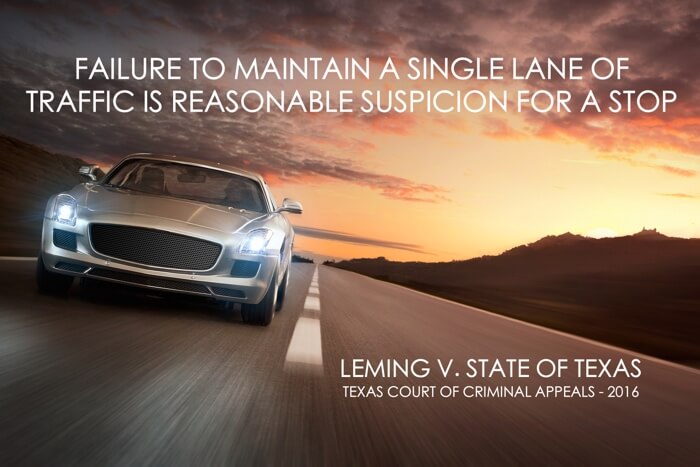
Failure to Maintain a Single Lane of Traffic DWI Attorney Fort WorthJames Leming was convicted of DWI after erratic driving alarmed fellow motorists to call police. On January 20, 2012, a citizen filed a report of a “swerving Jeep” and Officer Manfred Gilow responded. As the dashboard camera confirmed, the Jeep traveled thirteen miles under the speed limit; Gilow followed the Jeep for several miles. Officer Gilow observed the Jeep, “drifting [within the] lane to the left [with] tires on the stripes… back to the right, almost hit[ting] the curb twice.”

Officer Gilow said he did not stop the Jeep immediately because the heavy traffic made a traffic stop unsafe at the time. He wanted to wait until the Jeep approached “the 3000 block because I knew there’s parking lots where he could pull over [safely].” Gilow justified the warrantless stop under the Community Caretaking Exception, “due to the …[low] speed…and…swerving, it was an indication that the driver [was] somehow either distracted or physically not able to operate [his] motor vehicle carefully.”

Eventually, the officer pulled Leming over, noting on the police report, the smell of liquor. Though Leming denied drinking, he said he had taken some prescription pills. Officer Gilow conducted field sobriety tests and placed Leming under arrest for DWI.

Read the full opinion in Leming v. State.

Leming’s DWI Trial and Motion to Suppress the Stop

Before the trial began, Leming filed a motion to suppress the traffic stop, which was denied. At trial, Leming pled guilty to and was convicted of DWI. Because Leming had two prior DWI convictions (a felony under Texas law), the court assessed punishment at ten years’ imprisonment. Tex. Penal Code § 49.09(b)(2).

The Sixth Circuit Court of Appeals reversed the trial court’s ruling, holding that the trial court should have granted the motion to suppress. Leming v. State, 454 S.W.3d 78 (Tex. App.—Texarkana 2014). The Sixth Circuit concluded that Gilow lacked reasonable suspicion to detain Leming for the offense of failure to maintain a single lane under Section 545.0600(a) of the Texas Transportation Code. The court reasoned “in order for it to have been unlawful, the encroachment must have been made unsafely; [here,] there was no real danger of his colliding with another vehicle in an adjacent lane.” The State’s Prosecuting Attorney petitioned the Court of Criminal Appeals for discretionary review, arguing that the citizen’s report coupled with Officer Gilow’s observations were sufficient for reasonable suspicion that Leming was driving the Jeep under the influence.

The Issue Before the Texas Court of Criminal Appeals Regarding the Traffic Stop

The Court of Criminal Appeals had to determine whether a driver must BOTH fail to maintain a single lane AND not change lanes without checking to assure the maneuver can be accomplished safely, before it may be said that a driver has committed an offense. Such an offense would rise to the level of reasonable suspicion for a constitutionally-sound traffic stop.

What Does the Texas Transportation Code Say About Driving Within a Single Lane?

Section 545.060(a) states that “an operator on a roadway divided into two or more clearly marked lanes for traffic (1) shall drive as nearly as practical entirely within a single lane; and (2) may not move from the lane unless that movement can be made safely.”

The CCA Holds that a Driver Must Maintain a Single Lane AND Must not Leave the Lane Unless it is Safe.

The CCA explains that the fact that both the requirement to stay within a single lane as for as practical and the prohibition to not leave that lane unless it is safe to do so, originally appeared in the same subsection of the statute, does not indicate that the Legislature intended that both must be violated before an offense has occurred. Rather, the CCA believes that the Legislature intended a violation of EITHER part of the statute constitutes separately actionable offenses.

The CCA says that Officer Gilow knew from personal observations, as well as from the citizen’s report, that Leming had some sort of trouble maintaining a steady driving pattern while traveling under the speed limit. “That was sufficient information to justify a temporary detention to investigate whether Leming had actually failed at some point to remain in his dedicated lane of traffic as far as it was practical to do so under the circumstances—it matters not whether that failure was unsafe.” Further, Officer Gilow had an objectively reasonable basis to suspect Leming of driving under the influence.

As a matter of principle, the CCA notes, “it [would be] counterproductive and contrary to common sense to set the reasonable suspicion bar for DWI so high that law enforcement must hesitate to investigate such hazardous driving for fear that the stop will later be invalidated.” In a Concurring Opinion, Judge Richardson adds, “I believe [the community caretaking exception] provided justification for the officer’s stop, where, a reasonable police officer—given the totality of the circumstances-would believe [someone] is in need of help.” Dissenting, Judge Keasler stated, “this is a close case…the majority reaches the wrong result by misconstruing the statute and finds reasonable suspicion on the basis of a single insufficient articulable fact.” Judge Newell also dissented in this case.

Texting While Driving Cell Phone Search

Driving While InTEXTicated: Hand Over Your Cell Phone or Lose Your License

By Search & Seizure

Lawmakers and Forensic Engineers Introduce the Textalyzer to Combat Distracted Driving in New York

Texting While Driving Cell Phone SearchDid you talk on your mobile phone while driving to work this morning? Check your email? Have you ever asked Siri for help selecting a restaurant for dinner while you are driving around a new city? What about the urgent text from your boss—did you glance at that while driving? Ideally, we should answer each question with an emphatic, “No!” However, we don’t live in an ideal world—many drivers on Texas roads are distracted by mobile devices every time they drive. Just look over at the driver next to you and you’ll see it.

Distraction.gov, the official government website for distracted driving statistics, reports that in 2014, over 3,000 people were killed in the United States by distracted drivers. To combat the growing problem, lawmakers in New York are reviewing proposed legislation that would allow police to obtain the mobile devices of each person involved in a car accident for immediate testing by a Textalyzer.

What is the Textalyzer?

The Textalyzer is a mobile kiosk installed into law enforcement vehicles. The Textalyzer helps law enforcement determine whether someone involved in a car accident was distracted by a mobile device at the time of the accident. Created by the Israeli-based mobile forensics technology firm, Cellebrite, the Textalyzer, known in the techie world as the “UFED InField Kiosk,” conducts a scan of the phone to determine whether the device’s voice, text, or data features were used at the time of an auto accident.

According to Cellebrite’s UFED InField Kiosk datasheet, “officers and investigators can conduct a forensically sound, logical extraction of mobile device text messages, call logs, emails, etc., and quickly view and act decisively on potential evidence.” Almost every type of mobile device can be accessed by the UFED InField Kiosk, “the UFED Series is able to extract, decode, analyze and report data from thousands of mobile devices, including, smart phones, legacy and feature phones, portable GPS devices, tablets, memory cards and phones manufactured with Chinese chipsets.”

The New York Law | New York Senate Bill S6325A

In New York, Senate Bill S6325A is currently “in committee” but progressing with strong support. If signed into law, it would require drivers who have had car accidents to provide law enforcement with all of their mobile devices so that police could conduct a Textalyzer scan on the device at the scene. Although the Textalyzer is able to “scrape” all of the data from a phone, the mobile kiosks in New York would only be able to tell law enforcement whether the device was used and at what time, circumventing some Fourth Amendment privacy arguments. Information obtained at the scene would likely become evidence to be used in a case against the owner of the mobile device. Motorists who are found “guilty” will face more serious charges and tougher penalties than those found not guilty of being distracted.  If a motorist refuses to provide his or her cell phone to police officers for inspection, the new law provides that the person’s driver’s license could be suspended (similar to the refusal of breath or blood testing in a DWI context).

The bill began as a result of intense lobbying in part by the Distracted Operators Risk Casualties group, a group focused on creating tougher laws and stricter penalties for distracted drivers to protect innocent people from injuries caused by distracted driving. The co-founder of the group lost his son to distracted driving.

Mobile Forensics Data Collection and Analysis Creates Many Unanswered Legal Questions

The technology to “check” each of our phones at the scene of a car accident is here. The question remains—what will lawmakers decide to do with it? Further, unless legislatures provide clarification it, it will be up to the courts to wade through ambiguities. For example, what if drivers use “hands-free” options on mobile devices while operating a motor vehicle—how is such use different from using the radio or talking with a passenger—isn’t radio use just as distracting? Or what if a driver is distracted by a device and passes that device to a passenger after having an accident? Further, what if a distracted driver does not disclose he possesses a mobile device? What if a distracted driver has two phones, but only discloses one of the phones—the phone he wasn’t distracted by—to law enforcement? The “what ifs” are endless.

The Fourth Amendment protects from unreasonable searches and seizures—will the data itself (contact lists, the context of text messages, music playlists, the content of email, etc) be collected? If so, could the content of the data be held against a “distracted driver” in other court cases? Will we, perhaps, lose any reasonable expectation privacy altogether in our phones? Safety or privacy—which do you value more? Currently, Texas does not have a law like this in the works, but it could only be a matter of time if other states continue with this trend.

Dismissal Acquittal Double Jeopardy

Dismissal or Acquittal? The Difference Matters

By Double Jeopardy, DWI

DWI Charge Did Not Include a Year in the Allegation

Dismissal Acquittal Double JeopardyLouis Jarvis, Jr. and his wife Jennifer Jones were charged with driving while intoxicated arising out of separate but related incidents on the same evening. Both pled no contest to the charges against them. But before they were found guilty, it was discovered that neither complaint against Jarvis or Jones alleged a year that the offense was committed. The trial court granted their motions to acquit. The State appealed.



The trial court stated, “The date of an offense is a key element of the offense which must be pled and proved. There is no question that it was not pled in this case nor was any trial amendment requested to amend the Information to amend the pleadings. It is my belief that the law is very clear in this case, that the State accepted its burden of proof and failed to meet it.”

The State filed a motion for a rehearing in the two cases and argued that “acquittals could not be entered because jeopardy had not attached, the trial court had never accepted the no-contest pleas and found the defendants guilty, and effectively dismissing with prejudice the prosecutions was improper.” The trial court denied the motions for rehearing. The State appealed.

10th Court of Appeals Holds that the Acquittals were Actually Dismissals

The Tenth Court of Appeals then reviewed the appeal. The Tenth Court of Appeals disagreed that the State had accepted a burden of proof. The Court held that the State is not required to introduce any evidence to support a plea to a misdemeanor and that the trial court has not authority to weigh the sufficiency of the evidence in a guilty plea to a misdemeanor case. The Court found that the Trial Court’s problem was with the State’s charging instruments, not with the State’s evidence. The Appellate Court concluded that this was not an acquittal but was a dismissal with prejudice without the State’s consent.

This might sound like the same outcome, but it is in fact very different. A dismissal, usually occurring before trial begins, means that a case can be tried again so long as the statute of limitations has not expired. Whereas, an acquittal means that a trial was held (and jeopardy attached) and now the defendant cannot be tried again for this matter. Though these seem like subtle nuances, the difference between an acquittal and a dismissal can have huge implications on the defendant.

Double Jeopardy Does Not Bar Further Prosecution

The Tenth Court of Appeals went on to determine whether Jeopardy attached in Jarvis’s case. The Court determined, “even if jeopardy attached, because, as we have held, the trial court granted a defense motion to dismiss the prosecution on a legal basis unrelated to guilt or innocence and ‘without ultimately addressing the issue of guilt or innocence, there is no double jeopardy impediment to the State’s appeal.’” In essence, because the cases concluded with a DISMISSAL and not an ACQUITTAL, the defendants can now be retried under a new information that alleges the proper date.

For more information, read the court’s full opinion in State v. Jarvis.