All Posts By

Brandon Barnett: Texas Criminal Defense Insights at HLAW

Brandon Barnett is a partner and criminal defense attorney with Barnett Howard & Williams PLLC in Fort Worth, Texas. His law practice is exclusively focused on misdemeanor and felony criminal defense in Tarrant County and surrounding areas. He is also a military judge in the Marine Corps Reserve and a law professor at Texas A&M University School of Law.

Traffic light with red signal and blurred city background, captioned "Can a traffic violation become 'stale' after time? United States v. Zuniga," relevant to discussions on traffic violations and legal implications in drug crime cases.

Does a 15-Minute Delay Make a Traffic Violation Stale? U.S. v. ZunigaDoes a 15-Minute Delay Render a Traffic Violation Stale? | U.S. v. Zuniga

ByDrug Crimes

How Long Can an Officer Wait to Pull a Vehicle Over After Observing a Traffic Violation?

Traffic light with blurred background, text overlay reading "Can a traffic violation become 'stale' after time? United States v. Zuniga," relevant to legal analysis of traffic violations and case implications.United States v. Zuniga (US Court of Appeals, 5th Cir. 2017)

In this case, a San Antonio police detective, who was working with an informant, suspected that Appellant Zuniga was transporting methamphetamine in his vehicle and followed it. The detective witnessed the driver of the vehicle fail to engage the turn-signal as required. He did not pull the vehicle over at that time, but radioed the traffic violation to other officers. Approximately fifteen minutes later, an officer who had received the radio dispatch but had not witnessed the turn-signal violation, stopped the vehicle. During the stop, the officer encountered Appellant, who was riding in the passenger seat, and his girlfriend, who was driving the vehicle. The officer arrested Appellant on outstanding warrants and his girlfriend for driving without a valid driver’s license.

The arresting officer conducted a search of Appellant incident to arrest and found methamphetamine on his person. The officer also searched Zuniga’s car and found a backpack containing methamphetamine, a handgun, and other evidence related to drug trafficking.

As a result, the federal government charged Appellant with several drug-related offenses.

Motion to Suppress for Unreasonable Traffic Delay

Appellant filed a motion to suppress the evidence seized during the stop, arguing that the fifteen-minute delay in conducting the stop for the turn-signal violation rendered the information provided by the detective who observed the violation stale.

The trial court denied the motion to suppress, holding that the delay in conducting the stop was not enough to render the information stale or the stop unlawful. The court did not state a specific time limitation to which officers must adhere when conducting a traffic stop. Instead, the court stressed that stops following traffic violations must be reasonable in light of the circumstances. In this case, the court found that the fifteen-minute delay was reasonable. As soon as the officer observed the turn-signal violation, he immediately relayed this information to other officers, although none of those officers were in position to stop the vehicle at that time.

Collective Knowledge Doctrine Allows an Officer to Make a Stop for a Violation He Did Not Observe

The trial court further held that the collective knowledge doctrine allowed the arresting officer to lawfully stop the vehicle even though he did not personally observe the traffic violation. The collective knowledge doctrine allows an officer, who does not observe a criminal (or traffic) violation, to conduct a stop when that officer is acting at the request of another officer who actually did observe the violation. Here, the detective who observed the turn-signal violation communicated this information to the traffic officer who ultimately stopped the vehicle; therefore, the detective’s knowledge transferred to the officer who conducted the stop and made the arrest.

The 5th Circuit upheld the search and the conviction, holding that reasonable suspicion to stop the vehicle continued to exist despite the 15-minute lapse between the original observation of the traffic offense and the stop. The court explained:

“We make no attempt to articulate a specific time limitation to which officers must adhere in effecting a stop following a traffic violation. Rather, we stress that, consistent with our holdings in similar contexts, stops following transportation violations must be reasonable in light of the circumstances. See, e.g., United States v. Robinson, 741 F.3d 588, 598 (5th Cir. 2014) (emphasizing that “[s]tale information cannot be used to establish probable cause”). To reiterate, we hold only that the elapsed time between an observed violation and any subsequent stop must be reasonable upon consideration of the totality of the circumstances.”

Seal your DWI conviction graphic highlighting new Texas law effective 9/1/17, featuring blurred motion background and HLAW logo.

New Texas Law Makes First-Time DWI Convictions Eligible for Sealing

ByDWI

Expanding Eligibility for Orders of Nondisclosure for First-Time DWI and Other Offenses

Seal your DWI conviction graphic, featuring blurred lights representing motion, highlighting the new Texas law effective 9/1/17, associated with Howard Lotspeich Alexander & Williams, PLLC.Let’s face it, a criminal record is not a good thing when it comes to employment opportunities and other things that require a background search. Even when the criminal offense is non-violent and unintentional, like DWI, it can negatively impact a person’s future. Our Texas lawmakers recognized this stigma and did something about it. This past legislative session (2017), Texas lawmakers from both sides of the aisle proposed legislation to help expand the opportunity to seal criminal convictions with an order of non-disclosure.

What is an Order of Non-Disclosure?

Having your record “sealed” is common verbiage used by laypersons. Under Texas law, this is referred to as non-disclosure. Orders of non-disclosure “seal” a criminal record from the eyes of the general public and allow a person to deny such record in most situations. However, the offense will remain visible to law enforcement, state and federal authorities, and employers in government fields.

Non-Disclosures Prior to House Bill 3016

Before the legislature acted in 2017, the Texas Government Code required a court to issue an order of nondisclosure of criminal records for a person receiving discharge and dismissal of certain nonviolent misdemeanors for which the person was placed on deferred adjudication community supervision (probation). The code also allowed for some “second-chance” considerations under limited circumstances. However, the Texas Government Code did not previously allow for nondisclosure of DWI offenses under any scenario.

What is HB 3016?

Governor Greg Abbott signed HB 3016 on June 15th, 2017. HB 3016 will be effective, retroactively, beginning September 1, 2017. This law amends and expands the Texas Government Code to allow a person convicted of nonviolent misdemeanors, including DWI’s, to petition the court for orders of nondisclosure under certain circumstances and alters some waiting periods.

HB 3016 also allows a person to petition for an order of nondisclosure of criminal history if that person was ineligible to receive an automatic order based solely on a judge’s affirmative finding that issuing such an order was not “in the best interest of justice.” If the offense was a misdemeanor punishable by a fine only an individual may petition for an order of nondisclosure immediately upon the date of completion of their sentence. However, if the misdemeanor was not punishable by fine only, they must wait until the second anniversary of the date of completing the sentence to petition.

See the full text of HB 3016 – Enrolled version.

Orders of Non-Disclosure for DWI Offenses

HB 3016 now allows a person convicted of a first-time Driving While Intoxicated offense with a blood-alcohol concentration (BAC) less than 0.15 to petition for an order of non-disclosure of criminal history related to that offense. However, there are certain criteria that must be met to be eligible to petition for a non-disclosure of a Texas DWI.

A person may petition to have a DWI sealed only if he/she:

  • has never been convicted of or placed on deferred adjudication community supervision (probation) for another offense—this does not include a traffic offense (punishable by fine only);
  • has successfully completed any imposed community supervision and any term of confinement;
  • has paid all fines, costs, and restitution imposed; and
  • the waiting period has elapsed:
    • 2 years if the person successfully completed a period of at least six months of driving restricted to a motor vehicle equipped with an ignition interlock device as a part of the sentence; or
    • 5 years if there was no interlock requirement as part of the sentence.

Additionally, the court will not issue an order of nondisclosure if an attorney representing the state presents evidence sufficient to the court that demonstrates that the underlying offense, for which the order was sought, resulted in a motor vehicle accident involving another person (this includes a passenger of the defendant).

When may you Petition the Court for an Order of Non-Disclosure for a DWI?

The law requires individuals to wait until the second anniversary of the date of completion of their sentence, if the person:

  • complied with all conditions of the sentence for a period not less than six months; and
  • was restricted to operation of a motor vehicle equipped with an interlock device for at least 6 months.

If the court did not impose the above conditions, they are required to wait until the fifth anniversary of the date of completion of their sentence.

NOTE: Having a first-time DWI sealed by an Order of Non-Disclosure will NOT prevent another DWI from being charged as a DWI (Misdemeanor Repetition).

What are the Disqualifying Factors for DWI Sealing?

A person may NOT have their DWI record sealed if:

  • The DWI was a 2nd or 3rd offense;
  • The DWI involved a finding that the Blood-Alcohol Content was greater than 0.15;
  • The DWI involved an accident involving another person;
  • The DWI was within the last 2 years (5 years if there was not interlock requirement)*

*If the waiting period has not expired, but all other conditions are met, the applicant must simply wait until the waiting period is complete.

Which Offenses are Specifically Excluded from Consideration for an Order of Nondisclosure?

Certain misdemeanors are not eligible for consideration for an order of nondisclosure, mostly intoxication related offenses, which include any misdemeanors under the:

  • Alcoholic Beverage Code §106.041 (possession and/or consumption of or selling alcohol to minors); or,
  • Penal Code § 49.04(d) (driving while intoxicated .15 or higher);
  • 49.05 (flying while intoxicated);
  • 49.06 (boating while intoxicated); or,
  • 49.065 (operating an amusement park ride while intoxicated).

Additionally, any conviction under Chapter 71 of the penal code (engaging in organized criminal activity) may not be non-disclosed.

Furthermore, a person will not be granted an order of nondisclosure and is not eligible to petition the court if the person has previously been convicted or placed on deferred adjudication probation for:

  • an offense requiring sex offender registration;
  • murder;
  • capital murder;
  • aggravated kidnapping;
  • trafficking/continuous trafficking of persons;
  • abandoning or endangering a child;
  • violation/repeated violation of certain court orders or conditions of bond in a family violence, sexual assault or abuse, stalking, or trafficking case;
  • stalking; or
  • any other offense involving family violence.

Results of HB 3016 and the New Non-Disclosure Law

HB 3016 makes it easier for persons with certain low-level nonviolent offenses, particularly DWI’s, to obtain employment and become productive members of society. However, subsequent offenders will remain accountable because law enforcement may still use the “sealed” conviction against subsequent offenses and certain entities will still be able to view the offense.

Contact our Criminal Defense Team Today to See if You Qualify to Have Your Record Sealed Under this Law

Contact Barnett Howard & Williams today and let our team help you determine whether you may be eligible for a non-disclosure under this law when it takes effect in September 2017. We are happy to provide a free consultation to walk you through the steps for sealing your record.  Call our attorney today at (817) 993-9249.

Auto accident scene illustrating overturned vehicle, with text "AUTO ACCIDENT TURNED HOMICIDE CONVICTION REVERSED ON APPEAL" and "Queeman v. State (2017)", related to criminal negligence case in Texas.

Auto Accident Turned Homicide Conviction Reversed by CCA

ByCriminal Negligence

Does Failure to Control Speed and Keep a Proper Distance from other Vehicles Prove a Gross Deviation from the Standard of Care that an Ordinary Driver Would Exercise Under the Circumstances?

Auto accident turned homicide conviction reversed on appeal, Queeman v. State (2017), featuring overturned vehicle and legal branding of Howard Lotspeich Alexander & Williams, PLLC.The Court of Criminal Appeals recently handed down an opinion in Queeman v State regarding criminally negligent homicide. The issue facing the court was whether a death, which was caused by Appellant’s failure to control the speed of his vehicle and failure to maintain a proper distance from another vehicle, proves a gross deviation from the standard of care amounting to criminally negligent homicide.

Trial Court Found Appellant Guilty of Criminally Negligent Homicide.

Appellant was traveling down a two-lane highway when he drove into the back of an SUV that was waiting to make a left turn onto an intersecting road. The impact caused the SUV to be pushed into oncoming traffic where it was subsequently hit, killing one of the passengers. The accident investigator could not determine Appellant’s actual speed, and there was no other evidence to suggest a reason for his inattentiveness. However, Appellant was charged and convicted of criminally negligent homicide and sentenced to eighteen months in a state jail facility.

The Court of Appeals Reversed the Conviction, Holding that the Evidence was Legally Insufficient to Support the Conviction.

On appeal, Appellant challenged the sufficiency of the evidence from which his conviction was based upon. The accident investigator admitted that he had no way of knowing Appellants actual speed, nor did he know the amount of time or reason the Appellant was inattentive. The court of appeals determined that the evidence at hand provided no reasonable basis for the jury to prove that Appellant was traveling at excessively high speeds or was distracted for a certain reason—such as texting. As such, an inference would only amount to mere speculation. Therefore, the Court of Appeals reversed the trial courts decision.

The Court of Criminal Appeals Affirmed the Court of Appeals’ Decision—Holding the Evidence did not demonstrate that Appellant’s conduct rose to the Level of “Criminal Negligence.”

To demonstrate that Appellant was criminally negligent, the State must prove:

  • The defendant’s conduct caused the death of the individual;
  • The defendant should have been aware that there was a substantial and unjustifiable risk of death from his conduct; and,
  • The defendant’s failure to perceive such risk constituted a gross deviation from the standard of care and ordinary person would have exercised under similar circumstances.

However, the Court notes that the amount of carelessness for criminally negligent homicide is much higher than for civil negligence. Here, the Court agreed that Appellant’s conduct was negligent, however it held that the conduct did not rise to gross negligence. While the evidence was sufficient to prove that the defendant was speeding, it was not sufficient to prove that he was excessively speeding, and the State presented no evidence concerning the reason or length of time for which Appellant was inattentive. Absent any other evidence to show a failure to perceive a substantial and unjustifiable risk caused by the defendant’s conduct, no reasonable jury could have found that Appellant’s conduct constituted a gross deviation from the standard of care of an ordinary person under the circumstances. Therefore, the Court of Criminal Appeals affirmed Appellant’s acquittal.

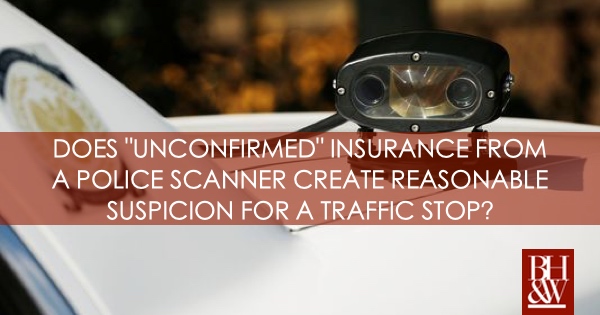
Police license plate scanner on vehicle roof with text overlay questioning if "unconfirmed" insurance creates reasonable suspicion for traffic stops, relevant to reasonable suspicion legal discussions by Howard Lotspeich Alexander & Williams, PLLC.

Whether “Unconfirmed” Insurance Creates Reasonable Suspicion to Stop

ByReasonable Suspicion

Is “Unconfirmed” Insurance Enough to Justify a Traffic Stop?

Police license plate scanner on vehicle hood with text overlay questioning if "unconfirmed" insurance creates reasonable suspicion for traffic stops.While conducting surveillance on an illegal immigration investigation, Homeland Security agents saw a vehicle leave a residence suspected of harboring undocumented immigrants. The agents notified local police officers to be-on-the-lookout for the vehicle. While on patrol, an officer began to follow the defendant’s vehicle because it matched the description of the vehicle from Homeland Security. While following the vehicle, the local officer entered its license plate number into a computer database designed to return vehicle information such as insurance status. The computer indicated the insurance status was “unconfirmed.” Based on his experience using this system, the officer reasoned that the vehicle was most likely uninsured, which is, of course, a violation of Texas law. The officer then conducted a traffic stop of the vehicle and learned that the defendant was in the United States illegally. The officer issued the defendant citations for violating the insurance requirement and driving without a license while he waited for the Homeland Security agents to arrive.

Defendant Challenges the Stop, Arguing that the Officer Lacked Reasonable Suspicion.

The United States government charged the defendant with conspiracy to harbor illegal aliens. The defendant argued that the “unconfirmed” insurance status obtained from the state computer database did not provide the officer reasonable suspicion to stop the defendant. The trial court was unconvinced by this argument.

The 5th Circuit Court of Appeals recognized that it had not yet addressed whether a state computer database indication of insurance status establishes reasonable suspicion as a matter of law. However, the court commented that the Sixth, Seventh, Eighth, and Tenth Circuits have found that such information may give rise to reasonable suspicion as long as there is either some evidence suggesting the database is reliable or at least an absence of evidence that it is unreliable. In this case, the court followed the other circuits that have decided this issue and held that a state computer database indication of insurance status may establish reasonable suspicion when the officer is familiar with the database and the system itself is reliable.

5th Circuit Upholds the Stop, Finding that “Unconfirmed” Insurance Creates Reasonable Suspicion.

Here, the court found that the officer’s testimony established the reliability of the database. First, the officer explained the process for inputting license plate information. Second, the officer described how records in the database are kept and stated that he was familiar with these records. Finally, the officer testified that based on his knowledge and experience as a police officer, he knows a suspect vehicle is uninsured when an “unconfirmed” status appears because the computer system will either return an “insurance confirmed,” or “unconfirmed” response. As a result, the court held that the officer had reasonable suspicion to stop the defendant.

Read the court’s full opinion in UNITED STATES V. BROCA-MARTINEZ, 2017 U.S. App. LEXIS 7612 (5th Cir. Tex. Apr. 28, 2017)

Misapplication of fiduciary property graphic featuring a white piggy bank and text referencing Texas Penal Code Section 32.45, relevant to white-collar crime legal consultation by Howard Lotspeich Alexander & Williams, PLLC.

Misapplication of Fiduciary Property in Texas | Texas Penal Code 32.45

ByWhite Collar

Misapplication of Fiduciary Property—What is it?

White piggy bank symbolizing misapplication of fiduciary property, with text overlay "Misapplication of Fiduciary Property" and "Texas Penal Code Section 32.45," representing legal issues related to fiduciary property in Texas.Misapplication of fiduciary property is a charge that is aimed at protecting beneficiaries of trusts, estates, receiverships and the like. Pursuant to Section 32.45 of the Texas Penal Code, a person commits the offense of misapplication of fiduciary property by intentionally, knowingly, or recklessly misapplying property he holds as a fiduciary in a manner that involves substantial risk of loss to the owner of the property. Tex. Penal Code Ann. § 32.45(b). “Substantial risk of loss” means a real possibility of loss. Casillas v. State, 733 S.W.2d 158, 163¬–64 (Tex. Crim. App. 1986). However, the possibility need not rise to the level of a substantial certainty (which is required for theft)—the risk of loss need only be more likely than not. Id.

Who is a “Fiduciary” Under Texas Law?

The penal code sets out four distinct groups that are considered fiduciaries pursuant to Section 32.45. These include:

  • A trustee, guardian, administrator, executor, conservator, and receiver;
  • An attorney in fact or agent appointed under a durable power of attorney;
  • An officer, manager, employee, or agent carrying on fiduciary functions on behalf of a fiduciary; or,
  • Any other person acting in a fiduciary capacity.

Id. at § 32.45(a)(1).

“Acting in a fiduciary capacity” is not defined in the penal code. However, the Texas Court of Criminal Appeals determined that because “fiduciary” has such a common meaning it should be construed according to its plain meaning. Berry v. State, 424 S.W.3d 579 (Tex. Crim. App. 2014).

The plain meaning of fiduciary means, “holding, held, or founded in trust or confidence.” More notably, a person who acts as a fiduciary is one “who has a duty, created by his own undertaking, to act primarily for another person’s benefit in matters connected with such undertaking.” Gonzalez v. State, 954 S.W.2d 98, 103 (Tex. App.—San Antonio 1997, no pet.). For example, courts have held that a person acts in a fiduciary capacity “when the business which he transacts, or the money or property which he handles, is not his or for his own benefit, but for the benefit of another person as to whom he stands in a relation implying and necessitating great confidence and trust on the one part and a high degree of good faith on the other part.” Gonzalez v. State, 954 S.W.2d 98, 103 (Tex. App.—San Antonio 1997, no writ).

Additionally, a person acting in a fiduciary capacity embraces any fiduciary, including a joint adventurer or partner. Coplin v. State, 585 S.W.2d 734 (Tex. Crim. App. 1979). This does not, however, include everyday business dealings. Berry, 424 S.W.3d at 584. The Court of Criminal appeals assume such transactions are entered into for a mutual benefit and, therefore, neither party is expected to act solely for the benefit of the other. Id.

What does it mean to “Misapply” Property?

The definition of “misapply” is fairly broad under the penal code. Pursuant to Section 32.45, a person who is a fiduciary misapplies property held as a fiduciary if the person deals property contrary to:

  • An agreement under which the fiduciary holds the property; or
  • A law prescribing the custody or disposition of the property.

Evidence that a defendant aided another person in misapplying property is sufficient, pursuant to the law of parties, to convict a defendant of misapplication of fiduciary property—even if the defendant did not personally handle the misapplied funds. Head v. State, 299 S.W.3d 414 (Tex. App.—Houston [14th Dist.] 2009, pet. ref’d). Furthermore, a defendant need not receive a benefit in order to misapply property. Talamantez v. State, 790 S.W.2d 33,37 (Tex. App.—San Antonio 1990, pet. Ref’d). Nor does it matter if a defendant donated the property to charity. Little v. State, 699 S.W.2d 316, 318 (Tex. App.—San Antonio 1985, no pet.).

Therefore, misapplication can occur by an omission or failure to act where a duty to act exists. Coleman v. State, 131 S.W.3d 303, 309-10 (Tex. App.—Corpus Christi 2004, pet. ref’d).

What does it take to Prove up an Agreement?

The government must prove the defendant knew of the agreement for misapplication to occur. Amaya v. State, 733 S.W.2d 168 (Tex. Crim. App. 1986). But, similar to “fiduciary,” Section 32.45 does not define “agreement.” Thus, the Court of Criminal Appeals construes agreement according to its plain meaning. Bynum v. State, 711 S.W.2d 321, 323 (Tex. App.—Amarillo 1986), aff’d, 767 S.W.2d 769 (Tex. Crim. App. 1989). To prove up an agreement, the State must be able to demonstrate a harmonious understanding or an arrangement, between two or more parties, as to a course of action. Id. Additionally, there is nothing in Section 32.45 that requires the agreement to be in writing or proved directly. Id.

Possible Defenses?

An effective defense to a charge of misapplication of fiduciary property is mistake of fact—otherwise negating the culpability required for the commission of the offense. Section 32.45 is designed to punish intentional, knowing or reckless misapplication of property. Thus, if it can be proved that the improper use or application of the property was the result of mere negligence, by mistake of fact, the statute will not apply. Other defense vary depending on the facts of the case.

What are the Penalties?

Texas has broad laws governing the use of property by a fiduciary. The charges can range from a Class C misdemeanor to a first-degree felony, based on the amount or value of property that is “misapplied.”

According to the Texas value ladder, an offense under this section is a:

  • Class C misdemeanor if the value of the property misapplied is less than $100;
  • Class B misdemeanor if the value of the property misapplied is $100 or more but less than $750;
  • Class A misdemeanor if the value of the property misapplied is $750 or more but less than $2,500;
  • State Jail Felony if the value of the property misapplied is $2,500 or more but less than $30,000;
  • Felony of the third degree if the value of the property misapplied is $30,000 or more but less than $150,000;
  • Felony of the second degree if the value of the property misapplied is $150,000 or more but less than $300,000; or
  • Felony of the first degree if the value of the property misapplied is $300,000 or more.

Id. at § 32.45(c).

Moreover, there is also an additional enhancement (to the next higher category) if it can be shown that the beneficiary was a person 65 years or older. § 32.45(d).

When Does Misapplication of Fiduciary Property Usually Occur?

This charge can arise in several different contexts. To name a few, misapplication of fiduciary property can occur:

  • When trustees misapply trust property;
  • When the holder of power of attorney makes a gift to herself;
  • When a business partner improperly diverts funds for personal use; or,
  • When an attorney misapplies a client’s funds.

These examples demonstrate that Section 32.45 covers many situations and may result in serious consequences. Thus, if you are under investigation or have been charged with the offense of misapplication of fiduciary property, it is necessary you seek help.

Misapplication of Fiduciary Property Defense Attorneys

Our criminal defense team handles Misapplication of Fiduciary Property cases in Tarrant County, Texas and surrounding areas. If you are under investigation for w financial crime or white collar offense, contact our firm today for a free case evaluation.

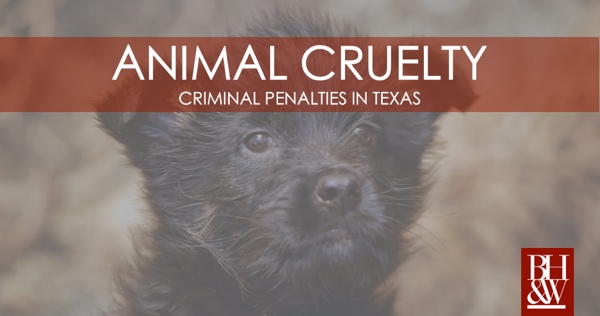
Animal cruelty awareness with a close-up of a black dog, overlaid with text "ANIMAL CRUELTY" and "CRIMINAL PENALTIES IN TEXAS," representing legal issues surrounding animal treatment in Texas.

Animal Cruelty Laws in Texas | Cruelty to a Non-Livestock Animal

ByAnimal Cruelty

Animal cruelty awareness graphic featuring a close-up of a black dog, with the text "ANIMAL CRUELTY" and "CRIMINAL PENALTIES IN TEXAS," representing legal implications of animal cruelty laws in Texas by Howard Lotspeich Alexander & Williams, PLLC.Texas is home to many animal owners. Whether residents own household pets, like cats and dogs, or livestock, most animal owners are responsible and ensure that their “fur babies” are provided with proper care. However, there are times when cases arise involving individuals who abuse or neglect their animal or someone else’s. If this occurs, there may be grounds for a police investigation and serious criminal charges. So, what conduct falls under animal cruelty laws in Texas and what are the potential criminal consequences?

What Constitutes Animal Cruelty?

Animal cruelty laws in Texas apply to domesticated animals, which are further divided into two categories:

  • Livestock animals
  • Non-livestock animals

Cruelty to non-livestock animals accounts for a majority of animal cruelty cases and, therefore, a proper understanding of Section 42.092 of the Texas Penal Code, governing animal cruelty to non-livestock animals, is essential.

Non-livestock animals are generally what most people would consider “household pets.” Section 42.092 defines a non-livestock animal as a domesticated living creature, including any stray or feral cat or dog, and a wild living creature previously captured. This would include dogs, cats, rodents and reptiles. Generally speaking though, animal cruelty laws do not apply to wild animals that are not captured—such as deer, wild hogs, mountain lions, etc.

Section 42.092 encompasses an array of behavior that is considered animal cruelty to non-livestock animals. To be charged with animal cruelty under this section, a person must have performed these “cruel acts” intentionally, recklessly or knowingly. The types of cruel behavior the statute covers include:

  • Torturing an animal (causing unjustifiable pain or suffering);
  • Killing an animal in a way that is considered cruel or leads to serious bodily injury of the animal;
  • Administering poison to an animal;
  • Failing to provide a reasonable amount of food, water, care and shelter to an animal;
  • Abandoning an animal;
  • Transporting or confining an animal in an unreasonable or cruel way;
  • Causing an animal to engage in a fight with another animal (if the animal is not a dog—dog fighting has its own Section in the penal code);
  • Without the owner’s consent, causing bodily injury to an animal;
  • Using a live animal as a lure in a dog race; or,
  • Seriously overworking an animal.

Some of these definitions are broad and can potentially cover a wide range of abuse.

Potential Consequences

Misdemeanor Animal Abuse

A person who intentionally, knowingly or recklessly fails to provide a reasonable amount of food, water, care and shelter; abandons an animal; transports or confines an animal in a cruel manner; causes bodily injury to an animal; or seriously overworks an animal will be punished with a Class A misdemeanor.

An individual convicted of a Class A misdemeanor may be sentenced to up to a year in county jail and a fine of up to $4,000. Additionally, a person who has been previously convicted two times for animal cruelty will have their punishment enhanced to a state jail felony. (see below for definition)

Felony Animal Abuse

3rd Degree Felony: A person who intentionally, knowingly or recklessly tortures; kills; administers poison to or causes serious bodily injury of an animal may be guilty of a Third Degree Felony. An individual convicted of a Third Degree Felony may be sentenced from 2 years to 10 years in prison and a fine up to $10,000.

A person who intentionally, knowingly or recklessly causes one animal to fight with another; or, uses a live animal as a lure could be punished with a State Jail Felony. A State Jail Felony may be sentenced from 180 days and up to two years in a state jail facility and a fine up to $10,000.

Additionally, a person who has been previously convicted two times for animal cruelty will have their punishment enhanced by one felony degree.

Defenses

Section 49.092 of the Texas Penal Code provides several defenses to prosecution of animal cruelty of non-livestock animals. For example, it is a defense if:

  • The animal is killed in self-defense;
  • The animal is killed or injured upon discovering the animal injuring or killing the person’s livestock or damaging the person’s crops;
  • The conduct occurs for legal hunting or agriculture practices; or
  • The conduct occurs for true scientific research.

While there are many potential defenses, a conviction for animal cruelty can be extremely serious and it may jeopardize a person’s future animal ownership rights. Thus, it is essential to seek help if you have or may be charged with animal cruelty.  Contact our team of criminal defense attorneys for a free consultation about your animal cruelty allegation.

Grand jury illustration featuring a panel of jurors with the text "What is the Grand Jury?" emphasizing the role of grand juries in Texas criminal law, relevant to Howard Lotspeich Alexander & Williams, PLLC's legal services.

What is a Grand Jury? | The Role of the Grand Jury in Texas Criminal Law

ByGrand Jury

Illustration of a grand jury with diverse jurors seated behind a bench, captioned "What is the Grand Jury?" relevant to Texas criminal law and the grand jury process.You may hear on the news that a case is going to the Grand Jury and wonder, What exactly is a Grand Jury? Is a grand jury to same thing as a regular jury? Can does a grand jury have special powers that a regular jury doesn’t have? Where does a grand jury fit into my case? This article seeks to answer those questions and clear up some of the myths about grand juries in Texas.

What is a Grand Jury?

A grand jury is group of 12 citizens that review felony criminal charges to determines whether probable cause exists for the case to continue forward. This is NOT the same type of jury that hears the case at trial.  The Grand Jury does not decide guilt or innocence, only probable cause. If the grand jurors determine that there is probable cause, then they vote to indict the case. An indictment is an essential part of every criminal case. If the grand jurors determine that there is not probable cause to believe an offense has been committed by the named defendant, then they vote to issue a no-bill. A no-bill typically means the case is dismissed and the District Attorney will not proceed with prosecution of the case.

How are the Grand Jurors Selected to Serve?

Prior to 2015, grand juries were chosen by “jury commissioner” appointed by district court judges. This process was known as the “pick-a-pal” system. The law changed in September 2015 and now grand jurors are selected in a random fashion, akin to the trial jury selection system. The jury pool is taken from registered voters in the county in which the court presides. Prospective jurors cannot have been convicted of any felony offense or a misdemeanor involving moral turpitude (like theft). They must also not have any criminal charges pending against them.

What is an Indictment?

An indictment is the formal accusation of a crime, issued by a grand jury. Prior to an indictment, the district attorney typically makes an allegation through a complaint. A complaint can become an indictment only after the grand jury votes to issue the indictment.  Only an indicted felony case can proceed to trial (where the real jurors decide whether a defendant is guilty or not guilty).

What is a No-Bill?

If a grand jury decides that a felony charge is not supported by probable cause, then it votes to return a no-bill on the case. This literally means that there was “no bill of indictment” issued. Sometimes, instead of a complete no-bill, a grand jury will indict a lesser-included charge, taking the felony to a misdemeanor.

The Mechanics of the Grand Jury Process in Texas

It is important to understand that the grand jury process is a secret proceeding. The defendant and his attorney do not have a right to be present in the hearing room or to present evidence unless the district attorney permits them to make a presentation. It is discretionary for the DA to allow either a paper submission or live testimony offered by the defense. During the grand jury hearing for a particular case an Assistant DA will explain the charge and the legal elements that the state is required to prove. The ADA will then run down the evidence from the police report and other video/audio recordings, giving the grand jurors a brief synopsis of the facts. The jurors can ask questions of the ADA and request further evidence if needed. In some cases, the ADA will call witnesses like police officers or victims to give testimony regarding the alleged offense. Most cases can be completed with the grand jury in a matter of hours, but the occasional complex case might take longer.

How is a Grand Jury Difference from a Regular Jury?

The grand jurors serve a term (approximately three months), usually coming to the courthouse a couple of day each week. A regular jury comes for jury service and will only hear one case. A grand jury only hears a brief version of the facts from the side of the state while the regular trial jury will hear the full version of the facts from both sides as well as cross-examination of the witnesses. Grand jurors can only vote to indict or no-bill. They cannot find a person guilty or not guilty – only a trial jury can do that. So, in a sense, the trial jury actually has the “grand” power.

Should the Defense Make a Grand Jury Presentation?

In our experience, it can be incredibly helpful to make a defense presentation to the grand jury. This can mean the difference between a felony indictment, a misdemeanor lesser charge, or a complete dismissal. Sometimes the best presentation is a written presentation and other times the defense would be better served to address the grand jurors in person. It really depends on the case and the overall strategy of the defense team. Grand jurors like to ask questions, so being there to answer them is usually a good thing (if you have good explanations).

Howard Lotspeich Alexander & Williams, PLLC logo featuring text "Howard Lotspeich Alexander & Williams, PLLC Attorneys and Counselors at Law" with a modern design in gray and red colors.

Indecent Exposure: From Class B Misdemeanor to Sex Offender

BySex Crimes

Sex Offender Registration for the Offense of Indecent Exposure

Most “sex offenses” in Texas are felonies. Most sex offenses involve some sort of physical contact or an indecent act with a minor. However, there is one offense that is classified as a low-level Class B misdemeanor, than can result in sex offender registration.

Indecent Exposure under Section 21.08 of the Texas Penal Code is a Class B misdemeanor, which means it only carries a range of punishment of 0-180 days in county jail and a fine up to $2,000. Indecent Exposure can range from urinating on a public golf course, to having intercourse in a parked car in a public parking lot, to flashing someone. A person convicted or sentenced to Deferred Adjudication for Indecent Exposure does not typically have to register as a sex offender. If the offense is the first time that person has been charged or convicted with Indecent Exposure, then there is no registration requirement.

10-Year Sex Offender Registration for the 2nd Indecent Exposure Conviction

Under Section 62.005(5)(F) of the Texas Penal Code, a person is required to register as a sex offender for a period of 10 years for “the second violation of Section 21.08 (Indecent exposure), Penal Code.” However, “if the second violation results in a deferred adjudication,” then the person is not required to register. Because the statute uses the term “violation,” instead of “conviction,” a first charge of Indecent Exposure that results in a deferred adjudication still counts toward the total, even if the defendant ultimately has their case dismissed. So it is imperative that a defense attorney negotiate for a deferred adjudication if their client has a previous conviction or deferred for Indecent Exposure.

See what other crimes require Sex Offender Registration in Texas.

How to request your military service records with visible military branch seals and organized file folders in the background.

How to Request a DD-214 or Other Military Service Records

ByVeterans

Getting a DD-214, Service Medical Records, or Other Military Service Information for Your Client

How to request your military service records with military branch insignias and file folders in the background.Once a United States servicemember has been released from active duty, they are issued a DD-214. The DD-214 is a critical document, in that it records the member’s discharge classification (e.g. Honorable, General, Other than Honorable, Bad Conduct, Dishonorable), lists their tours of foreign duty, and assigns a re-entry code. The DD-214 is proof of service, and is used to verify eligibility for government benefits, including the GI Bill, VA loan, and others. Additionally, whether applying for a home loan, renewing a driver’s license, or applying for a college scholarship, the DD-214 is very useful.

In my line of work, I often need to see my client’s DD-214 in order to show the prosecutor that my client is an honorably discharged veteran or to help them apply for a Veteran’s Court program. Additionally, service medical records and other administrative documents contained within an Official Military Personnel File (OMPF) are often useful when defending a criminal case.

Use Standard Form 180 (SF-180) to Apply for Military Service Record Documents

TheStandard Form 180, Request Pertaining to Military Records (SF-180) is used to request information from military records. Certain identifying information is necessary to determine the location of an individual’s record of military service. When filling out the SF 180, you should try to answer each item on the form, if possible. If you do not have and cannot obtain the information for an item, write “NA,” meaning the information is “not available,” but try to include as much of the requested information as you can. Incomplete information on the SF 180 can delay response time. To determine where to mail the request form, look at Page 2 of the SF-180 for record locations and facility addresses.

What Information Do I need in Order to Make a DD214 Request?

The following information is required to request military service records, including a DD-214:

  • Veteran’s complete name used while in service
  • Service number (usually, the Social security number, until recently when the DOD moved to a new DOD ID#)
  • Branch of Service.
  • Dates of entry and Date of release of service
  • Date and place of birth

How Long Does it Take to Receive Military Records and How Much Does it Cost?

I can only speak from experience. Every time I have requested military records from one of my clients, using the SF-180, I have received the requested personnel records within 45 days from the applicable records center. If you fill out as much of the SF-180 as possible, then the chances are that you will receive a response from the records center faster than if you leave items blank. Additionally, if you are request personnel documents on behalf of a military veteran client, then you’ll want to include a Power of Attorney with your request. I typically have the client sign the request form but then use my office address as the place to mail the records. You can check the status of your records request by telephone at NPRC Customer Service Line (314) 801-0800.

There is no cost, typically, for receiving a DD-214, medical records, or a basic OMPF. Some records will involve a fee, but you will be contacted if that is the case, prior to them sending you the records.

Expedited Service for Military Service Records

If you need records immediately, for a funeral, trial, or something urgent, you should try using the service (eVetRecs) from the National Archives. They strive for a 2-day turnaround on urgent requests.  You could also use this service instead of the SF-180 if you choose, even if your request is not urgent.


If you are a retired or discharged military member and you do not have several copies (or an e-copy) of you DD-214, you should download the SF-180 and request your records today. You never know when you’ll need them.

*PLEASE NOTE: Our firm only assists current clients in retrieving military service records as needed for their cases. Do to time limitations, we cannot help others in getting their military records. But hopefully, some of the information on this article will help you get your records.

Pass out or blackout text overlay on image of man lying on couch surrounded by party remnants, illustrating the effects of alcohol on memory in sexual assault contexts.

Passout vs. Blackout: How Alcohol Can Affect Memory (Voice for Defense Article)

BySex Crimes

Alcohol and Memory: An Interview with Texas Forensic Psychologist, Dr. Kelly Goodness, Ph.D
Person lying on a couch surrounded by empty drink containers and party debris, with overlay text "PASS OUT or BLACKOUT HOW ALCOHOL CAN AFFECT MEMORY," relevant to discussions on alcohol's impact on memory in sexual assault cases.As you can probably imagine, many criminal cases involve events that occur when people are intoxicated. This can be especially true for cases involving allegations of sexual offenses. In these alcohol-fueled situations, the issue of memory can play a large part in the case. When we encounter intoxication and memory issues in sexual assault cases, we often employ the assistance of a forensic psychologist to serve as either an expert consultant or expert witness.  One of the best in her field is Dr. Kelly Goodness of Keller, Texas. Dr. Goodness is an expert in alcohol and the brain, including the difference between “pass out” and “blackout” evidence.  She is one of the most highly employed experts for alcohol-related sexual assault cases involving members of the U.S. Military. What follows is an interview that we conducted with Dr. Goodness regarding how alcohol can impact a person’s memory and how it can apply to the sexual assault context.
______________________

Q: Dr. Goodness, How is Alcohol Related to Memory?

A: Alcohol is a potent amnestic agent. Beginning with just one or two drinks, alcohol can produce detectable memory impairments. As the dose increases, so does the potential magnitude of the memory impairments, all the way up to the total inability to recall events during a drinking episode, otherwise known as a blackout.

Q: How does alcohol disrupt memory formation?

A: There are three general processes involved in long-term memory formation, all of which can be impacted by alcohol. First, information must be perceived by one or more of the senses (sight, hearing, taste, smell, and touch) to form a sensory memory which can last a few seconds. Second, if concentrated on for more than about eight seconds, sensory memory can be transferred to short-term memory to be retained. Short-term memory can last from seconds to minutes, depending on distractions and ability to rehearse or repeat the information. Third, once some kind of association or sufficient repetition has occurred; information can be consolidated, encoded and transferred from short-term memory into long-term memory which then makes the information available for later recall.

Alcohol, affects all stages of the memory process, but the primary effect is on the transfer of information from short-term to long-term memory storage. The drinker can recall long-term memories that were established before they became intoxicated, but their ability to transfer information into long-term storage can begin to degrade with just one or two drinks. As the dose of alcohol increases, the impairment increases and can culminate in blackouts. When blackouts occur the individual can participate in complex activities and even very emotionally charged events that they later cannot remember.

Q: You mentioned blackouts. What exactly is a blackout?

A: Blackouts are periods of amnesia, caused by excessive consumption of alcohol, during which a person actively engages in behaviors, but the brain’s ability to create memories for what transpires is impaired or non-existent. This leaves holes in a person’s memory that can range from spotty recall for events of the previous night (or drinking episode) to the utter absence of memory for large portions of an evening. The person is still able to carry on conversations, engage in activities and respond to others. They just will not recall some or all of what occurred.

Q: Are there different types of blackouts that a person can experience?

A: Yes. There are En Bloc Blackouts and Fragmentary Blackouts. Blackouts are classified based on the extent of amnesia. The amnesia can be total (“en bloc”) or partial (“fragmentary”).

En Bloc blackouts are classified by the inability to later recall any memories from the intoxication period, even when prompted or given cues.

  • No matter what happens, you can never recall it.
  • The information was never recorded so recall is not possible.
  • Memory of what transpired cannot be restored through hypnosis or any other means because no memory ever truly existed.
  • It is difficult to determine the end of this type of blackout as sleep typically occurs before they end.

Think of a loved one you have known who has Alzheimer’s. They may tell you what they had for dinner and five minutes later tell you the exact same thing. They never recorded the event of initially informing you in the first place, so they tell you again. En Bloc blackouts are essentially the same phenomenon – just with a different cause.

Fragmentary blackouts are characterized by the inability to recall some events from an intoxicated period, but not all events.

  • The person may be unaware that memories are missing until reminded by others of the existence of these “gaps” in memory.
  • Cues can help them remember at least some of what happened because at least some of the information actually was recorded.
  • They may have more snapshot type recall and it may not be in sequential order.
  • Research indicates fragmentary blackouts are far more common than en bloc blackouts and likely involve alcohol-induced deficits in contextual memory.

Q: Is a blackout different from passing out?

A: Yes, they are different. Although many people refer to “passing out” as going to sleep following ingestion of alcohol, when I say “pass out” in my testimony or describing the research, I am referring to the more formal definition as used in the field of alcohol treatment, in which a pass out is a loss of consciousness due to excessive alcohol intake. By definition, blackout and pass out are mutually exclusive: a blackout is amnesia for the events of any part of a drinking episode, without loss of consciousness. A person in blackout continues to interact and perform complex activities, but has amnesia for these events. A person who is passed out is unconscious and is not having any behavioral experiences to record.

Q: Can blackout and pass out co-occur?

A: Yes. Passing out and blacking out can co-occur. Under the right conditions, a person who consumed alcohol to the point of passing out can be awakened from sleep, engage in activities and have a blackout for that time period.

Q: Can you tell if someone is having a blackout?

A: Determining whether someone is in a blackout state from their behavior alone is next-to impossible. To outside observers, the person may appear to be aware and functioning well enough. During blackouts, people can participate in events ranging from the mundane, like eating food, to the emotionally charged, like fights or serious aggression, with little or no recall. They can drive a car, have a normal conversation, or engage in sexual relations.

Even loved ones are unlikely to know. We know that the wives of alcoholics who are known to be prone to blackouts may only know their husband was blacked out when he does not recall information the next day.

Research designed to bring about blackouts shows that those who are in the midst of an En Bloc blackout can easily recall things that have occurred within the last 2 minutes, yet they cannot recall anything that occurs during the episode prior to this period.

Q: From your knowledge of the research on this topic, what causes blackouts?

A: Blackouts are caused by the selective effects of alcohol on specific brain systems and involve a breakdown in the production and utilization of proteins and neurotransmitters in the brain. Blackouts can occur from rapid consumption of alcohol, such as guzzling, chugging, or shots and are more likely with consumption of hard alcohol or the combination of hard alcohol and beer, versus beer alone.

Q: Is there a typical Blood-Alcohol Concentration (BAC) at which a blackout is likely to occur?

A: Blackout BAC’s are individual dependent, but we know the blood-alcohol level is typically very high (above 0.25) when a blackout occurs. Some recent studies indicate .28 to .30 as the median BAC at which blackout is likely to occur. Still, a person can experience a fragmentary blackout with a BAC as low as .08 and an en bloc blackout with a BAC of.14 and above. These can only be used as estimates.

Q: Is intoxication level synonymous with blackouts?

A: No. Intoxication depends not only on the blood alcohol level, but on the rate of increase and tolerance of the individual. One may have a blackout without appearing grossly impaired. One may be drunk with poor judgment and control but not blackout. This is why even eye-witnesses may be (and usually are) unaware that a person is having a blackout.

Q: Are there any known risk factors for blackouts?

A: Yes. The following are risk factors typically associated with alcohol blackouts:

  • Drinking on an empty stomach as there is less food to absorb alcohol
  • History of serious head injury
  • Heavy drinker – but to be sure – a blackout can happen with a single drinking episode and naïve drinkers are not immune
  • History of prior alcohol blackouts – past history of blackouts shows the person is vulnerable ad also can produce damage that predisposes the person to future blackouts
  • Genetic predisposition
  • Alcohol in combination with certain common drugs
  • Female

Q: Why are females more vulnerable to memory impairment when drinking?

A: Several reasons.

  • Females typically weigh less.
  • They also have less water in their bodies, which means that they cannot dilute the alcohol as well, which can result in a higher alcohol levels in the brain.
  • Females are more likely to skip meals to save calories when they drink which means there is less food in the stomach to help absorb alcohol.
  • Females are more likely to drink beverages that are higher in alcohol concentration such as wine and mixed drinks rather than beer.
  • Females have less of an enzyme in the gut that breaks down alcohol before it gets into the body. In fact, studies have shown that it takes much less alcohol for women to experience blackouts than for men.

Q: What does research indicate is the prevalence rate of blackouts?

A: Research shows that 50% of college-age drinkers experience blackouts. Further, one in four college students who drink will experience a blackout in a given year. Although blackouts commonly occur with alcoholics, blackouts also occur in 25% of social drinkers.

Q: How can we know if a blackout is real or feigned?

A: It is hard to know. However, we can look at the known risk factors I previously discussed to determine whether the person was at a legitimate risk of experiencing a blackout.

Q: How does a drinker usually know if they passed out or experienced a blackout?

A: The short answer is they often do not know – and they especially do not know for sure given holes in their memory. Passout or blackout experiences are deduced from the circumstances in which the drinker finds themselves once they rouse, or from the information they are provided by others, or a combination of both. Loosing time through passout or a blackout can be very disturbing to an individual.

Once they wake, begin to sober, or are confronted by information from their surroundings or facts alleged by others; the drinker does what we all do all the time – they try to make sense of their situation by filling in the blanks with what seems logical to them. Their efforts may lead them to inaccurate assumptions and conclusions. This can be particularly true when the drinker has personal (i.e., religious, moral, employment) reasons for being distressed by behaviors such as those involving sexual activity.

Q: Can you explain how you would distinguish between a blackout and a pass out?

A: The fact patterns must be considered. If a person is so intoxicated that they are rendered unconscious, it should take significant time to return to normal cognitive and motor functioning. On the other hand, if a drinker was able to get up, communicate generally coherently, engage in physical movement, but later could not recall doing so, a blackout is much more likely.

Q: In a sexual assault allegation, why is it significant that the complainant might have been in a blackout rather than passed out?

A: Many who have experienced a blackout presume they physically and mentally could not have initiated or participated in sexual activity since they have no memory of doing so and may conceptualize themselves as someone who would never engage in sex in that situation or perhaps even with that person. Moreover, the notion they may have engaged in sex may bring them great cognitive dissonance and angst. As such, they may jump to the conclusion that they were passed out which by definition (unconscious) would mean they could not have participated. In reality, those who are in a blackout can, and do, engage in very complex behaviors including initiating and participating in sexual activity they simply will not recall because the memory traces were not encoded. To be sure, a person in a blackout can continue to perform any number of complex behaviors including driving, making purchases, arguing, criminal activity, and importantly – initiating and engaging in sexual activity – making it sometimes vital for fact finders to understand the psychological science related to blackouts.

Q: Thank you for your time, Dr. Goodness. If someone wanted to retain you to review a sexual assault case, how would they go about doing that?

A: They can either email me at kelly.goodness@drgoodness.com or contact my office at (817) 379-4663 and we can go from there.
______________________

As you can see, alcohol can have a significant impact not only in the decisions that a person makes, but also in the way they remember those decisions. In the sexual assault context, this is particularly important because a complaining witness may engage in (and perhaps even initiate) sexual behavior and not remember what he or she did. Without a memory of the night’s events, the complaining witness might mistakenly believe that they were “passed out” when the sexual behavior occurred and that they were taken advantage of by an opportunistic assailant, when in all reality, they were an active and willing participant. Based on their words and actions, others around them, including their sexual partner, would have no idea that the person was experiencing an en bloc or fragmentary blackout.

Thank you to Dr. Kelly Goodness for her time an expertise in preparing this article. Dr. Goodness’s contact information is provided below:

Kelly R. Goodness, Ph.D
Clinical and Forensic Psychology
121 Olive Street
Keller, Texas 76248
www.drgoodness.com
Office: (817) 379-4663

________________

Brandon Barnett is a criminal defense attorney with Barnett Howard & Williams PLLC in Fort Worth, Texas. He earned his J.D. from Texas Tech University School of Law and his LL.M. from George Washington University Law School. He is also a military judge in the Marine Corps Reserve and an adjunct professor at Texas A&M University Law School. He can be reached at barnett@bhwlawfirm.com.

Kelly Goodness, Ph.D. began her career as a clinical psychologist at the maximum security forensic hospital in Vernon, Texas. She entered private practice after learning lessons that could never be taught in a book and achieving recognition for her ability to identify and treat the factors that led individuals to be labeled the most dangerous and violent psychiatric patients in Texas. Dr. Goodness developed a thriving practice as a criminal litigation consultant and expert witness who feels privileged to offer her expertise in jury selection, case theory, expert testimony, and case presentation to the parties in state, federal and military cases worldwide with a special focus on homicide and sexual assault.