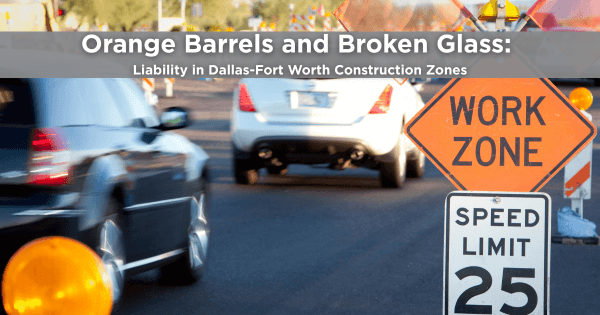
Navigating the maze of orange barrels in Dallas-Fort Worth: When confusion leads to a crash, proving liability often requires looking beyond the driver to the construction company itself.
If you live in Keller or commute through Fort Worth, you know the reality: the orange barrels seem permanent. Whether it is the massive widening projects along I-30 from Linkcrest Drive to I-820, or the perpetual “North Tarrant Express” updates on I-35W, Tarrant County drivers are constantly navigating a shifting maze of concrete barriers.
But here is the hard truth that many drivers overlook: Construction zones do not just cause traffic; they actively create hazards.
When a crash happens in these confused, narrow chutes of highway, the default assumption is “driver error.” The police report might simply say “Failure to Control Speed.” However, as experienced attorneys, we know that in many cases, the road designwas the true culprit.
If you were injured because a construction company created a “trap” on the roadway, who is responsible? The answer lies in a complex intersection of engineering standards and Texas law.
The Anatomy of a “Construction Negligence” Case
It is not enough to say the road was confusing. To win a personal injury claim involving road construction, we must prove that the setup violated the Standard of Care.
In Texas, construction companies are bound by specific safety protocols, usually outlined in the Texas Manual on Uniform Traffic Control Devices (TMUTCD).
Common violations we see in Fort Worth include:
The “Ghost Lane” Phenomenon
When traffic is shifted to a new pavement section, the old white lines must be completely obliterated. Often, contractors do a poor job of grinding them off. When it rains or the sun hits at a certain angle (glare), the old lines reappear. If you drifted into a car because you were following what looked like a valid lane, that is a failure of the contractor’s duty to warn.
The “Edge Drop-Off” Hazard
During widening projects (like on I-30), contractors often leave a significant drop-off between the paved lane and the shoulder. If a wheel slips off the edge, a driver’s natural reaction is to jerk the steering wheel back, often causing a rollover or a crossover head-on collision. If that drop-off was not properly marked or shielded with barriers, the contractor may be liable.
Inadequate Signage Spacing
The TMUTCD mandates exactly how far in advance a “Right Lane Closed” sign must be placed based on the speed limit. If the speed limit is 65 MPH but they placed the warning sign only 100 feet before the taper, they effectively deprived you of the reaction time needed to merge safely.
The Legal Hurdle: Sovereign Immunity vs. Private Liability
This is the most critical legal concept for victims to understand.
The Government (TxDOT):Under the doctrine of Sovereign Immunity, the government is generally immune from lawsuits. You generally cannot sue TxDOT for a design decision they made years ago.
The Private Contractor:TxDOT hires private consortiums and construction firms to execute the work. These private companies do not enjoy the same immunity.If a private contractor deviates from the approved Traffic Control Plan (TCP)—for example, if the plan said “place barrels every 20 feet” and they placed them every 50 feet—they can be sued for negligence.
- The “Derivative Immunity” Defense:Contractors often try to argue, “We were just doing what TxDOT told us to do.”
- How We Defeat It:We subpoena the daily logs and inspection reports. If we can prove the contractor cut corners, ignored the blueprints, or failed to fix a known hazard (like a pothole or missing sign) within a reasonable time, they lose that protection.
The “Proportionate Responsibility” Trap
Insurance adjusters love construction zone accidents because they are chaotic. Their favorite tactic in Texas is to use the Modified Comparative Negligencerule (the “51% Bar”).
They will argue: “Sure, the lane lines were confusing, but you were driving 5 MPH over the work-zone speed limit. Therefore, you are more than 50% at fault, and we owe you nothing.”
In a construction zone case, fighting this percentage is everything. We counter this by hiring accident reconstruction experts who can prove that no reasonable drivercould have navigated that hazard safely, regardless of a minor speed variance. We shift the focus from your driving to the inevitabilityof the crash caused by the trap they set.
The Investigation: What We Look For
If you hire a generalist lawyer, they might just pull the police report. At Howard Lotspeich Alexander & Williams (HLAW), we dig much deeper for construction-specific evidence:
- The Traffic Control Plan (TCP):The literal blueprint of where every cone and sign shouldhave been. We compare this to photos of where they actually were.
- The Contractor’s Daily Logs:Site superintendents must keep logs of work performed and inspections made. Did they check the signs that morning? Did they note that a barrier had been knocked over but fail to fix it?
- 311 and TxDOT Complaint Logs:Often, other drivers have reported the exact same hazard days before your crash. If the contractor knew about the danger and ignored it, that moves the case from simple negligence to potentially gross negligence.
- Body Cam & Dash Cam Footage:Police body cams often capture the officer complaining about the confusing road setup. This is powerful jury evidence.
Steps to Protect Your Claim Immediately
Construction zones change daily. The evidence that exists today will be paved over tomorrow.
- Take Wide-Angle Photos:Don’t just photograph the damage to your car. Photograph the approach to the crash site. We need to see what the signs looked like beforeyou hit the hazard.
- Check for Witnesses:Did other drivers stop? Ask them if they found the lane configuration confusing.
- Preserve Your Vehicle:If the crash was caused by a mechanical failure due to road debris or a drop-off, the physical damage to your tires and suspension is evidence. Do not let the insurance company salvage the car until we have inspected it.
Why Local Representation Matters
Navigating a claim against a major construction consortium is not a DIY project. These companies have teams of lawyers whose sole job is to blame the driver.
You need a firm that understands both the Criminal (traffic citations) and Civil (injury) sides of the law to protect your rights fully. If you or a loved one has been injured in a confusing construction zone in Keller or Fort Worth, don’t assume it was just “bad luck.”
[Contact HLAW Today for a Case Evaluation]
Let our team investigate if a failure in the road design turned your commute into a crisis.