
Tag

Drugs

CBD Oil Legal Texas

Is CBD Oil Legal in Texas? Perhaps, But it Must Fit These Qualifications

By Drug Crimes

What is CBD Oil?

CBD Oil Legal TexasCBD Oil, which is short for cannabidiol oil, is a cannabinoid extract that is alleged to have the health benefits of cannabis (e.g. pain relief, easing of inflammation, anxiety management and the treatment of epilepsy) without the psychoactive effects of marijuana. CBD Oil is sold as a supplement in marijuana dispensaries, nutrition stores, and even as an additive in smoothies. While the popularity of CBD Oil is growing substantially, the product remains unregulated by the U.S. Food and Drug Administration, leading to wide discrepancies in the product’s ingredients and quality. The variety of ingredients and compounding methods may have significant ramifications for consumers depending on Federal and state law and the interpretation of those laws by state law and health code enforcement agencies.

Is CBD Oil Legal Under Federal Law?

Yes, if it is produced within federal guidelines.

As of December 20, 2018, the Fed Gov has legalized hemp that has a tetrahydrocannabinol (THC) concentration of no more than 0.3% by removing it from Schedule I of the controlled substances act. States and Indian Tribes may regulate the production of Hemp by submitting a plan to the USDA. This bill also makes hemp producers eligible for the federal crop insurance program and certain USDA research grants.

With the passing of the new 2018 Farm Bill, hemp and hemp-derived products have been officially removed from the purview of the Controlled Substances Act, such that they are no longer subject to Schedule I status. Meaning that so long as CBD is extracted from hemp and completely pure (with less than 0.3% THC on a dry weight basis of THC, something the DEA doubts is possible) and grown by licensed farmers in accordance with state and federal regulations, it is legal as a hemp product.

However, in 2016 the Drug Enforcement Agency released an administrative ruling considering CBD Oil to be a Schedule One drug, comparable to heroin, peyote and LSD, operating on the theory that it is extracted from the same parts of the Cannabis sativa plant that contain THC, the active ingredient of marijuana. CBD consumers and manufacturers assert that CBD can also be extracted from the non-intoxicating parts of the Cannabis sativa plant that produce hemp, however, a recent 9th Circuit decision affirmed the DEA’s authority to classify CBD Oil as within their administrative purview.2

For CBD Oil to be considered legal in the Federal system under the DEA’s guidelines it must “consist[] solely of parts of the cannabis plant excluded from the CSA definition of marijuana.” In the definition of marijuana given by the Controlled Substances Act, the “mature stalks of such plant, fiber produced from such stalks, oil or . . . any other . . derivative, mixture, or preparation of such mature stalks” are excluded from the definition. Presently the DEA considers an extraction process using only the parts of the cannabis plant that are excluded from the CSA definition of marijuana to be “not practical.” This is because the extraction process used would “diminish any trace amounts of cannabinoids that end up in the finished product.”

Is CBD Oil Illegal Under the Laws of the Various Individual States?

Yes, CBD is legal, but not in all states.

At the state level, CBD Oil is considered legal in the states where marijuana is legal for recreational use (Alaska, California, Colorado, DC, Maine, Massachusetts, Nevada, Oregon, Vermont). Twenty-nine states have made marijuana legal for medical use in various quantities and CBD is also considered legal under those state laws, irrespective of the THC content of the source of the oil. In states that have not decriminalized marijuana, CBD Oil is also likely illegal.

Is CBD Oil Legal In Texas?

NO, unless you fall within the qualifications set by the Compassionate Use Act.

If you are prescribed the use of medical CBD oil and use ‘low-THC” CBD, then the use is legal. Texas has legalized marijuana for medical use only, but only in a very narrow set of circumstances. The Compassionate Use Act of 2015 authorizes the prescription of “low-THC cannabis,” defined as having no more than 0.5% THC for patients diagnosed with intractable epilepsy and entered into the state-maintained “compassionate-use registry.”3 The Act requires prescription by two physicians however, it is currently illegal under federal law for a physician to “prescribe” marijuana. Under a 2000 court ruling, it is legal for physicians to “recommend” marijuana to their patients but the language of the Compassionate Use Act calls for a prescription, setting up a conflict with Federal law.4 Additionally, to qualify for the medical use of CBD, the patient must have tried two FDA-approved drugs and found them to be ineffective. There are currently three dispensaries licensed by Texas to sell qualifying products to authorized consumers.

If you do not fall within the qualifications set by the Compassionate Use Act, then possession of CDB oil containing any amount of THC is against Texas law. The State definition of marijuana closely tracks the Federal definition. The Texas Health and Safety Code defines marijuana as “the plant Cannabis sativa . . . and every compound, manufacture, salt, derivative, mixture, or preparation of that plant or its seeds.” The Code excludes “the mature stalks of the plant or fiber produced from the stalks [and] a compound, manufacture, salt, derivative, mixture, or preparation of the mature stalks, fiber, oil.” Texas does not currently have legislation allowing for the cultivation of hemp, though industrial hemp derived from the mature stalks of the Cannabis sativa plant may be sold and consumed.

What is the Penalty for Possession of CBD Oil in Texas?

In Texas, if you possess CBD oil with any trace of THC, you could be charged with a Felony for Possession of a Controlled Substance in Penalty Group 2, which (depending on the weight in grams) can carry a range of punishment from 180 days in a state jail facility up to 20+ years in prison and a fine not to exceed $10,000. Several of our clients have been arrested for possessing CBD oil after officers performed a field test and discovered that yielded a positive result for THC.

If the CBD oil does not contain any THC, is it currently a Schedule V substance not in any penalty group. Possession of CBD with no THC can be charged as a Class B Misdemeanor with a punishment range of 0 – 180 days in jail and a fine up to $2,000.

What To Look For In CBD Oil In Texas

CBD Oil made from the mature stalks of the Cannabis sativa plant are likely in conformity with both Federal and Texas State law. Consumers seeking to purchase CBD Oil in Texas should look for a product advertised as being the product of “industrial hemp” or “mature hemp.” Products advertised as containing “THC” or “CBD Oil” should be avoided because of potential conflict with State and Federal laws.

  • Texas consumers with intractable epilepsy may seek to join the Compassionate Use Registry and get a prescription for CBD Oil containing less than 0.5% THC from an authorized dispensary.
  • Physicians should be mindful that “prescribing” CBD Oil to Texas residents under the Compassionate Use Act may fall into conflict with existing Federal law.
  • Retailers that are not one of the three state-authorized dispensaries authorized by the Compassionate Use Act should take care to carry only products that do not advertise themselves as containing CBD Oil but instead focus on being the product of industrial hemp.

Where Can I Purchase CBD Oil with 0% THC?

While there are many CBD oil stores popping up all over Texas, we have found one near our office that sells CBD Oil with 0% THC in it. They test it to confirm the THC content so that you can be sure of what you are getting. Visit Your CBD Store at https://yourcbdstorekeller.com to learn more or purchase their CBD products online. But remember that even though many agencies are not choosing to arrest or prosecute for  zero THC CBD oil, the Tarrant County DA’s office is still filing these cases if a person is arrested.

Sources:

  1. H.R.2642 – 113th Congress (2013-2014): Agricultural Act of 2014.
  2. Hemp Industries Association v. USDEA, No. 17-70162
  3. SB339  Texas Compassionate Use Program
  4. Conant v. McCaffrey  WL 1281174
Reasonable Suspicion Brodnex Texas 2016

Turns Out That Walking Late at Night in a High-Crime Area Is Not Criminal Activity

By Reasonable Suspicion, Search & Seizure

Reasonable Suspicion Brodnex Texas 2016Frequently the public’s perception as to what officers can and cannot do during encounters is convoluted and even wrong. Many people are unaware of what their 4th Amendment rights actually afford them when it comes to contact with police officers. First, it’s important to know that an officer is completely free to approach whomever he wants and have a consensual encounter with someone whether or not he has a specific reason. However, an officer cannot detain you on a simple hunch, the police officer must have reasonable suspicion of criminal activity. Then comes the question of what exactly is reasonable suspicion.
What is Reasonable Suspicion?

According to Fourth Amendment law, reasonable suspicion exists when there are specific articulable facts that, when combined with rational inferences from the facts, would lead a reasonable officer to believe crime was afoot. The police officer must have more than a hunch that a crime was in progress. If a police officer detains, frisks, or searches someone without reasonable suspicion that officer has violated the 4th Amendment and evidence coming from that unlawful detention must be suppressed.

The 4th Amendment in Action – Brodnex v State of Texas (2016)

In a case just decided by the Court of Criminal Appeals of Texas, the Court overturned a conviction because it found the officer did not have reasonable suspicion to detain the defendant, thus, violating the 4th Amendment.

In Brodnex v. State, the defendant was arrested and convicted of possession of a controlled substance. The arresting officer observed Brodnex and a female walking in an area known for narcotic activity around 2 a.m.. The officer approached the two individuals, asked them their names and what they were doing. When Brodnex identified himself, the officer asked him “Didn’t you just get picked up?” and Brodnex replied “Hell no.” The Officer then searched Brodnex and found a cigar tube with crack cocaine.

The Officer’s reasons for detaining Brodnex were:

  • The time of day;
  • The area’s known narcotic activity, and
  • His belief, based on what other officers had told him, that Brodnex was a “known criminal.”

Brodnex filed a motion to suppress challenging both the stop and search. The trial court denied the motion and the appellate court affirmed.

The CCA Overturns the Conviction for Lack of Reasonable Suspicion

The Court of Criminal Appeals of Texas held that Brodnex was illegally detained because at the time of detention, under the totality of the circumstances, the facts apparent to the officer “did not provide him with a reasonable suspicion for the detention.” Therefore, the crack cocaine should have been suppressed. The court’s holding relied on the fact that the officer had simply seen Brodnex walking, not doing anything that would suggest he was engaged or about to engage in criminal activity. Additionally, the court found that the officer’s limited personal knowledge of Brodnex’s criminal history was not enough to support the belief that Brodnex was lying about not being picked up.

Know Your Rights

This case explains that the officer must have sufficient information that links the suspect to a particular crime before reasonable suspicion exists. While the time of day and high-crime area are factors that Texas courts consider, those alone are insufficient to develop reasonable suspicion. Since reasonable suspicion is based on the totality of the circumstances, it is often not completely clear as to whether a particular set of facts rises to the level of reasonable suspicion.

If you are facing criminal charges that resulted from a detention or search that might not have been supported by reasonable suspicion, any evidence found from might be able to be suppressed. Contact our criminal defense team today to discuss your case and determine whether a reasonable suspicion issue is present.

*To know your rights on the go, download our FREE Mobile App.

Knowing Possession of Drugs in Texas

Trace Amounts of Drugs Inside Pipe Not Enough For Knowing Possession of Drugs

By Drug Crimes

What Does it Mean to Be in Knowing Possession of Drugs in Texas?

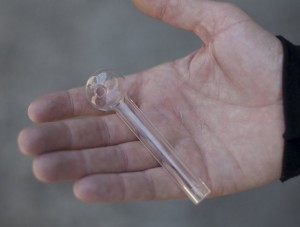
Knowing Possession of Drugs in TexasPolice found George Williams sitting behind an air conditioner unit of a business building. Even though it was a cool morning, Williams had his shirt off and was sweating profusely. After doing a pat-down of Williams, police found a crack pipe in his pocket that was later determined to have cocaine residue in it by police and a chemist.



The Trial Court convicted Williams of knowingly possessing a controlled substance. The elements are:

  1. that appellant exercised actual care, control and management over the contraband; and
  2. that appellant had knowledge that the substance in his possession was contraband.

The 14th Court of Appeals (Houston) wanted to look further to see whether the evidence would support a reasonable inference that the defendant knowingly possessed the contraband. When the quantity of a substance possessed is so small that it cannot be measured, there must be evidence other than mere possession to prove that the defendant knew the substance in his possession was a controlled substance.

Read the Case:  Williams v. State (14th District Court of Appeals – Houston, 2015)

In other cases, the defendant was convicted because the State proved that there was saliva on the crack pipe, suggesting that it had recently been smoked and that the defendant was intoxicated at the time the police found him. Another example is a defendant being found in a well-known drug house holding a syringe with cocaine in it in a manner that he was about to insert, or had just inserted it, into his body.

In this case, the Court of Appeals found that the only evidence was that Williams had his shirt off and was sweating. The Court of Appeals held that this was not enough to prove Williams had recently used the pipe or knew of its purpose as a crack pipe. The Court of Appeals reversed this case in the favor of Williams.

This signals that it takes more than just merely being found with a pipe containing trace amounts of a drug to be convicted of knowingly possessing the drug. There must be more evidence such as intoxication, recent usage, or being found in a known drug house.

Fort Worth Drug Crimes Attorneys | Free Case Consultation

If you have been charged with possession of a controlled substance or any other drug crimes, contact our attorney today for a Free consultation of your case. We will take the time to speak with you about the incident and answer your questions about the criminal justice process in Tarrant County. Contact our office at (817) 993-9249.

Equivocal Consent to Search is Still Consent

By Search & Seizure

Search & Seizure Update | Fort Worth Illegal Search & Seizure Attorneys

Late in the evening, two San Antonio police officers saw a truck driven by Arthur Warren. The truck matched the description of a vehicle that was suspected of transporting a large shipment of narcotics. When the officers saw Warren’s truck, they observed that the license plate on the trailer was not illuminated, and they saw the truck swerve across the median and across the double white line.

The officers stopped Warren’s vehicle. Officer Dupee testified that he saw a can of beer inside the truck. Officer Galvan asked Warren to get out of the truck, and the officers performed a field sobriety test on Warren.

The officers asked Warren if they could search the truck and trailer. Officer Dupee testified that Warren said, “Yes, go right ahead.” Officer Galvan saw something peculiar as he searched the truck and signaled Officer Dupee to handcuff Warren. Officer Dupee told Warren that he was not under arrest, but he was just being detained. Officer Dupee testified that Warren’s demeanor changed from “nice and compliant” to “upset and depressed.” Warren gave the officers the keys to a compartment where they found marijuana.

Warren testified that he did not give consent to search the truck and trailer, but rather said, “Well, you’re going to anyway.” He further testified that the officers handcuffed him only after he became upset about how they were searching the car on the trailer.

In a pre-trial motion, Warren moved to suppress the evidence (the marijuana) as a violation of his Fourth Amendment protection against unreasonable search and seizure. The trial judge denied the motion. Warren made a plea agreement and received six years deferred adjudication.

On appeal, Warren claimed that the State had failed to prove that he voluntarily consented to the search of his truck and trailer and that any consent that might have been given was tainted because Warren was detained for an extended time.

As with any appellate review of a motion to suppress, the Court of Appeals gave almost total deference to the trial court’s determination of the facts and assessment of credibility of witnesses. The Court then reviewed the trial court’s application of the law to the facts.

An exception to the Fourth Amendment protection against warrantless searches is a search where voluntary, uncoerced consent is given. The State bears the burden of proving that the search was voluntary. Warren argued that the State did not meet this burden.

The trial judge determined Officer Dupee to be credible when he stated that Warren gave consent to the search voluntarily and not under duress. Warren’s claim that he felt he had no choice but to consent was considered, but the Court of Appeals noted that case law provides for a presumption that if someone’s constitutional rights are about to be violated, the individual will assert those rights.

The Court of Appeals gave deference to the trial court’s assessment of Officer Dupee’s and Warren’s credibility and upheld the conclusion that Warren’s consent was voluntary.

As for the length of the detention, the Court noted that police cannot use a traffic stop as a “fishing expedition” to discover unrelated criminal activity. Once the purpose of a traffic stop is satisfied, additional reasonable suspicion is required for further detention. The trial court had found that the detention was initially related to the tip that narcotics were being transported in a vehicle matching the description of Warren’s truck and that Warren’s erratic driving justified the officers investigating whether he was intoxicated.

Even if the officers had satisfied their investigation of Warren’s intoxication, they were justified in continued detention due to the traffic violations they had observed and their observation of Warren’s bloodshot eyes and the beer can in the cab of the truck. Based on the officers’ testimony that Warren had consented to the search of the vehicle, the trial court found that the detention was not extended illegally. The Court of Appeals agreed that the officers had probable cause to initiate the stop, that Warren consented to the search and that the length of the detention was not unreasonable.

This case highlights two principles of Fourth Amendment law. First, while the State is required to prove the voluntary nature of a consent to search, the court is not required to accept the defendant’s position on that issue if the circumstances indicate that consent was voluntary. Second, while police officers may not extend a traffic stop to search for other possible unrelated violations, as long as the officers have reasonable suspicion of illegal activity and are investigating that suspicion, the driver can be detained until the officers’ investigation is complete.

This case reinforces our advice in previous articles…DO NOT GIVE CONSENT TO SEARCH!  Make the officers get a warrant.  It’s their job and your right!

Reliable Enough for Probable Cause

By Probable Cause

When a probable-cause affidavit describes a “controlled purchase” that was performed by an individual whose credibility or reliability were unknown, is that (or can it be) sufficient to sustain a probable-cause determination?  The Court of Criminal Appeals said YES in Moreno v. State.

Moreno v. State: After receiving a tip from the Clovis, New Mexico Police Department that Appellant, Dimas Moreno, was distributing narcotics from his home, the Lubbock police department orchestrated a controlled purchase of drugs from Appellant. Officers enlisted the help of a confidential informant (“CI”), who was familiar with cocaine deals, to purchase crack cocaine from Appellant. The CI approached an unknowing participant in an effort to purchase the crack cocaine. The individual told the CI that he would go to Appellant’s house to pick up the crack cocaine. Police observed the individual go to Appellant’s house, enter, and exit a few minutes later. The unknowing participant then drove to the predesignated location and delivered the crack cocaine to the CI.

On the basis of these facts, a magistrate issued a warrant to search Appellant’s residence for crack cocaine and any other related contraband. After executing a warrant, police found the drugs and arrested Appellant. Appellant was subsequently charged with possession with intent to deliver a controlled substance in an amount of four or more but less than 200 grams. Appellant filed a motion to suppress, challenging the sufficiency of the affidavit. He claimed that there could be no probable cause when an affidavit describes a controlled purchase in which an unidentified individual of unknown credibility and reliability purchased the drugs.

The trial court held a hearing and denied Appellant’s motion. Appellant preserved his right to appeal, pled guilty and was sentenced to fifteen years’ confinement. The court of appeals affirmed, concluding that the affidavit was sufficient because probable cause was based upon police observations rather than upon any statements made by the unknowing participant.

To issue a search warrant, a magistrate must first find probable cause that a particular item will be found in a particular location. The magistrate must “make a practical, common-sense decision whether, given all the circumstances set forth in the affidavit before him, including the ‘veracity’ and ‘basis of knowledge’ of persons supplying hearsay information, there is a fair probability that contraband or evidence of a crime will be found in a particular place.”

In this case, the court of criminal appeals held that the police observations of the controlled purchase and the reasonable inferences therefrom were sufficient to support a finding of probable cause. It was reasonable for the magistrate to infer that the unknowing participant obtained the crack cocaine from Appellant’s house based on “common-sense conclusions about human behavior.” While it was possible that the third party obtained the cocaine from another source, Appellant presented no persuasive argument as to why the magistrate’s inference was unreasonable or whether the unknown participant had a motive to mislead the police. Therefore, the judgment of the court of appeals was affirmed.

Search & Seizure Defense Lawyers | Fort Worth, Texas

If you or a loved one were the subject of an unconstitutional and illegal search, seizure, or arrest, please contact us today for a free consultation of your case.

No Solicitors or Drug-Sniffing Dog!

By Warrantless Search

The Legality of Drug-Sniffing Dog Searches

Let’s face it, nobody really likes uninvited guests on their front porch, unless, of course, it is the time of year when the Girl Scouts are selling cookies or little trick-or-treat monsters are out and about.  Aside from that, I’m not too keen on having people drop by unannounced, especially if that person is trying to investigate a crime or conduct a search and seizure.

The United States Supreme Court recently considered a case involving an unannounced (and unwelcome) furry visitor to a man’s front porch.  The question presented was this:  Is a dog sniff at the front door of a suspected drug house by a trained narcotics detection dog a Fourth Amendment “search” requiring probable cause?

In a 5-4 decision authored by Justice Scalia, the Supreme Court said YES, the use of the drug-sniffing dog was an unreasonable search.

Florida v. Jardines, 133 S. Ct. 1409 (2013)-  In 2006, the Miami-Dade Police Department received an unverified tip that marijuana was being grown in the home of respondent Joelis Jardines.  One month later, police took a drug-sniffing dog to Jardines’s front porch, where the dog gave a positive alert for narcotics.  Officers obtained a search warrant, which revealed marijuana plants inside the home.  Jardines was charged with trafficking in cannabis.

At trial, Jardines moved to suppress the marijuana plants on the ground that the canine investigation was an unreasonable search.  The trial court granted the motion but the Florida Third District Court of Appeal reversed.  On a petition for discretionary review, the Florida Supreme Court quashed the decision of the Third District Court of Appeal and approved the trial court’s decision to suppress, holding that the use of the trained narcotics dog to investigate Jardines’s home was a Fourth Amendment search unsupported by probable cause, rendering invalid the warrant based upon information gathered in that search.

The Supreme Court of the United States granted certiorari, limited to the question of whether the officers’ behavior was a search within the meaning of the Fourth Amendment.  The Court held that the front porch of a home is part of the home itself for Fourth Amendment purposes.  While custom typically permits a visitor to approach the home “by the front path, knock promptly, wait briefly to be received, and then leave,” it does not allow a visitor to engage in investigative activity such as bringing a trained drug dog on the porch and allowing it to sniff around for incriminating evidence.  Therefore, the government’s use of trained police dogs to investigate the home and its immediate surroundings was a “search” within the meaning of the Fourth Amendment.

To learn more about Police Canine Training, check out our friend and trainer Steve Scott at Scott’s Police K9 in North Texas.

Vigilant Border Protection

By Drug Crimes

Out near El Paso, the law enforcement folks are pretty anal about boundaries.  Apparently, their “border-protection” mentality applies equally to law enforcement officers from neighboring jurisdictions.  Below is a summary from a federal quarrel between officers of El Paso and Hudspeth Counties.  While it isn’t directly on point for this blog, it is tangentially related to Texas criminal law and it has a little bit of 4th amendment seizure flavor to it.

Short v. West, Fifth Circuit Court of Appeals – November 2, 2011

Appellant was an officer in the El Paso Police Department, (EPPD) assigned to a narcotics task force for the 34th Judicial District. The 34th Judicial District includes both El Paso and Hudspeth counties. While conducting a task force related traffic stop in Hudspeth County, appellant encountered a Hudspeth County Sheriff Department (HCSD) deputy who asked him what he was doing there.  Appellant identified himself to the satisfaction of the deputy and told her that EPPD task force officers were working in Hudspeth County.  The deputy contacted her dispatcher who in turn called Hudspeth County Sheriff West and told him that EPPD officers were performing traffic stops in Hudspeth County.  Sheriff West ordered his deputies and find out whether the EPPD officers were, in fact, law enforcement officers.  Sheriff West also ordered his deputies to round up the EPPD task force officers and escort them to his office.

A lieutenant in the HCSD located appellant’s supervisor, who produced identification showing him to be an officer with the EPPD and the task force.  Appellant’s supervisor ordered him and the other task force members to return to El Paso County.  While on the way back to El Paso County, appellant and several task force members were stopped and surrounded by HCSD deputies.  The HCSD deputies ordered appellant and the other task force members to go to a nearby HCSD substation.  They were told that they would be arrested if they failed to comply.  Appellant and the task force members went to the HCSD substation where Sheriff West complained that he had not been notified of the task activities in his county. He then told the task force officers that they were free to leave.  Appellant sued Sheriff West under 42 U.S.C. § 1983 for violating his rights under the Fourth Amendment.

The court held that Sheriff West was not entitled to qualified immunity.  First, the court found that appellant was seized for Fourth Amendment purposes. The HCSD deputies surrounded the task force officers’ vehicles preventing them from returning to El Paso County.  In addition, appellant was threatened with arrest if he did not accompany the deputies to the HCSD substation.  A reasonable person would not feel free to ignore such a show of force and go about his business.

Second, the court found that such a seizure was objectively unreasonable.  Sheriff West ordered the task force officers to be detained and brought to the HCSD substation so he could personally examine them. This was not likely to quickly confirm or dispel his suspicions as to whether or not the task force officers were legitimate law enforcement officers.  There were less intrusive ways to accomplish this.  Sheriff West could have contacted the EPPD Chief, whom he knew or he could have run the license plates on the task force officers’ vehicles. It was unreasonable to not recognize or pursue these options as alternatives to seizing Short.