Tag

DWI

Enhancements for crimes committed after illegal reentry into the U.S. displayed on a chain-link fence background, relevant to sentencing laws and legal implications discussed by Howard Lotspeich Alexander & Williams, PLLC.

Enhancement for Crimes Committed Deportation Illegal Reentry into the US

BySentencing

Enhancements for crimes committed after illegal reentry into the U.S. displayed on a blurred background of a chain-link fence, relevant to sentencing laws and legal consequences discussed by Howard Lotspeich Alexander & Williams, PLLC.What happens when someone who illegally enters the country commits a crime? Further, does it matter is that person was previously deported from the United States? Does federal law provide for sentencing enhancements to extend the prison terms for wrongdoers in this position? The answer is yes—and no. Read on to see how the Fifth Circuit Court of Appeals analyzes federal statutes and sentencing guidelines that could support such an enhancement for the defendant, but decides against doing so.

US v. Rodriguez (5th Circuit, 2016)

A 2002 Theft and Deportation Set the Stage

In 2002, Benito Sanchez-Rodriguez, an “undocumented immigrant,” was convicted in Florida for “Dealing in Stolen Property,” a violation of a state law. Pleading guilty at trial, Rodriguez was sentenced to three years’ imprisonment, which was suspended for three years’ probation. Six months later, he was deported to Mexico because he had no legal status to remain in the US. Over a decade later, in 2014, Rodriguez was arrested for DWI in Texas. While under arrest, the federal government charged him will illegal entry into the US. Ultimately, Rodriguez was indicted on one count of illegal reentry into the US, a violation of federal statute 8 U.S.C. § 1326(a) and (b)(1).

Rodriguez Faces Criminal Charges, Again

In August of 2015, Rodriguez plead guilty to the illegal entry indictment and the district court accepted his plea. Before the sentencing phase, a US Probation Officer prepared a “pre-sentence investigation report” (“PSR”), relying upon the United States Sentencing Guidelines (“USSG”). The PSR assigned Rodriguez base offense level of 8, which was raised by 8 additional levels because of the 2002 “Dealing in Stolen Property” conviction (an aggravated felony qualifier), for a total base offense level of 16. U.S.C. § 2LI.2(b)(1)(C). The PSR added that because Rodriguez took responsibility by entering a guilty plea, the total base offense level was reduced by 3, for a final total of 13. The PSR recommended that with a base offense level of 13, Rodriguez should face between 24 to 30 months in federal prison. Rodriguez objected both on the record and in writing, arguing that the 2002 conviction was not an aggravated felony qualifier, however, the district court adopted the PSR’s recommendations. Accordingly, he was sentenced to 27 months’ imprisonment.

Rodriguez Appeals to the Fifth Circuit, Argues Florida Statute Overbroad

Rodriguez now appeals to the Fifth Circuit for relief, arguing, that the 2002 conviction is not an aggravated felony qualifier for sentencing purposes because the Florida law “Dealing in Stolen Property” is overly broad. The Fifth Circuit must determine whether Rodriguez’s prior 2002 conviction qualifies as an “aggravating felony offense” under the USSG, because if so, he faces a longer prison term and could potentially set a precedent for the federal “aggravated felony qualifier” status of this Florida law.

Federal Law: Sentencing Enhancements

A defendant’s base offense level will be increased by 8 levels if the defendant previously was deported, or unlawfully remained in the US after conviction for an aggravated felony, without regard to the date of the conviction for the aggravated felony. U.S.S.G. § 2LI.2(b)(1)(C); U.S.S.G. § 2LI.2 cmt. N.3(A); United States v. McKinney, 520 F.3d 425, 429 (5th Cir. 2008). An aggravated felony is defined as a “theft offense, including receipt of stolen property, or burglary offense, for which the prison term is at least one year.” 8 U.S.C. § 1101(a)(43)(G).

Federal Cases: Determining Aggravated Felony Qualifiers

A “categorical approach” is used to determine whether a prior conviction is an offense under the USSG. Taylor v. United States, 495 U.S. 575, 602 (1990); United States v. Rodriguez-Negrete, 772 F.3d 221, 224-25 (5th Cir. 2014). Courts compare the elements of a statute forming the basis of the defendant’s conviction with the elements of the generic crime (the offense as it is commonly understood). United States v. Schofield, 802 F.3d 722, 727-28 (5th Cir. 2015). If the offense of conviction has the same elements as the generic crime, then the prior conviction may serve as the predicate, because anyone convicted under that law is guilty of all of the elements. Descamps v. United States, 133 S. Ct. 2276, 2281, 2283 (2013).

Similarly, a “modified categorical approach” is used by courts to analyze the elements of a divisible statute (a criminal statute that is comprised of several varied offenses). In a two-step “modified categorical approach,” the court first reviews indictments and jury instructions, among other documents, to determine which part of a statute formed the basis of a defendant’s prior conviction. Next, the court compares the elements of the crime of conviction with the element of the general crime.

The Fifth Circuit Weighs In

Here, the Fifth Circuit adopted the modified categorical approach to analyze the case. Here, the “generic crime” is a theft offense—the “Dealing in Stolen Property” conviction from 2002. Because the provision does not clearly define “theft offense,” the Fifth Circuit applied the generic definition of theft, “a taking of property or an exercise of control over property without consent with the criminal intent to deprive the owner of rights and benefits of ownership.” United States v. Medina-Torres, 703 F.3d 770, 774 (5th Cir. 2012)(per curiam). Burke v. MuKasey, 509 F.3d 695, 697 (5th Cir. 2007).

The court examined the Florida statute reads, “Traffic means to (a) sell, transfer, distribute, dispense or otherwise dispose of property; (b) to buy, receive, possess, obtain control of, or use property with the intent to sell, transfer, distribute, dispense, or otherwise dispose of property.” Fla. Stat. § 812.012(8). Next, the Court reviewed Rodriguez’s charging document, which read, “Rodriguez knew or should have known that the property was stolen.” The Court examined Florida case law that showed that Florida applies the statute to conduct outside of the generic definition of theft—which created a problem when applying this conviction to the sentencing enhancement provision as outlined in the PSR. Without the enhancement provision, Rodriguez’s sentence would likely not have been as long with a lower base offense level. Accordingly the Fifth Circuit vacates the 27-month prison term and remands the case for resentencing only.

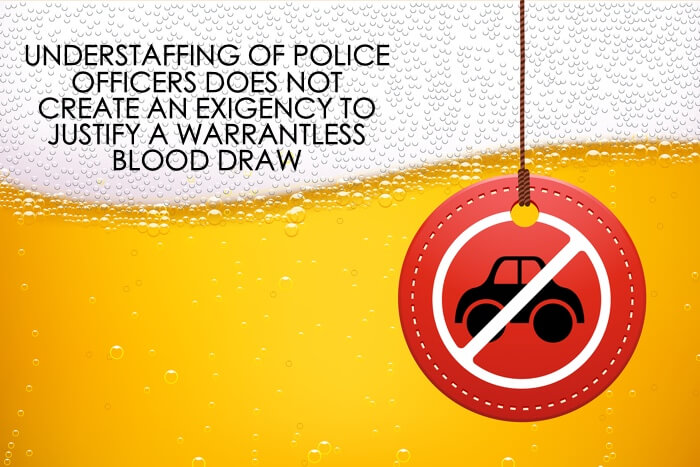
Understaffing of police officers does not create an exigency to justify a warrantless blood draw, with a no driving sign against a backdrop of frothy beer.

Understaffing of Police Cannot Create the “Exigency” to Justify a Warrantless Blood Draw

ByDWI

In a Warrantless DWI Blood Draw Case, State Offers “Understaffing of Police” as an Exigent Circumstance.

Understaffing of police officers does not create exigency to justify warrantless blood draw, with a prohibition sign over a car in a beer-themed background.Bonsignore v State (2nd Court of Appeals – Fort Worth, 2016)

After traveling eighty miles an hour in a forty miles per hour zone, Jeremy Bonsignore pulled into a Waffle House and started walking toward the restaurant. Unknown to Bonsignore, law enforcement had been following him for several minutes. Once the officer pulled into the parking lot, he activated his lights and began yelling at Bonsignore to stop walking. Bonsignore turned around, stumbled, and lost his balance. The officer noted the presence of a strong odor of alcohol and that Bonsignore’s eyes appeared glassy.

Bonsignore admitted to having a few drinks earlier in the day, which prompted the officer to conduct several field sobriety tests. Bonsignore failed them and then abruptly refused to do anymore tests or provide a breath or blood sample. Bonsignore was placed under arrest at 1:49 am. Dispatch informed the officer that Bonsignore had two prior DWI convictions, which could amount to Bonsignore being a repeat DWI offender, a felony offense. With this information in mind, the officer instructed a second officer to take Bonsignore to the hospital for a mandatory blood draw. The blood draw was conducted at 2:55 am. Bonsignore did not consent to the taking of his blood and the officer did not obtain a warrant.

Warrantless Blood Draw Issue at Trial

Before trial began, Bonsignore filed a motion to suppress the results of the blood draw, arguing that the blood draw was warrantless, and therefore, unconstitutional. The motion was never officially ruled upon, although the court did take the motion under advisement. During trial, when asked why he ordered the blood draw, the officer said that Bonsignore’s “two prior convictions were his only authority for obtaining the blood draw.” The officer did not attempt to obtain a search warrant, and he acknowledged that Bonsignore did not give his consent to a blood draw.

The officer testified that he relied solely on the statute, Texas Transportation Code 724.012, for authority to order the draw against Bonsignore’s will. Pleading guilty to the charges, the trial court issued Bonsignore a two-year sentence. Bonsignore appealed, arguing that his motion to suppress the evidence should have been ruled upon because the blood draw was taken without his consent and without a search warrant, violating the ruling in Missouri v. McNeely, 133 S. Ct. 1552 (2013). The State argues that (1) Bonsignore’s blood-alcohol level would dissipate over time, (2) he was a repeat felony offender, and (3) the police department was small and understaffed, and that obtaining a warrant in this case would have been overly-burdensome for the officers that night.

Is “Dissipation” an Exigent Circumstance to Justify a Warrantless Search?

In the wake of the McNeely case, the Second Court of Appeals must determine whether Bonsignore’s blood draw was constitutional, and, whether the State may rely on an exigency “emergency circumstances” argument as an exception to the Fourth Amendment.

Texas Transportation Code

Section 724.012(b)(3)(B) states that blood or breath samples may be required to be taken when the suspect is arrested for DWI and he refuses to give the specimen voluntarily, so long as the suspect has two prior DWI convictions, “although [the code] does not expressly authorize taking the specimen without a warrant.” State v. Swan, 483, S.W.3d 760, 764 (Tex. App.—Fort Worth 2016, no pet.).

However, “the explicit refusal to submit to blood testing overrides the existence of any implied consent and that implied consent that has been withdrawn by a suspect cannot serve as a substitute for the free and voluntary consent that the Fourth Amendment requires.” State v. Villarreal, 475 S.W.3d 784, 800.

Precedent Case Law: Missouri v. McNeely

“The natural metabolism of alcohol in the bloodstream [does not] present a per se exigent circumstance justifying an exception to the Fourth Amendment’s warrant requirement for nonconsensual blood testing in all drunk-driving cases.” McNeely, 133 S. Ct. at 1556, 1558.

The Second Court of Appeals Weighs In

The Second Court of Appeals agreed with Bonsignore. “The police may not create their own exigency to make a warrantless arrest or search.” Parker v. State, 206 S.W.3d 593, 598 (Tex. Crim. App. 2006). “Exigent circumstances do not meet Fourth Amendment standards if [law enforcement] deliberately creates the [circumstances].” Id.

Here, the Court held, law enforcement knew that it was not a “No Refusal Weekend” in Texas. Further, the police department knew that it only had three officers on duty the entire night Bonsignore was arrested. In fact, understaffing the department was a typical occurrence. There was nothing out of the norm about the number of officers on duty that night. “Deliberately scheduling an insufficient number of patrol officers on an evening shift does not constitute an exigent circumstance.” State v. McClendon, NO. 02-15-00019-CR, 2016 WL 742018 (Tex. App.—Forth Worth, Feb. 25, 2016, no pet.).

Additionally, the department had a protocol for obtaining warrants, even in the absence of magistrates “on call.” Also, there was no earth-shattering emergency or problem that prevented the officers from making attempts to secure a warrant for Bonsignore’s search. The Court makes a point to highlight the efficiency of fax machines for the purposes of securing warrants, “thanks to the fax machine, [law enforcement] could …request a search warrant” and “thanks again to a fax machine…once [law enforcement] had the search warrant, [they] could fax it directly to a hospital instead of driving [the warrant] there.” The argument that the police department is small was unpersuasive for the Second Court of Appeals. For these reasons, the Second Court of Appeals reversed the trial court’s ruling, and remanded the case to the trial court for a new trial.

Three glass jars with metal lids, overlaid with bold text reading "PRESERVING APPEAL IN A CRIMINAL CASE," relevant to DWI legal discussions and appellate issues.

Warrantless Blood Draw Case Turns on Defense Failure to Preserve Appellate Issue

ByDWI

Court of Criminal Appeals Considers Whether Defense Failed to Preserve Appeal

Three glass jars with the text "PRESERVING APPEAL IN A CRIMINAL CASE" emphasizing the importance of preserving legal issues in DWI cases.

Smith v. State (Tex Crim. App. 2016)

Warrantless Blood Draw Provides Evidence of DWI

William Smith was stopped by police for driving without a seatbelt. Immediately, law enforcement suspected Smith of driving under the influence because of the “extremely strong smell of alcohol” coming from Smith. Accordingly, law enforcement administered several field sobriety tests and determined that Smith “exhibited clues of intoxication.” Smith became belligerent after being arrested, and refused a breathalyzer. Law enforcement searched Smith’s car incident to his arrest, finding three open containers that were “cold to the touch.” Dashboard camera footage captured the entire stop.

Law enforcement decided to transport Smith to a local hospital for a blood draw because a quick check of Smith’s ID showed that he had two prior DWI convictions. The blood sample taken at the hospital reflected a blood-alcohol concentration of .21 grams of alcohol per 100 milliliters of blood—well above the legal limit of .08. Smith elected a bench trial.

Defense Counsel Argues that Blood Draw was Unconstitutional, Trial Judge Seems to Agree

At trial, the State called a forensic scientist to testify about Smith’s blood sample. The forensic scientist testified that Smith’s blood alcohol level exceeded the statutory minimum of .08. Shortly thereafter, there was discussion between the judge and counsel about Texas case law in regards to whether the court must have an “order” signed by a judge or magistrate in order for a blood alcohol test to be admitted into evidence. The defense counsel stated, “I would…object…on constitutional grounds [because] there should be a written order [in evidence].” The State replied that law enforcement was “operating under the laws of the State.” The judge seemed to agree with defense counsel, “No…the legislature allows for this…but that doesn’t mean the law is constitutional.” The judge decided to “carry” the constitutional issue so that each side could research and make a formal brief before the court. However, at the end of the trial, Smith was convicted of DWI. The judge stated the “video of [Smith] showed signs of intoxication, but the judge was surprised…that [Smith]…did as well as he did on the [field sobriety tests]” given the .21 blood alcohol concentration. The judge sentenced Smith to twenty-five years imprisonment. There were no further objections on the record made by defense counsel post-judgment.

Appeal Turns on Lawfulness of the Blood Draw

On appeal, the court of appeals reversed Smith’s conviction because the blood sample was obtained without a warrant, violating the Fourth Amendment. State appeals to the Court of Criminal Appeals, arguing that Smith did not preserve error at trial with regard to his Fourth Amendment issue, and as a result of the failure, Smith was precluded from raising a constitutional argument on appeal.

The Issue Before the CCA – Did the Defense Preserve Appeal of the Blood Draw Issue?

The CCA must determine whether defense preserved error so that the fourth amendment search and seizure issue could be raised on appeal. To preserve error, defense counsel must obtain a ruling on the complaint, or object to the trial judge’s refusal to rule.” Tex. R. App. P. 33.1(a)(2) However, “even evidence that is improperly admitted is considered in determining whether the evidence is sufficient to support a conviction.” Soliz v. State, 432 S.W.3d 895, 900 (Tex. Crim. App. 2014).

The CCA Holds that Appellate Issue was NOT Preserved

Here, the CCA determined that the trial judge declined to rule on the Fourth Amendment constitutional issue at the time, but decided to “carry” the issue. Garza v. State, 126 S.W.3d 79, 83 (Tex. Crim. App. 2004). The CCA says that although the trial judge admitted the blood-alcohol test results, he did not rule on Smith’s initial objection, and thus, error was not preserved in this case. “In any event,” says the CCA, “there was…evidence to support [Smith’s] conviction aside from the blood-test results.” “Smith never asked for a ruling on the [constitutional issue], nor did defense counsel object to the trial judge’s failure to rule. In sum, failure to preserve error on a fourth amendment search and seizure argument for warrantless blood draws in DWI cases precludes a defendant from raising the constitutional argument on appeal.

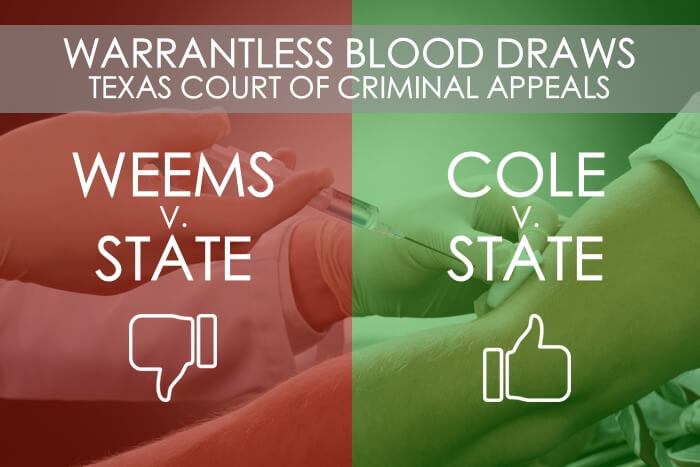
Warrantless blood draws comparison graphic featuring Weems v. State with a thumbs down and Cole v. State with a thumbs up, highlighting differing outcomes from Texas Court of Criminal Appeals decisions.

Two New Warrantless Blood Draw Opinions; Two Different Results

ByDWI

CCA Reaches Different Conclusions in Two Separate Warrantless Blood Draw DWI Cases
Warrantless blood draws comparison graphic featuring Weems v. State and Cole v. State cases, illustrating differing outcomes in DWI legal decisions by Texas Court of Criminal Appeals.Just when we thought the warrantless blood draw issue was starting to reach firm footing in our appellate case law, the Texas Court of Criminal Appeals (CCA) throws a wrench into it. This week the CCA handed down a confounding set of opinions relating to warrantless blood draws in two separate DWI cases—Weems v. State and Cole v. State. Both cases dealt with drivers who were alleged to be intoxicated, both cases involved serious car accidents, both drivers suffered injuries, and, both cases presented law enforcement with the difficult decision to obtain blood samples without a warrant, as the body’s natural metabolic process threatened to destroy evidence over time that could have been used to charge and to prosecute the suspected intoxicated drivers. Procedurally, both Weems and Cole argue that the Texas Transportation Code § 724.012 is at odds with the Fourth Amendment and McNeely. Let’s take a look at the facts of each case and briefly review Texas law to reveal the reasoning behind the surprising conclusions reached by the CCA.

Two Texas CCA Opinions on Warrantless Blood Draws in DWI CasesWeems v. State

A Night of Drinking Leads to a Car Accident

FACTS: Daniel Weems drank heavily at a bar for several hours one summer evening in June of 2011. Weems decided to drive home around 11:00pm, and on the way, his car veered off the road and flipped over, striking a utility pole. A passerby stopped to help, but saw Weems exit the car through his window. When asked if he was alright, Weems stumbled around saying that he was drunk. Noticing the smell of alcohol, the passerby called 911 and watched Weems run from the scene. When the first police officer arrived at midnight, Weems was found hiding under a parked car.

Law enforcement noted his bloodshot eyes, slurred speech, and inability to stand without assistance in the police report. Moments later, a second police officer came to the scene and arrested Weems on suspicion of driving while intoxicated (“DWI”). Law enforcement decided against conducting field sobriety tests because Weems suffered injuries and had “lost the normal use of his mental and physical faculties due to alcohol.” TEX. PENAL CODE § 49.01 (2)(A). Weems, however, refused a breathalyzer and a blood test, even after law enforcement informed him of the potential consequences (suspended license, etc.) for refusal. Emergency responders transported Weems to a nearby hospital because Weems complained of neck and back pain.

Arrest Leads to Warrantless Blood Draw

Weems was seen in the hospital’s trauma unit and the second police officer completed the form, requesting a blood draw, while the first police officer remained on duty, but on standby. Weems blood was taken at 2:30 am, over two hours post-arrest, with a result of .18—well above the .08 legal limit. Relying on the Supreme Court case Missouri v. McNeely, where the highest court held that the body’s natural metabolic processing of alcohol in the bloodstream does not create an exigency (emergency) such that an exception to the Fourth Amendment’s warrant requirement is created, Weems sought to have the results of the blood draw suppressed at trial. The trial court did not grant the suppression and jury found Weems guilty of felony DWI, sentencing him to eighty years’ imprisonment. On appeal, Weems argued that his Fourth Amendment rights were violated. Surprisingly, the Fourth Court of Appeals agreed with Weems, holding that in light of McNeely, Texas’s implied consent and mandatory blood draw schemes do not give way to warrant-requirement exceptions, and, that the record established at Weems’s trial did not support admitting the warrantless blood draw results under an exigency exception. The State appealed to the CCA.

Cole v. State

Fatal Car Crash Leads to Arrest

FACTS: On a December evening in 2011, Steven Cole drove his vehicle 110 miles per hour down a busy street, running a red light, and crashing into a pickup truck. The crash caused a large explosion and fire, killing the driver of the pickup truck instantly. When the first police officer arrived at the scene around 10:30pm, he saw Cole shouting for help because he was trapped in his truck in the fire’s path. Shortly thereafter, several police officers arrived and began putting out the multiple fires to secure the area for pedestrians and motorists.

Law enforcement would later testify that “from a law enforcement and safety perspective, they needed as many officers on the scene as they could possibly get” because the raging fires and continued explosions put the public in danger. When the crash occurred, the police were in the middle of a shift change which further complicated securing the scene, conducting the investigation and maintaining public safety. Cole was eventually rescued from his truck and was examined by EMTs, to whom Cole admitted that he had taken some meth. Because of the large debris field that spanned an entire block, fourteen police officers remained at the scene to collect evidence and secure the area, which pushed the limits of the small precinct’s manpower. The debris field was not fully cleared until 6:00am—almost eight hours after the crash. Because of the size of the debris field and dangerousness of the scene requiring multiple officers to secure, only one police officer accompanied Cole to the hospital.

Suspected Intoxication Leads to Warrantless Blood Draw

At the hospital, Cole was observed complaining of pain, but also, “tweaking” and shaking—potential symptoms of suspected methamphetamine intoxication. Under a directive from the superior officer on duty, the police officer arrested Cole at 11:38pm and asked Cole for consent to collect blood and breath samples. When Cole refused, the officer read the statutory consequences for failure to consent. Cole interrupted the officer several times to comment that he had not been drinking, rather, he had taken meth. The officer made a request to the hospital for a blood draw, which was done at 12:20am. The results confirmed that Cole’s blood contained amphetamine and methamphetamine.

Cole moved to suppress the evidence at trial, but the trial court overruled the motion. The jury convicted Cole of intoxication manslaughter, sentencing Cole to a life imprisonment. On appeal, the court of appeals held that the lower court erred in not suppressing Cole’s blood draw results because State v.Villarreal “foreclosed on the State’s reliance on the mandatory blood-draw provision found in the Texas Transportation Code, and that, the trial court record did not establish that an emergency (exigency) existed to justify the warrantless blood draw. Cole v. State, 454 S.W.3d 89, 103 (Tex. App—Texarkana 2014). The State appealed to the CCA.

Law Applicable to Warrantless Blood Draws

The Fourth Amendment

The Fourth Amendment to the United States Constitution provides, “the right of the people to be secure in their persons, houses, papers, and effects, against unreasonable searches and seizures, shall not be violated, and no Warrants shall issue, but upon probable cause.” U.S. CONT. amend. IV. McNeely informs that blood tests are Fourth Amendment searches that implicate a “most personal and deep-rooted expectation of privacy.” McNeely, 133 S. Ct. at 1558-59 (quoting Winston v. Lee, 470 U.S. 753, 760 (1985)). Case law has determined that “a warrantless search is reasonable only if it falls within a recognized exception.” State v. Villarreal, 475 S.W.3d 784, 796 (Tex. Crim. App. 2015), reh’g denied, 475 S.W.3d 817, (Tex. Crim. App. 2015) (per curiam).

One exception to the Fourth Amendment warrant requirement is a warrantless search performed to prevent imminent evidence destruction when there is no time to secure a warrant. Cupp v. Murphy, 412 U.S. 291, 296 (1973); McNeely, 133 S. Ct. at 1559. Whether law enforcement faces an emergency that justifies acting without a warrant calls for a case-by-case determination based upon the totality of the circumstances. Id. In order for courts to determine whether an emergency existed, courts must analyze the totality of the circumstances based on an objective evaluation of the facts reasonably available to law enforcement at the time of a search, and not based on 20/20 hindsight of the facts as they are known after the fact. Brigham City, Utah v. Stuart, 547 U.S. 398, 404 (2006); Ryburn v. Huff, 132 S. Ct. 987, 992 (2012)(per curiam).

Texas Transportation Code § 724.012

Texas Transportation Code § 724.012(a) states, “specimens of a person’s breath or blood may be taken if the person is arrested and at the request of [law enforcement] having reasonable grounds to believe the person was intoxicated while operating a motor vehicle.” § 724.012(b) states, “[Law enforcement] shall require the taking of a specimen of the person’s breath or blood…if the officer arrests the person [for DUI/DWI] and the person refuses the officer’s request to submit to the taking of the specimen voluntarily…[where] any individual has died…an individual other than the person has suffered serious bodily injury.”

The CCA Weighs In—What did the CCA Decide and How Did the Judges Reach The Decisions?

In both Weems and Cole, the Court of Criminal Appeals had to determine whether the warrantless blood draws were justified by exigent (emergency) circumstances under a totality of the circumstances review of the facts. It may be surprising that in one case the CCA upheld the legality of the blood draw and in the other case the CCA held that the blood draw was unlawful.  The charts below shed some light on the relevant facts of each case that the CCA reviewed to determine the holdings in each case. As you can see, the cases are quite similar, yet have some striking differences—differences that distinguished each case just enough for the CCA to arrive at opposite conclusions.

Totality of the Circumstances Analysis
Similarities Between Weems and Cole

WEEMSCOLE
Refused consent to breath and blood tests.Refused consent to breath and blood tests.
Driver caused car crash.Driver caused car crash.
Driver injured in crash.Driver injured in crash.
Admitted to drinking during initial questioning.Admitted to using meth during initial questioning.
Moved to suppress evidence at trial.Moved to suppress evidence at trial.
Warrantless blood draw.Warrantless blood draw.
Law enforcement claimed “exigency/emergency” as reason for warrantless blood draw.Law enforcement claimed “exigency/emergency” as reason for warrantless blood draw.
Law enforcement concerned BAC would fall over time, destroying potential evidence.Law enforcement was concerned intoxication levels would fall over time, destroying potential evidence.

Totality of the Circumstances Analysis
Differences Between Weems and Cole

WEEMSCOLE
Single-vehicle crash.Two-vehicle crash.
Small, rural road.Large, high-traffic intersection.
Two police officers, one who remained on “stand-by”.Entire police department tasked with maintaining and securing the exceedingly dangerous scene.
No deaths as a result of crash.One fatality as a result of crash.
Small debris field.Large “one block long” debris field.
Alcohol was the substance at issue.Meth was the substance at issue.
Alcohol has a ‘known’ dissipation time.Meth has a ‘lesser known’ dissipation time.
Police department’s manpower was not overwhelmed by the crash.Police department’s manpower pushed to the limits by the crash.
Nothing on the record to indicate Weems was going to receive pain medication that would impact the results of a blood test.Hospital was set to give narcotics to Cole because of pain, narcotics that could potentially impact the results of a blood test.

The CCA’s Holding in Weems – Warrantless Blood Draw Improper

In Weems v. State, the CCA concluded that the warrantless blood draw was NOT justified by exigent (emergency) circumstances. The CCA affirmed the holding of the court of appeals that said that § 724.012 of the Texas Transportation Code does not create an exigency exception to the Fourth Amendment and that the trial court did not establish on the record any facts to support a finding of an exigent circumstance. The CCA stated that law enforcement might have had a “temporal disadvantage,” however, the time frame from the crash to the time Weems was transported to the hospital was short and that the police officer who was on standby could have called a magistrate to obtain a warrant, “the hypothetically available officer could have secured a warrant in the arresting officer’s stead.”

Further, even though the hospital took two hours to obtain the sample, such a timeframe would not have been known beforehand by law enforcement, and thus is considered “hindsight.” Hindsight is not factored into the totality of circumstances analyses. Additionally, the police department’s manpower was not completely tied up with the details of Weems’s crash. Lastly, the CCA commented that law enforcement should have protocols in place to process and deal with blood draw warrants in cases where the suspected intoxicated driver is transported to the hospital with injuries, “the record does not reflect what procedures, if any, existed for obtaining a warrant when an arrestee is taken to the hospital.”

The CCA’s Holding in Cole – Warrantless Blood Draw Authorized

In Cole v. State, the CCA held that the trial record established circumstances rendering obtaining a warrant impractical and that the warrantless search was justified under the exigency exception to the Fourth Amendment’s warrant requirement. The case was reversed and remanded to the court of appeals.

The CCA said that the size and severity of the accident scene requiring several police officers to remain on the scene for public safety concerns, the large debris field that required accident investigators extended time to complete the investigation, the fact that someone died in the crash, and the fact that the dissipation rate for methamphetamine is not widely known among law enforcement the way alcohol dissipation in known, are reasons that come together to create a constellation of exigency under a totality of the circumstances analysis.

“Law enforcement was confronted with not only the natural destruction of evidence though natural dissipation of intoxicating substances, but also with the logistical and practical constraints posed by a severe accident involving a death and the attendant duties this accident demanded.” Further, because Cole complained of pain, law enforcement had a legitimate concern that any narcotic drugs administered would impact the outcome of a blood test, rendering the test ineffective for evidence in trial later on.

Justice Johnson did file a dissent in Cole, “I would hold that the circumstances and testimony at trial indicate that a warrant was required.” Justice Johnson says that someone on the police force could have obtained a warrant and had enough time to do so, “this was not a now or never situation that would relieve the state of its burden.”

Where do we go from here?

United States Supreme Court graphic featuring "Birchfield v. North Dakota" and the question "Should drivers face criminal charges for refusing a breath test?" related to DWI law and warrantless blood draws.

Should Drivers Face Criminal Charges for Refusing a Breathalyzer Test?

ByDWI

SCOTUS Hears Oral Argument in Birchfield v. North Dakota

United States Supreme Court graphic for Birchfield v. North Dakota case, questioning criminal charges for refusing a breath test, with classical columns in the background.On April 20, 2016, the Supreme Court of the United States (“SCOTUS”) heard oral arguments in Birchfield v. North Dakota, a case that consolidates Birchfield with Bernard v. Minnesota and Beylund v. Levi, where the SCOTUS will determine whether the government may, without a warrant, make it a crime for a motorist to refuse to take a blood-alcohol test. Currently, thirteen states make it a crime to refuse any form of drunk-driving tests (breathalyzer, field sobriety, etc.). Birchfield comes on the heels of the 2013 Missouri v. McNeely case, where the SCOTUS held that if police have time, they should get a warrant before taking an invasive test of a suspected drunk driver. Let’s take a look at each consolidated case to understand the big issue before the Supreme Court.
Case #1: Birchfield v. North Dakota

In Birchfield, motorist Danny Birchfield drove his car off of a North Dakota road and subsequently failed a field sobriety test and a preliminary breath test, given by the state highway patrol. At that point Birchfield was arrested, told he had to take another more invasive chemical test, and informed of North Dakota’s implied consent rule. In North Dakota, any individual who operates a motor vehicle on any public or private road in the state is deemed to have consented to a chemical test for alcohol in the blood stream. Birchfield refused to submit to any further testing and was charged with both DUI and Failure to Submit to chemical testing. Birchfield filed several appeals, arguing that North Dakota’s implied consent law is unconstitutional under the 4th Amendment of the United States Constitution. Birchfield is opposed to “refusal” being a crime all by itself.

Read the brief in Birchfield here.

Case #2: Bernard v. Minnesota

In Bernard, police confronted a man who smelled of alcohol on a public boat ramp and asked him to consent to field sobriety tests. Bernard consented to a breathalyzer test after being told of the criminal penalties for refusal. Under Minnesota’s implied consent law, it is a criminal offense for a driver who has been arrested on probable cause for driving while impaired to refuse a chemical test. Minnesota argues that a warrantless breath search is constitutional under the “search incident to an arrest” doctrine. On the other hand, Bernard argues that a breathalyzer is not a valid search incident to an arrest because the search does nothing to further officer safety or to preserve evidence.

Read the brief in Bernard here.

Case #3: Beylund v. Levi

In Beylund, law enforcement observed a car driving erratically and stopping in the middle of the road. The police asked defendant Beylund to consent to chemical testing. At trial, Beylund argued that the test imposed an unconstitutional condition on his driver’s license.

Read the brief in Beylund here.

The Big Issues—Implied Consent or Criminalization of a Constitutional Right?

The highest court will determine whether in the absence of a warrant, a state can make it a crime, in and of itself, for a person to refuse to take a chemical test (blood, breath and urine) to detect the presence of alcohol in the blood? The Supreme Court will likely be examining the following questions to determine the answer to that question:

  • When drivers obtain a driver’s license from a state agency, does a driver impliedly consent to invasive chemical testing to detect the presence of alcohol?
  • Is refusing an invasive chemical test criminal in and of itself?
  • Do citizens have the constitutional right to refuse an invasive chemical test without penalty?
  • Do states have a compelling interest in protecting public roadways from drunk driving so that they may order chemical testing for suspected drunk drivers even without a warrant?
  • Can a government benefit (such as driving on public roadways) be conditioned upon search requirements, even if the search is an invasive chemical test?

Precedent Case: Missouri v. McNeely

Driving While Intoxicated and invasive chemical testing are not new topics to the SCOTUS. In 2013, the Court heard Missouri v. McNeely. Defendant McNeely had been arrested for DUI after failing field sobriety tests. He refused to take a breathalyzer, so law enforcement transported him to a hospital where his blood was removed against his will. After several appeals and suppression hearings, McNeely was heard by the SCOTUS. Chief Justice Sonia Sotomayor reiterated that a blood draw “is an invasion of bodily integrity that implicates the most personal and deep-rooted expectations of privacy.” Although the SCOTUS noted that from time to time cases may arise that will allow for a warrantless blood alcohol test, the Court ultimately held, “in drunk driving investigations, the natural dissipation of alcohol in the bloodstream does not constitute an exigency in every case sufficient to justify conducting a blood test without a warrant.”

What Will the Supreme Court Say About Warrantless Breath Tests?

Several national organizations, such a Mothers Against Drunk Driving (see the MADD brief here) and the American Civil Liberties Union (read the ACLU brief here), have filed amicus “friends of the court” briefs for this case arguing for and against the constitutionally of implied consent laws. In the past decade, 112,998 people have been killed in alcohol-impaired driving crashes. With grim statistics underpinning many of the individual states’ implied consent laws, will the Supreme Court overturn or add to McNeely? It will be very interesting to see how the SCOTUS squares this case with the precedent case law and which legal theory they will select to reach a conclusion.

Failure to maintain a single lane of traffic with a silver car on a highway, highlighting reasonable suspicion for a traffic stop in the context of Leming v. State of Texas, Texas Court of Criminal Appeals - 2016.

Failure to Maintain a Single Lane of Traffic Leads to a DWI Conviction

ByReasonable Suspicion

Does an Officer have “Reasonable Suspicion” to Make a Traffic Stop When Vehicle Weaves Inside a Traffic Lane?

Failure to maintain a single lane of traffic is reasonable suspicion for a stop, Leming v. State of Texas, Texas Court of Criminal Appeals - 2016, car driving on highway at sunset.James Leming was convicted of DWI after erratic driving alarmed fellow motorists to call police. On January 20, 2012, a citizen filed a report of a “swerving Jeep” and Officer Manfred Gilow responded. As the dashboard camera confirmed, the Jeep traveled thirteen miles under the speed limit; Gilow followed the Jeep for several miles. Officer Gilow observed the Jeep, “drifting [within the] lane to the left [with] tires on the stripes… back to the right, almost hit[ting] the curb twice.”


Officer Gilow said he did not stop the Jeep immediately because the heavy traffic made a traffic stop unsafe at the time. He wanted to wait until the Jeep approached “the 3000 block because I knew there’s parking lots where he could pull over [safely].” Gilow justified the warrantless stop under the Community Caretaking Exception, “due to the …[low] speed…and…swerving, it was an indication that the driver [was] somehow either distracted or physically not able to operate [his] motor vehicle carefully.”

Eventually, the officer pulled Leming over, noting on the police report, the smell of liquor. Though Leming denied drinking, he said he had taken some prescription pills. Officer Gilow conducted field sobriety tests and placed Leming under arrest for DWI.

Read the full opinion in Leming v. State.

Leming’s DWI Trial and Motion to Suppress the Stop

Before the trial began, Leming filed a motion to suppress the traffic stop, which was denied. At trial, Leming pled guilty to and was convicted of DWI. Because Leming had two prior DWI convictions (a felony under Texas law), the court assessed punishment at ten years’ imprisonment. Tex. Penal Code § 49.09(b)(2).

The Sixth Circuit Court of Appeals reversed the trial court’s ruling, holding that the trial court should have granted the motion to suppress. Leming v. State, 454 S.W.3d 78 (Tex. App.—Texarkana 2014). The Sixth Circuit concluded that Gilow lacked reasonable suspicion to detain Leming for the offense of failure to maintain a single lane under Section 545.0600(a) of the Texas Transportation Code. The court reasoned “in order for it to have been unlawful, the encroachment must have been made unsafely; [here,] there was no real danger of his colliding with another vehicle in an adjacent lane.” The State’s Prosecuting Attorney petitioned the Court of Criminal Appeals for discretionary review, arguing that the citizen’s report coupled with Officer Gilow’s observations were sufficient for reasonable suspicion that Leming was driving the Jeep under the influence.

The Issue Before the Texas Court of Criminal Appeals Regarding the Traffic Stop

The Court of Criminal Appeals had to determine whether a driver must BOTH fail to maintain a single lane AND not change lanes without checking to assure the maneuver can be accomplished safely, before it may be said that a driver has committed an offense. Such an offense would rise to the level of reasonable suspicion for a constitutionally-sound traffic stop.

What Does the Texas Transportation Code Say About Driving Within a Single Lane?

Section 545.060(a) states that “an operator on a roadway divided into two or more clearly marked lanes for traffic (1) shall drive as nearly as practical entirely within a single lane; and (2) may not move from the lane unless that movement can be made safely.”

The CCA Holds that a Driver Must Maintain a Single Lane AND Must not Leave the Lane Unless it is Safe.

The CCA explains that the fact that both the requirement to stay within a single lane as for as practical and the prohibition to not leave that lane unless it is safe to do so, originally appeared in the same subsection of the statute, does not indicate that the Legislature intended that both must be violated before an offense has occurred. Rather, the CCA believes that the Legislature intended a violation of EITHER part of the statute constitutes separately actionable offenses.

The CCA says that Officer Gilow knew from personal observations, as well as from the citizen’s report, that Leming had some sort of trouble maintaining a steady driving pattern while traveling under the speed limit. “That was sufficient information to justify a temporary detention to investigate whether Leming had actually failed at some point to remain in his dedicated lane of traffic as far as it was practical to do so under the circumstances—it matters not whether that failure was unsafe.” Further, Officer Gilow had an objectively reasonable basis to suspect Leming of driving under the influence.

As a matter of principle, the CCA notes, “it [would be] counterproductive and contrary to common sense to set the reasonable suspicion bar for DWI so high that law enforcement must hesitate to investigate such hazardous driving for fear that the stop will later be invalidated.” In a Concurring Opinion, Judge Richardson adds, “I believe [the community caretaking exception] provided justification for the officer’s stop, where, a reasonable police officer—given the totality of the circumstances-would believe [someone] is in need of help.” Dissenting, Judge Keasler stated, “this is a close case…the majority reaches the wrong result by misconstruing the statute and finds reasonable suspicion on the basis of a single insufficient articulable fact.” Judge Newell also dissented in this case.

Human anatomy illustration with digital binary background, highlighting HIPAA, medical privacy, and police investigations.

HIPAA Does Not Bar Admissibility of Private Medical Records in Criminal Case

ByDWI, Evidence

Does HIPAA Impact Fourth Amendment Standing When the State Obtains Medical Records in a Criminal Investigation?

Human figure with visible veins and organs, overlaid with binary code, captioned "HIPAA, Medical Privacy, and Police Investigations," illustrating the intersection of medical privacy laws and criminal investigations in the context of DWI cases.We’ve all signed the “HIPAA” privacy statements at the doctor’s office before treatment. The HIPAA Privacy Rule mandates nationwide standards to protect our medical records and personal health information by establishing safeguards, such as disclosure rules, patient authorization, and uniform protocols for the electronic transmission of medical data. HIPAA also grants patients the right to their own health information, but what about others? Does HIPAA prohibit the release of health information in a criminal investigation? What if that information is obtained via a grand jury subpoena?


State v. Huse (Tex. Crim. App. 2016)

One Month After Car Accident, Man is Charged with DWI

On February 13, 2010, Hayden Huse ran off the road and crashed into a cotton field at two in the morning. When law enforcement responded to the scene, they smelled alcohol on Huse’s breath. Instead of giving him a sobriety test, they transported him to the local hospital for injuries he sustained. During the medical exam, the hospital ran routine blood work. A few hours later during an interview with law enforcement, Huse admitted that he consumed six or seven alcoholic drinks the previous evening. However, he refused law enforcement’s request for a breath or blood specimen for blood alcohol analysis.

One month later, based upon the police report taken of Huse’s car accident, a Lubbock County Assistant District Attorney filed an application for a grand jury subpoena to obtain Huse’s medical records from the hospital, even though no grand jury had been investigating Huse. The hospital complied with the subpoena, providing Huse’s medical records, along with a business records affidavit. The records revealed that approximately two hours after the car accident, Huse’s blood alcohol concentration was .219—an amount well above the legal limit.

Huse Files a Motion to Suppress the Evidence

Huse filed a motion to suppress the records at a suppression hearing. The trial court granted his motion to suppress on the grounds that the records were obtained in violation of the Fourth Amendment and that the Assistant District Attorney misused the grand jury subpoena process. The State appealed to the Seventh Court of Appeals, which reversed the trial court’s suppression order because “[Huse] lacked standing to raise a Fourth Amendment challenge…and [because] the State did not acquire [Huse’s] medical records through an unlawful grand jury subpoena.” State v. Huse, No. 07-12-00383-CR, 2014 WL 931265 (Tex. App.—Amarillo Mar. 6, 2014). Huse filed a petition to the Court of Criminal Appeals for a discretionary review of his case.

The Two Big Issues for The Court of Criminal Appeals

The Court of Criminal Appeals set out to determine whether the Health Insurance Portability and Accountability Act of 1996 (“HIPAA”) impacts Fourth Amendment standing when the State obtains medical records in a criminal matter, and, whether the State acquired Huse’s records via a grand jury subpoena that potentially violated HIPAA.

The Fourth Amendment and Reasonable Expectation of Privacy

Under the Fourth Amendment, “the right of the people to be secure in their persons, houses, papers, and effects, against unreasonable searches and seizures, shall not be violated.” U.S. CONST. amend. IV. “The provision protects people, not places.” Katz v. United States, 389 U.S. 347, 351 (1967). In order to raise a Fourth Amendment claim, a person must have legal standing, that may be “predicated on…a reasonable expectation of privacy principle.” United States v. Jones, 132 S.Ct. 945 (2012); Florida v. Jardines, 133 S.Ct. 1409 (2013).

State v. Hardy: The Precedent Case for the CCA

In Hardy, the CCA recognized that when the State itself extracts blood from a DWI suspect, and then subsequently conducts a blood alcohol analysis, then two “discrete searches” have occurred for a Fourth Amendment analysis. State v. Hardy, 963 S.W.2d 516 (Tex. Crim. App. 1997). The State neither extracted the sample nor conducted the blood alcohol analysis. As a result, the CCA concluded that the “Fourth Amendment does not apply to a search or seizure, even an arbitrary one, effected by a private party on its own initiative.” Skinner v. Railway Labor Exec. Assn., U.S. 602, 624 (1989). Further, “society [does not] recognize a reasonable expectation of privacy in privately-generated and maintained medical records that would show the result of a blood alcohol analysis [in a DWI investigation].” Hardy, 963 S.W.2d at 525-27.

The CCA Decides Whether HIPAA Trumps the Holding In Hardy?

Here, the CCA says that the State neither extracted nor analyzed Huse’s blood sample—the third-party hospital did. Huse, therefore, has no Fourth Amendment standing because he had no reasonable expectation of privacy in his privately-generated and maintained medical records. Further, “whatever interests society may have in safeguarding the privacy of medical records, [such interests] are not strong to require protection of blood-alcohol test results taken by hospital personnel solely for medical purposes after a traffic accident.” Id. But what about HIPAA? Does HIPAA trump the holding in Hardy?

The CCA explains that while HIPAA “might support a broader claim that society recognizes that patients have a legitimate expectation of privacy in their own medical records, generally, HIPAA does not undercut the Court’s holding in Hardy.” Further, the CCA states, “HIPAA expressly permits the disclosure of otherwise protected health information when it is sought by grand jury subpoena.”

In sum, Huse had no expectation of privacy in third-party generated and maintained medical records for a Fourth Amendment claim, and, no provisions in HIPAA specifically deny the disclosure of health information in the event of a criminal investigation. The CCA affirms the judgment Seventh Court of Appeals that Huse’s medical records shall not be suppressed.

Wooden signs reading "DISMISSAL" and "ACQUITTAL" against a blue sky, symbolizing legal outcomes in criminal defense cases, relevant to DWI law discussions.

Dismissal or Acquittal? The Difference Matters

ByDouble Jeopardy, DWI

DWI Charge Did Not Include a Year in the Allegation

Wooden signs labeled "Dismissal" and "Acquittal" against a bright blue sky, symbolizing legal outcomes relevant to DWI cases and criminal defense.Louis Jarvis, Jr. and his wife Jennifer Jones were charged with driving while intoxicated arising out of separate but related incidents on the same evening. Both pled no contest to the charges against them. But before they were found guilty, it was discovered that neither complaint against Jarvis or Jones alleged a year that the offense was committed. The trial court granted their motions to acquit. The State appealed.


The trial court stated, “The date of an offense is a key element of the offense which must be pled and proved. There is no question that it was not pled in this case nor was any trial amendment requested to amend the Information to amend the pleadings. It is my belief that the law is very clear in this case, that the State accepted its burden of proof and failed to meet it.”

The State filed a motion for a rehearing in the two cases and argued that “acquittals could not be entered because jeopardy had not attached, the trial court had never accepted the no-contest pleas and found the defendants guilty, and effectively dismissing with prejudice the prosecutions was improper.” The trial court denied the motions for rehearing. The State appealed.

10th Court of Appeals Holds that the Acquittals were Actually Dismissals

The Tenth Court of Appeals then reviewed the appeal. The Tenth Court of Appeals disagreed that the State had accepted a burden of proof. The Court held that the State is not required to introduce any evidence to support a plea to a misdemeanor and that the trial court has not authority to weigh the sufficiency of the evidence in a guilty plea to a misdemeanor case. The Court found that the Trial Court’s problem was with the State’s charging instruments, not with the State’s evidence. The Appellate Court concluded that this was not an acquittal but was a dismissal with prejudice without the State’s consent.

This might sound like the same outcome, but it is in fact very different. A dismissal, usually occurring before trial begins, means that a case can be tried again so long as the statute of limitations has not expired. Whereas, an acquittal means that a trial was held (and jeopardy attached) and now the defendant cannot be tried again for this matter. Though these seem like subtle nuances, the difference between an acquittal and a dismissal can have huge implications on the defendant.

Double Jeopardy Does Not Bar Further Prosecution

The Tenth Court of Appeals went on to determine whether Jeopardy attached in Jarvis’s case. The Court determined, “even if jeopardy attached, because, as we have held, the trial court granted a defense motion to dismiss the prosecution on a legal basis unrelated to guilt or innocence and ‘without ultimately addressing the issue of guilt or innocence, there is no double jeopardy impediment to the State’s appeal.’” In essence, because the cases concluded with a DISMISSAL and not an ACQUITTAL, the defendants can now be retried under a new information that alleges the proper date.

For more information, read the court’s full opinion in State v. Jarvis.

Stopped at the border graphic featuring a Canadian flag with bold text "STOP" and the question "WHY DOES CANADA CARE ABOUT YOUR DWI CONVICTION?" emphasizing DWI conviction implications for entry into Canada.

Crossing the Canadian Border with a Texas DWI Conviction

ByDWI

Traveling to Canada, Eh?  Travel Plans for Some Americans May Be Foiled as Canada Cracks Down on DWI Arrests and Convictions

Red and white Canadian flag background with a prominent stop sign in the center, text reads "STOP" and "STOPPED AT THE BORDER" with the question "WHY DOES CANADA CARE ABOUT YOUR DWI CONVICTION?" reflecting concerns about DWI convictions impacting entry into Canada.Do you have a DWI conviction in Texas (or anywhere in the United States)? Are you traveling to Canada any time soon? If you answered “Yes” to both of these questions, you may be in for a surprise at the border. Even if you have recently been acquitted of a DWI charge, you may still be turned away and deemed “criminally inadmissible for entry.” This article will explain the law and provide some solutions if you find yourself in this dilemma.


Canada’s Immigration Laws Create Anxiety for Americans with DWI Charges

Recently, Canada enacted strict immigration laws making entry into the country by car, plane, train or boat more difficult for United States passport holders who have a DWI arrest or conviction on their record. Regardless of whether the arrest or conviction was a misdemeanor charge, whether you plan to drive while in Canada, or whether the charge happened when you were a juvenile, any DWI charge at all could cause you to be turned away at the border, further damaging chances for success in all Canadian immigration programs for life. Bottom line: travelers with any type of DWI arrest or conviction will face enhanced scrutiny by the border patrol and must comply with additional legal requirements set forth by the Canadian government for entry. It is a better strategy to be proactive and prepared before traveling, instead of reactive and defensive once “caught” at the border.

Unlike the division between federal and state powers in the United States with regard to law enforcement, Canadian criminal law is solely a federal responsibility. As a result, criminal laws are uniformly interpreted and enforced throughout all of the Canadian provinces. Traveling to a different province in the hope of more leniency because of different criminal laws will not be helpful.

The federal Canadian Immigration and Refugee Protection Act (“IRPA”) governs immigration admissibility into Canada. Section 36(b)-(c) of IRPA states, “a permanent resident or a foreign national is inadmissible on grounds of serious criminality for having been convicted of an offense [or committing an act] outside Canada that, if committed in Canada, would constitute an offense under an Act of Parliament punishable by a maximum term of imprisonment of at least ten years.” Basically, IRPA converts any DWI charge or conviction from the United States into a “serious criminal offense” in Canada and allows Canadian authorities to deny entry into the country at border checkpoints on roads, railways, airports, and maritime ports.

Generally speaking, Canada views DWI offenses—even minor offenses—very seriously. However, there are a few options available for travelers who have a DWI on their record. If a traveler wishes to apply for relief, Canadian officials will assess the following: number and type of offense(s), when the sentencing for the offense(s) was completed, and the severity of the offense(s). The three solutions below are the most popular options for relief for travelers with DWI history, however, they are not an exhaustive list of all of the application and appeals procedures, so please consult an attorney for specific details on your particular case.

Solutions For Gaining Permission to Enter Canada with a DWI

Option 1: The Temporary Resident Permit (“TRP”)

The TRP allows a traveler with a DWI to gain entry Canada on a temporary basis. The permit can be issued for any length of stay, up to a period of three years, and the traveler must state the reason for the visit (for example, family or school). Travelers should apply for the TRP if their most recent offense occurred within the last five years. According to the Canadian Immigration Newsletter, this type of permit may take six months to a year to process.

Option 2: Criminal Rehabilitation

Travelers seeking to permanently resolve their inadmissibility issues can apply for Criminal Rehabilitation. Essentially, the traveler with a DWI charge or conviction is asking the Canadian government to forgive their DWI history. In order to be eligible, more than 5 years must have passed since the completion of one’s most recent sentence (which may have included alcohol classes, counseling, fines, jail or prison time, community service, community supervision, driving courses, probation, etc.). Rehabilitation applications can take a year or more to process. It is possible to have a TRP while one is applying for Permanent Criminal Rehabilitation, so that one has the ability to travel to Canada in the interim while waiting on the resolution of the Criminal Rehabilitation application.

Option 3: Deemed Rehabilitation

If a traveler has only one single DWI conviction where more than 10 years have passed from completion of the full sentence (for example jail or prison time, fines paid, reinstatement of driver’s license, etc), an individual may be deemed rehabilitated by virtue of the time that has elapsed. However, even if you fit this category, it is probably still a good idea to have prepared an affidavit or letter explaining the incident to Canadian border officials because full disclosure is critical to overcoming the barriers to entry. Trying to hide a conviction or denying altogether that you have one are sure fire ways to be denied entry permanently into the country.

Getting into Canada with a DWI is not as easy as showing up to the border checkpoint with a valid passport and a smile. Don’t be caught by surprise at the border! To increase your chances of admissibility into Canada, it is a good idea to talk with an attorney who will help you take the proactive steps before your trip so that you have the greatest possible chance of gaining approval for entry.

Tarrant County Misdemeanor DWI Court gavel and law books, established 2016, relevant to legal insights on DWI cases.

Tarrant County Starts New Misdemeanor DWI Court Program

ByDWI

Judge Deborah Nekhom to preside over Tarrant County’s new DWI Court Program for Misdemeanor DWI Cases

Tarrant County Misdemeanor DWI Court gavel and law books, established 2016, highlighting legal context for DWI cases.Tarrant County has many specialty court programs for various types of criminal cases, but for DWI cases, the only specialty program available was limited to felony-level cases – the Felony Alcohol Intervention Program (FAIP). Not anymore. After much debate, Tarrant County started a new specialty court designed for misdemeanor DWI cases (it is not currently listed on the county’s website). The program officially began on March 30, 2016.  Judge Deborah Nekhom in County Criminal Court 4 is the presiding judge over the new DWI Court and she is dedicated to making it a success.

DWI Court is Designed for High-Risk / High-Need Offenders

The goal of the new DWI Court is to identify high-risk DWI defendants and intervene so that they do not end up with a felony DWI down the road. With the help of defense attorneys and clinical specialists, the program seeks to identify defendants with significant substance abuse issues, who are in need of serious help. While the specifics of the program are still being ironed out, our firm has been told that there will be strict oversight and accountability for all participants so that they can have the best chance of successfully completing the program and their DWI probation.

What are the benefits of the Tarrant County DWI Court?

The main benefit of participating in the new DWI Court is that participants will receive the counseling and support they need to overcome their addiction and live a health, productive, alcohol-free and drug-free lifestyle. In addition, some of the following benefits have been discussed and are being implemented:

  • Probation time is reduced after completion of the program, allowing participants to enter into a non-reporting status;
  • Waiver of DWI fines (up to $4,000)
  • No program fees
  • *Dismissal of the underlying DWI charge and allowance for a Non-Disclosure (*this expires on 1/1/17 with changes to the Texas Government Code)

Several other benefits are being considered and are not ripe for public discussion at this point.

How Do I Get a Client into the DWI Court?

If you have a client that would be a good candidate for misdemeanor DWI Court, you should get him or her an assessment ASAP to determine whether they are classified as high-risk / high-need. You should then discuss the option of DWI court with the presiding judge of your client’s DWI case. If, after seeing the assessment, the judge agrees that DWI court is a good option, he or she will transfer the case to CCC4 after your clients enters a plea of guilty to the DWI.

Contact Us for More Information About DWI Court

I realize that this article does not provide a lot in the way of specifics about the new program, but it only started yesterday and there are not a lot of specifics to publish at this point. If you have some questions, our DWI defense attorneys would be happy to answer them if we can. Contact our office at (817) 993-9249.