Tag

Guest Blog

Federal Prosecutor Tips

5 Things I Wish Defense Attorneys Knew in Federal Criminal Cases

By Criminal Defense

Guest Blog Post: Former Federal Prosecutor Offers Tips for Defense Attorneys in Federal Criminal Cases

Former Assistant United States Attorney and long-time U.S. Marine prosecutor Glen Hines provides some tips regarding Federal criminal cases from his time as an AUSA in Arkansas.  The views contained in this post are his own and not those of the Department of Justice, the United States Marine Corps or any other government organization.

Below are the top five unsolicited practice points for defense attorneys practicing in the Federal justice system:

Number 1 Icon

Read up on the U.S. Attorneys’ Manual.

Although this is non-binding guidance to AUSAs, they rarely deviate from it. Be aware of the Principles of Federal Prosecution, at Section 9-27.000, because you can use these to get your client a better outcome in some cases. This will give you a good idea of DOJ policy on issues like charging decisions, non-criminal alternatives to prosecution, plea agreements and their provisions, and cooperation issues. These policies form the AUSA’s mindset to any federal case. If the AUSA on your case deviates from the USAM to the detriment of your client, ask him or her why they are doing it.

Number 2 icon

Get out ahead of the government’s case.

This is easier said than done in practice; unfortunately, by the time most of your clients get around to retaining you, they have likely already been indicted. But in the rare event one hires you beforehand, it’s an opportunity for you to shape the case before it even gets started. Don’t be afraid to proffer your client. If you think he has something to offer the government that might help them get a bigger fish, most offices have a standard use immunity agreement to cover whatever your client tells them during the proffer. Moreover, as stated above, if you can get in touch with the AUSA on your case, you might be able to obtain a non-criminal alternative to prosecution; for instance in financial cases you could offer the government that your client agree to a civil, financial forfeiture and “pretrial diversion” (Section 9-22.000) in lieu of indictment.

Number 3 icon

Know the Federal Sentencing Guidelines.

They drive everything. For some reason, a lot of defense attorneys avoid federal cases because they are afraid of having to deal with the guidelines, but it really isn’t rocket science. This is very important because almost every case I did as an AUSA, I pulled up the guidelines first to see what the case was going to be worth, the idea being, why should the government spend the resources to indict a case if the punishment was going to be very minimal? Know generally how to calculate the range, know about enhancements and deductions, and especially know that your client gets 3 points off the applicable range for timely pleading and “acceptance of responsibility.” See section 3E1.1.  Your client is going to want to know how much time he is going to have to do if he pleads as opposed to going to trial and getting convicted, so you need to be able to calculate that number. A helpful calculator (not affiliated with any governmental entity) is on the internet HERE. Always check your numbers against what the AUSA comes up with.

Number 4 icon

“The squeaky wheel gets the grease”/Return my phone calls.

This goes along with #2 above. The defense attorney who calls or emails me about his case will get their call or email returned. If I know you are paying attention to your client’s case and hearing from you, it’s more likely I will view you as a straight-shooter and try to work with you on a potential deal. If I never hear from you and you never return my calls or emails, I will assume you want to go to trial and I’ll start preparing to do so.

Number 5 icon

The AUSA is not going to deal your case out at the last minute.

Do not turn down a plea offer because you think the AUSA is going to knuckle under at the last minute and give you a sweetheart deal as the jury is walking in for voir dire. I know this happens on the state level, but as said before, the AUSA does not have the discretion to fashion some kind of sentence deal; the guidelines drive sentencing. If you wait that long, expect to go to trial. AUSAs typically don’t have the huge caseload state deputy district attorneys do, so they try fewer cases and are only more than willing to roll the case out to the jury when the time comes.

Glen Hines Former Federal ProsecutorGlen. R. Hines (LinkedIn) is a former Assistant U.S. Attorney and a reserve Marine Corps Lieutenant Colonel and judge advocate. The majority of his 18-year, active-duty and reserve military career has been served as a prosecutor and Military Judge. He is a graduate of George Washington University (LLM-Highest Honors) and the University of Arkansas, Fayetteville (JD). He has written on national security, federal and military criminal law, and gun control issues.  See his past article at Task & Purpose.
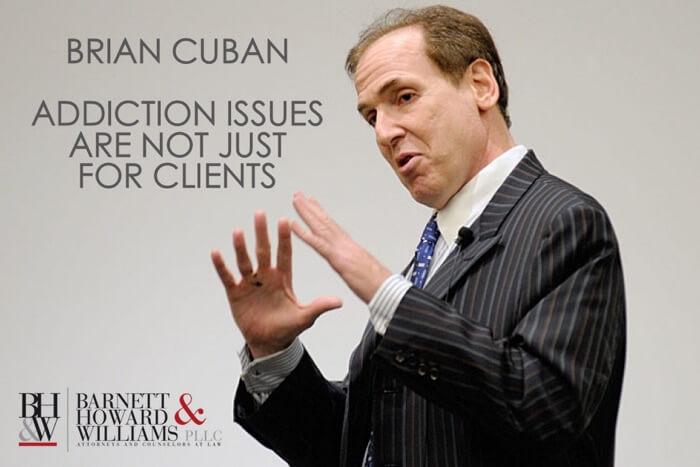
Brian Cuban The Addicted Lawyer

Addiction Issues Are Not Just for Clients

By Drug Crimes

Brian Cuban: The Addicted Lawyer

Brian Cuban The Addicted LawyerBe it alcohol, drugs, or something else, many of our clients struggle with addiction.  We work everyday to counsel them and help them get plugged into the right places that assist in recovery.  But we sometimes forget that addiction issues aren’t limited to our clients.  Many of our friends and colleagues in the legal community struggle with addiction.  Overworked and overstressed, many lawyers turn to alcohol or drugs as an escape.

Recently, a friend of mine connected me with Brian Cuban. For those of you who don’t know of Brian Cuban, he is a lawyer, speaker, and activist, and the brother of Mark Cuban (the owner of the Dallas Mavericks).  Brian has been fighting (and winning) his battle against addiction since 2007.  He is also a writer with a new book coming out soon – The Addicted Lawyer.  I asked Brian if he would write a guest blog post about addiction.  The story below is from Brian.  Our hope is that this story will help to remind us to remember to help our colleagues in times of need and be on the lookout for the warning signs of addiction.

Gary Was a Lawyer, A Friend, An Addict

I drove past the same bus-stop every day. To the average person on his/her way to their next “stop” of the day, in life, nothing to set it off from any other.

That morning, I saw one such story I was intimately familiar with. There was Gary waiting for the bus. A lawyer. Undergraduate of Boston College Summa Cum Laude. Near the top of his class at Antioch School of Law. On to a great job with NBC. On to the NYC nightlife and the genetic pull of a family line ripe with alcohol use. Gary was an alcoholic and drug addict long before that bus stop. An addict trying to keep the shreds of his life and legal career together.

I had met Gary years before when we both worked of-counsel to a local Dallas firm. I was trying to hold my life together between addiction and an eating disorder. High functioning was a blessing and a curse. I needed no help. I showed up to court sober. I only did cocaine in the bathroom of the firm when I had no appointments. The pick up I needed after all night cocaine and alcohol benders. It all made perfect sense to me. In my mind, I was not an addict.

I had actually tried my last case with Gary. A bench trial contract matter. He ran the show. He was sober and brilliant. I didn’t want that show. I hated the practice of law. I was not afraid of a courtroom but I was sickened by them. A reminder of how much I hated my life and the career I had chosen for all the wrong reasons. We had a good result. Then Gary disappeared as he had sporadically done over the years since I first met him. I knew what that meant. We all knew. Periods of sobriety and stellar representation of his clients, periods of complaints of neglect and even showing up to client meetings apparently high.

Gary does not see me drive by him at the bus stop. He is looking at the ground. Waiting. My calls to him were never heard as his voicemail was full. I knew what that meant. Most addicts and their families know what that means. I went further down the road and turned around so I could drive up along side him. He got in. He had been to a 12-step meeting and was headed down to the Dallas 24-Hour club where he was a resident. He asked if I knew he had been disbarred. I had seen it in the local legal periodical. As what often happens with lawyers and addiction, clients money never made it to the client. State Bars take a dim view of stealing from clients and addiction is not an excuse. A common story. A common explanation from Gary. It was all a mistake. He had lost everything and was still in denial. I thought back to what my shrink had said to me April 8th 2007, the day I began my sobriety journey. “Brian, you have a law degree but you’re not a lawyer, you’re an addict.”

I drove Gary down to the 24 Hour Club. I bought him lunch. A familiar request for money until “he got back on his feet.” It became our routine. The bus stop. The drive. The excuses. The helplessness. Then he was gone again. The full voicemail. No longer at the transitional living home. He had tested dirty.

August 2013. My cell phone rings. A 516 area code. Long Island. Where some of Gary’s family lived. He had moved back home much as I had moved to Dallas to be with my brothers after finishing Pitt Law deep in alcohol use disorders. My family would save me. If recovery was only that simple. A quick conversation. He said he was sober and working as an attorney. He was also licensed in New York. I hid my annoyance at the fact that he had just been disbarred and yet was right back participating in another jurisdiction that may not know about his past. Was I ethically bound to say something? I struggled with the conflict between my view as a lawyer and as a recovering addict. It was not my recovery. It was his.

The day is finally here! My first book, “Shattered Image” is going to be released. Looking forward to the release party! A Facebook message from Gary. I had not heard from him in a while. The message was cheerful. A photo of a plane ticket to come to Dallas for my book signing. It would be the last time I would hear from Gary.

The message came from his ex-wife. The google explosion of his name told the story.

“Gary Abrams , 54 Fatally Struck By Truck Tractor Trailer” walking along a highway.

It is unknown whether he had been drinking but it does not matter. He is gone. He never “got it” in recovery. It’s not that he didn’t want it. He tried. I miss him and wish he had gotten it. Gary was a lawyer, a friend, a husband, a sibling, an alcoholic. an addict. In his passing, he also helped me. I know my recovery is only as good as today. Thank you Gary.

***************************

Brian Cuban: An authority on body dysmorphic disorder, male eating disorders and addiction(including steroids), Brian Cuban is the author of the best-selling book, Shattered Image: My Triumph Over Body Dysmorphic Disorder. It chronicles his first-hand experiences living with, and recovering from, twenty-seven years of eating disorders, alcoholism, drug addiction and Body Dysmorphic Disorder (BDD).

www.briancuban.com