Skip to content
Tag

Personal Injury Protection (PIP) Essentials: Texas Coverage Guide

5 articles

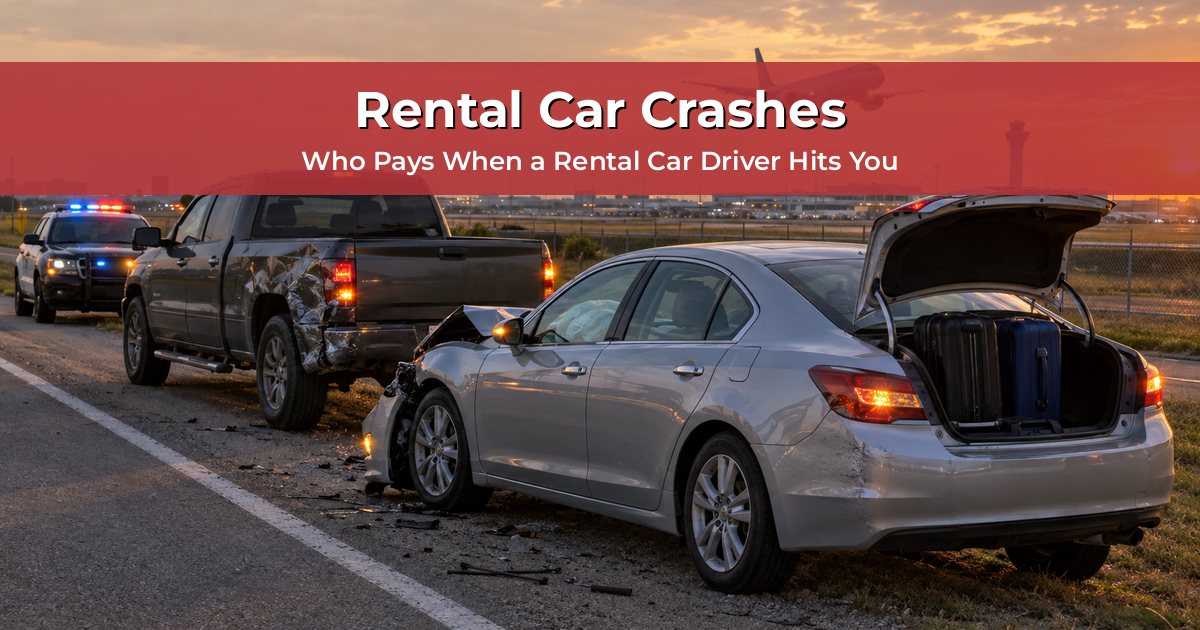
Silver rental sedan with luggage in the open trunk after a rear-end crash with a pickup near a DFW airport

Hit by a Rental Car Driver in DFW? Who Pays After a Rental Car Crash in Texas

By Jesse Lotspeich · Personal Injury

Short answer: If a driver in a rental car hits you in Texas, the claim usually runs against the driver and the insurance that covers the driver, not the rental company. A federal law known as the Graves Amendment bars holding a rental company liable just because it owns the car. Rental companies can still be liable for their own negligence, such as renting a car with known defects. Texas law also gives you a way to sue an out-of-state renter who has already flown home.

Silver rental sedan with luggage in the open trunk after a rear-end crash with a pickup near a DFW airport

With two major airports, DFW International and Dallas Love Field, Dallas-Fort Worth sees a steady stream of out-of-town drivers on unfamiliar roads like the airport's spur highways, Highway 114, Highway 183, and I-635, often tired and relying on GPS. When one of them causes a crash, injured people usually face the same questions: Who pays? Does the rental company's insurance apply? What if the driver lives in another state?

At Howard Lotspeich Alexander & Williams, PLLC (HLAW), our Fort Worth trial lawyers handle personal injury claims throughout Tarrant, Dallas, Denton, Collin, Johnson, and Parker counties. This guide explains how rental car crash claims work in Texas, whether you were hit by a renter or were driving a rental yourself.

Key Takeaways

  • The Graves Amendment generally shields rental companies from owner-based liability. A company in the rental business "shall not be liable... by reason of being the owner of the vehicle" for harm arising from the renter's use, if there is "no negligence or criminal wrongdoing" by the company (49 U.S.C. §30106).
  • Direct negligence is a different story. Federal courts in Texas have held that the Graves Amendment bars vicarious liability but "does not preempt theories of direct liability" (N.D. Tex. 2025 opinion).
  • Texas minimum liability coverage is 30/60/25: $30,000 per person, $60,000 per crash for bodily injury, and $25,000 for property damage (Tex. Transp. Code §601.072).
  • Out-of-state drivers can still be sued here. The chair of the Texas Transportation Commission is the agent for service of process on a nonresident in a suit arising from a Texas collision (Tex. Civ. Prac. & Rem. Code §17.062).
  • Your own coverage may matter most. UM/UIM and PIP can fill gaps when the renter's coverage is low or missing.

Who Is Liable When a Rental Car Driver Hits You in Texas?

The starting point is the same as any Texas car wreck: the driver who caused the crash is responsible for the harm caused by their negligence. Texas assigns fault by percentage, and you can recover as long as you're not more than 50% responsible. Our guide to how fault works in Texas personal injury cases explains those rules.

What's different in a rental car case is the question of who else might be responsible, and whose insurance pays.

What the Graves Amendment says

Before 2005, some states made rental companies liable for their customers' crashes simply because the companies owned the cars. Congress ended that with the Graves Amendment. It provides that an owner that rents or leases a vehicle "shall not be liable under the law of any State... by reason of being the owner of the vehicle... for harm to persons or property that results or arises out of the use, operation, or possession of the vehicle during the period of the rental or lease," as long as the owner is "engaged in the trade or business of renting or leasing motor vehicles" and "there is no negligence or criminal wrongdoing on the part of the owner" (49 U.S.C. §30106(a)).

Courts in Texas apply this rule regularly. In a 2025 Dallas federal case involving a leased trailer, the court held that the Graves Amendment barred the plaintiff's vicarious liability and respondeat superior claim against the leasing company, while noting that the statute "does not preempt theories of direct liability, like negligent hiring and training" (N.D. Tex. 2025).

The law also has a carve-out for financial responsibility. It doesn't override state laws "imposing financial responsibility or insurance standards on the owner of a motor vehicle," or liability on rental businesses "for failure to meet the financial responsibility or liability insurance requirements under State law" (§30106(b)).

When Can a Rental Car Company Be Held Responsible?

Because the Graves Amendment protects only against liability based on ownership, a rental company can still be responsible for its own negligence. Potential claims include:

  • Negligent maintenance. Renting out a car with bad brakes, bald tires, or a known defect, including an unrepaired safety recall.
  • Negligent entrustment. Renting to someone the company knew, or should have known, was unlicensed, incompetent, or reckless.
  • Criminal wrongdoing by the company or its employees.

These claims are hard to win. Under Texas law, negligent entrustment requires proof of "(1) entrustment of a vehicle by the owner; (2) to an unlicensed, incompetent, or reckless driver; (3) that the owner knew or should have known to be unlicensed, incompetent, or reckless; (4) that the driver was negligent on the occasion in question; and (5) that the driver's negligence proximately caused the accident" (O'Donnell v. Diaz, N.D. Tex.). Federal courts applying Texas law have also said a company that entrusts a vehicle "has no duty to investigate a driver's competency when a valid, unrestricted driver's license is presented" (Marr v. Croxton, W.D. Tex.).

Causation is another hurdle. In Allways Auto Group v. Walters, the Supreme Court of Texas held that a dealership that gave a customer a loaner car wasn't liable when the customer drove drunk and caused a crash eighteen days later, because the loan was not a proximate cause of the crash (Tex. 2017).

In practice, the rental company is most often a defendant when there's evidence of a mechanical failure. That makes it critical to preserve the vehicle and its maintenance records before the company repairs, resells, or returns the car to the fleet.

Whose Insurance Pays After a Rental Car Crash?

Several layers of coverage may be involved, and the order in which they apply depends on the policies and the rental contract. Common sources include:

Coverage source What it may cover Notes
Renter's personal auto policy Liability for injuries the renter causes Many personal policies extend to rental cars; check the policy language
Rental company coverage Liability up to the limits the company provides Often limited; Texas minimums are 30/60/25 (§601.072)
Supplemental liability insurance bought at the counter Additional liability limits Only if the renter purchased it
Your own UM/UIM coverage Your injuries when the at-fault driver has no or too little insurance See our UM/UIM and PIP guide
Your own PIP Medical bills and lost income regardless of fault Covers the named insured, household members, and authorized drivers and passengers of the named insured's vehicle (Tex. Ins. Code §1952.151)
Credit card rental benefits Usually damage to the rental car itself Generally not a source of payment for your injuries

Because rental crashes often involve minimum or uncertain coverage, your own UM/UIM policy can become the most important coverage in the case. If the renter fled the scene or had no valid coverage, see our article on what to do after an uninsured driver accident in Fort Worth.

What If the Rental Car Driver Lives in Another State?

Many renters at DFW and Love Field are visitors who are back home within days. That doesn't put them beyond the reach of a Texas court. Under Section 17.062 of the Civil Practice and Remedies Code, the chair of the Texas Transportation Commission is an agent for service of process on a nonresident "in any suit against the person or agent that grows out of a collision in which the person or the person's agent is involved while operating a motor vehicle in this state." The same rule applies to a driver who lived in Texas at the time of the crash and later moved away.

Section 17.063 sets out the mechanics: a certified copy of the process must be served on the chair at least 20 days before the return date, and the chair then mails the papers to the nonresident by registered or certified mail (§17.063). In other words, an out-of-state renter can be sued in Tarrant or Dallas County, close to where the crash happened, rather than forcing you to file in another state.

International renters raise added issues, such as foreign insurance and serving papers abroad. Those cases call for early legal advice.

What If I Was Driving the Rental Car When I Got Hurt?

If you were driving or riding in a rental car and someone else caused the crash, your claim is against the at-fault driver, just like any other wreck. A few rental-specific issues often come up:

  • Damage to the rental car. The rental company may bill you or your insurer for repairs, loss of use, and administrative fees. Don't sign anything admitting responsibility for the crash.
  • The rental company's own crash report. Rental counters often ask you to fill out an incident form. Stick to the facts and keep a copy.
  • Your PIP and UM coverage. Depending on the policy terms, your own PIP and UM/UIM coverage may apply even though you were in a rental. Read the policy or have a lawyer review it.
  • Rideshare rentals. If you rented a car to drive for a rideshare app, different coverage rules may apply. See our guide to Uber and Lyft accidents.

What Should You Do After a Crash With a Rental Car in DFW?

  1. Call 911 and get a police report. In a crash with an out-of-town driver, the police crash report is often the best record of who was involved and their insurance.
  2. Photograph the rental car's identifiers. Photograph the plate, VIN sticker, and any barcode or fleet number, plus the renter's driver's license and insurance information.
  3. Get the renter's home address and phone number, and ask whether they bought coverage at the counter.
  4. Write down the rental company and location (for example, the airport rental center or a neighborhood branch).
  5. See a doctor promptly, even if you feel fine. Our article on seeing a doctor after a minor car accident explains why.
  6. Send a preservation letter early if a mechanical defect may have played a role, so the rental company keeps the car and its maintenance records.
  7. Be cautious with multiple adjusters. You may hear from the renter's insurer, the rental company's claims administrator, and your own carrier. Read about insurance adjuster tactics before giving a recorded statement.
  8. Watch the deadline. Most Texas injury lawsuits must be filed within two years. See our Texas statute of limitations guide.

Frequently Asked Questions

Can I sue the rental car company if its customer hit me?

Usually not just because the company owns the car. The Graves Amendment bars ownership-based liability for companies in the rental business, but it doesn't protect a company from liability for its own negligence or criminal wrongdoing (49 U.S.C. §30106). Evidence of poor maintenance or a known defect can support a direct claim.

Does the rental company's insurance cover my injuries?

It may, depending on the coverage the company provides and the rental agreement. Coverage is often limited, and Texas minimum liability limits are $30,000 per person and $60,000 per crash for bodily injury (Tex. Transp. Code §601.072). The renter's own auto policy or a supplemental policy bought at the counter may also apply.

The driver who hit me flew home to another state. Can I still sue in Texas?

Yes. Texas law makes the chair of the Texas Transportation Commission the agent for service of process on nonresident drivers involved in collisions in Texas (CPRC §17.062).

Is a rental company liable for renting to a bad driver?

Only in limited situations. A negligent entrustment claim requires proof that the company knew or should have known the driver was unlicensed, incompetent, or reckless (O'Donnell v. Diaz), and courts have said there is no duty to investigate further when a valid, unrestricted license is presented (Marr v. Croxton).

What if the renter didn't have enough insurance?

Your own uninsured/underinsured motorist coverage may pay the difference, up to your policy limits. PIP can also pay medical bills and lost income regardless of fault (Tex. Ins. Code §1952.151).

How long do I have to file a claim?

Most Texas personal injury claims must be filed within two years of the crash. Claims involving government vehicles can have much shorter notice deadlines.

Talk to a Fort Worth Car Wreck Lawyer

Rental car crashes add layers of insurance, out-of-state drivers, and federal law to an already stressful situation. HLAW can identify every available policy, preserve the vehicle evidence, and serve a driver who has already left Texas. Call (817) 993-9249 or contact us online for a free consultation.

This article is for general informational purposes only and is not legal advice. Reading it does not create an attorney-client relationship. Every case depends on its specific facts, and the laws discussed here may change.

Read full article
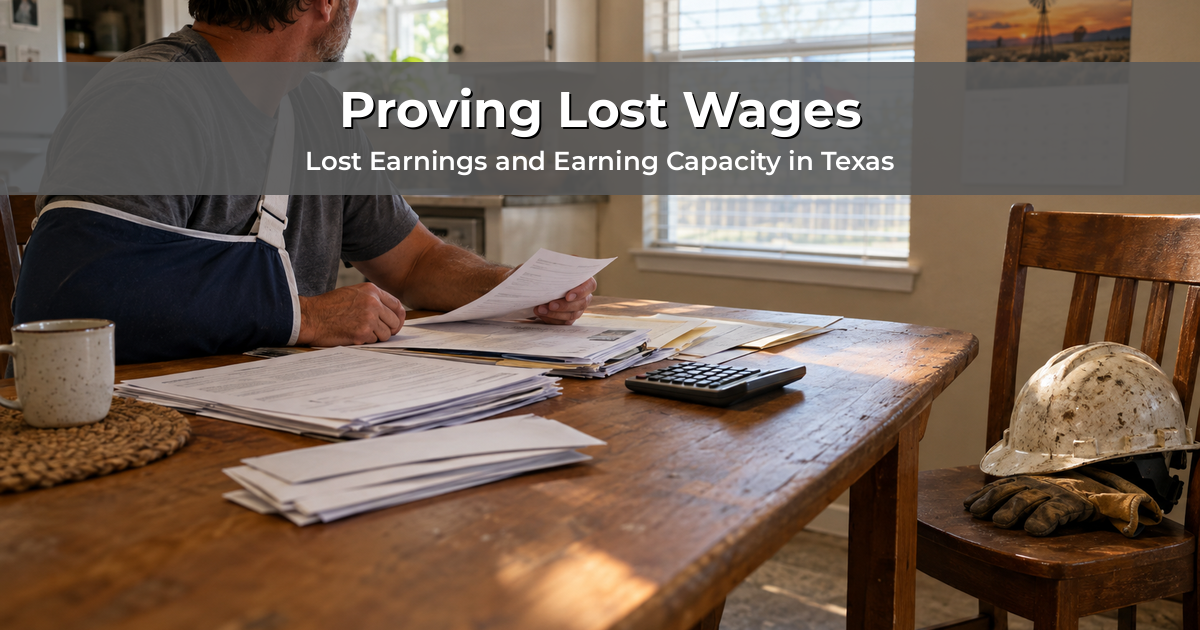
Injured worker with his arm in a sling reviewing pay records and bills at a kitchen table, hard hat on a nearby chair

Missed Work After a DFW Injury? How to Prove Lost Wages and Lost Earning Capacity in Texas

By Jesse Lotspeich · Personal Injury

Short answer: In a Texas personal injury case, you can recover the wages you've already lost and the loss of your future capacity to earn, but you have to prove both with evidence, not estimates. Texas law requires lost earnings to be presented as a net loss after federal income taxes. Courts let juries consider your past earnings, stamina, efficiency, ability to work with pain, and work-life expectancy when measuring future losses. Pay stubs, tax returns, employer statements, medical work restrictions, and, in bigger cases, vocational and economic experts are what turn a lost paycheck into a recoverable claim.

Injured worker with his arm in a sling reviewing pay records and bills at a kitchen table, hard hat on a nearby chair

After a wreck on I-30 or a fall at a Fort Worth job site, the bills that hurt most are often not the medical bills. They're the missed paychecks. Missed shifts, used-up PTO, a lost promotion, or a career you can no longer do are all real economic losses under Texas law, but insurance companies routinely discount them when they aren't documented well.

At Howard Lotspeich Alexander & Williams, PLLC (HLAW), our Fort Worth trial lawyers handle personal injury cases throughout Tarrant, Dallas, Denton, Collin, Johnson, and Parker counties. This guide explains how Texas law treats lost wages and lost earning capacity, what evidence works, and the mistakes that shrink these claims.

Key Takeaways

  • Two different claims. Past lost earnings cover income you've already missed. Loss of earning capacity covers your diminished ability to earn in the future, even if you were paid the same or more after the injury.
  • Net, after taxes. Evidence of lost earnings or earning capacity "must be presented in the form of a net loss after reduction for income tax payments" under federal income tax law (Tex. Civ. Prac. & Rem. Code §18.091).
  • Reasonable measurement in dollars. You must give the jury evidence "sufficient to permit a jury to reasonably measure earning capacity in monetary terms" (Big Bird Tree Service v. Gallegos, Tex. App.—Dallas 2012).
  • Lost wages are economic damages. Texas defines economic damages as compensation for "actual economic or pecuniary loss" (CPRC §41.001(4)).
  • PIP can help right away. Personal injury protection coverage pays "replacement of income lost as the result of the accident" for income producers, regardless of fault (Tex. Ins. Code §1952.151).

What Is the Difference Between Lost Wages and Lost Earning Capacity?

Texas law treats these as related but distinct damages.

Past lost earnings (lost wages) are the income you actually lost between the injury and trial or settlement: missed hours, missed shifts, unpaid leave, lost overtime, lost commissions, and lost bonuses that were reasonably certain.

Loss of earning capacity looks at something broader: your ability to earn money. Texas courts describe it as an assessment of the plaintiff's capacity to earn a livelihood before the injury and the extent to which the injury impaired that capacity. It "is not measured by what a person actually earned before an injury, but by the person's capacity to earn, even if he had never worked in that capacity in the past" (Tex. App.—Houston [1st Dist.] 2013).

That second point matters. Courts "have consistently upheld judgments for reduced earning capacity, even though the plaintiff was making as much or even more money after the injury than before," where pain, weakness, or diminished functional ability impaired the person's capacity to get and hold a job, or the duration, consistency, or efficiency of their work (Kelsey-Seybold Medical Group v. Roberts, Tex. App.—Houston [1st Dist.] 2024).

Past lost earnings Loss of future earning capacity
Time period Injury to trial or settlement After trial, for the rest of your work life
What it measures Income actually lost Diminished ability to earn
Typical proof Pay stubs, W-2s, tax returns, employer letter, timesheets Medical restrictions, vocational testimony, economist, past earnings history
Tax rule Net after federal income tax (§18.091) Net after federal income tax (§18.091)

How Do You Prove Lost Wages in a Texas Injury Claim?

For an hourly or salaried employee, the proof is usually straightforward, but it has to be complete:

  1. A doctor's work restriction. A note or record showing you were taken off work or placed on light duty, and for how long. Without it, insurers will argue you chose not to work.
  2. Pay records. Recent pay stubs and W-2s showing your rate, typical hours, and overtime history.
  3. An employer verification letter. A letter from HR or a supervisor confirming your position, pay rate, the dates you missed, and any lost overtime, bonuses, or promotion.
  4. Tax returns. Usually two to three years, especially if your income varies.
  5. PTO and sick leave records. If you used paid leave to cover missed days, document it.

What if I'm self-employed or a gig worker?

Self-employed claims require more proof, but they're recoverable. Courts recognize that "when the plaintiff seeks special damages for loss of earning capacity in a particular business, the amount of his earnings or the value of his services in that business must be shown with reasonable certainty" (Perez v. Perez, Tex. App.—Corpus Christi 2013). Useful evidence includes:

  • Schedule C or business tax returns for several years
  • 1099 forms and app earnings statements for rideshare and delivery drivers
  • Bank deposits, invoices, and canceled contracts or jobs you had to turn down
  • The cost of hiring someone to cover your work while you recovered
  • Testimony from regular customers or business partners

When income has been irregular, an accountant or economist can help show average earnings and what you would likely have earned during your recovery.

How Do Texas Courts Measure Lost Future Earning Capacity?

Future losses are uncertain by nature, and Texas law accepts that. "Proof of loss of earning capacity is always uncertain and is left largely to the discretion of the jury" (Big Bird Tree Service v. Gallegos). But the jury's award must rest on evidence, not speculation. Courts have said an award "must be based on something more than mere conjecture" (Durham Transportation Co., Tex. App.).

The Dallas Court of Appeals lists non-exclusive factors juries may consider: "evidence of past earnings, the plaintiff's stamina, efficiency, and ability to work with pain, and the plaintiff's work-life expectancy" (Big Bird Tree Service). Other Texas courts add "the weaknesses and degenerative changes that will naturally result from the plaintiff's injury" (Durham Transportation).

In practice, strong future-earnings claims usually include:

  • Treating doctor testimony on permanent restrictions (for example, no lifting over 20 pounds, no repetitive overhead work).
  • A vocational expert who explains which jobs you can still do and what they pay in the DFW labor market.
  • An economist who calculates the difference over your expected work life, adjusts for taxes as §18.091 requires, and reduces future amounts to present value.
  • Your own testimony and co-workers' testimony about how the injury affects your stamina and performance.

Will My Lost Wage Award Be Taxed?

Generally, damages for personal physical injuries aren't taxable as income under federal law, which is the reason for Texas's net-of-tax rule. Section 18.091(b) also requires the court to "instruct the jury as to whether any recovery for compensatory damages sought by the claimant is subject to federal or state income taxes" (CPRC §18.091). The practical effect: your lost earnings must be calculated on take-home pay, not gross pay. Tax questions about a specific settlement should go to a tax professional.

Can PIP Pay My Lost Income After a Car Wreck?

Yes, if you have it. Texas personal injury protection coverage pays, for an income producer, "replacement of income lost as the result of the accident," for expenses incurred within three years of the accident (Tex. Ins. Code §1952.151). Insurers aren't required to offer more than $2,500 per person in PIP, though many people buy more (§1952.153). The insurer must pay benefits no later than the 30th day after it receives satisfactory proof of the claim (§1952.156).

PIP applies regardless of fault, so it can help cover the gap while the liability claim is pending. Our guide to UM/UIM and PIP coverage explains how these policies fit together.

If you were hurt on the job, the rules may be different. Workers' compensation, or the lack of it with a non-subscriber employer, changes how lost income is handled. See our page on workplace accidents.

What Mistakes Hurt Lost Wage Claims?

  • Returning to work against medical advice, then trying to claim the time later.
  • Gaps in treatment, which insurers use to argue you were well enough to work.
  • Unreported cash income. If income wasn't reported on tax returns, it's very difficult to prove and can create other problems.
  • Posting on social media about physical activities or side jobs while claiming you can't work.
  • Giving the adjuster a recorded statement that downplays your limitations. Read about insurance adjuster tactics in Fort Worth.
  • Settling before you know your restrictions. If a surgeon hasn't released you, you may not yet know whether you can return to your trade.
  • Missing the deadline. Most Texas injury lawsuits must be filed within two years. See our Texas statute of limitations guide.

Lost earnings are only part of the picture. Our article on what compensation is available in a Texas personal injury lawsuit covers medical expenses, pain and suffering, and other damages. Noneconomic damages are defined separately in Texas law and include "physical pain and suffering, mental or emotional pain or anguish... physical impairment," and similar losses (CPRC §41.001(12)).

Frequently Asked Questions

Can I recover lost wages if I used PTO or sick days?

It may be possible. Paid leave you were forced to use because of the injury is a benefit you can no longer use for other purposes, and it is commonly presented as part of the earnings claim. Whether it is recoverable depends on the facts, so keep the payroll records showing the leave you used and the dates.

Can I claim lost earning capacity if I went back to the same job?

Possibly. Texas courts have upheld earning-capacity awards even when the plaintiff earned as much or more after the injury, where pain or diminished function impaired the ability to get and hold work or to work consistently and efficiently (Kelsey-Seybold v. Roberts).

Do I need an expert to prove future lost earnings?

Not always, but in cases involving permanent injury or a career change, a vocational expert and an economist are often the most persuasive way to give the jury a reasonable dollar measure, which the law requires (Big Bird Tree Service).

Are lost wages calculated before or after taxes in Texas?

After. Section 18.091 requires lost earnings and earning-capacity evidence to be presented as a net loss after federal income taxes (CPRC §18.091).

I'm self-employed. How do I prove what I lost?

Use tax returns, 1099s, invoices, bank deposits, and evidence of jobs you lost or turned down. The earnings or value of your services must be shown with reasonable certainty (Perez v. Perez).

Will my own insurance pay lost income while I wait?

If your auto policy includes PIP, it covers lost income for income producers regardless of fault, and the insurer must pay within 30 days of satisfactory proof (Tex. Ins. Code §§1952.151, 1952.156).

Talk to a Fort Worth Personal Injury Lawyer

If an injury has cost you paychecks, or your career, the way that loss is documented can make a substantial difference in what you recover. HLAW can gather your employment records, work with your doctors on restrictions, and bring in vocational and economic experts when needed. Call (817) 993-9249 or contact us online for a free consultation.

This article is for general informational purposes only and is not legal advice. Reading it does not create an attorney-client relationship. Every case depends on its specific facts, and the laws discussed here may change.
Read full article
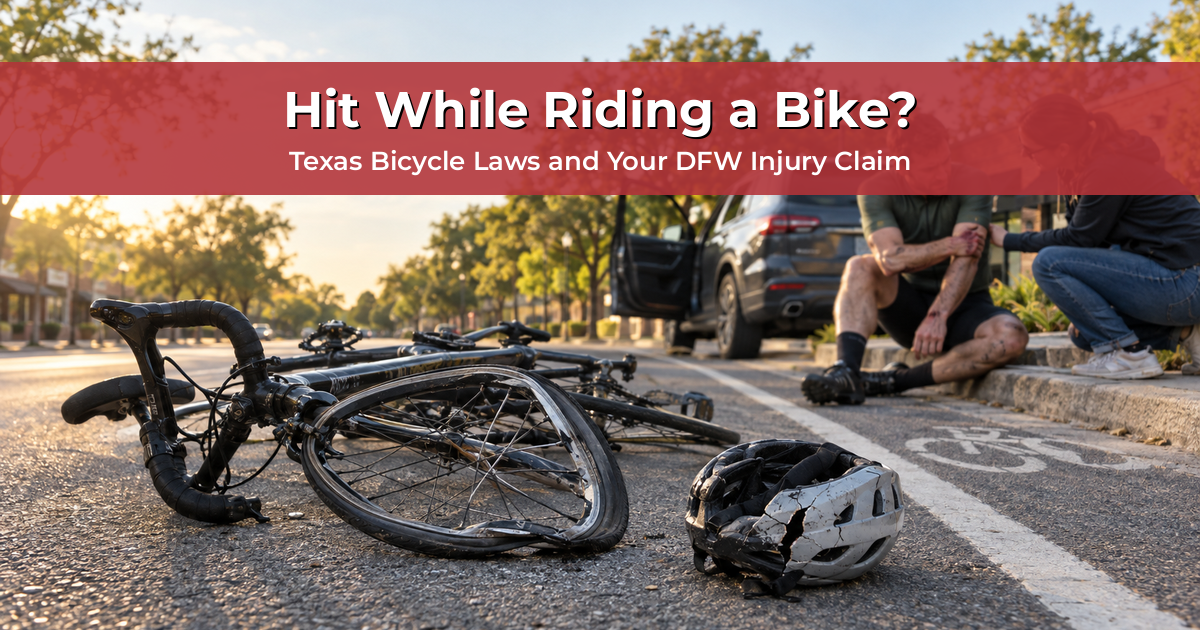
Damaged road bicycle and cracked helmet in a bike lane after a dooring crash, with an injured cyclist on the curb being helped by a passerby

Hit While Riding a Bike in Fort Worth or Dallas? Texas Bicycle Laws and Your Injury Claim

By Jesse Lotspeich · Personal Injury

Short answer: If a driver hits you while you're riding a bicycle in Fort Worth, Dallas, or elsewhere in North Texas, you can usually recover compensation from the at-fault driver's insurance for medical bills, lost income, and pain and suffering. You may also be able to use your own auto policy's PIP and uninsured motorist coverage, even though you weren't in a car. Texas treats a bicycle as a vehicle with the same rights on the road. Fort Worth and Dallas have local "vulnerable road user" ordinances that require drivers to give cyclists safe passing room. You can recover damages as long as you are not more than 50% at fault, so evidence about who caused the crash matters from day one.

Damaged road bicycle and cracked helmet in a bike lane after a dooring crash, with an injured cyclist on the curb being helped by a passerby

Bicycle crashes are some of the most serious collisions we see. A cyclist has no seatbelt, no airbag, and no steel frame, so even a low-speed impact from a right-turning SUV or an opening car door can cause broken bones, a head injury, or worse. According to TxDOT, 80 bicyclists died and another 429 were seriously injured in 2,761 Texas traffic crashes in 2024. Driver inattention, failure to yield the right of way, and speeding were the top contributing factors.

At Howard Lotspeich Alexander & Williams, PLLC (HLAW), we represent injured cyclists across Tarrant, Dallas, Denton, Collin, Johnson, and Parker counties. This guide explains the Texas bicycle laws that matter in an injury claim, how fault is decided, which insurance pays, and what to do after a crash.

Key Takeaways

  • A bike is a vehicle in Texas. Cyclists have the rights and duties of drivers. They must ride with traffic and generally keep to the right, but the law lists several exceptions that let you take the lane.
  • Texas has no statewide 3-foot law. Fort Worth and Dallas have local vulnerable road user ordinances requiring at least 3 feet of clearance for passenger vehicles and 6 feet for trucks.
  • Crosswalk crashes can be crimes. Under Transportation Code §545.428, a driver who negligently injures a cyclist in a crosswalk commits a Class A misdemeanor. It becomes a state jail felony if the cyclist suffers serious bodily injury.
  • The 51% rule. Under CPRC §33.001, you can recover damages if you are 50% or less at fault. Your recovery is reduced by your percentage of fault.
  • Your own auto policy may cover you on a bike. PIP and UM/UIM coverage often protect you as a cyclist, which matters when the driver is uninsured, underinsured, or flees.
  • No helmet doesn't bar your claim. Texas doesn't require adult cyclists to wear helmets, though insurers may still argue about it.
  • The deadline is generally two years. Texas's personal injury statute of limitations is generally two years.

What Texas Bicycle Laws Apply in DFW?

Bicycles have the same rights as cars

The City of Fort Worth's bicycle law guide, drawing on the Texas Driver Handbook, explains that a bicycle is a vehicle. A person riding one has the rights and duties of any vehicle driver, except those that by their nature can't apply to bicycling. Cyclists must obey signs and signals, stop at red lights and stop signs, and ride with traffic, not against it.

When cyclists can take the lane

Drivers and insurance adjusters often assume a cyclist must hug the curb. That's not quite the law. Under Transportation Code §551.103, a cyclist moving slower than traffic must ride "as near as practicable" to the right curb or edge, unless:

  1. They are passing another vehicle;
  2. They are preparing to turn left;
  3. A hazard prevents safe riding at the edge, such as a parked car, debris, a pedestrian, or a poor road surface; or
  4. The outside lane is less than 14 feet wide with no bike lane, or is too narrow for a bike and car to travel safely side by side.

On a one-way street with two or more marked lanes, a cyclist may also ride near the left curb. Many DFW streets have outside lanes narrower than 14 feet, so a cyclist riding in the middle of the lane is often doing exactly what the law allows.

Safe passing: no statewide 3-foot law, but Fort Worth and Dallas have rules

Texas is unusual: it has no statewide minimum passing distance. The Legislature passed a safe passing bill in 2009, but it was vetoed. Statewide, a driver overtaking another vehicle must pass to the left "at a safe distance" under Transportation Code §545.053.

Several North Texas cities have filled the gap. According to the North Central Texas Council of Governments:

City Ordinance Key requirements
Dallas City Code Ch. 28, Sec. 28-58.2 Pass at a safe distance (3 ft for cars, 6 ft for trucks/commercial vehicles); no throwing objects at cyclists; no "right hook" turns in front of a cyclist
Fort Worth City Code Ch. 22, Sec. 22-95 Same as Dallas, plus a ban on maneuvering a vehicle to intimidate or harass a vulnerable road user

BikeTexas reports that Texas cities with safe passing ordinances include Fort Worth, Denton, and Plano. In a civil case, a violation of a safety ordinance like this can be powerful evidence of negligence.

"Dooring" is against the law

One of the most common urban bike crashes happens when a parked driver or passenger opens a door into a cyclist's path. Transportation Code §545.418 says a person may not open a door on the side available to moving traffic unless it can be done "in reasonable safety without interfering with the movement of other traffic." Dooring crashes are common in busy areas like Magnolia Avenue, West 7th, Deep Ellum, and Bishop Arts, where riders pass rows of parked cars.

Crosswalks and the vulnerable road user offense

Under §545.428, a driver commits an offense if they operate a vehicle in a crosswalk with criminal negligence and injure a pedestrian or a person riding a bicycle, scooter, or similar device. It's a Class A misdemeanor, or a state jail felony if the rider suffers serious bodily injury. The statute provides an affirmative defense if the rider was violating traffic laws at the time. A criminal charge doesn't decide your civil case, but it can strengthen your claim.

Helmets and lights

Texas has no statewide helmet requirement for adult cyclists. Fort Worth's guide says wearing an approved helmet is "highly suggested" but "not required by law." At night, Texas law requires a white front lamp and a red rear reflector or lamp, and TxDOT recommends both.

Who Is at Fault in a Texas Bicycle Accident?

Fault is decided under Texas's proportionate responsibility system. A jury or the parties' negotiations assign each person a percentage of responsibility:

  • If you are 50% or less at fault, you can recover, but your damages are reduced by your percentage. For example, 20% fault on a $100,000 claim leaves $80,000.
  • If you are more than 50% at fault, you recover nothing from that defendant.

Insurers know this, so they look for ways to shift blame to the cyclist. Common arguments include riding outside the bike lane, not wearing a helmet, having no lights, wearing dark clothing, or "coming out of nowhere." Many of these arguments fall apart once the facts and the law are examined, such as when §551.103 allowed the cyclist to take the lane. We explain fault in more detail in our article on how fault works in Texas personal injury cases.

Common causes of bike crashes we see in DFW

  • Right hooks: a driver passes a cyclist, then turns right across the cyclist's path.
  • Left crosses: an oncoming driver turns left in front of the cyclist.
  • Unsafe passing: a driver passes too close, sideswipes the cyclist, or forces them off the road.
  • Dooring: a parked car door opens into the cyclist.
  • Driveway and parking-lot exits: a driver pulls out without looking for cyclists on the road or a trail crossing.
  • Distracted driving: texting, using navigation, or using a phone while driving.
  • Road defects: potholes, broken pavement, or debris, which can sometimes support a claim against a government entity, with very short notice deadlines.

Which Insurance Pays After a Bicycle Accident?

Cyclists are often surprised to learn how many coverages may apply:

  1. The at-fault driver's liability insurance. Texas requires minimum liability coverage of $30,000 per person and $60,000 per accident for bodily injury. For a serious bike injury, that's often not enough.
  2. Your own Personal Injury Protection (PIP). PIP is no-fault coverage on Texas auto policies that pays medical bills and lost wages regardless of fault. Depending on your policy language, it may cover you as a cyclist struck by a motor vehicle.
  3. Your own uninsured/underinsured motorist (UM/UIM) coverage. If the driver has no insurance, too little insurance, or leaves the scene, UM/UIM can fill the gap. See our guides on UM/UIM and PIP coverage and hit-and-run crashes in Texas.
  4. Health insurance. Health insurance pays medical bills up front, but it may have a right to be repaid from your settlement. Read more in Who Gets Paid First? Hospital Liens and Your DFW Injury Settlement.
  5. Commercial or employer policies. If a delivery van, work truck, or rideshare vehicle hits you, additional and often larger policies may apply.

Every policy is different. Get a lawyer's review before you give a recorded statement to any insurer, including your own. See insurance adjuster tactics in Fort Worth.

What Compensation Can an Injured Cyclist Recover?

Depending on the facts, damages can include:

  • Past and future medical expenses, including ER care, surgery, physical therapy, and future care.
  • Lost wages and loss of earning capacity.
  • Physical pain and mental anguish.
  • Physical impairment and disfigurement, including scarring and road rash.
  • Damage to your bicycle, helmet, clothing, and gear. High-end bikes and electronics can be expensive.
  • Wrongful death damages for families when a crash is fatal. See wrongful death claims.

In Texas, recoverable medical expenses are generally limited to amounts actually paid or incurred, not the full amount billed, so documenting your medical care carefully matters.

What Should You Do After a Bike Crash in DFW?

  1. Call 911 and get checked out. Adrenaline hides injuries. Head, neck, and internal injuries may not show up right away. Read why you should see a doctor even after a "minor" crash.
  2. Make sure a police report is made. Officers sometimes treat bike crashes as minor. A Texas Peace Officer's Crash Report (CR-3) documents the scene and the driver's information. See how to get your car wreck police report.
  3. Photograph everything. Take photos of the vehicle, its position, the lane, any bike lane markings, skid marks, debris, your bike, and your injuries.
  4. Save your ride data and video. GPS apps (such as Strava or Garmin), helmet cams, and handlebar cameras can show your speed, route, and position on the road. Ask nearby businesses for security footage quickly, and look for dash-cam video. See dash-cam footage in Texas accident cases.
  5. Don't repair or throw away the bike or helmet. Your damaged equipment is evidence.
  6. Get witness names and phone numbers. Independent witnesses are especially valuable when the driver blames the cyclist.
  7. Don't give a recorded statement or post about the crash before talking with a lawyer.
  8. Watch the deadlines. The Texas statute of limitations is generally two years, and claims involving a city or county can require written notice within months.

Frequently Asked Questions

Does Texas have a 3-foot passing law for bicycles?

Not statewide. A statewide safe passing bill was vetoed in 2009. However, Fort Worth (City Code Ch. 22, Sec. 22-95) and Dallas (City Code Ch. 28, Sec. 28-58.2) have vulnerable road user ordinances requiring drivers to pass at a safe distance: 3 feet for passenger vehicles and 6 feet for trucks and commercial vehicles. Statewide, drivers must still pass at a safe distance under §545.053.

Can I recover damages if I wasn't wearing a helmet?

Yes. Texas has no statewide helmet law for adults, so not wearing one isn't illegal. An insurer may argue a helmet would have reduced a head injury, but that doesn't bar your claim. How much it matters depends on the injury and the evidence.

Do I have to ride in the bike lane?

Texas law generally requires a cyclist moving slower than traffic to ride as near as practicable to the right edge, but §551.103 lists exceptions. These include hazards and lanes too narrow to share safely. Riding outside a bike lane isn't automatically negligent, and the specific facts and any local ordinance matter.

Will my car insurance cover me if I was hit while on my bike?

Often, yes. PIP and UM/UIM coverage on a Texas auto policy may protect you as a cyclist struck by a motor vehicle, depending on the policy language. This is especially important in hit-and-run cases and when the driver carries only minimum coverage.

What if the driver says I came out of nowhere?

That's one of the most common defenses in bike crash cases. Evidence often answers it: video, GPS data, lighting, sight lines, crash reconstruction, and witnesses. Under Texas's proportionate responsibility rule, you can still recover if you are found 50% or less at fault.

How long do I have to file a bicycle accident claim in Texas?

Generally two years from the date of the crash for a personal injury lawsuit. Claims against government entities, such as for a road defect or a city vehicle, can require formal notice much sooner. Talk to a lawyer promptly.

Is a bike crash in a crosswalk a crime for the driver?

It can be. Under §545.428, a driver who negligently injures a cyclist within the area of a crosswalk commits a Class A misdemeanor, or a state jail felony if the cyclist suffers serious bodily injury. The criminal case is separate from your civil claim, but a conviction can help prove fault.

Talk to a Fort Worth Bicycle Accident Lawyer

Cyclists are entitled to share the road, and drivers who ignore that should be held responsible. HLAW's personal injury attorneys represent injured cyclists, pedestrians, and drivers throughout Dallas-Fort Worth. We gather the evidence, deal with the insurers, and fight for full compensation. Call (817) 993-9249 or contact us online for a free consultation.


This article is for general informational purposes only and is not legal advice. Reading it does not create an attorney-client relationship. Insurance coverage depends on your specific policy language, local ordinances can change, and every case depends on its facts. Consult a licensed Texas attorney about your situation.

Read full article
UM UIM PIP Insurance Texas

What You Need to Know When Buying or Renewing Your Car Insurance

By Jason H. Howard · Car Wreck

Protect Your Family By Knowing These 3 Car Insurance Acronyms

UM UIM PIP Insurance Texas
Car insurance premiums, like everything else these days, have reached historic highs. You get your renewal notice in the mail and gasp at the increase. So, you make the call to your insurance agent to see what can be done to save you money.

We’ve all seen the commercials – switch to us, bundle this with that, install this in your car, etc. and promises are made to save you money! A lot of times you will receive discounts by doing these things, BUT one of the main ways that insurance companies try to “save you money” is by asking you to reject KEY options in your policy that you’re unfamiliar with.

Here are the acronyms we want to educate you about:

UM – Uninsured Motorist Policy UIM – Underinsured Motorist Policy PIP – Personal Injury Protection

Under Texas law, these three options are required to be offered to you by your insurance company. However, you can choose to reject them as part of your car insurance policy if you so choose (Texas Insurance Code Art. 5.06(1) & Sec. 1952.152(b).)

It’s important to note these insurance options are part of YOUR insurance policy that add extra layers of coverage if you or your family are involved in a car wreck. Let’s talk about what these options are and why they are crucial to providing the adequate protection you need.

What is Uninsured Motorist Insurance (UM)?

This one’s pretty straightforward. This Uninsured Motorist insurance provides coverage if you are involved in an accident with another at-fault driver who does NOT have car insurance. Research estimates that around 1,500,000 drivers in Texas are not insured. That’s a lot of folks and the importance of having this insurance cannot be overstated!

What is Underinsured Motorist Insurance (UIM)?

This insurance provides coverage when you are involved in an accident and the at-fault party’s insurance limits aren’t enough to pay for your or your family’s medical bills, lost wages, loss of earning capacity, pain and suffering, etc. Believe it or not Texas’ minimum policy limits for auto insurance is STILL $30,000 per person/$60,000 per accident (Texas Transportation Code 601.072.) Those are the same minimum coverage amounts that existed in 2011! We could go into further discussion regarding why those amounts haven’t increased in 12 years, but we think it’s pretty obvious that the insurance companies have done a good job of making sure our state legislature doesn’t address this issue. When you consider how expensive medical bills have become and how much inflation has occurred over the last 12 years, it becomes apparent that this insurance is extremely necessary, too.

What is Personal Injury Protection (PIP)?

If you are involved in a car wreck, regardless of who is at fault, Personal Injury Protection insurance provides coverage to a certain limit for necessary expenses for:

1) Necessary medical, surgical, x-ray, or dental services, including prosthetic devices, and necessary ambulance, hospital, professional nursing or funeral services
2) Replacement of income lost as the result of the accident (lost wages) and,
3) if not an income or wage producer, reimbursement of necessary and reasonable expenses for essential services ordinarily provided by that person for care and maintenance of the family or household (Texas Insurance Code 1952.151.)

This coverage extends not only to the driver, but also to all occupants in the vehicle driven by you or your family member. It also provides coverage to you or your family member if you or they are a passenger in another vehicle driven by another person with their own insurance.

These three options were created by law to provide solid insurance coverage to protect Texas citizens and their families. For insurance companies, however, it’s not good for their bottom line and profits.

And, unfortunately, Texas law allows a way for insurance companies to avoid offering these options as part of your insurance policy. How do they do it? By getting YOU to agree to reject these options at the time you purchase your car insurance.

Now that you’ve read this and know what these insurance options provide, you would never agree to reject them, right? The reality, however, is that when you’re going through the insurance shopping experience (especially nowadays with current inflation rates) your focus becomes:

“HOW MUCH IS THIS GOING TO COST ME AND ARE THERE WAYS TO SAVE ME MONEY?”

Therein lies the vulnerability that insurance companies love to pounce on.

Your insurance agent or company will offer to save you a nominal amount of money if you agree to reject these options. We use the word nominal because the savings you might see are significantly outweighed by the out-of-pocket costs you will experience if involved in a car wreck and don’t have these coverages.

It’s worth noting that some insurance companies operate in such a way that they’d prefer to not even discuss UM/UIM/PIP and will instead deceptively present rejecting them as an easy option to save money without informing you fully about the consequences of doing so. That is exactly why we are providing you with the information in this article. Most shoppers are savvy these days and want to be informed about their purchases. We hope this article helps educate you about why these insurance options matter and how rejecting them ultimately offers you no real benefit. Don’t let the small amount of increase in your total policy premium deter you from REFUSING to reject UM/UIM/PIP coverage. Simply put – the additional amount you will pay IS WORTH IT.

Things we recommend when shopping for your insurance or when renewing it:

1) CONFIRM with your insurance agent or company that you are NOT rejecting UM/UIM/PIP,
2) READ WHAT YOU SIGN - we know this can be overwhelming and the insurance companies prefer it that way but do your best,
3) LOOK SPECIFICALLY for documentation that indicates you are rejecting UM/UIM/PIP,
4) LOOK SPECIFICALLY at your declarations page and look to see where UM/UIM/PIP coverages are included,
5) PAY ATTENTION to the minimum amounts for each so you know what you’re getting, and
6) IF YOU WANT MORE THAN THE MINIMUM COVERAGE, ask your insurance agent what higher limits they offer.

One more thing to note – if, after reading this article, you look at your policy and discover that you have rejected UM/UIM/PIP as part of your insurance coverage, call your insurance agent or company and inform them you want it added as soon as possible. We often handle cases where the client has rejected UM/UIM/PIP and unfortunately discover the “full coverage” they thought they had is far from it.

We’ll conclude with this – our hope is you have solid insurance coverage and NEVER need to use it. That really is the best case. If, however, you or your family are involved in a car accident, we highly recommend you consult with an attorney. Barnett, Howard & Williams, PLLC offers a free consultation and are here if you need us.

Read full article
UM UIM Claims Texas

UM/UIM Insurance: When the At-Fault Driver's Insurance is Not Enough

By Luke A. Williams · Insurance, Personal Injury

UM UIM Claims TexasTexas law is clear that every driver must maintain financial responsibility (auto insurance). But, the truth of the matter is that there are thousands of drivers on Texas roads who are underinsured with a minimum policy or not insured at all. What this means is that if you are hit and injured in a car wreck by one of these uninsured or underinsured drivers, you may have to use your own insurance to pay for your medical bills, lost wages, lost ability to work and/or other damages.
What can you do to protect yourself if you are injured in an accident caused by an underinsured or uninsured driver?

We recommend that you carry a significant amount of uninsured motorist (UM) and underinsured motorist (UIM) protection insurance. These policies, which typically only cost you a few dollars per month, ensure that if you are injured by an underinsured or uninsured motorist you and your attorney will have a policy to pursue to properly compensate you for your injuries.

What are the minimum requirements of insurance in Texas and what else can you do to protect yourself?

Texas law requires that a driver have at least $30,000 of coverage for injuries per person, and a total of $60,000 per accident. Insurance companies also offer an option called personal injury protection (PIP). While some states require that drivers carry PIP, Texas does not. PIP is an additional option that provides coverage specifically for injuries sustained in a car wreck. Most people carry $2,500 in coverage under their PIP – this is the minimum coverage required to be “offered” in Texas when you purchase an auto insurance policy. PIP not only pays medical bills but, 80% of your lost income and reasonable household duties. You can purchase even higher limits of PIP through your insurance company and you should get as much PIP coverage as you can. Most insurance companies will sell you at least $10,000 in coverage under PIP, some even more.

Ultimately, if you are injured in a car wreck, your own PIP insurance would be the first policy to pay towards your damages before you can start to pursue the driver’s insurance who hit you.

Why the minimum coverage (and PIP) typically aren’t enough.

Often times, when you’re seriously injured, using your PIP and having the minimum amount of coverage to go after against the driver who hit you just isn’t enough. This is especially (and obviously) the case if the at-fault driver is uninsured. This is where your UIM/UM policy kicks in. If you don’t have UIM/UM coverage under your own policy, then you could be out of luck.

With UM and UIM insurance, claims that exceed your own PIP and the at-fault driver’s insurance will be covered up to the limits of your UM/UIM policy. Because of the vast amount of driver’s in Texas who are either underinsured or uninsured, in many cases UM/UIM policies are one of the only coverages available for your attorney to seek to compensate you for your injuries.

Do you need an attorney for UM/UIM cases?

Yes you do. First and foremost, you need an advocate to make sure you’re getting the most out of your claim against the at-fault driver. But if the at-fault driver is underinsured or uninsured and you have UM/UIM coverage, that doesn’t just mean that your own insurance company is going to automatically hand over the limits of your own UM/UIM policy.

When a driver seeks to be compensated out of their own UM/UIM coverage, they are often times still met with resistance by their own insurance company. The insurance company will still do what they can to pay you as little as possible (they’re a business and unfortunately, you’re often times still treated more like a number than an injured person). An attorney’s job is to break this mentality and advocate for you to be treated fairly and be taken seriously by these insurance companies – not just treated as another number in their computer programs.

What can you do if your own insurance company is not fairly compensating you under your UM/UIM policy?

The first step is to retain our firm to represent you. We’ll advocate for you and work to maximize your claim not only against the at-fault driver’s insurance company but with your insurance provider as well if you’re covered under a UM/UIM policy. Ultimately, if negotiations do not produce a fair offer from your insurance company, you may even bring suit to pursue a fair outcome against your UM/UIM policy.

To speak with an attorney about insurance policies that might be available in your case – including UM/UIM coverage – please contact our office for a free initial consultation.

Best Tarrant County Car Accident Attorney

Read full article

Speak with a Fort Worth attorney

Call (817) 993-9249 or send us a message to discuss your case.