How Far Does the Trial Courts Discretion Go in Determining Whether to Hold a Pretrial Evidentiary Hearing?
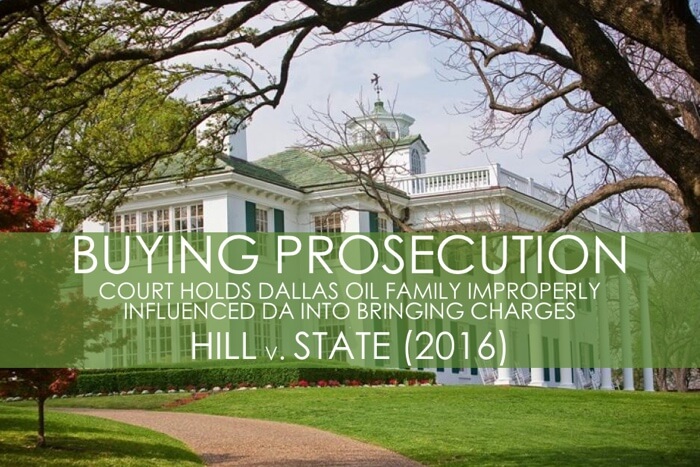
 On September 21st the Texas Court of Criminal Appeals issued a decision on the oil tycoon heir Albert Hill III’s criminal appeal. The question the Court faced was whether it was in the trial court’s discretion to conduct a pretrial evidentiary hearing on Hill’s motions to quash and dismiss based on prosecutorial vindictiveness. The Court determined that it was within the trial court’s discretion to conduct such a pretrial evidentiary hearing and that discretion was not limited by the defendant meeting “a certain threshold evidentiary requirement.”
Court Opinion: State of Texas v. Albert Hill (Tex. Crim. App. 2016)
The Facts | Trial Court Finds Dallas DA’s Actions Improper
Appellant Hill is the great-grandson of legendary Dallas oil billionaire H.L. Hunt and the events surrounding the indictment dealt with a multi-million dollar trust litigation between Hill and his father. Hill and his wife Erin were indicted in 2011 for making false and misleading statements in order to obtain a $500,000 mortgage from Omni American Bank. The indictment came shortly after Hill won in the trust litigation against his father. Prior to the indictment (but after Albert Hill’s victory in the trust litigation) Hill’s father’s attorney, Michael Lynn delivered a memo to the Dallas County District Attorney’s Office which alleged various offenses committed by Hill and his wife. Hill challenged these charges by filing a motion to quash the indictment and a motion to dismiss. Hill argued that the District Attorney, Craig Watkins, was under the influence of his disgruntled father as well as Lisa Blue Baron, one of Hill’s attorneys in the trust litigation case that had just filed a lawsuit against Hill seeking several million dollars in legal fees.
Some items of interest that the court noted were:
- Lisa Blue Baron exchanged several phone calls and text messages with Watkins leading up to the indictment;
- Michael Lynn’s law partner donated $48,500 to Watkins’ campaign prior to the indictment;
- Lisa Blue Baron made a $100,000 donation to SMU LAW in Watkins’ honor after the indictment;
- Lisa Blue Baron also held a fundraising event for Watkins’ campaign at her house and made a $5,000 donation to the campaign.
The trial court held an evidentiary hearing on Hill’s motions and granted both the motion to quash and the motion to dismiss.
The Court of Appeals Reversed the Trial Court’s Decision
The Fifth Court of Appeals reversed the trial court’s dismissals holding that the trial court “erred in conducting a hearing on Hill’s motion to dismiss.” The State argued that the trial court should not have held a pretrial evidentiary hearing because Hill failed to prove, with evidence, a prima facie case of prosecutorial misconduct and vindictiveness. The Court of Appeals stated that before a pretrial evidentiary can be held for a defendant claiming a violation of his constitutional rights, the defendant must “present facts sufficient to create a reasonable doubt about the constitutionality of his prosecution.” The Court of Appeals found that Hill did not sufficiently meet this standard.
The Court of Criminal Appeals Disagrees with the Court of Appeals, holds that Trial Courts Have Sound Discretion to Conduct a Pretrial Evidentiary Hearing
1. Article 28.01 – The CCA points to Article 28.01 in determining that the trial court had the discretion to hold a pretrial hearing on Hill’s motions to quash and suppress. Article 28.01 §1 provides that a trial court “may set any criminal case for a pre-trial hearing” and that some of things that the pre-trial hearing shall be to determine is the “pleadings of the defendant,’ ‘exceptions to the form or substance of the indictment,’ or discovery.’” Article 28.01 §1(1), (2), (4), (8). Additionally, while Article 28.01 does not expressly provide for an evidentiary hearing on a motion to dismiss like it does for a motion to suppress, the Court determined that it would be a misapplication of the rules of statutory construction to decide that oral testimony cannot be used in a pretrial hearing to resolve any other issue raised.
2. Case Law – The Court supported its Article 28.01 decision with the Court’s decision in Neal v. State which held that a defendant is required to “preserve a complaint of vindictive prosecution by filing a pretrial motion to quash and dismiss.” 150 S.W.3d 169. With that decision in mind the Court said “it would make no sense to limit the trial court’s discretion to hold an evidentiary hearing on such motion.”
The State pointed to federal case law that provided defendant must make a prima facie case that raised a reasonable doubt. However, these cases dealt with the issue of whether the trial court erred by denying a pretrial hearing. Thus, the Court stated that this case law is not on point in Hill’s case and thus are not controlling on this issue, and do not persuade the Court to hold otherwise.
Decision of the Criminal Court of Appeals | The Trial Court’s Discretion is Not Limited
The CCA determined that Article 28.01 has no limiting factor on the judge’s discretion to hold a pretrial evidentiary hearing based on any threshold evidentiary standard. Accordingly, the trial court did not err in conducting the pretrial evidentiary hearing in Hill’s case but instead acted within its bounds of sound discretion.

 A district court convicted Renee Pratt, a prominent Louisiana politician, of conspiracy to violate the federal Racketeer Influenced and Corrupt Organizations Act (“RICO”). 18 U.S.C. § 1962(d). Pratt’s conviction resulted from a thorough investigation of her long-time friend, Mose Jefferson, a well-known Louisiana community organizer and politician, as well as his family. United States v. Pratt, 728 F.3d 463 (5th Cir. 2013), cert. denied, 134 S. Ct. 1328 (2014). The Jefferson family and Pratt were accused of obtaining community-service grants, and using the money for personal gain. Id. Pratt timely appealed, citing new evidence that several prosecutors from the U.S. Attorney’s Office (“USAO”), made negative and persuasive online comments in public forums, including a local newspaper’s website, regarding her case around the time of trial. Pratt claims that the jury rendered a guilty verdict because of the disparaging and prejudicial comments.