
Tag

Self-Defense

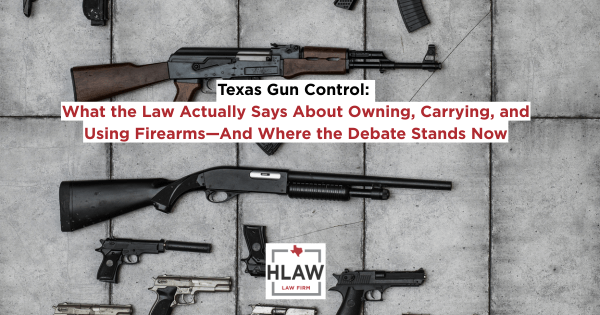
Assorted firearms arranged on concrete with the headline “Texas Gun Control: What the Law Actually Says About Owning, Carrying, and Using Firearms—And Where the Debate Stands Now,” featuring the HLAW Law Firm logo

Texas Gun Control: What the Law Actually Says About Owning, Carrying, and Using Firearms—And Where the Debate Stands Now

By Criminal Defense
Assorted firearms arranged on concrete with the headline “Texas Gun Control: What the Law Actually Says About Owning, Carrying, and Using Firearms—And Where the Debate Stands Now,” featuring the HLAW Law Firm logo

Texas Gun Control: Understanding state laws on owning, carrying, and using firearms—and how today’s gun-control debate shapes the rights of Texas gun owners. Presented by HLAW Law Firm.

Texas has some of the nation’s most permissive gun laws—but there are still bright-line rules about who may possess a gun, where you can carry, how you must carry, and when force (including deadly force) is justified. Recent court rulings and new legislation have also shifted the ground under both gun-rights and gun-safety advocates. This guide breaks it all down in plain English.

1) The Legal Backdrop: The Second Amendment & Recent Supreme Court Cases

  • Bruen (2022): The Supreme Court held that when the Second Amendment covers conduct, the government must justify restrictions by showing they fit the nation’s historical tradition—often called the “text, history, and tradition” test. This ruling reshaped challenges to gun laws nationwide.
  • Rahimi (2024): The Court upheld the federal ban on firearm possession by people subject to qualifying domestic-violence restraining orders (18 U.S.C. § 922(g)(8)), emphasizing that disarming those who pose a credible threat is consistent with historical tradition.
  • Cargill (2024): The Court struck down ATF’s administrative bump-stock ban, holding bump stocks are not “machineguns” under the federal statute—leaving regulation of these devices to Congress or the states. 

These decisions influence how Texas laws are interpreted and what new measures are likely to survive in court.

2) Who Can and Cannot Possess a Firearm in Texas

  • General rule: If you are not prohibited by state or federal law, you may possess firearms.
  • Felony convictions: A person convicted of a felony generally cannot possess a firearm. After five years from release from confinement, parole, or probation, limited possession only at the person’s residence may be allowed; possession elsewhere remains illegal.
  • Family-violence & protective orders: Federal law bars possession while you’re subject to certain domestic-violence restraining orders; Rahimi confirms that ban’s constitutionality. Texas law also restricts possession after certain family-violence findings. 

3) Carrying Handguns: Permitless Carry vs. License to Carry (LTC)

Permitless (“constitutional”) carry

Since September 1, 2021, most adults 21+ who may lawfully possess a handgun can carry it—openly in a holster or concealed—without a state license. There are still many exceptions (see “Prohibited Places” below). 

18–20-year-olds: Following Firearms Policy Coalition v. McCraw, Texas no longer enforces the 21+ carry limit solely based on age; DPS now accepts 18–20-year-old applicants for LTC and acknowledges the ruling in its guidance. (Young adults must still be otherwise eligible under state and federal law.) 

Why many Texans still get an LTC

The LTC program remains in effect and offers real advantages: streamlined carry in certain contexts, interstate reciprocity, and practical benefits in stops or travel. DPS maintains an official list of LTC benefits

4) Where Guns Are 

Prohibited

 (Even if You Can Otherwise Carry)

Texas Penal Code § 46.03 lists “places weapons prohibited.” Highlights include schools, polling places, courts, secured airport areas, 51% alcohol-sales establishments, amusement parks, hospitals/nursing facilities (with required notices), and more—subject to detailed exceptions/defenses. Violations can be serious felonies in some settings. Always check the statute before you go. 

Newer “46.03 sign” notices: Covered locations may post a § 46.03-specific sign at entrances that eliminates certain defenses for accidental carry in prohibited places. If you see it, don’t carry past it. 

5) Private Property & Signs: Texas Penal Code 30.05, 30.06, 30.07 (What They Mean)

Private owners can restrict handguns on their property through specific notice:

  • Texas Penal Code §30.05 (Criminal Trespass) “No guns” notice: Bars people (especially those without an LTC) from entering/remain­ing with a firearm if proper notice is given.
  • Texas Penal Code §30.06: “No concealed handguns by license holders.” Applies to LTC holders carrying concealed.
  • Texas Penal Code §30.07: “No openly carried handguns by license holders.” Applies to LTC holders carrying openly.

To be enforceable, these notices must follow statutory format/placement. If you receive oral notice, you must depart or disarm—even if the sign is imperfect. (When in doubt, leave and call us before you risk an arrest.) 

6) How You May Carry: The “Unlawful Carrying” Rules

Texas Penal Code §46.02 governs unlawful carrying of weapons, including handguns in vehicles and on-person. Key points include holster requirements for open carry, restrictions while committing other crimes, and special rules for carry inside your vehicle or on your own property. Violations can escalate quickly depending on location and circumstances. 

7) Self-Defense, Defense of Others, & Defense of Property (When Force Is Justified)

Texas Penal Code Chapter 9 spells out when force—and deadly force—is justified.

  • Self-defense (Texas Penal Code §9.31): Force is allowed if you reasonably believe it’s immediately necessary to counter another’s unlawful force. Texas has no general duty to retreat if you meet statutory conditions.
  • Deadly force (Texas Penal Code §9.32): Allowed if you meet § 9.31 and you reasonably believe it’s immediately necessary to stop unlawful deadly force or certain serious violent felonies (e.g., aggravated robbery). Presumptions may apply in home/vehicle/business intrusion scenarios.
  • Defense of others (Texas Penal Code §9.33): You can use force (including deadly force) to protect another if they would have the same right of self-defense and your belief is reasonable.
  • Property (Texas Penal Code §§ 9.419.42): Force may stop trespass or interference with property; deadly force is narrow—limited to specific nighttime crimes and other strict conditions. These cases are fact-sensitive and heavily scrutinized. Call a lawyer before you make statements.

8) State Preemption: Why Cities & Counties Can’t Add Their Own Gun Codes

Texas preempts most local gun regulation. Municipalities and counties generally cannot regulate the possession, carry, storage, transfer, or registration of firearms (and now explicitly, air guns, archery equipment, knives, ammunition, and explosives). Recent legislation in 2025 (SB 2284) further clarified and expanded these limits. 

There are limited carve-outs (e.g., regulating discharge at outdoor ranges; narrow subdivision rules), but the default is broad state control. 

9) Red-Flag (ERPO) Policies: Where Texas Stands

Texas does not have a red-flag law—and in June 2025 lawmakers passed an “Anti-Red Flag Act” (SB 1362) that blocks courts and local officials from using or enforcing ERPO-style orders under state law and resists enforcement of most federal or out-of-state ERPOs. (Separate protective-order laws and federal prohibitions for domestic-violence orders still apply.) 

10) The Ongoing Policy Debate in Texas

  • Gun-rights advocates emphasize self-defense and constitutional protections, backing permitless carry, preemption, and resistance to ERPOs; they cite Bruen and Cargill as guardrails against expansive regulation.
  • Gun-safety advocates continue to push for measures like universal background checks and ERPOs, noting strong polling support among Texans post-Uvalde—though the Legislature has largely moved in the opposite direction.

Expect continued litigation and incremental statutory tweaks. When laws change, the details (age thresholds, signage, prohibited places, defenses) matter.

11) Practical Tips for Texans

  1. Know the signs and the setting. If you see a § 46.03 prohibited-place sign or a 30.05/30.06/30.07 notice—or you’re orally told not to carry—don’t carry past it.
  2. Vehicle carry vs. public carry. The rules are different; ensure holster compliance and avoid any conduct that could elevate a simple stop into an arrest.
  3. Consider an LTC. Reciprocity, training, and practical benefits still matter—especially when traveling or interacting with law enforcement.
  4. After any defensive display or use of force: call counsel first. Chapter 9 defenses are technical and fact-intensive. 

12) How Our Firm Helps

Navigating Texas gun laws is not just about quoting statutes—it’s about protecting your rights while reducing your legal risk. Whether you were stopped while carrying, face a 46.03 or 30.05/30.06/30.07 charge, need counsel after a defensive incident, or want compliant policies for your business or church, we’re here.

Free, confidential consultation: If you’re facing a firearm-related investigation or charge—or you simply want clarity before you carry—call us. We’ll review your facts, assess exposure under Penal Code §§ 46.02, 46.03, 46.04 and Chapter 9, and map a strategy to protect your freedom. (The earlier we engage, the more options we have.) 

Statutes & Key References (select)

Self Defense Deadly Force in Texas

The Castle Doctrine: Understanding Self Defense in Texas

By Self-Defense

Know your Rights and Responsibilities Before Using Deadly Force for Self Defense in Texas

Self Defense Deadly Force in TexasYou may have heard about Texas Stand Your Ground Law or The Castle Doctrine.  These ideas refer to “standing your ground” in your “castle” against intruders by using deadly force to protect yourself.  But do you know when you can use force and what kind of force can be used? Understanding the Texas gun laws is incredibly important so that you know exactly what you can and cannot do when protecting yourself or your home, car, or business.
What exactly is the Castle Doctrine? When Can Deadly Force be used for Self Defense Purposes?

In Texas, Section 9 of the Texas Penal Code provides legal justifications for the use of force in a limited set of circumstances when a person has no duty to retreat. For example, a homeowner in his own home does not have a duty to retreat and may use deadly force to protect himself against an armed intruder. This would be the same for a business owner in his place of business and a truck driver in his own truck.

Texas law provides for a justifiable defense at trial when using deadly force if the person claiming self defense:

  1. Reasonably believed the deadly force was immediately necessary;
  2. Had a legal right to be on the property;
  3. Did not provoke the person against whom deadly force was used; and
  4. Was not engaged in criminal activity at the time the deadly force was used.

What is Considered Self Defense in Texas?

Self Defense will be a justifiable defense so long as the type of force used is reasonable and necessary in the moment to protect against an attacker. A person may use force against another when they reasonably believe it is immediately necessary to protect from another’s “use or attempted use of unlawful force.” A person may use deadly force in self defense under Section 9.31 of Texas Penal Code if he:

  • Knew the intruder unlawfully with force entered into his home, vehicle, or place of employment; or
  • Was being kidnapped; or
  • The intruder was attempting to sexually assault, rob, kidnap, or murder.

What is the Difference Between Deadly Force and Threat of Force?

Threat of force is when a person displays a weapon as a threat, showing that they will use deadly force to cause death or serious bodily injury if necessary. Texas Penal Code §9.04.  Threat of Force is a precursor to the use of Deadly Force.

For example, a landowner, on his property, sees a trespasser running towards him. If the landowner decides to turn in such a way to display his holstered, loaded gun which causes the trespasser to run off the property, Texas law says this is likely a justifiable threat of force.

When is Defense of Another Person Justifiable?

A person is justified in using force or deadly force to protect a third party if he believes intervention is immediately necessary and would be justified in using force or deadly force to protect himself against the unlawful force in the same circumstance.

However, use of force is not justified if in the use of force to protect a third party, the person gets the circumstances wrong and ends up seriously injuring or killing an innocent third party.

For example, a man sees his friend in a fight and intervene by using deadly force to protect his friend and kills the third party. The man did not realize that the third party was actually using force as self defense against his friend. In this situation, the man would not be able to use defense of others as a justification for killing the third party.

Protection of One’s Own Property

Under Texas Penal Code §9.42, a person may use deadly force against another to protect land or property if:

  1. He is the owner of the land;
  2. He reasonably believes using the force is immediately necessary to prevent arson, burglary, or robbery; and
  3. He reasonably believes that the land or property cannot be protected or recovered by any other means.

Know Your Rights and Responsibilities

In conclusion, while Texas law does have a few justifications for use of force and deadly force, the justifications are only proven in a very limited set of circumstances. Further, even if a person has a justification for using force, he may still be arrested and face trial. Additionally, even though an actor may have been justified in using force, he may still face civil litigation and penalties associated with the use of force against another.

Using force for self defense purposes is a serious response and should only be used in truly dangerous and threatening situations. Texas law makes it abundantly clear that those who use force will only be justified in doing so if they meet specific criteria, given the circumstances, and acted as a reasonable person would have under the same or similar circumstances.


Fort Worth Gun Crimes Defense Attorney
Rating: ★★★★★ 5 / 5 stars
Rated By Google User
“Absolutely amazing! It was comforting to know I had a Marine veteran defending my case.”


Self-Defense Jury Charge Texas

When is a Defendant Entitled to a Jury Instruction on Self-Defense?

By Self-Defense

Self-Defense Jury Charge TexasThe Court of Criminal Appeals recently released an opinion regarding when a defendant is entitled to a self-defense charge. The issue facing the Court was whether there was some evidence, from any source, that would support the elements of self-defense and whether self-defense was authorized when a deadly weapon was used in response to verbal provocation.


Gamino v. State, Court of Criminal Appeals (2017)

The Facts—The Trial Court Denied Defendant’s Request for a Self-Defense Instruction and Defendant was Subsequently Convicted.

On August 11, 2013, Cesar Gamino (Defendant) and his girlfriend were leaving downtown Fort Worth as the local bars were closing. While Defendant and his girlfriend were walking back to his truck they passed by a group of men who were heard saying lewd comments. Believing the comments were directed at his girlfriend, Defendant confronted the men. Khan, one of the men, told Defendant they were not talking about his girlfriend. According to Khan, Defendant then said “I got something for you,” went to his truck, retrieved a gun, and pointed it in their direction. Two police officers working nearby heard Defendant’s comment and saw Defendant with the gun. Defendant was subsequently arrested and charged with aggravated assault with a deadly weapon. Khan was also arrested and charged with public intoxication.

During trial, Defendant testified that the men threatened him and his girlfriend by saying “grab her ass” and that they would “F her if they wanted to,” and that they would “kick [his] ass.” Defendant further testified that one of the men got up and moved towards him in an aggressive manner. This behavior, coupled with the fact that Defendant was disabled, caused him to believe he and his girlfriend were in danger. As a result, Defendant testified that he reached into his truck, grabbed his gun and told the men, “[s]top, leave us alone, get away from us.” Defendant’s girlfriend also testified that he was in fact disabled and that the men had confronted them and threatened her—causing her to fear for her life.

At the end of the trial, the defense asked for a self-defense instruction in the jury charge and the trial court denied the request.

The Court of Appeals Reversed the Trial Court’s Decision—Holding Defendant was Entitled to a Self-Defense Instruction Regardless of the Fact that he was Charged with Aggravated Assault with a Deadly Weapon.

Section 9.31 of the Texas Penal Code governs self-defense. According to Section 9.31, a person is justified in using force against another when and to the degree that person reasonably believes the force is immediately necessary to protect himself against another person’s use or attempted use of unlawful force. Verbal provocation by itself is not enough.

Section 9.32 governs the use of “deadly force” in self-defense cases. In the case at hand, the lower court charged Defendant with using a deadly weapon. However, even if a defendant uses a deadly weapon, deadly force as defined in section 9.32 may not apply if it meets the requirements of Section 9.04.

Under Section 9.04, a threat to cause death or serious bodily injury by the production of a weapon as long as the actor’s purpose is limited to creating an apprehension that he will use deadly force if necessary, does not constitute the use of deadly force.

The Court of Appeals determined that Defendant reasonably believed his use of force was immediately necessary to protect against Khan’s use or attempted use of unlawful force, and Defendant produced his gun for the limited purpose of creating an apprehension. Thus, the Court of Appeals ruled that under Defendant’s version of events, the use of his gun did not constitute the use of deadly force, and Defendant was not disqualified from receiving a self-defense instruction even though he was charged with aggravated assault with a deadly weapon because he met the requirement of Section 9.04.

Accordingly, the trial court erred by not submitting an instruction on self-defense to allow the jury to decide the issue of self-defense.

The Court of Criminal Appeals Affirmed the COA—Holding that the Jury Should Have Been Given the Opportunity to Assess Whether Appellant’s Conduct was Justified as Self-Defense.

The Court of Criminal Appeals agreed that the trial court erred in taking away the self-defense issue from the jury. According to Texas case law, it is error for a trial court to deny a self-defense instruction if there is some evidence, from any source, that will corroborate the elements of a self-defense claim—even if the evidence is weak, contradicted or not credible.

The State argued, as well as the dissent, that Defendant was not entitled to a self-defense instruction because he did not admit to threatening the victim with imminent bodily injury. This argument was based on the idea that self-defense is a confession and avoidance justification, and the confession was missing here. The Court however disagreed, inferring a confession.

Here, Defendant testified that he displayed his gun and yelled, “stop,” “get away,” and “leave us alone.” Accordingly, the court held it to be reasonable for the jury to infer that if the men did not stop, Defendant would have used his gun for protection. As such, even though the evidence was contradicted by the State, Defendant believed the display of his gun was immediately necessary to protect himself against the use or attempted use of unlawful force, and that he displayed his weapon for the limited purpose of creating an apprehension that he would use deadly force if necessary.

Using the Court of Appeals’ analysis, the Court of Criminal Appeals affirmed their judgment holding that the jury should have been given the opportunity to analyze Defendant’s actions as self-defense.

See also the Gamino Dissenting Opinion

Evil Clown Scare Texas

Hold Your Fire…Don’t Shoot the Clowns! Yet.

By Self-Defense

Evil Clown Scare TexasRecently, a friend asked me if it was legal for individuals to dress as clowns and scare the public. He also wanted to know what would happen if he were frightened by one of these clowns and shot the clown. While not asking the latter in complete seriousness, these questions do bring up potential criminal law issues.



Is it Legal to Dress as a Clown in Public?

There’s no state law that we’re aware of that makes dressing up like a clown in public per se illegal.

The only potential laws that may be applicable to these situations would be individual city ordinances. A search of city codes in a handful of Texas towns around the Metroplex reveals no ordinance specifically prohibiting dressing like a clown in public. The only codes we are able to find related to costumes primarily had to do with a prohibition on costumes which fail to cover private areas in regards to sexually oriented businesses.

While dressing like a clown doesn’t appear to be per se prohibited, there is certainly the risk of breaking other laws while dressed as a clown. In addition, dressing like a clown in public and creating unnecessary alarm or panic could be deemed as disorderly conduct.

Texas Penal Code, Chapter 42 lays out a list of behaviors that could constitute up to a Class B misdemeanor. Class B misdemeanors can carry a penalty of up to 6 months in jail and up to a $2,000 fine. Sec. 42.01 (a)(2) states that a person commits an offense [of disorderly conduct] if he intentionally or knowingly makes an offensive gesture or display in a public place, and the gesture or display tends to incite an immediate breach of the peace. An offense of this nature is a Class C misdemeanor and carries the possibility of up to a $500.00 fine.

Can I use Deadly Force Against the Clown?

Let’s start with the simple answer of “NO”. While individuals may be suffering from coulrophobia (the fear of clowns), this condition does not give you a right to use deadly force – or any force for that matter – against an individual simply because he or she is standing in public dressed as a clown.

The more complex answer of “maybe” would have to do with the use of force for self-defense purposes. Section 9.31 of the Texas Penal Code provides for a justifiable defense at the time of trial for self-defense, so long as the type of force used is reasonable and necessary in the moment to protect against an attacker. Under this law, the actor must reasonably believe that the force is reasonably necessary to protect against the other’s use or attempted use of unlawful force. Simply observing a clown, with no weapon or threat to use a weapon, provides no grounds to use force – much less deadly force – against that clown.

In addition, the Penal Code does establish that force may be used to protect one’s own property. A person in “lawful possession” of real property or personal property is justified in using force if “the actor reasonably believes the force is reasonably necessary to prevent or terminate the other’s trespass on the land…” However, the use of deadly force to protect one’s own property is limited. “A person is justified in using deadly force against another to protect land or property if (1) he is justified under TPC §9.41; (2) he reasonably believes using the force is immediately necessary to prevent commission of arson, burglary, or robbery; and, (3) the actor reasonably believes that the land or property cannot be protected or recovered by any other means [such as by calling law enforcement]. Tex. Penal Code Section 9.42.

Using force for self-defense purposes is a serious response to dangerous and threatening situations – but certainly not an appropriate response to being “creeped” out.

Bottom Line | Do Not Shoot the Clown (Yet)

Dressing up as a clown and causing fear amongst the public is a stupid (and perhaps even illegal) idea. Our attorneys would advise you strongly against it. You certainly place yourself in the position of having your behavior scrutinized by law enforcement for any potential illegal activity. And, if you’re simply afraid of clowns, do your defense attorney a favor and please do not shoot them.  BUT…If the clown lays a hand on you or chases you through a park, all bets are off. You may use force against the clown to avoid an assault.

Can Rougned Odor Be Charged With Assault for Punching Jose Bautista?

By Assault

Did Rougned Odor Assault Jose Bautista Under Texas Law?

If you live in Texas, have a pulse and have absolutely any contact with the outside world, you are very aware of the incident that occurred between Texas Ranger’s infielder Rougned Odor and the Toronto Blue Jays’ Jose Bautista during last Sunday’s game. If you have no idea what I’m referring to, STOP reading, watch this video and then come back and finish reading. Bautista was attempting to break up a double play at second base by taking a hard slide at Odor’s legs (which Odor avoided). After the slide, Bautista quickly stood to his feet and squared up to Odor. Odor pushed Bautista and both men went to throw a punch, but Odor was quicker and landed a strike directly on Bautista’s jaw, causing Bautista’s sunglasses to fly and the benches to clear in an all-out brawl between both teams. Under Texas law, if Odor caused Bautista physical pain or even if this physical contact was offensive, Odor could theoretically be charged with assault.

Assault Under Texas Law

Some know (but most don’t) that it doesn’t take much to be charged with a Class A misdemeanor Assault in Texas, even less for a Class C Assault. A person commits the offense of assault in Texas if that person intentionally, knowingly or recklessly causes bodily injury to another. Bodily injury as defined by Texas law means physical pain, illness or any impairment of physical condition.

Theoretically, a simple pinch could result in a class a misdemeanor assault if it causes another pain. The law further goes on to provide that a person commits the offense of assault if a person causes physical contact with another when the person knows or should reasonably believe that the other will regard the contact as offensive or provocative (that is a Class C and is punishable by fine only).

What are Rougned Odor’s Defenses to a Charge of Assault?

While it is highly unlikely (and unprecedented in a sports context) that Odor would be charged with assault for his actions against Bautista on Sunday, he does have some viable defenses under Texas law.

Self-Defense

In analyzing the situation, it could be argued that Odor’s actions were a result of self defense. Texas law provides that a person can be justified in using force against another when and to the degree the actor reasonably believes the force is immediately necessary to protect the actor against the other’s use or attempted use of unlawful force. Watching the incident again, one can see that Bautista clearly committed an illegal slide by attempting to interfere with Odor’s legs. Had Odor not been able to dodge the attempt, it’s possible that this type of slide could have caused bodily injury to him, hence the reason this type of slide is illegal. Immediately upon rising to his feet, Bautista turns to face Odor in what could be perceived as a threatening stance. Odor, in an effort to distance Bautista from himself gives Bautista a shove to the chest. The shove results in Bautista winding his right hand back which could also be reasonably perceived as preparing to strike Odor. Odor, with reactions obviously much quicker than the sluggish Bautista, literally beats him to the punch and ensures that no further harm can befall him at the hands of Bautista. A reasonable jury could conclude that Odor’s reactions were justified and immediately necessary to protect himself from Bautista’s efforts to cause him harm.

Consent

In addition to the potential defense of self defense, Odor could also raise the defense of consent. Under Texas law, a victim’s effective consent or the actor’s reasonable belief that the victim consented to the actor’s conduct is a defense to an assault charge as long as the conduct did not threaten or inflict serious bodily injury. In addition, consent is a defense to assault if the victim knew that the conduct was a risk of his occupation. Could a jury reasonably conclude that Bautista consented to the assault due to the fact that he should have known that a solid right hook to the jaw was a risk of his occupation – especially following an illegal slide? There are unwritten customs in professional baseball. Anyone who’s followed professional baseball for any significant amount of time has witnessed a fight break out in the course of such extreme competition. Ultimately, a jury could conclude that under these laws there was consent and that Bautista should have known that this type of action was a risk of his occupation.

Will Rougned Odor be Criminally Charged with Assault?

No, he won’t. Fights like this happen on the field of professional sports on a fairly regular basis (even more so on the ice during professional hockey games). In addition to clear defenses, law enforcement has broad discretion to determine whether a crime has been committed and prosecutors have broad discretion whether to pursue cases or not. It’s clear that that discretion is used regularly when these things happen (and I’m sure my prosecutor friends will comment and give even more reasons why this type of thing would never warrant criminal charges). Regardless of the national media coverage of the fight, Odor is now a folk hero in DFW. No, the only indictment being issued from this fight is an indictment on Bautista’s prior behavior and unsportsmanlike conduct. I’m not sure if this saga is over, but I would have to say that Bautista’s sentence has now been served — right off the end of Rougned Odor’s right fist.

No Duty to Retreat in the Defense of Others

By Duty to Retreat, Self-Defense

In Morales v. Statethe Texas Court of Criminal Appeals held that there is NO duty to retreat when you are rightfully defending another person.  The CCA held that:

A person is justified in using deadly force against another if he could be justified in using force against the other in the first place … and when he reasonably believes that such deadly force is immediately necessary to protect himself against the other person’s use or attempted use of unlawful deadly force and if a person in the defendant’s situation would not have had a duty to retreat…

Therefore a person may act against another in defense of a third person, provided he acted upon a reasonable apprehension of danger to such third person, as it appeared to him from his standpoint at the time, and that he reasonably believed such deadly force by his intervention on behalf of such third person was immediately necessary to protect such person from another’s use or attempted use of unlawful deadly force, and provided it reasonably appear to such person, as seen from his viewpoint alone, that a person in the situation of the person being defended would not have had a duty to retreat.

A person who has a right to be present at the location where the force is used, who has not provoked the person against whom the force is used, and who is not engaged in criminal activity at the time the force is used is not required to retreat before using force as described herein.

Self-Defense and Reckless Offenses

By Self-Defense

Under Chapter 9 of the Texas Penal Code, self-defense is provided as a justification to the offense of murder (among others).  Chapter 9 makes clear that if a fact-finder believes a defendant’s actions are justified, the fact-finder may not convict for an offense based on those self-defense actions.  In essence, a defendant that pleads self-defense is telling the fact-finder that he intentionally performed certain actions in order to protect himself against the unlawful actions of another.  So…if the defendant intentionally performed the self-defensive actions, can self-defense be applied to an offense like manslaughter that requires “reckless” conduct vice intentional?

In Alonzo v. State, the 13th District Court of Appeals (Corpus Christie) “believed it is illogical for a defendant to argue self-defense when charged with an offense whose requisite mental state is recklessness.”  The Texas Court of Criminal Appeals, however, disagrees, explaining that “there is nothing in Penal Code Section 2.03 or Chapter 9 that limits justification defenses to intentional or knowing crimes, nor do we have a reason to infer such a limitation.” The CCA notes that limiting self-defense to only intentional or knowing crimes could encourage prosecutors to charge manslaughter (a reckless offense) vice murder when there is a self-defense issue, because self-defense would be inapplicable.

Judge Womack explains that “by arguing self-defense, a defendant is arguing that his actions were justified, and therefore he did not act recklessly.” So really, it’s just another way to disprove the charged offense.

Of course, a defendant cannot argue self-defense in the face of a murder charge and then at the same time request a lesser-included instruction on manslaughter. The CCA made sure not to disrupt prior caselaw holding such. But the overarching takeaway from Alonzo is that a defendant that is acquitted of a murder charged based on self-defense CANNOT be convicted of the LIO of manslaughter.

The CCA reversed the decision of the 13th Court and remanded the case for a harm analysis.  Presiding Judge Keller concurred. Alonzo Concurrence