

Tag

Unlawful Search

Supreme Court Holds Police May Not Search Vehicle in Driveway Without a Warrant

By Search & Seizure

Collins v. Virginia – US Supreme Court Considers Whether Police May Search a Vehicle in a Driveway Without a Warrant


Collins v. Virginia (US Supreme Court 2018)

In Collins v. Virginia, police officers were looking for a motorcycle that they suspected was stolen. They tracked the motorcycle to a home where it appeared to be parked in the driveway and covered by a tarp. Officers walked up the driveway, removed the tarp, discovered the motorcycle and conducted a search of the license plates. The license plate search indicated that the motorcycle was indeed stolen. The officers then replaced the tarp over the motorcycle and waited in their car for the driver of the motorcycle. When Collins appeared, they arrested him.

Collins’s Motion to Suppress the Warrantless Search

In the trial court, Collins made a motion to suppress evidence, claiming that the officers violated his 4th Amendment right when they entered the curtilage of his home and conducted a warrantless search of the driveway. The trial court denied the motion and Collins was convicted of Receipt of Stolen Property. The Virginia appellate court and State Supreme Court affirmed Collins’ conviction, reasoning that the “automobile exception” to the warrant requirement applied to the search in this case.

What is the Automobile Exception to the Warrant Requirement?

Generally, the “automobile exception” to the 4th Amendment allows officers to search a vehicle without a warrant if they have probable cause. The rationale behind this exception is that automobiles should be treated differently than houses because of the “ready mobility” of the automobile. Virginia argued that the automobile exception should apply in this case, because the motorcycle was capable to being driven away from the home.

Supreme Court Overturns the Virginia Courts, Defining the “Curtilage” of the Home to Include the Driveway

The US Supreme Court, Justice Sotomayor writing for a nearly unanimous court, held that the officers violated Collins’ 4th Amendment right to be free from unreasonable searches and seizures. The Court emphasized that the area of the driveway where the motorcycle was parked was a protected area of the home.

[T]he part of the driveway where Collins’ motorcycle was parked and subsequently searched is curtilage. When Officer Rhodes searched the motorcycle, it was parked inside a partially enclosed top portion of the driveway that abuts the house. Just like the front porch, side garden, or area “outside the front window,” that enclosure constitutes “an area adjacent to the home and ‘to which the activity of home life extends.’ “

Justice Sotomayor further explained that:

Nothing in this Court’s case law suggests that the automobile exception gives an officer the right to enter a home or its curtilage to access a vehicle without a warrant. Such an expansion would both undervalue the core Fourth Amendment protection afforded to the home and its curtilage and “ ‘untether’ ” the exception ” from the justifications underlying’ ” it.

In holding that the search violated the 4th Amendment, the Court reversed the decision of the Virginia Supreme Court and remanded to case back to the state.

Takeaway

The curtilage of the home extends to the driveway and items that might be found therein. Of course, if the officers had been able to view the license plates from the street, without removing the tarp, things would likely be different. However, as it stands, the Supreme Court is unwilling to adopt any rule that would allow police to enter the curtilage of the home to conduct a warrantless search.

Terry Stop Officer Pat Down Search

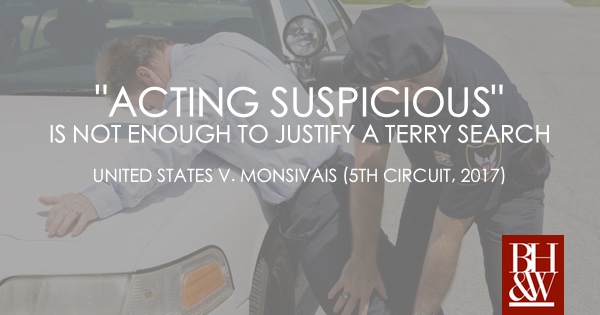
“Acting Suspicious” is Not Enough to Justify a Pat Down Search

By Search & Seizure

Does an Officer’s Testimony That a Person was “Acting Suspicious” Establish Reasonable Suspicion to Support a Terry Stop?

Terry Stop Officer Pat Down SearchThe Fifth Circuit Court of Appeals recently handed down an opinion concerning the reasonable suspicion standard required for law enforcement officers to conduct a Terry stop—an exception to the warrant requirement. The issue facing the Court was whether merely “acting suspicious” is enough to establish reasonable suspicion to justify a law enforcement officer to initiate a Terry stop.


United States v. Monsivais, 848 F.3d 353 (5th Cir. 2017)

The Facts — District Court Found the Terry Stop to be Lawful Based On the Defendant’s Demeanor, Remarks, and for Officer-safety Reasons

While on patrol in a marked police car, two officers observed Monsivais walking down the side of the I-20 interstate away from an apparently disabled truck. The officers stopped in front of Monsivais and activated the car’s emergency lights in order to ask Monsivais if he needed roadside assistance. As Monsivais approached, he ignored the officers and walked past their patrol car. At this point, the officers exited their vehicle, and asked Monsivais where he was going and if he needed any help. Monsivais told the officers he was heading to Fort Worth (even though his vehicle was pointed towards Abilene). During questioning, Monsivais appeared nervous and repeatedly placed his hands in his pockets; however upon the officer’s request, Monsivais removed his hands. Additionally, Monsivais responded politely to all of the officers’ questions. After approximately four minutes, one of the officers advised Monsivais that he was going to pat Monsivais down for weapons because of his behavior, inconsistent statements and for officer safety reasons. Shortly thereafter, Monsivais told the officer that he had a firearm in his waistband. The officer seized the firearm and Monsivais was later charged with possession of a firearm while being unlawfully present in the United States.

Monsivais filed a motion to suppress the firearm and other evidence, arguing that the officer violated the Fourth Amendment because he did not have reasonable suspicion to believe Monsivais was involved in criminal activity when he detained him. The district court denied Monsivais’ motion to suppress, holding only that the “consensual encounter was transformed into a lawful Terry frisk due to the Defendant’s demeanor, remarks, and for officer-safety reasons.”

The Court of Appeals Reversed the District Court’s Decision—Holding the Officers Lacked a Basis to Reasonably Suspect Monsivais of a Criminal Act

The Court first determined that the officer seized Monsivais for Fourth Amendment purposes when he told Monsivais that he was going to pat him down. At this point, the officer converted the roadside assistance “welfare check” into an investigative detention—otherwise known as a Terry stop.

“The Fourth Amendment generally requires officers to obtain a warrant before searching or seizing an individual.” However, pursuant to a narrow exception announced in Terry v. Ohio, 392 U.S. 1, 88 (1968), police officers may briefly detain a person for investigative purposes if under the totality of relevant circumstance they can point to “specific and articulable facts” that give rise to reasonable suspicion that a particular person has committed, is committing, or is about to commit a crime. United States v. Hill, 752 F.3d 1029, 1033 (5th Cir. 2014).

Here, the Court found that while Monsivais’ behavior might not have been typical of all stranded motorists, the officers could not point to any specific and articulable facts that Monsivais had committed, was committing, or was about to commit a crime before seizing him.

The court explained that Monsivais’ nervous demeanor alone was insufficient to create reasonable suspicion of criminal activity in order to justify a Terry stop. In fact, the Court gives little or no weight to an officer’s statement that a suspect appeared nervous. United States v. Portillo–Aguirre, 311 F.3d 647, 656 (5th Cir. 2002). Moreover, the Court held that evidence of Monsivais placing his hands in his pocket is of little significance. The Court noted that any number of people walking down the street might have their hands in their pockets. Additionally, the Court determined there were no inconsistencies in Monsivais’ story; and, even if there were, the inconsistencies would not connect Monsivais with any reasonably suspected unlawful conduct. Moreover, Monsivais’ choice to ignore the officers’ presence by merely walking past them, not fleeing, did not give rise to criminal activity.

In conclusion, the officer testified that he never suspected Monsivais was involved in any criminal activity, but rather that Monsivais was just acting “suspicious.” As such, the court found that the officer seized Monsivais without reasonable suspicion and that the evidence obtained from the unlawful seizure should have been suppressed.

Purging Unconstitutional Taint from Unlawful Search

By Unlawful Search

Although the Fourth Amendment acts as a safeguard against unlawful search and seizures, the State can still use evidence it finds against a defendant in a consensual search of their property if the search is sufficiently detached from an illegal search that purges any unconstitutional taint. Accordingly, such a search is valid if the search was voluntary and an independent act of freewill.  In order to determine whether a search was an independent act of freewill, the Court analyzes several factors, none of which are controlling by themselves:

  1. the temporal proximity of the illegal conduct and the consent,
  2. the presence of intervening circumstances, and
  3. the purpose and flagrancy of the initial misconduct.

In US v. Montgomery, the Defendant was stopped by a police officer and frisked during a traffic stop in front of the Defendant’s house. As the officer frisked the Defendant, the Defendant pushed the officer’s hands away from his pockets after the officer felt a bulge. The Defendant revealed that the bulge was cocaine, prompting his arrest and Mirandizing. The Defendant, eventually, consented to a search of his house. During the search, the Defendant was allowed into the house to obtain medicine and made several requests to officers on scene for his cell phone to erase some “naked pictures” that he did not want his father to find. The Defendant consented to one of the officers using his phone to delete the pictures, but the officer found what appeared to be child pornography. The Defendant was later indicted for possession of child pornography.

At trial, the Defendant claimed that the frisk and seizure of cocaine that led to his arrest was unlawful, which tainted his consent for the officer the see his cell phone. Nevertheless, the Court held that even if the frisk and seizure were illegal, the Defendant’s several voluntary and independent acts of freewill relieved the search of the Defendant’s phone of any unconstitutional taint, specifically, the Defendant asking several times to see his cell phone so that he could delete the naked images, and the Defendant consenting to a search of his phone after being Mirandized. Nothing was presented at trial that showed the police officers even wanted to search his cell phone. In the words of the Court, “[The Defendant] broached the phone search himself.” Moreover, the Court also cited several intervening events and factors establishing that the Defendant’s “consent was sufficiently detached from the arrest to purge any taint” such as the officers reading the Defendant his Miranda rights, the Defendant’s criminal record, and the Defendant going into his house to retrieve his medicine.

Yet another reason why we advise NEVER GIVE CONSENT TO SEARCH, period.

The Evils of Technology | GPS Search

By Warrantless Search

I love technology – from tablet computers to smartphones to flat-screen televisions.  If it’s shiny and new and guaranteed to make me the envy of my friends and family, I’ll buy it (to the dismay of my wife).  One of the recent (in the last 5 years) technological advancements that has made its way into just about every home in America is GPS.  Whether it be a Garmin running watch, a TomTom navigational device, or a GPS location broadcaster on your cell phone, most people use some sort of GPS device every day.  Aside from the fact that we’ve lost the capability to drive somewhere without turn-by-turn directions, GPS is great.

Jose Juan Hernandez, however, might not agree that GPS is so great.  In a recent 5th Circuit Court of Appeals Case (United States v. Hernandez), Hernandez challenged the GPS search that the DEA had surreptitiously (and without a warrant) performed on his brother’s truck to track its movements.  Hernandez was arrested while driving his brother’s truck to California on a drug run.  The police seized 20 pounds of meth from the truck.  At trial, Hernandez moved to suppress the drugs, arguing that the discovery was the result of an unlawful search (as a result of the GPS tracking).  The trial court denied the request.

The 5th Circuit held that Hernandez had standing to challenge the use of the GPS search device placed on his brother’s vehicle by FBI agents because he drove the vehicle with consent, but he lacked standing to challenge its placement because the vehicle was not registered to him.  The Court also held that the DEA agents’ use of the surreptitious GPS search device to track Hernandez was not a search within the meaning of the Fourth Amendment, explaining that it was more akin to the old beepers that police used to place on vehicles in the 80’s and 90’s.  Accordingly, the Court upheld the trial court’s denial of the motion to suppress. The Court did not decide whether a GPS search device that continuously and precisely monitors location would constitute a search.

Identity Theft in Texas

Girlfriend Destroys Expectation of Privacy in Identity Theft Case

By Identity Theft

Identity Theft in TexasAfter being convicted of aiding and abetting mail fraud and aggravated identity theft, Lonnie Oliver Jr., challenged his convictions on appeal, arguing that federal agents conducted an illegal search of the contents of a cardboard box that his girlfriend provided to them and that his statements to police officers were involuntary.


See the full opinion in United States v. Oliver  (5th Circuit, 2011)

Mr. Oliver left an unsecured cardboard box, which contained ample evidence of his identity theft operation, in the dining room of his girlfriend’s apartment. When agents interviewed his girlfriend, she gave them the box, but did not tell them she had already examined its contents.

Does a person have a Reasonable Expectation of Privacy in the contents of a box that was not kept private from his girlfriend?

The court held that the girlfriend’s prior search of the box destroyed Appellant’s reasonable expectation of privacy in it, and rendered the subsequent warrantless police search permissible under the Fourth Amendment. The court stated that the girlfriend’s search made the agents’ warrantless search permissible, regardless of whether the agents knew about it. The court cautioned that his holding was limited to the unique facts of this case and was not intended to expand significantly the scope of the private search doctrine.

Does a waiver of Miranda Right to remain silent need to be in writing?

Appellant also argued that incriminating statements he made to the agents during his custodial interrogation should have been suppressed, claiming that he had not waived his Miranda rights. After agents arrested Appellant, they advised him of his Miranda rights and provided him two forms. Appellant signed the first form acknowledging that he understood his rights, but he refused to sign the second form waiving those rights. Nevertheless, Appellant told the agents that he wished to answer their questions and he confessed to his role in a mail fraud and identity theft scheme.

The Court explained that suspect may waive his Miranda rights if the waiver is made voluntarily, knowingly and intelligently. The mere refusal to sign a written Miranda waiver does not automatically make subsequent statements by a defendant inadmissible. The court held that the circumstances surrounding Appellant’s arrest and interview established that Appellant’s waiver was voluntary, even though he refused to sign the wavier form. Specifically: (1) agents provided Appellant with a copy of the Miranda warning waiver form and read it aloud to him as he followed along, (2) Appellant expressly told the agents that although he would not sign the Miranda waiver form, he would discuss the fraud scheme, (3) Appellant never requested an attorney, (4) Appellant was articulate, coherent and not under the influence of alcohol or drugs, and appeared to understand what was going on, (5) Appellant clearly understood his rights since he signed the first form that acknowledged this, and he had extensive experience with the criminal justice system, and (6) Appellant was not coerced in any way during the interview.