
All Posts By

Laura Alexander

Divorced couple seated apart, with divorce papers and wedding rings on a table, symbolizing no-fault divorce in Texas, related to legal guidance from HLAW.

Understanding Grounds for Divorce in Texas

ByFamily Law


Divorcing couple sitting apart at a table with wedding rings and legal documents, illustrating no-fault divorce grounds in Texas, with text overlay "Understanding Grounds for Divorce in Texas" and HLAW logo.When it comes to divorce, Texas follows a “no-fault” policy but also allows for several “fault-based” grounds. Understanding these distinctions is essential for anyone considering a divorce in the Lone Star State. In this blog post, we’ll explore the different types of grounds for divorce in Texas and what they mean for your case.

No-Fault Divorce in Texas

The most common ground for divorce in Texas is “insupportability,” often referred to as a no-fault divorce. This means that the marriage has become insupportable due to conflict or discord, making reconciliation impossible. Neither spouse is blamed for the breakdown of the marriage. No-fault divorces are generally quicker and less contentious, as they do not require proving misconduct by either party.

Fault-Based Divorce Grounds in Texas

While no-fault divorce is common, Texas law allows for several fault-based grounds. These grounds can influence issues such as property division and spousal support. The fault-based grounds include:

  1. Adultery– Adultery occurs when one spouse engages in a romantic or sexual relationship with someone outside the marriage. Evidence of adultery can significantly impact the division of marital property, as courts may award a larger share to the wronged spouse.
  2. Cruelty– Cruelty refers to one spouse treating the other in a manner that makes living together insufferable. This can include physical abuse, emotional abuse, or other forms of mistreatment.
  3. Abandonment– Abandonment occurs when one spouse leaves the other with the intent to abandon and remains away for at least one year without consent.
  4. Conviction of a Felony– If one spouse is convicted of a felony and imprisoned for at least one year, the other spouse can file for divorce on these grounds. However, this ground is not applicable if the convicted spouse was convicted based on the other spouse’s testimony.
  5. Living Apart– A couple can file for divorce if they have lived apart for at least three years without cohabitation.
  6. Confinement in a Mental Institution– If one spouse has been confined to a mental institution for at least three years with little or no likelihood of recovery, the other spouse can file for divorce.

Why Grounds for Divorce Matter

The grounds for divorce in Texas can impact the following:

  • Property Division:Fault-based grounds like adultery or cruelty may lead to a more favorable division of marital property for the wronged spouse.
  • Spousal Support:Fault-based divorces can also influence whether spousal maintenance is awarded and in what amount.
  • Custody Decisions:While courts prioritize the best interests of the child, fault-based issues such as cruelty may influence custody arrangements.

Filing for Divorce in Texas

Whether filing for a no-fault or fault-based divorce, it’s essential to meet Texas’ residency requirements. One spouse must have lived in Texas for at least six months and in the county where the divorce is filed for at least 90 days.

Additionally, collecting evidence is crucial in fault-based cases. For example, proving adultery may require text messages, emails, or witness testimony, while cruelty may need documentation of injuries or other forms of abuse.

Conclusion

Understanding the grounds for divorce in Texas can help you make informed decisions about your case. While no-fault divorces are often simpler, fault-based divorces may provide a legal advantage in certain circumstances. If you’re considering a divorce, consult with a qualified family law attorney to determine the best approach for your situation.

Navigating divorce can be challenging, but knowing your options is the first step toward a fresh start.

Contact HLAW today for a free case evaluation and consultation.
Texas Standard Possession Order calendar for child custody, featuring BHW Law Firm logo and relevant dates highlighted.

Texas Child Custody: Standard Possession and Visitation in Texas

ByChild Custody

Which Parent Gets Custody? The Standard Possession Order for Child Custody in Texas

Texas Standard Possession Order calendar for child custody, featuring structured visitation schedule and law firm branding for Howard Lotspeich Alexander & Williams, PLLC.When parents in Texas divorce or separate, one of the most important issues they face is child custody. Texas law recognizes two types of custody: physical custody, which refers to where the child lives, and legal custody, which refers to the right to make decisions about the child’s upbringing. In cases where parents cannot agree on custody arrangements, the court may order a standard possession order.


A standard possession order is a court-ordered schedule that determines when each parent will have physical custody of the child. The order is designed to provide regular and predictable time for both parents to spend with the child. In Texas, the standard possession order is governed by the Texas Family Code, and it provides a default schedule that can be modified by agreement of the parties or by the court if certain circumstances exist.

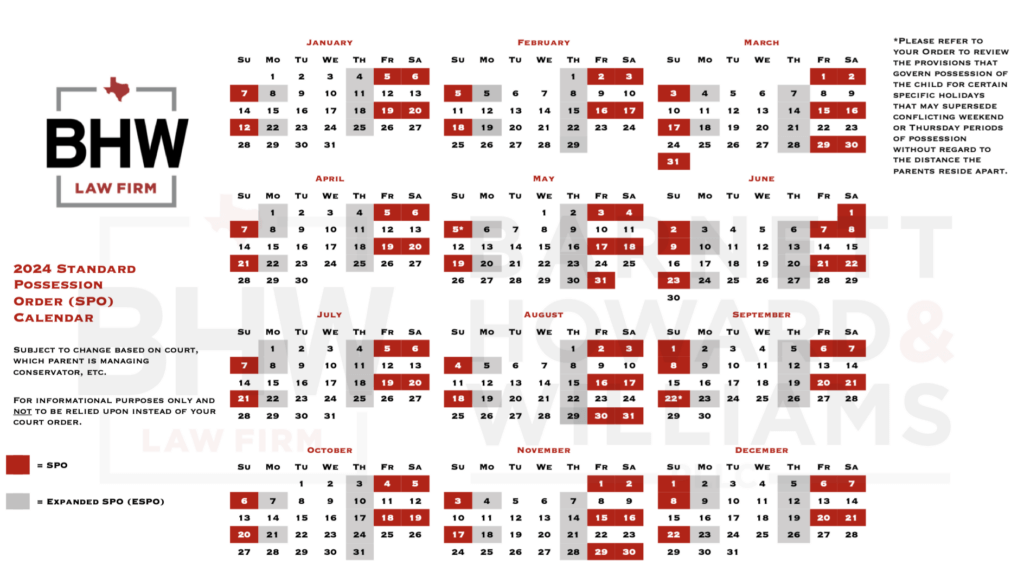
Under the standard possession order, for parents residing within 50 miles of each other, the non-custodial parent (referred to as the “possessory conservator” in Texas) has the right to possession of the child on the first, third, and fifth weekends of each month, starting at the time school is dismissed on Friday and ending at the time school resumes on Monday. In addition, the possessory conservator has the right to possession on mid-week during the school year from the time school is dismissed on Thursday until the time school resumes on Friday morning.

The standard possession order, for parents residing within 50 miles of each other, also provides for the possessory conservator to have the child for 30 days in the summer, which can be broken up into two periods of at least seven days each. The order also provides for the possessory conservator to have the child on alternating holidays, such as Thanksgiving, Christmas, and spring break. The exact dates and times for each holiday are specified in the order.

Printable Standard Possession Order for 2024. CLICK HERE

2024 Standard Possession Order (SPO) calendar for child custody, featuring monthly grids with designated weekends, holidays, and notes on court orders, branded with Howard Lotspeich Alexander & Williams, PLLC logo.

Does the SPO Apply if the Parents Live Too Far Away?

In cases where the parent lives more than 50 miles but less 100 miles apart, the non-custodial parent (referred to as the “possessory conservator” in Texas) has the right to possession of the child on the first, third, and fifth weekends of each month, starting at 6:00 pm on Friday and ending at 6:00 pm on Sunday. In addition, the possessory conservator has the right to possession on Thursdays during the school year from 6:00 pm to 8:00 pm.

In cases where the parents live more than 100 miles apart, the standard possession order provides for additional periods of possession to ensure that the non-custodial parent has meaningful time with the child. For example, the non-custodial parent may have the right to possession on one weekend per month instead of the first, third, and fifth weekends. You
should consult with your family law attorney to determine whether this distance consideration impacts your situation.

Can the Standard Possession Order be Modified?

It’s worth noting that the standard possession order is just that – a default schedule that can be modified by agreement of the parties or by the court. Parents who are able to work together to create a schedule that works for their family may be able to deviate from the standard possession order. However, if the parties cannot agree, the court will likely order the standard possession order.

Overall, the standard possession order provides a predictable schedule for both parents to spend time with the child. While it may not work for every family, it is a useful starting point for parents who are unable to agree on a custody schedule.

An Experienced Divorce and Child Custody Lawyer Can Help Determine When Each Parent Has Possession of Their Child

Most of the time, it is best to contact an experienced family law attorney to help explain and establish each of these possession schedules, including any customizations or unique provisions the court finds to be in the best interest of your child. You are often not limited to the standard and expanded standard schedule above–but you may need an experienced attorney to fight for you to have more time with your child. Let our experienced family law attorneys assist you in discussing this schedule with the other parent and the court. Contact BHW Family Law at (817) 993-9249 for a free consultation of your family law matter.