Close-up of a courthouse clock symbolizing the statute of limitations for personal injury lawsuits in Texas.

How Long Do You Have to File a Personal Injury Lawsuit in Texas?

By Personal Injury
Close-up of a courthouse clock symbolizing the statute of limitations for personal injury lawsuits in Texas.

Don’t miss your window to file a claim—learn the statute of limitations for personal injury cases in Texas.

If you’ve been injured in an accident in Texas, you may be considering filing a personal injury lawsuit to seek compensation for your losses. However, time is of the essence. Texas law sets strict deadlines for filing personal injury claims, and missing these deadlines could mean losing your right to pursue compensation. In this blog post, we’ll explain the statute of limitations for personal injury cases in Texas and what you need to know to protect your legal rights.

What Is the Statute of Limitations?

The statute of limitations is the legal deadline for filing a lawsuit. In Texas, the statute of limitations for personal injury cases is typically two years from the date of the injury. This means you must file your lawsuit within two years of the accident or incident that caused your injuries.

Key Points About the Two-Year Deadline

  1. Accident Date Matters: The clock starts ticking on the date the injury occurred. For example, if you were injured in a car accident on January 1, 2025, you would generally have until January 1, 2027, to file your lawsuit.
  2. Discovery Rule: In some cases, the statute of limitations may begin later if the injury wasn’t immediately discoverable. For example, if you were exposed to a harmful substance and didn’t realize the effects until months later, the clock may start when you discovered or reasonably should have discovered the injury.
  3. Minors and Legal Disabilities: If the injured party is a minor or has a legal disability (e.g., mental incapacitation), the statute of limitations may be tolled (paused) until the minor turns 18 or the legal disability is removed.
  4. Wrongful Death Claims: If the injury results in death, the statute of limitations for filing a wrongful death lawsuit is two years from the date of the person’s death, not the date of the injury.

Exceptions to the Rule

While the two-year statute of limitations is the general rule, there are some exceptions that may shorten or extend the deadline:

  • Claims Against Government Entities: If your injury involves a government entity, such as a city bus or a state employee, you may need to file a notice of claim within six months or less. Failing to do so could bar your lawsuit entirely.
  • Fraud or Concealment: If the at-fault party concealed their role in causing your injury, the statute of limitations may be extended to account for the time it took to uncover the fraud.
  • Statutory Exceptions: Certain laws or circumstances may alter the filing deadline. For example, medical malpractice cases have their own specific deadlines and requirements under Texas law.

Why Acting Quickly Is Important

Even though you technically have two years to file a personal injury lawsuit, waiting too long can hurt your case. Here’s why:

  • Evidence Can Be Lost: Physical evidence, witness memories, and other critical information can fade or disappear over time.
  • Insurance Deadlines: Many insurance companies have their own internal deadlines for filing claims, which are often much shorter than the statute of limitations.
  • Building a Strong Case Takes Time: Gathering medical records, expert opinions, and other documentation is time-intensive. The sooner you start, the better your chances of success.

How to Protect Your Rights

To ensure you don’t miss the deadline for filing your personal injury lawsuit, consider these tips:

  • Consult an Attorney Early: An experienced personal injury attorney can help you understand your legal rights, calculate deadlines, and build a strong case.
  • Document Everything: Keep records of your medical treatments, accident reports, and any communication with insurance companies.
  • Don’t Wait to File: Filing sooner rather than later can help avoid complications and ensure all deadlines are met.

Conclusion

In Texas, you generally have two years from the date of your injury to file a personal injury lawsuit. However, exceptions and special circumstances can alter this timeline. To protect your rights and ensure you don’t miss your chance to seek compensation, it’s crucial to act quickly and consult an experienced attorney. Our attorneys have years of experience dealing with personal injury and wrongful death claims and would be honored to speak to you about your case and talk to you more about your matter. But, if you or a friend or family member have been seriously injured, don’t let time run out on your claim—take action today!

Click Here to contact our office for a free case evaluation.

Judge’s gavel resting on a stack of cash symbolizing personal injury compensation in Texas.

How much is my personal injury case worth in Texas?

By Personal Injury
Judge’s gavel resting on a stack of cash symbolizing personal injury compensation in Texas.

Curious about what your injury case might be worth? Texas law outlines key factors in determining compensation.

If you’ve been injured in an accident in Texas, one of the first questions you may have is: “How much is my case worth?” The truth is, there isn’t a one-size-fits-all answer. Every personal injury case is unique, and the value of a claim can depend on a variety of factors—from the nature of the injuries to the extent of negligence. In this blog post, we’ll break down the essential elements that affect the value of a personal injury case in Texas, helping you get a clearer picture of what to expect.

The Basics: Types of Recoverable Damages

When you pursue a personal injury case in Texas, you’re generally seeking compensatory damages—the financial award meant to cover the losses caused by your injury. These damages fall into two main categories:

Economic Damages

    • Medical Expenses: This includes hospital bills, medication costs, physical therapy, and future medical expenses related to the injury.
    • Lost Wages: If you have to take time off work, you can seek compensation for lost income. If your injury affects your long-term earning capacity, you may also be entitled to future lost wages.
    • Property Damage: If your personal property (like a vehicle in a car accident) was damaged, the cost of repairs or replacement can be included.

Non-Economic Damages

    • Pain and Suffering: In Texas, you can recover damages for physical pain, mental anguish, emotional distress, and related issues.
    • Loss of Consortium: Spouses and sometimes family members may be able to recover damages if the injury has affected the relationship.
    • Loss of Enjoyment of Life: If your quality of life or your ability to engage in hobbies and activities you once enjoyed has been diminished, these losses can sometimes be compensated.

In rare cases, you might also be eligible for punitive damages if the defendant’s actions were especially reckless or malicious. However, punitive damages are subject to specific legal standards and caps in Texas.

Factors That Influence the Value of Your Case

Calculating the value of your case involves weighing several important factors:

Extent of Injuries – The severity of your injuries plays a major role. For example, minor cuts and bruises generally lead to lower-value claims than permanent disabilities or severe injuries requiring ongoing medical treatment.

Clear Liability or Fault – If there’s little doubt that the other party was at fault—say, in a car accident where the other driver was clearly negligent—your chance of receiving a higher settlement increases. Texas follows a modified comparative fault rule, meaning your compensation might be reduced if you bear some responsibility for the accident. If you’re found 50% or more at fault, you may be barred from recovering damages altogether.

Evidence and Documentation – Solid evidence—such as medical records, photographs, witness statements, and expert testimonies—strengthens your case. The more proof you have, the more likely you can negotiate for a favorable settlement or succeed at trial.

Insurance Policy Limits – Often, the at-fault party’s insurance coverage will dictate how much you can realistically recover. Even if your damages exceed the policy limits, an insurance company typically won’t pay more than the covered amount unless there are special circumstances.

Negotiation vs. Trial – Most personal injury claims settle out of court, but if negotiations fail, your lawyer might advise you to file a lawsuit. Trials can be lengthy and expensive, but they can also lead to a higher award if a jury finds in your favor—though this is not guaranteed and comes with additional risk.

Texas Damage Caps – Texas imposes certain statutory caps on damages in specific types of cases, especially medical malpractice claims. In other personal injury cases (like car accidents or slip-and-falls), there typically isn’t a strict cap on compensatory damages. However, punitive damages (if awarded) are capped in Texas. The cap is generally set at:

  • $200,000, or
  • Twice the amount of economic damages plus an equal amount of non-economic damages (up to $750,000).

This means the maximum possible in punitive damages is the greater of these amounts, though every case is fact-specific and these limits can be complex. Consulting an attorney for clarity is important if punitive damages might apply to your situation.

The Role of a Personal Injury Attorney

Why hire a lawyer? Here are a few reasons:

  • Case Assessment: A personal injury attorney will evaluate the facts of your case, gather evidence, and assess potential damages.
  • Dealing with Insurance Companies: Insurance adjusters often try to settle for the lowest possible amount. An attorney can handle negotiations and prevent you from accepting an unfair offer.
  • Litigation Experience: If negotiations fail, an experienced trial attorney can file a lawsuit and advocate for your best interests in court.

While you can handle a claim on your own in some cases—especially minor ones—a skilled lawyer can help you avoid pitfalls that might reduce your compensation.

Common Myths About Personal Injury Cases

Myth #1: All personal injury claims result in huge settlements.
Reality: Many personal injury claims result in more modest amounts that simply cover medical bills and lost wages. Significant settlements or verdicts often involve catastrophic injuries or gross negligence.

Myth #2: Hiring an attorney means you’re definitely going to trial.
Reality: Most personal injury cases settle out of court. A strong claim can encourage the other side to offer a fair settlement.

Myth #3: You can predict a settlement amount by looking at other cases.
Reality: Even cases with similar injuries vary greatly depending on factors like liability, damages, and unique circumstances.

Getting the Best Possible Outcome

To maximize your compensation in a Texas personal injury case, consider these steps:

  1. Seek Medical Attention Immediately: Prompt treatment not only helps you recover but also documents the extent of your injuries.
  2. Document Everything: Keep a file of all medical records, bills, photos of your injuries/property damage, and correspondence with insurance companies.
  3. Avoid Talking Too Much: Be cautious about giving recorded statements or signing any documents without consulting an attorney.
  4. Stay Off Social Media: Comments, photos, or “check-ins” can be used to dispute the severity of your injuries.
  5. Consult an Experienced Attorney: A reputable Texas personal injury lawyer can guide you through the process and help protect your rights.

Final Thoughts

Determining the value of a personal injury case in Texas is a nuanced process that depends on numerous factors, including the severity of your injuries, liability, and the available insurance coverage. While there’s no foolproof formula to calculate your exact settlement or verdict, understanding the types of damages, legal framework, and the role of strong evidence can give you a good starting point.

If you’d like to discuss your potential claim or learn more about how Texas law may apply to your unique situation, HLAW would love to help.  Don’t hesitate to reach out to our office for a free case evaluation.

Disclaimer: This blog post is for informational purposes only and does not constitute legal advice. Laws and regulations change over time, and your specific situation may require tailored guidance. If you have questions about your case, it’s always best to consult with an experienced Texas personal injury attorney.

A judge’s gavel in front of cannabis containers, representing legal possession laws in Texas.

Understanding Possession in Texas Criminal Law

By Criminal Defense, Drug Crimes
A judge’s gavel in front of cannabis containers, representing legal possession laws in Texas.

Understanding what counts as “possession” in Texas can make all the difference in a criminal case.

In Texas, the concept of “possession” can sometimes be a little tricky when we think about it in terms of the law as opposed to what we all commonly define as “possession”. Whether it’s related to controlled substances, firearms, or stolen property, possession is a key element in many criminal offenses. But what does possession actually mean in the eyes of Texas law? This post will break down the definition, legal standards, and consequences of possession in the Lone Star State.

Definition of Possession in Texas Law

Under Texas Penal Code §1.07(a)(39), possession is defined as having “actual care, custody, control, or management.” This broad definition means that possession isn’t limited to physical ownership. Instead, it can include situations where a person has any access to or control over an object, even if they don’t physically hold it at the moment.

Possession can be categorized into two types:

  1. Actual Possession: This occurs when the individual has physical custody of the item. For instance, if someone is holding a bag containing illegal drugs, they are in actual possession.
  2. Constructive Possession: This arises when an individual does not have physical custody but still has control or the right or ability to excersise control the item. For example, if illegal drugs are found in the glove compartment of a car that a person owns and operates, they may be deemed to have constructive possession. Even if they don’t own or are operating the vehicle, police officer’s may deem a passenger in the vehicle as having the ability to exercise care, custody, control or management of the illegal item.

Establishing Possession in a Criminal Case

To prove possession in a criminal case, the prosecution must demonstrate two key elements:

  1. Knowledge: The accused must have known about the presence of the item, and;
  2. Control: The accused must have exercised, or had the ability to exercise, control over the item.

Merely being near an illegal item is not enough to establish possession. For example, if drugs are found in a house shared by multiple roommates, the prosecution must show evidence linking the accused to the drugs specifically—such as fingerprints, ownership of the container, or incriminating statements.

Joint Possession

Texas law also recognizes the concept of joint possession. This means that more than one person can be found to have possession of the same item. For example, if two people are in a vehicle and illegal contraband is found in a location accessible to both, they could both potentially be charged with possession.

Consequences of Possession Charges

Possession charges can carry serious consequences in Texas, varying based on the type and quantity of the item in question. For instance:

  • Drug Possession: Penalties depend on the type of drug and the amount, with punishments ranging from misdemeanors to first-degree felonies.
  • Firearm Possession: Certain individuals, such as convicted felons, are prohibited from possessing firearms, and violating this prohibition can result in severe penalties.
  • Stolen Property: Possession of stolen property can lead to theft charges, with penalties depending on the value of the property.

Defenses to Possession Charges

There are several potential defenses to possession charges in Texas, including:

  • Lack of Knowledge: Demonstrating that the accused was unaware of the item’s presence.
  • Lack of Control: Arguing that the accused did not have the ability to exercise control over the item.
  • Mistaken Identity: Showing that the item belonged to someone else and the accused had no connection to it.
  • Violation of Constitutional Rights: If law enforcement obtained evidence through an illegal search or seizure, that evidence may be suppressed.

Conclusion

“Possession” is a nuanced legal concept in Texas, encompassing both actual and constructive control over items. Understanding the intricacies of possession is crucial for anyone facing criminal charges. What you think may or may not be possession may be different than what the law defines it as. If you or someone you know is dealing with a possession-related charge, consulting an experienced criminal defense attorney is essential to ensure your rights are protected and to navigate the complexities of the legal system effectively.

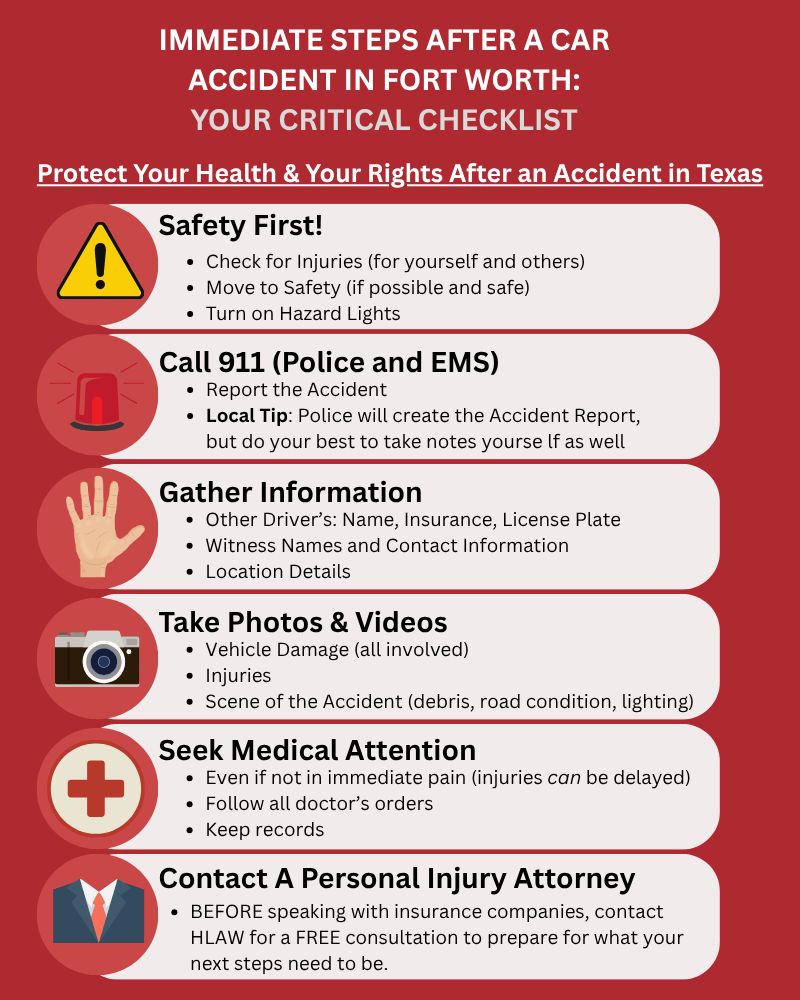
Infographic outlining immediate steps to take after a car accident in Fort Worth, including safety, calling 911, gathering information, taking photos, seeking medical help, and contacting a personal injury lawyer.

A Victim’s Guide to Personal Injury Claims in Texas: What to Do After an Accident in Fort Worth

By Personal Injury

Table of Contents:
I. Introduction: Navigating the Aftermath of an Accident in Fort Worth
II. Immediate Steps After an Accident in Fort Worth: Your Critical Checklist
III. Understanding Texas Personal Injury Law: The Foundations of Your Claim
IV. Types of Damages You Can Recover in a Texas Personal Injury Claim
V. The Personal Injury Claims Process in Texas: From Accident to Resolution
VI. Dealing with Insurance Companies: Protecting Your Rights
VII. Why Hire a Fort Worth Personal Injury Lawyer?
VIII. Frequently Asked Questions (FAQs) About Personal Injury Claims in Texas
IX. Conclusion & Next Steps: Get the Help You Deserve
X. Local Resources for Accident Victims in Fort Worth & Tarrant County

I. Introduction: Navigating the Aftermath of an Accident in Fort Worth

An accident, whether it’s a sudden car crash on I-35W, a slip and fall at a local Dallas-Fort Worth, Texas business, or a devastating truck accident in the State of Texas, can instantly turn your world upside down. Beyond the shock and physical pain, you’re likely facing mounting medical bills, lost wages, and overwhelming uncertainty about your future. In the busy Dallas-Fort Worth Metroplex, accidents are an unfortunate reality, and understanding your rights as a victim is paramount.

At the Howard Lotspeich Alexander & Williams, PLLC (HLAW), we understand the profound impact an unexpected injury can have on your life and your family. We see firsthand the challenges Dallas and Fort Worth residents face when dealing with complex legal processes and aggressive insurance companies. This comprehensive guide is designed to provide you with the clarity and actionable steps you need to navigate the confusing aftermath of an accident in Texas.

Our purpose is simple: to empower you with knowledge. While this guide offers detailed information about Texas personal injury laws and the claims process, it is not a substitute for personalized legal advice. Every accident and injury claim is unique. We strongly encourage you to contact an experienced Fort Worth personal injury attorney at the HLAW Law Firm for a confidential consultation to discuss the specifics of your situation.

Let’s begin your journey toward understanding your rights and seeking the compensation you deserve.

II. Immediate Steps After an Accident in Fort Worth: Your Critical Checklist

The moments immediately following an accident are often chaotic and frightening. However, the actions you take (or don’t take) in these crucial first hours and days can significantly impact your personal injury claim. This checklist focuses on what you should do after an accident in Fort Worth, Texas, to protect your health and your legal rights.

A. Safety First: Prioritize Your Well-being
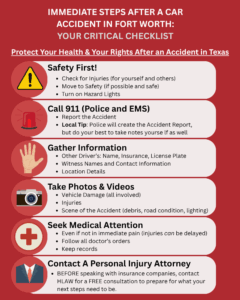
Infographic outlining immediate steps to take after a car accident in Fort Worth, including safety, calling 911, gathering information, taking photos, seeking medical help, and contacting a personal injury lawyer.

Protect your health and legal rights after a crash with this quick checklist of what to do immediately following an accident in Fort Worth, Texas.

  1. Check for Injuries: First and foremost, assess yourself and anyone else involved for injuries. Even if you don’t feel immediate pain, adrenaline can mask symptoms.
  2. Move to Safety (If Possible and Safe to Do So): If your vehicle is operational and moving it won’t cause further harm or risk, steer it to the side of the road or a nearby safe location. Turn on your hazard lights. If you’re on foot, get clear of traffic.
  3. Stay Calm: While difficult, try to remain calm. Panic can lead to poor decisions. Do your best to think clearly even turning on your hazard lights to make sure to alert drivers around the area that there has been a car wreck.

B. Call 911: Involve Law Enforcement and Emergency Medical Services

  1. Report the Accident: For any accident involving injuries, significant property damage, or disputes, call 911 immediately. In Dallas and Fort Worth, law enforcement (Dallas or Fort Worth Police Department or Texas Highway Patrol) will respond to traffic accidents.
  2. Request Medical Assistance: If anyone is injured, even if it seems minor, request an ambulance. Early medical documentation is crucial.
  3. The Accident Report: The responding police officer will likely create an official Texas Peace Officer’s Crash Report (CR-3). This report contains vital information, including details of the accident, involved parties, witness statements, and often, the officer’s initial determination of fault. How to Get Your Texas Accident Report: You can typically obtain a copy of your accident report from the Fort Worth Police Department’s website or records division a few days after the incident. Your attorney can also assist with this.
  4. Cooperate, But Don’t Speculate: Provide factual information to the police. Do not admit fault, make excuses, or speculate about what happened. Simply state the facts as you observed them.

C. Gather Information at the Scene: Document Everything

This is your opportunity to collect critical evidence that could support your claim.

  1. Exchange Information: Get the following from ALL other drivers involved: Full Name and Contact Information, Insurance Company and Policy Number, Driver’s License Number, Vehicle Make/Model/Year, and License Plate Number
  2. Identify and Collect Witness Information: If anyone saw the accident, ask for their name and contact information. Their unbiased account can be invaluable.
  3. Take Photos and Videos: Use your smartphone! Take pictures and videos of: Damage to all vehicles involved (close-ups and wider shots), Your injuries (bruises, cuts, swelling), The accident scene from different angles (skid marks, debris, traffic signals, road conditions, weather), Vehicle positions, Relevant surroundings (street signs, landmarks, cross streets), The other driver’s license plate and insurance card.
  4. Note Location Details: Be precise about where the accident occurred. Note the street names, nearest cross street, specific addresses, or highway markers.
  5. Avoid Discussions of Fault: Again, do not discuss the accident details to anyone other than the police or apologize. Anything you say can potentially be used against you.

D. Seek Medical Attention Immediately: Prioritize Your Health and Documentation

  1. Go to the ER/Urgent Care: Even if you feel fine, internal injuries or delayed onset pain (like whiplash) are common. Get checked out by a medical professional as soon as possible.
  2. Follow All Medical Advice: Adhere strictly to your doctor’s recommendations for follow-up appointments, specialists, physical therapy, and medications. Gaps in treatment can be used by insurance companies to argue your injuries aren’t serious. Keep Detailed Records: Maintain a log of all medical appointments, treatments, medications, and out-of-pocket expenses.

E. Do NOT Admit Fault or Give Recorded Statements to Insurance Companies

  1. Protect Your Statements: You are only required to report the accident to your own insurance company. You are NOT required to give a recorded statement to the at-fault driver’s insurance company without consulting an attorney.
  2. Beware of Quick Offers: Insurance adjusters may try to offer a quick, lowball settlement before you fully understand the extent of your injuries and damages. Do not accept or sign anything without legal counsel.
  3. Refer Them to Your Attorney: Once you hire a personal injury lawyer, they will handle all communications with insurance companies on your behalf, protecting your rights and ensuring you don’t inadvertently jeopardize your claim.

F. Contact the HLAW law firm as soon as possible.

  1. Early Legal Counsel is Critical: The sooner you involve an experienced personal injury attorney in Fort Worth, the better. They can advise you on your rights, guide you through the process, and protect you from common pitfalls.
  2. Free Consultation: Most personal injury lawyers, including the HLAW Law Firm, offer a free, no-obligation consultation to discuss your case. There’s nothing to lose by getting professional advice.

III. Understanding Texas Personal Injury Law: The Foundations of Your Claim

A personal injury claim in Texas is based on the concept of “negligence.” To recover compensation, you generally need to prove that another party’s negligent actions caused your injuries. Understanding these legal principles is fundamental to your case.

A. Negligence Explained: The Cornerstone of Your Claim

Negligence occurs when someone fails to act with the reasonable care that a prudent person would exercise under similar circumstances, resulting in harm to another. To prove negligence in Texas, four elements must typically be established:

  1. Duty of Care: The at-fault party owed you a legal duty to act reasonably (e.g., drivers have a duty to operate their vehicles safely).
  2. Breach of Duty: The at-fault party failed to uphold that duty (e.g., ran a red light, drove distracted, failed to maintain their property).
  3. Causation: The at-fault party’s breach of duty directly caused your injuries.
  4. Damages: You suffered actual, quantifiable harm (injuries, financial losses).

B. Texas Comparative Fault Law (Proportionate Responsibility)

Texas follows a modified comparative fault rule, often referred to as “proportionate responsibility.” This means:

  • If you are found to be partially at fault for the accident, your compensation can be reduced by your percentage of fault.
  • However, if you are determined to be more than 50% at fault (51% or greater), you are barred from recovering any damages from the other party.
  • This rule highlights why it’s crucial to have legal representation; insurance companies will often try to shift blame to minimize their payout.

C. Statute of Limitations in Texas: Don’t Miss the Deadline!

A critical legal deadline in personal injury cases is the “statute of limitations.” In Texas, the general rule is that you have two (2) years from the date of the accident to file a personal injury lawsuit.

  • Why it’s Crucial: If you don’t file a lawsuit within this two-year period, you will likely lose your right to pursue compensation, regardless of the merits of your case.
  • Exceptions: While two years is the general rule, some exceptions can shorten or extend this period (e.g., claims against government entities have much shorter deadlines, claims involving minors may be extended). It’s always best to consult an attorney immediately to confirm the applicable deadline for your specific case.

D. Types of Accidents Covered by Personal Injury Law

Personal injury law in Texas covers a wide range of incidents where one person’s negligence causes harm to another. Some of the most common types of cases handled by the HLAW Law Firm include:

  • Car Accidents: By far the most frequent type, involving collisions due to distracted driving, speeding, drunk driving (DWI), fatigued driving, reckless driving, or failure to yield.
  • Truck Accidents: Collisions involving 18-wheelers, semi-trucks, and other commercial vehicles often result in catastrophic injuries due to their massive size and weight. These cases can be complex, involving federal trucking regulations.
  • Motorcycle Accidents: Motorcyclists are highly vulnerable on the road, and accidents often lead to severe injuries.Pedestrian & Bicycle Accidents: When drivers fail to yield or act negligently around pedestrians and cyclists, devastating injuries can occur.
  • Slip and Fall / Premises Liability: Accidents occurring on someone else’s property due to hazardous conditions (e.g., wet floors, uneven surfaces, poor lighting) that the property owner knew or should have known about.
  • Dog Bites: Texas law has specific rules regarding liability for dog bites, often related to the owner’s knowledge of the dog’s dangerous propensities.
  • Wrongful Death: When an individual dies due to the negligence or wrongful act of another, surviving family members may pursue a wrongful death claim for their losses.

IV. Types of Damages You Can Recover in a Texas Personal Injury Claim
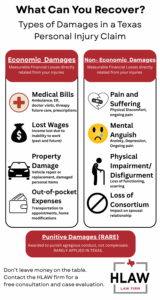
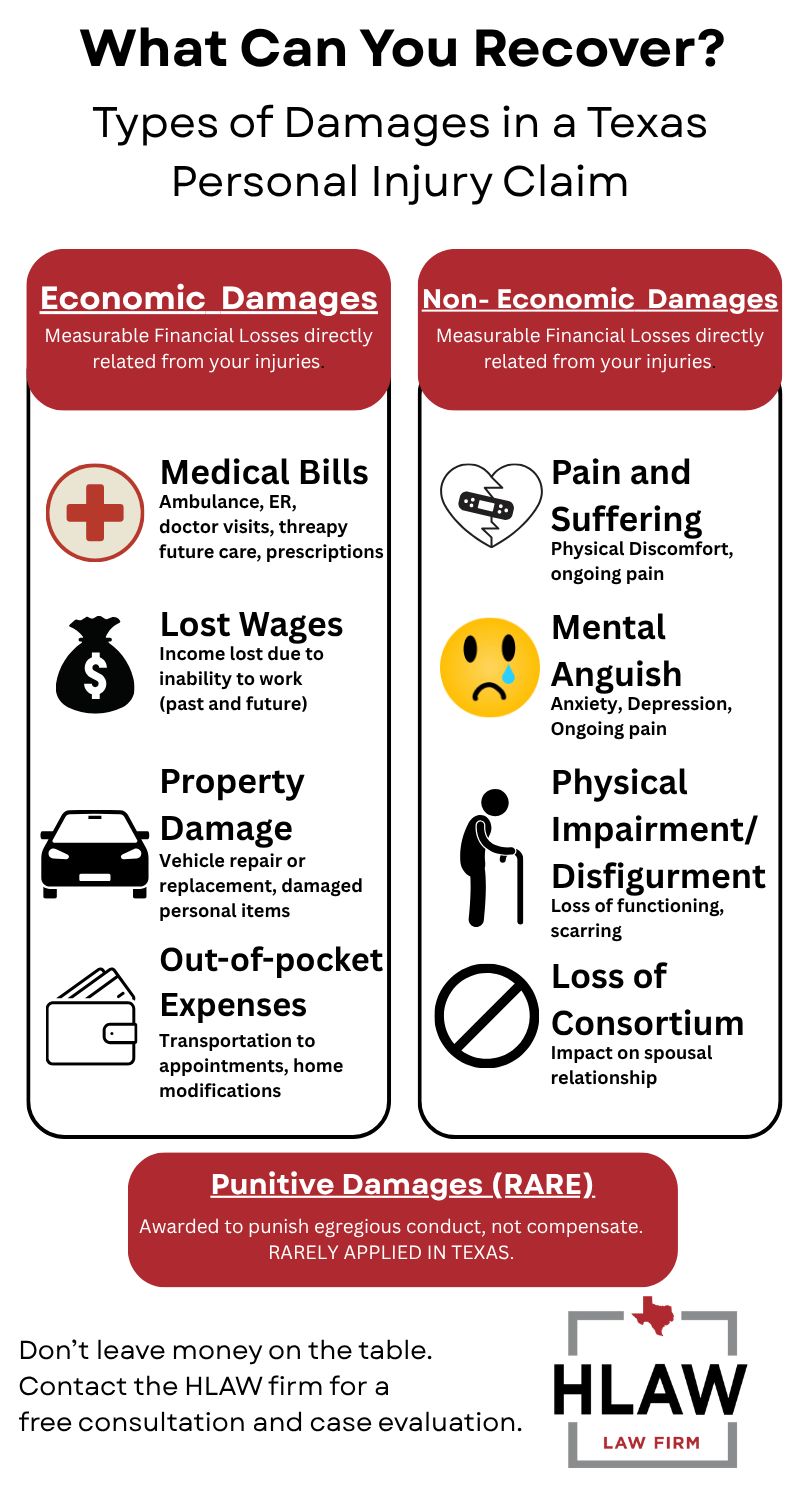
Infographic showing types of damages recoverable in a Texas personal injury claim, including economic, non-economic, and rare punitive damages.

Understanding your rights after an accident starts with knowing what you can recover. This breakdown of damages helps Texas injury victims see what compensation may be available under the law.

If you’ve been injured due to someone else’s negligence in Texas, you may be entitled to recover various types of damages. These damages aim to compensate you for the losses you’ve suffered and put you back in the position you would have been in had the accident not occurred.

A. Economic Damages (Quantifiable Losses)

These are measurable financial losses directly resulting from your injury.

  • Medical Expenses: This includes all costs related to your treatment, from the ambulance ride and emergency room visits to surgeries, doctor appointments, physical therapy, prescription medications, medical devices, and even estimated future medical care.
  • Lost Wages: Compensation for income you lost due to your inability to work after the accident. This can include hourly wages, salary, commissions, bonuses, and even lost vacation or sick days.
  • Loss of Earning Capacity: If your injuries prevent you from performing your job duties or force you into a lower-paying role, you can seek compensation for the future income you will no longer be able to earn.
  • Property Damage: Cost to repair or replace damaged property, most commonly your vehicle, but could also include personal items damaged in the accident.
  • Out-of-Pocket Expenses: Any other accident-related expenses you incurred, such as transportation costs to medical appointments, childcare, or home modifications needed due to your injuries.

B. Non-Economic Damages (Non-Quantifiable Losses)

These are subjective, non-monetary losses that impact your quality of life. They are more challenging to quantify but are equally important.

  • Pain and Suffering: Compensation for the physical pain and discomfort you’ve endured, both immediately after the accident and ongoing.
  • Mental Anguish / Emotional Distress: This includes anxiety, fear, depression, PTSD, or other emotional and psychological trauma resulting from the accident.
  • Physical Impairment/Disfigurement: Compensation for the loss of use of a body part, disfigurement (e.g., scarring), or the inability to perform daily activities or participate in hobbies you once enjoyed.
  • Loss of Enjoyment of Life: If your injuries prevent you from engaging in activities that brought you joy and fulfillment prior to the accident.
  • Loss of Consortium: In certain cases, a spouse may claim damages for the loss of companionship, affection, and intimacy due to the injured spouse’s injuries.

C. Punitive Damages (Exemplary Damages in Texas)

In Texas, punitive damages (also called “exemplary damages”) are rarely awarded in personal injury cases. They are not intended to compensate the victim but rather to punish the at-fault party for exceptionally egregious conduct and to deter similar actions in the future. To be awarded punitive damages, you typically need to prove that the defendant’s conduct was grossly negligent, malicious, or fraudulent.

V. The Personal Injury Claims Process in Texas: From Accident to Resolution (IMAGE)

Understanding the typical steps involved in a Texas personal injury claim can help demystify the process and alleviate some of your stress. While every case is unique, the general flow often follows these stages:

A. Initial Investigation & Evidence Gathering

  • Your Role: This begins with the immediate steps you take at the accident scene (as detailed in Section II).
  • Your Attorney’s Role: Your Fort Worth personal injury attorney will launch a thorough investigation. This includes:
    • Obtaining the police report and any accident reconstruction reports.
    • Collecting all medical records and bills related to your injuries.
    • Gathering witness statements.
    • Analyzing photos, videos, and other evidence from the scene.
    • Working with experts (e.g., accident re-constructionists, medical specialists, economists) if needed.
    • Determining all liable parties.
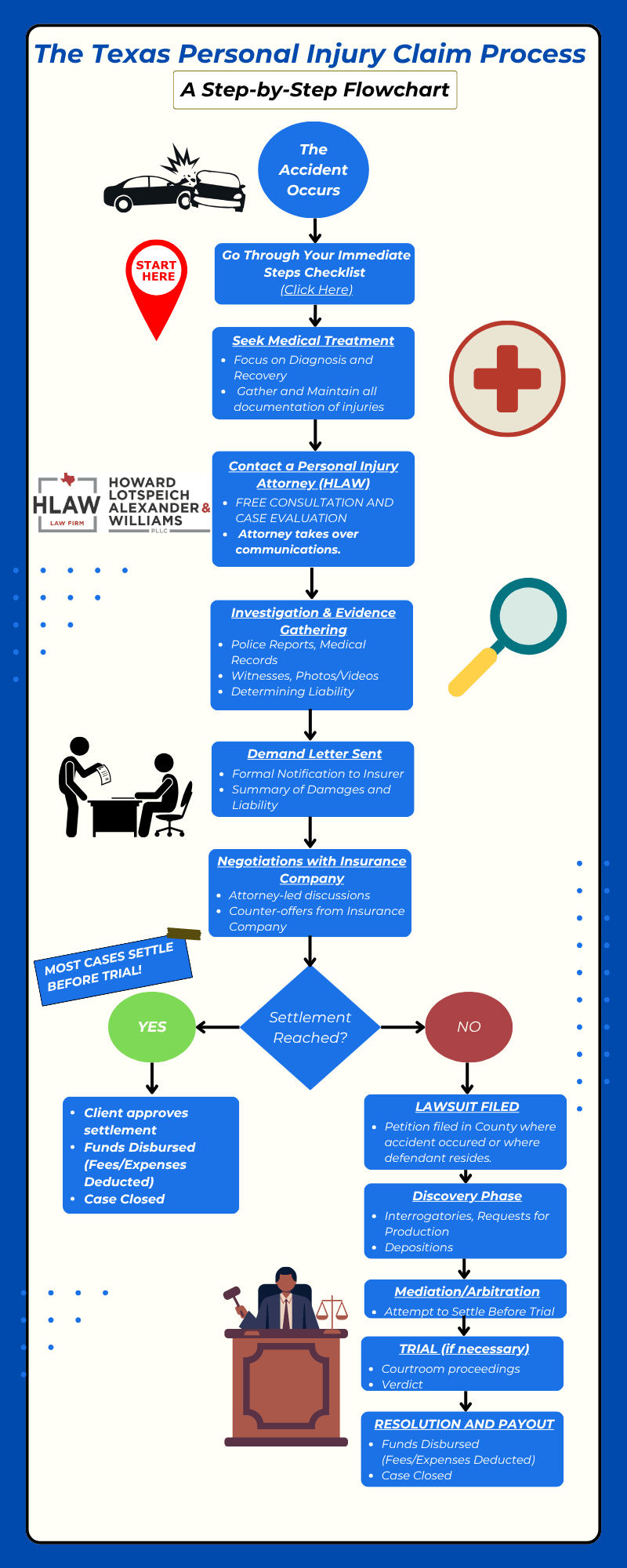
Step-by-step infographic showing the Texas personal injury claims process, from the accident and attorney consultation to investigation, negotiation, possible lawsuit, and case resolution.

From accident to resolution, this flowchart walks you through each phase of a Texas personal injury claim. Know what to expect—and how HLAW can help every step of the way.

B. Demand Letter

Once you have completed medical treatment or reached maximum medical improvement (MMI), your attorney will compile all evidence and losses into a comprehensive “demand letter.” This letter formally notifies the at-fault party’s insurance company of your claim, outlines the facts of the accident, details your injuries and damages, and demands a specific amount of compensation to settle the claim.

C. Negotiation with Insurance Companies

  • Initial Offers: The insurance company will review the demand letter and typically respond with a counter-offer. Be prepared: initial offers are often significantly lower than what your case is truly worth.
  • Attorney’s Role: This is where the skill and experience of your personal injury lawyer are crucial. They will negotiate aggressively on your behalf, countering low offers, providing additional evidence, and advocating for the full value of your claim. They understand the tactics insurance companies use to minimize payouts.

D. Filing a Lawsuit (If Settlement Not Reached)

If negotiations with the insurance company fail to produce a fair settlement, your attorney will recommend filing a personal injury lawsuit. This doesn’t necessarily mean your case will go to trial; most lawsuits settle before reaching a courtroom.

  • Petition: Your attorney files a formal complaint (petition) with the appropriate court, outlining your claims against the at-fault party.
  • Discovery: Both sides exchange information and evidence through various formal processes, including:
    • Interrogatories – Written questions answered under oath
    • Requests for Production: Requests for documents and evidence.
    • Depositions: Oral testimony given under oath by involved parties and witnesses.

E. Mediation & Arbitration

Before or during the lawsuit phase, many personal injury cases in Texas are resolved through alternative dispute resolution (ADR) methods:

  • Mediation: A neutral third-party mediator facilitates discussions between you and the insurance company/defendant, helping you reach a mutually agreeable settlement. Mediation is a common and often successful way to resolve cases without trial. Fort Worth has many skilled mediators specializing in personal Injury cases.
  • Arbitration: A neutral third-party arbitrator hears evidence and makes a binding or non-binding decision.

F. Trial (If Necessary)

If all attempts at settlement or ADR fail, your case may proceed to trial. This involves:

  • Jury Selection: Choosing jurors.
  • Opening Statements: Attorneys present their case overview.
  • Presenting Evidence: Witnesses testify, documents are introduced.
  • Closing Arguments: Attorneys summarize their cases.
  • Verdict: The jury or judge delivers a decision.

G. Appeals

If either party is dissatisfied with the trial outcome, they may have the right to appeal the decision to a higher court.

VI. Dealing with Insurance Companies: Protecting Your Rights

Insurance companies, even your own, are businesses focused on their bottom line. Their primary goal is to minimize the amount they pay out in claims, not necessarily to ensure you are fully compensated. This adversarial dynamic makes dealing with them particularly challenging for accident victims.

A. Your Own Insurance vs. The At-Fault Driver’s Insurance

  • Your Policy: You are required to report the accident to your own insurance company. They may handle initial medical payments (if you have MedPay) or property damage claims.
  • At-Fault Driver’s Policy: This is the company that will ultimately be responsible for paying your personal injury damages. Their adjuster represents their client (the at-fault driver), not you.

B. Understanding Uninsured/Underinsured Motorist (UM/UIM) Coverage

In Texas, while car insurance is mandatory, many drivers are uninsured or carry only minimum coverage. UM/UIM coverage is an optional but highly recommended addition to your own policy. If the at-fault driver has no insurance or insufficient insurance to cover your damages, your UM/UIM coverage can step in to protect you. This is a claim made against your own policy, but it still often requires skilled legal negotiation.

C. Tips for Dealing with Adjusters (If you have to talk to them before you hire a lawyer)

  • Be Polite, But Firm: Remain courteous but understand their objective.
  • Provide Basic Information Only: Give your name, contact information, and policy number.
  • Do NOT Give Recorded Statements: Politely decline any requests for recorded statements about the accident details or your injuries. Simply state that you are not prepared to give a statement at this time.
  • Do NOT Speculate or Admit Fault: Even a simple “I’m sorry” can be misconstrued as an admission of fault.
  • Do NOT Sign Anything: Never sign medical releases or settlement offers without first consulting with a personal injury attorney. Signing a general medical release gives the insurance company access to all your medical history, not just accident-related records.
  • Keep a Log: Document all communications with insurance adjusters, including dates, times, names, and what was discussed.

D. How a Lawyer Changes the Dynamic

Once you hire a personal injury lawyer from the HLAW Law Firm, all communications with insurance companies will go through your legal team. This immediately levels the playing field. Your attorney will:

  • Handle all phone calls, paperwork, and negotiations.
  • Prevent you from saying anything that could jeopardize your claim.
  • Ensure you receive the full and fair compensation you deserve.
  • Protect your rights from predatory insurance practices.

VII. Why Hire a Fort Worth Personal Injury Lawyer?

After an accident, you’re recovering from injuries, dealing with stress, and likely overwhelmed. Adding the complexities of a legal claim to that burden can be too much. This is precisely why having an experienced Fort Worth personal injury attorney on your side is not just helpful, but often essential.

A. Navigating Complex Legal Procedures

Texas personal injury law is intricate. There are specific rules of evidence, court procedures, filing deadlines (statutes of limitations), and legal precedents that apply. Without a deep understanding of these complexities, you risk making critical errors that could undermine your case. An attorney knows the law and how to apply it to your specific situation.

B. Maximizing Your Compensation

Insurance companies are experts at minimizing payouts. They have vast resources and strategies designed to reduce your claim’s value. An attorney knows how to:

  • Accurately Assess Damages: They can identify all potential economic and non-economic damages, ensuring nothing is overlooked.
  • Gather Compelling Evidence: They know what evidence is needed to prove negligence and the full extent of your injuries.
  • Negotiate Effectively: They have the negotiation skills and legal leverage to counter lowball offers and fight for the maximum compensation you deserve. Studies often show that injured individuals with legal representation receive significantly higher settlements than those without.

C. Dealing with Insurance Companies on Your Behalf

This is perhaps one of the most significant benefits. Your attorney will handle all communication with insurance adjusters, allowing you to focus on your recovery. They will protect you from misleading questions, settlement traps, and pressure tactics.

D. Access to Resources

Experienced personal injury firms like the HLAW Law Firm have established networks of professionals, including:

  • Medical Experts: To provide second opinions or expert testimony on your injuries and prognosis.
  • Accident Re-constructionists: To recreate the accident scene and provide expert analysis.
  • Investigators: To gather crucial evidence.
  • Financial Experts: To calculate lost earning capacity and future medical costs.

E. Peace of Mind

Knowing that a dedicated legal team is fighting for your rights can significantly reduce your stress and allow you to concentrate on healing. You won’t have to worry about answering tricky questions from adjusters, filling out complex forms, or navigating the court system alone.

F. Cost-Effective Representation: Contingency Fees Explained

Many accident victims hesitate to hire a lawyer because they worry about upfront costs. At the HLAW Law Firm, we work on a contingency fee basis for personal injury cases. This means:

  • You Pay Nothing Upfront: You won’t owe any attorney fees unless we win your case through a settlement or trial verdict.
  • No Win, No Fee: If we don’t recover compensation for you, you owe us nothing in attorney fees.
  • Our Fee Comes from the Recovery: Our fee is a pre-agreed-upon percentage of the final settlement or award. This aligns our interests directly with yours: the more compensation you receive, the more we earn.

G. Why Choose the HLAW Law Firm for Your Fort Worth Personal Injury Claim?

At HLAW, our attorneys are deeply rooted in the Fort Worth community. We bring:

  • Extensive Experience: Our team has a proven track record of successfully handling a wide range of personal injury cases across Texas, including complex wrongful death, car, truck, and premises liability accidents.
  • Former Prosecutors and Trial Lawyers: Our unique background as former prosecutors and courtroom litigators gives us an invaluable perspective on building strong cases and understanding litigation strategies, which we apply to our personal injury practice.
  • Client-Centered Approach: We prioritize clear communication, personalized attention, and aggressive advocacy to achieve the best possible outcome for each client.
  • Local Knowledge: Our familiarity with Tarrant County courts, local procedures, and even specific accident hot spots in Fort Worth provides an advantage in your case.
  • Reputation for Excellence: We are dedicated to upholding our reputation for aggressive and ethical representation, fighting tirelessly for our clients’ rights.

VIII. Frequently Asked Questions (FAQs) About Personal Injury Claims in Texas

Here are answers to some of the most common questions we receive from accident victims in Fort Worth:

Q1: How much is my personal injury case worth? A: There’s no average or magic number. The value of your case depends entirely on the unique facts, including the severity of your injuries, the medical treatment required, lost wages, pain and suffering, and the clarity of fault. An attorney can provide a more accurate estimate after a full review of your case.

Q2: How long does a personal injury claim take in Texas? A: The timeline varies greatly. Simple cases with clear liability and minor injuries might settle in a few months. More complex cases involving serious injuries, extensive medical treatment, multiple parties, or the need for a lawsuit can take a year or more, sometimes several years if it goes to trial.

Q3: What if I can’t afford medical treatment after an accident? A: This is a common concern. An experienced personal injury attorney can often help you get the medical care you need, even if you don’t have health insurance or cash upfront. This might involve working with providers who agree to be paid out of your settlement or connecting you with resources.

Q4: Do I have to go to court? A: Most personal injury cases in Texas settle out of court through negotiation or mediation. While the HLAW Law Firm prepares every case as if it will go to trial, only a small percentage actually do. The decision to go to trial is always made in consultation with you.

Q5: What if the accident was partially my fault? A: Texas’s modified comparative fault rule (the 51% rule) means you can still recover damages if you are 50% or less at fault. Your compensation will be reduced by your percentage of fault. If you are found to be 51% or more at fault, you cannot recover. This makes proving fault crucial.

Q6: Can I still claim if I was a passenger in an accident? A: Yes. If you were injured as a passenger due to the negligence of any driver (yours or another vehicle’s), you generally have a valid personal injury claim.

Q7: How much does a personal injury lawyer cost in Fort Worth? A: Most personal injury lawyers, including Howard Lotspeich Alexander and Williams, PLLC (HLAW), work on a contingency fee basis. This means you pay no upfront legal fees, and your attorney’s fee is a percentage of the compensation they recover for you. If they don’t win, you don’t pay attorney fees.

Q8: Should I accept the first settlement offer from the insurance company? A: Almost never. Initial offers are typically low and designed to resolve your claim quickly and cheaply, before the full extent of your injuries and damages are known. Always consult an attorney before accepting any settlement offer.

IX. Conclusion & Next Steps: Get the Help You Deserve
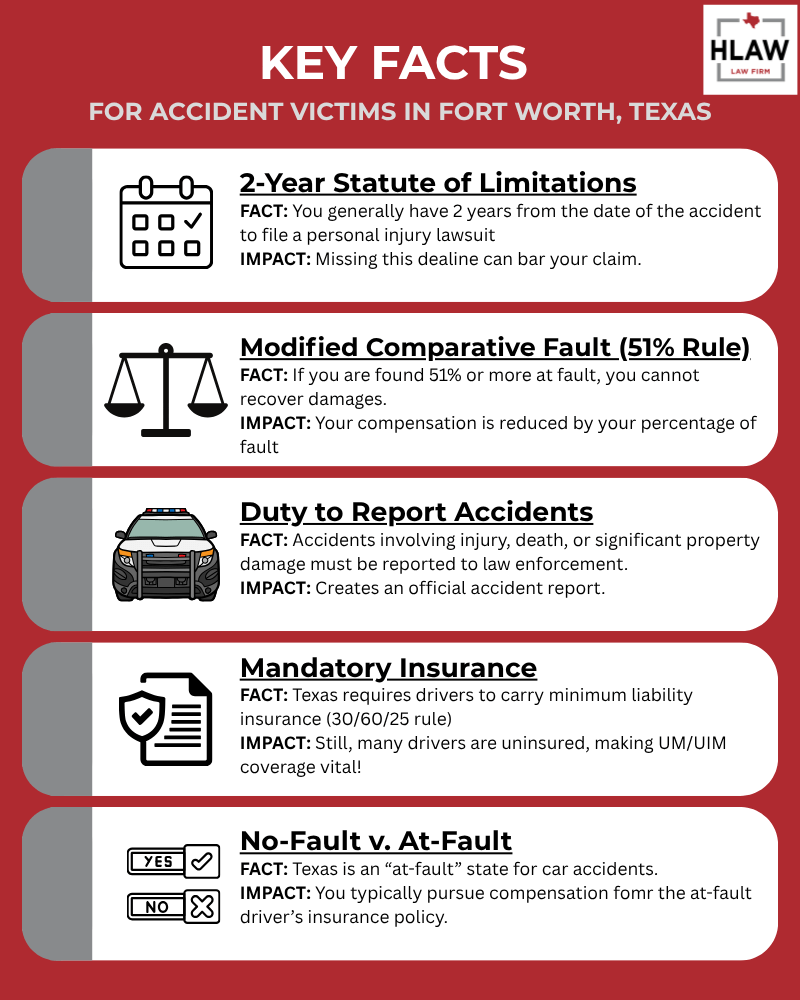
Infographic listing key legal facts for accident victims in Fort Worth, Texas, including statute of limitations, comparative fault, reporting duties, insurance requirements, and fault-based compensation rules.

Know your rights after an accident. This quick-reference guide highlights five essential legal facts every Fort Worth injury victim should understand.

Experiencing a personal injury accident in Fort Worth can be a traumatic and life-altering event. While this guide provides a comprehensive overview of your rights and the legal process in Texas, remember that you don’t have to navigate this complex journey alone.

The choices you make immediately after an accident, and the legal representation you secure, can profoundly impact your ability to recover financially and physically. Insurance companies have teams of lawyers and adjusters working to protect their interests; you deserve equally dedicated and experienced advocates fighting for yours.

At the HLAW Law Firm, we are committed to providing compassionate yet aggressive legal representation to accident victims across the Dallas-Fort Worth Metroplex. Our team will tirelessly investigate your case, gather evidence, negotiate with insurance companies, and if necessary, represent you vigorously in court. Our goal is to alleviate your burden so you can focus on what truly matters: your recovery.

Don’t delay. The statute of limitations is ticking, and evidence can disappear.

Contact the HLAW Law Firm today for a free, no-obligation consultation to discuss your Fort Worth personal injury claim. Let us help you understand your options and seek the justice and compensation you deserve.

Call us now at 817-993-9249 or fill out our online contact form to schedule your free consultation and case evaluation today.

X. Local Resources for Accident Victims in Fort Worth & Tarrant County

Here are some helpful resources for accident victims in our local community:

•Fort Worth Police Department (FWPD): https://police.fortworthtexas.gov/home
◦Accident Report Request: https://police.fortworthtexas.gov/How-Do-I/Get-Copy-Accident-Report-
•Tarrant County District Clerk’s Office: https://www.tarrantcountytx.gov/en/district-clerk.html
•Texas Department of Transportation (TxDOT): https://www.txdot.gov
◦Crash Report Request (for statewide reports): https://www.txdot.gov/data-maps/crash-reports-records.html
•Local Hospitals & Medical Centers in Fort Worth: 
-Baylor Scott & White: https://www.bswhealth.com
-Texas Health Harris Methodist Hospital Fort Worth: https://www.texashealth.org/Locations/texas-health-fort-worth
-Medical City Fort Worth: https://www.medicalcityhealthcare.com/locations/medical-city-fort-worth- hospital
•Texas Bar Association: https://www.texasbar.com
•Texas Civil Practice and Remedies Code: https://statutes.capitol.texas.gov/docs/sdocs/civilpracticeandremediescode.pdf

[UPDATED 05/28/2025]

Assorted firearms arranged on concrete with the headline “Texas Gun Control: What the Law Actually Says About Owning, Carrying, and Using Firearms—And Where the Debate Stands Now,” featuring the HLAW Law Firm logo

Texas Gun Control: What the Law Actually Says About Owning, Carrying, and Using Firearms—And Where the Debate Stands Now

By Criminal Defense
Assorted firearms arranged on concrete with the headline “Texas Gun Control: What the Law Actually Says About Owning, Carrying, and Using Firearms—And Where the Debate Stands Now,” featuring the HLAW Law Firm logo

Texas Gun Control: Understanding state laws on owning, carrying, and using firearms—and how today’s gun-control debate shapes the rights of Texas gun owners. Presented by HLAW Law Firm.

Texas has some of the nation’s most permissive gun laws—but there are still bright-line rules about who may possess a gun, where you can carry, how you must carry, and when force (including deadly force) is justified. Recent court rulings and new legislation have also shifted the ground under both gun-rights and gun-safety advocates. This guide breaks it all down in plain English.

1) The Legal Backdrop: The Second Amendment & Recent Supreme Court Cases

  • Bruen (2022): The Supreme Court held that when the Second Amendment covers conduct, the government must justify restrictions by showing they fit the nation’s historical tradition—often called the “text, history, and tradition” test. This ruling reshaped challenges to gun laws nationwide.
  • Rahimi (2024): The Court upheld the federal ban on firearm possession by people subject to qualifying domestic-violence restraining orders (18 U.S.C. § 922(g)(8)), emphasizing that disarming those who pose a credible threat is consistent with historical tradition.
  • Cargill (2024): The Court struck down ATF’s administrative bump-stock ban, holding bump stocks are not “machineguns” under the federal statute—leaving regulation of these devices to Congress or the states. 

These decisions influence how Texas laws are interpreted and what new measures are likely to survive in court.

2) Who Can and Cannot Possess a Firearm in Texas

  • General rule: If you are not prohibited by state or federal law, you may possess firearms.
  • Felony convictions: A person convicted of a felony generally cannot possess a firearm. After five years from release from confinement, parole, or probation, limited possession only at the person’s residence may be allowed; possession elsewhere remains illegal.
  • Family-violence & protective orders: Federal law bars possession while you’re subject to certain domestic-violence restraining orders; Rahimi confirms that ban’s constitutionality. Texas law also restricts possession after certain family-violence findings. 

3) Carrying Handguns: Permitless Carry vs. License to Carry (LTC)

Permitless (“constitutional”) carry

Since September 1, 2021, most adults 21+ who may lawfully possess a handgun can carry it—openly in a holster or concealed—without a state license. There are still many exceptions (see “Prohibited Places” below). 

18–20-year-olds: Following Firearms Policy Coalition v. McCraw, Texas no longer enforces the 21+ carry limit solely based on age; DPS now accepts 18–20-year-old applicants for LTC and acknowledges the ruling in its guidance. (Young adults must still be otherwise eligible under state and federal law.) 

Why many Texans still get an LTC

The LTC program remains in effect and offers real advantages: streamlined carry in certain contexts, interstate reciprocity, and practical benefits in stops or travel. DPS maintains an official list of LTC benefits

4) Where Guns Are 

Prohibited

 (Even if You Can Otherwise Carry)

Texas Penal Code § 46.03 lists “places weapons prohibited.” Highlights include schools, polling places, courts, secured airport areas, 51% alcohol-sales establishments, amusement parks, hospitals/nursing facilities (with required notices), and more—subject to detailed exceptions/defenses. Violations can be serious felonies in some settings. Always check the statute before you go. 

Newer “46.03 sign” notices: Covered locations may post a § 46.03-specific sign at entrances that eliminates certain defenses for accidental carry in prohibited places. If you see it, don’t carry past it. 

5) Private Property & Signs: Texas Penal Code 30.05, 30.06, 30.07 (What They Mean)

Private owners can restrict handguns on their property through specific notice:

  • Texas Penal Code §30.05 (Criminal Trespass) “No guns” notice: Bars people (especially those without an LTC) from entering/remain­ing with a firearm if proper notice is given.
  • Texas Penal Code §30.06: “No concealed handguns by license holders.” Applies to LTC holders carrying concealed.
  • Texas Penal Code §30.07: “No openly carried handguns by license holders.” Applies to LTC holders carrying openly.

To be enforceable, these notices must follow statutory format/placement. If you receive oral notice, you must depart or disarm—even if the sign is imperfect. (When in doubt, leave and call us before you risk an arrest.) 

6) How You May Carry: The “Unlawful Carrying” Rules

Texas Penal Code §46.02 governs unlawful carrying of weapons, including handguns in vehicles and on-person. Key points include holster requirements for open carry, restrictions while committing other crimes, and special rules for carry inside your vehicle or on your own property. Violations can escalate quickly depending on location and circumstances. 

7) Self-Defense, Defense of Others, & Defense of Property (When Force Is Justified)

Texas Penal Code Chapter 9 spells out when force—and deadly force—is justified.

  • Self-defense (Texas Penal Code §9.31): Force is allowed if you reasonably believe it’s immediately necessary to counter another’s unlawful force. Texas has no general duty to retreat if you meet statutory conditions.
  • Deadly force (Texas Penal Code §9.32): Allowed if you meet § 9.31 and you reasonably believe it’s immediately necessary to stop unlawful deadly force or certain serious violent felonies (e.g., aggravated robbery). Presumptions may apply in home/vehicle/business intrusion scenarios.
  • Defense of others (Texas Penal Code §9.33): You can use force (including deadly force) to protect another if they would have the same right of self-defense and your belief is reasonable.
  • Property (Texas Penal Code §§ 9.419.42): Force may stop trespass or interference with property; deadly force is narrow—limited to specific nighttime crimes and other strict conditions. These cases are fact-sensitive and heavily scrutinized. Call a lawyer before you make statements.

8) State Preemption: Why Cities & Counties Can’t Add Their Own Gun Codes

Texas preempts most local gun regulation. Municipalities and counties generally cannot regulate the possession, carry, storage, transfer, or registration of firearms (and now explicitly, air guns, archery equipment, knives, ammunition, and explosives). Recent legislation in 2025 (SB 2284) further clarified and expanded these limits. 

There are limited carve-outs (e.g., regulating discharge at outdoor ranges; narrow subdivision rules), but the default is broad state control. 

9) Red-Flag (ERPO) Policies: Where Texas Stands

Texas does not have a red-flag law—and in June 2025 lawmakers passed an “Anti-Red Flag Act” (SB 1362) that blocks courts and local officials from using or enforcing ERPO-style orders under state law and resists enforcement of most federal or out-of-state ERPOs. (Separate protective-order laws and federal prohibitions for domestic-violence orders still apply.) 

10) The Ongoing Policy Debate in Texas

  • Gun-rights advocates emphasize self-defense and constitutional protections, backing permitless carry, preemption, and resistance to ERPOs; they cite Bruen and Cargill as guardrails against expansive regulation.
  • Gun-safety advocates continue to push for measures like universal background checks and ERPOs, noting strong polling support among Texans post-Uvalde—though the Legislature has largely moved in the opposite direction.

Expect continued litigation and incremental statutory tweaks. When laws change, the details (age thresholds, signage, prohibited places, defenses) matter.

11) Practical Tips for Texans

  1. Know the signs and the setting. If you see a § 46.03 prohibited-place sign or a 30.05/30.06/30.07 notice—or you’re orally told not to carry—don’t carry past it.
  2. Vehicle carry vs. public carry. The rules are different; ensure holster compliance and avoid any conduct that could elevate a simple stop into an arrest.
  3. Consider an LTC. Reciprocity, training, and practical benefits still matter—especially when traveling or interacting with law enforcement.
  4. After any defensive display or use of force: call counsel first. Chapter 9 defenses are technical and fact-intensive. 

12) How Our Firm Helps

Navigating Texas gun laws is not just about quoting statutes—it’s about protecting your rights while reducing your legal risk. Whether you were stopped while carrying, face a 46.03 or 30.05/30.06/30.07 charge, need counsel after a defensive incident, or want compliant policies for your business or church, we’re here.

Free, confidential consultation: If you’re facing a firearm-related investigation or charge—or you simply want clarity before you carry—call us. We’ll review your facts, assess exposure under Penal Code §§ 46.02, 46.03, 46.04 and Chapter 9, and map a strategy to protect your freedom. (The earlier we engage, the more options we have.) 

Statutes & Key References (select)

Emergency responders at a nighttime car accident scene in Texas, illustrating personal injury law context.

What Qualifies as a Personal Injury in Texas? A Quick Guide to Claims & Compensation

By Personal Injury

When accidents or injuries happen, understanding whether your situation qualifies as a personal injury case is crucial. A Texas Personal Injury Case arises when someone is harmed due to another party’s negligence, intentional actions, or strict liability. In this blog post, we’ll break down what qualifies as a personal injury case and provide examples to help you determine your next steps.

Emergency responders at a nighttime car accident scene in Texas, illustrating personal injury law context.

A serious car crash highlights the importance of understanding what legally qualifies as a personal injury in Texas.

The Basics of Texas Personal Injury Cases

A personal injury case typically involves:

  1. Duty of Care: The responsible party owed a legal duty to act in a way that avoids causing harm to others.
  2. Breach of Duty: The responsible party failed to meet that duty, either through negligence or intentional actions.
  3. Causation: The breach of duty directly caused the injury.
  4. Damages: The injured party suffered measurable harm, such as medical expenses, lost wages, or pain and suffering.

Common Types of Personal Injury Cases in Texas

  1. Car Accidents

    One of the most common types of personal injury cases, car accidents occur when a driver acts negligently, such as speeding, texting while driving, or running a red light. Texas law requires drivers to carry liability insurance to cover damages they cause.

  2. Slip and Fall Accidents

    Property owners have a duty to maintain safe premises. If you slip, trip, or fall due to hazards like wet floors, uneven surfaces, or poor lighting, you may have a personal injury case under premises liability law.

  3. Workplace Injuries

    Texas employers must provide a safe working environment. If an injury occurs on the job, workers may be eligible for workers’ compensation or, in some cases, file a lawsuit for damages if the employer’s negligence was involved.

  4. Medical Malpractice

    When healthcare providers fail to meet the standard of care, patients can suffer harm. Examples include surgical errors, misdiagnosis, or medication mistakes. Texas has specific laws governing medical malpractice claims, including damage caps.

  5. Product Liability

    If a defective product causes injury, you may be able to file a lawsuit against the manufacturer, distributor, or retailer. Common cases involve faulty machinery, contaminated food, or unsafe toys

  6. Dog Bites and Animal Attacks

    Texas law holds pet owners responsible if their animal injures someone, especially if the owner knew the animal had aggressive tendencies.

  7. Wrongful Death

    If a loved one dies due to another party’s negligence or wrongful act, surviving family members may file a wrongful death claim to seek compensation for their loss.

Examples of Negligence in Personal Injury Cases

Negligence can take many forms, including:

  • Distracted driving (e.g., texting or eating while driving)
  • Failing to clean up spills or repair hazards on a property
  • Ignoring safety protocols at work
  • Manufacturing a product with design flaws

Proving a Personal Injury Case

To successfully pursue a personal injury case, you’ll need to prove:

  • The other party’s fault: This often requires evidence such as photos, video footage, police reports, or witness statements.
  • Your damages: Medical records, bills, pay stubs, and expert testimony can help establish the financial and emotional impact of your injury.

Damages in Personal Injury Cases

If your case is successful, you may recover:

  • Economic damages: Medical expenses, lost wages, property damage, and future earning capacity.
  • Non-economic damages: Pain and suffering, emotional distress, and loss of enjoyment of life.
  • Punitive damages: Awarded in rare cases to punish extreme negligence or intentional misconduct.

Do You Have a Case?

If you’re unsure whether your situation qualifies as a personal injury case, we would be happy to visit with you and offer a free consultation. We can evaluate your case, explain your legal options, and help you seek the compensation you deserve.

Conclusion

Personal injury cases in Texas cover a wide range of situations, from car accidents to product liability. The key is proving negligence, causation, and damages. If you believe you’ve been harmed due to someone else’s actions, don’t wait to take action—time limits apply to most personal injury claims. Don’t wait – Texas law limits how long you have to file a personal injury claim! Contact us today for a free consultation and get the justice you deserve.

Learn more about filing a personal injury claim in Texas.

What factors should I consider when choosing a personal injury firm in Fort Worth, Texas?

By Personal Injury No Comments


How to Choose the Best Personal Injury Firm in Fort Worth: Key Factors and Lawyer Reviews

Selecting the right personal injury firm in Fort Worth can significantly impact the outcome of your case. With numerous options available, understanding the key factors that influence your choice is essential. This article will guide you through the critical elements to consider when choosing a personal injury lawyer, including their experience, reputation, and client reviews. By the end, you will be equipped with the knowledge to make an informed decision that aligns with your needs and expectations.

What Are the Most Important Factors When Choosing a Fort Worth Personal Injury Lawyer?

When selecting a personal injury lawyer in Fort Worth, several factors play a crucial role in ensuring you receive the best representation. These include the attorney’s experience, the law firm’s reputation, and the feedback from previous clients. Understanding these elements can help you gauge the potential success of your case and the level of service you can expect.

How Does Attorney Experience Impact Your Injury Case Outcome?

The experience of an attorney is vital in personal injury cases, as it directly influences the outcome. Experienced lawyers possess a deep understanding of the legal landscape, which allows them to navigate complex cases effectively. They are familiar with the tactics used by insurance companies and can leverage their knowledge to negotiate better settlements. Furthermore, a seasoned attorney often has a proven track record of success in similar cases, which can instill confidence in clients.

Indeed, the value of an experienced attorney in personal injury cases is consistently highlighted in legal scholarship.

Why Is a Law Firm’s Reputation Crucial in Fort Worth?

A law firm’s reputation is a significant factor in your decision-making process. A firm with a strong reputation is likely to have a history of successful case outcomes and satisfied clients. This reputation can be assessed through client reviews, peer recognition, and awards. A well-regarded firm not only enhances your chances of a favorable outcome but also provides peace of mind, knowing that you are in capable hands.

How Can You Evaluate Fort Worth Injury Lawyer Reviews Effectively?

Evaluating reviews of personal injury lawyers in Fort Worth is essential for making an informed choice. Reviews can provide insights into the experiences of past clients and highlight the strengths and weaknesses of a firm. When assessing these reviews, look for detailed testimonials that discuss specific outcomes and the overall satisfaction of clients.

What Should You Look for in Client Testimonials and Case Success Stories?

When reading client testimonials, focus on the specifics of their experiences. Look for mentions of successful case outcomes, the attorney’s communication style, and the level of support provided throughout the legal process. Testimonials that detail the challenges faced and how the attorney helped overcome them can be particularly telling of their capabilities.

How Do Online Review Platforms Influence Your Choice?

Online review platforms, such as Yelp and Avvo, play a significant role in shaping your perception of a personal injury lawyer. These platforms aggregate client feedback and provide a broader view of a lawyer’s reputation. Pay attention to the overall ratings, the number of reviews, and the consistency of feedback across different platforms. A lawyer with numerous positive reviews is likely to be a reliable choice.

What Questions Should You Ask During a Personal Injury Lawyer Consultation in Fort Worth?

During your initial consultation with a personal injury lawyer, asking the right questions is crucial to understanding their approach and capabilities. This dialogue can help clarify their fee structures, communication preferences, and overall strategy for your case.

Understanding the dynamics of client decision-making during this crucial phase is further illuminated by research into the lawyer-client relationship.

Which Fee Structures and Contingency Costs Should You Clarify?

Understanding the fee structure is essential when hiring a personal injury lawyer. Most personal injury attorneys work on a contingency fee basis, meaning they only get paid if you win your case. Clarify the percentage they will take from your settlement and any additional costs you may incur. This transparency will help you avoid unexpected expenses later on.

How to Assess Consultation Availability and Attorney Communication?

Effective communication is vital in any attorney-client relationship. During your consultation, assess how responsive the attorney is to your questions and concerns. Inquire about their availability for meetings and updates on your case. A lawyer who prioritizes communication will likely provide a better overall experience.

How Do Fort Worth Car Accident Attorneys Handle Personal Injury Claims?

Understanding how personal injury claims are handled in Fort Worth is essential for anyone involved in an accident. Car accident attorneys typically follow a structured process to ensure that clients receive the compensation they deserve.

What Is the Typical Personal Injury Claim Process in Texas?

The personal injury claim process in Texas generally involves several key steps. Initially, the attorney will gather evidence, including police reports and medical records, to build a strong case. Next, they will negotiate with insurance companies to reach a fair settlement. If a settlement cannot be reached, the attorney may file a lawsuit and represent you in court. This structured approach ensures that all aspects of your case are thoroughly addressed.

How Long Do Personal Injury Cases Usually Take in Fort Worth?

The duration of personal injury cases can vary significantly based on several factors, including the complexity of the case and the willingness of the parties to negotiate. On average, personal injury cases in Fort Worth can take anywhere from several months to a few years to resolve. Factors such as the need for extensive medical treatment or disputes over liability can extend this timeline.

How to Verify a Personal Injury Law Firm’s Reputation and Success Rate in Fort Worth?

Verifying a law firm’s reputation and success rate is crucial before making your final decision. This process involves researching their track record and understanding how they have performed in past cases.

Where to Find Reliable Case Success Statistics and Legal Credentials?

To verify a law firm’s success rate, look for case success statistics on their website or legal directories. Many firms publish their achievements, including the number of cases won and the total amount recovered for clients. Additionally, checking their credentials through the Texas State Bar Association can provide insights into their standing and any disciplinary actions.

How Does Local Legal Expertise Affect Your Injury Claim?

Local legal expertise can significantly impact your injury claim. Attorneys familiar with Fort Worth’s legal landscape understand the nuances of local laws and regulations. This knowledge can be advantageous in navigating the legal system and ensuring that your case is handled effectively. Furthermore, local attorneys often have established relationships with judges and opposing counsel, which can facilitate smoother negotiations.

Why Choose Howard Lotspiech Alexander & Williams, PLLC (HLAW) for Your Personal Injury Case in Fort Worth?

Howard Lotspiech Alexander & Williams, PLLC (HLAW) exemplifies the qualities outlined in this article, making it an excellent choice for your personal injury needs in Fort Worth. Our firm combines extensive attorney experience, a strong reputation, and a commitment to client satisfaction that aligns perfectly with the key factors you should consider when selecting legal representation.

At HLAW, our attorneys bring years of specialized experience in personal injury law, having successfully handled a wide range of cases similar to yours. This experience equips us to navigate the complexities of insurance negotiations and litigation effectively, maximizing your chances of a favorable outcome.

Our firm’s reputation in the Fort Worth community is built on a foundation of trust, integrity, and proven results. We are proud of the positive reviews and testimonials from past clients who highlight our communication, dedication, and successful case resolutions. These endorsements reflect our commitment to providing personalized and attentive legal service.

We understand the importance of transparent fee structures and clear communication. During your consultation with HLAW, we will thoroughly explain our contingency fee arrangement and ensure you are fully informed about any potential costs. Our attorneys prioritize responsiveness and accessibility, keeping you updated throughout every stage of your case.

Moreover, our deep local legal expertise and established relationships within the Fort Worth legal community enable us to advocate effectively on your behalf. We are dedicated to guiding you through the personal injury claim process with professionalism and care, ensuring that your rights are protected and your interests vigorously represented.

Choosing Howard Lotspiech Alexander & Williams, PLLC means partnering with a firm that not only meets but exceeds the criteria for selecting the best personal injury lawyer in Fort Worth. We invite you to contact us for a consultation to discuss how we can assist you in achieving the best possible outcome for your case.

For a free case evaluation and consultation with our team, contact us today!