

Tag

Texas Court of Criminal Appeals Case Archives | HLAW

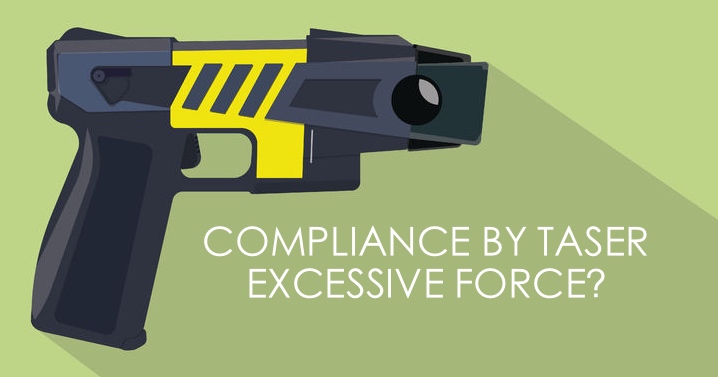
Taser illustration with text "Compliance by Taser | Excessive Force?" relevant to discussions on police use of force and legal implications in drug crime cases.

Compliance by Taser | Excessive Force?

ByDrug Crimes

Taser device illustration with text "Compliance by Taser Excessive Force?" relevant to legal analysis of police conduct and excessive force in criminal defense cases.

The Texas Court of Criminal Appeals recently heard a case involving excessive force by police.

In, Hereford v. State the ultimate issue presented to the CCA was whether forced used by officers to recover drugs from a defendant was excessive and unreasonable. The court held that it was.

The appellant in Hereford pulled into a parking lot and got out of his car. An officer observed him and recognized him as someone he had dealt with in the past. The officer knew Hereford had outstanding warrants. The officer conducted a pat down search and arrested him for the warrants. After appellant was arrested, the officer searched his vehicle. When the officer did not find any narcotics, he called a K9 unit whose dog alerted on the car.  Despite the alert, officers again failed to find any narcotics. When the officer returned to his patrol unit, appellant had his head down and was chewing on something. The officer commanded appellant to spit it out but he refused. The officer and two others then removed appellant from the patrol unit and tased him on the leg. The officer who made initial contact with appellant then grabbed him around the throat and tried to force him to spit out the substance. The officers then ceased trying to force the appellant to spit out the substance. After discussing their options for fifteen to twenty minutes, the officers decided to take the appellant to the hospital.

At the hospital, the officers appellant over to another officer working off-duty at the hospital. Appellant still had the substance in his mouth.  The hospital tried to get him to release it by using ammonia capsules. This did not work. The off-duty officer then took appellant into an examining room and began to tase him repeatedly – three times in the upper inner thigh (the groin) and once in the right forearm. When he was being tased, appellant’s mouth would open involuntarily.  While appellant’s mouth was open (during the tasing of his groin) the officer was able to get the substance out of his mouth.  It turned out to be a plastic baggie of crack cocaine.

The issue presented for the CCA was whether, under the Fourth Amendment, the manner in which the evidence that was seized was reasonable. The court used the factors found in Winston v. Lee, 470 U.S. 753 (1985) to balance the intrusion to the appellant’s personal interests, the societal need for effective law enforcement, and the state’s need for evidence. Those factors include whether the police conduct:

  1. threatened the suspect’s health or safety;
  2. conformed to accepted medical practices;
  3. was performed by a trained professional;
  4. arose from the existence of probable cause to believe the suspect had evidence of a crime;
  5. unduly intruded upon the suspect’s dignity interests in personal privacy; and
  6. was a commonplace procedure to which individuals are often subjected.

Balancing those interests, the court found that the off-duty officer’s actions were unreasonable and violated appellant’s Fourth Amendment prohibition against unreasonable searches and seizures.

The CA, however, made it a point to highlight that this ruling was not to be construed to imply that the use of a Taser in these types of instances is per se unreasonable. The Court highlighted Ellis v. Columbus City Police Dep’t, No. 1:07CV123-A-A, 2009 U.S. Dist. LEXIS 95821 (N.D.Miss. September 15, 2009), where almost the same set of circumstances happened.  In that case though, the suspect had lunged at officers and was openly chewing a plastic bag of cocaine. The Court differentiated that case from this one by explaining that in Ellis, the officers stopped after tasing appellant several times and the tasing occurred during the arrest (not long after and by another officer).

Presiding Judge Keller dissented without opinion.
Courts Should Not Apply Strict Rules of Grammar and Syntax When Reviewing Search Warrant Affidavits

BySearch & Seizure

“On Sunday, he advised me that he had been in Russia” is not the same as “He advised me that he had been in Russia on Sunday.”

The Court of Criminal Appeals considered a similar ambiguity in an Affidavit for a search warrant in State v. McClain. The Affiant stated in the affidavit, “In the past 72 hours, a confidential informant advised” the defendant had been seen in possession of Meth. Without more, this purports to state that the informant provided the information in the past 72 hours and DOES NOT state when the informant actually observed the behavior – a critical piece of information, indeed.

The trial court found the affidavit deficient and suppressed the evidence that was seized during the search. The 7th District Court of Appeals (Amarillo) affirmed. The CCA now reversed the Court of Appeals, holding that the search warrant based on this affidavit was proper.

The CCA cautions trial courts not to view such affidavits in a “hypertechnical” manner.

Since the Fourth Amendment strongly prefers searches to be conducted pursuant to search warrant, the United States Supreme Court has provided incentives for law-enforcement officials to obtain warrants instead of conducting warrantless searches. One incentive is a less-strict standard for reviewing the propriety of a search conducted pursuant to a warrant. In this situation, courts must give great deference to the magistrate’s probable-cause determination.

The CCA, with the exception of Judge Johnson who dissented, held that the lower courts violated the prohibition on hypertechnical review of warrant affidavits when it strictly applied rules of grammar and syntax in its analysis. The CCA further held:

Reviewing courts should only be concerned with whether the magistrate’s determination in interpreting and drawing reasonable inferences from the affidavit was done in a commonsensical and realistic manner. And reviewing courts should defer to all reasonable inferences that the magistrate could have made.

Man in a suit raising a handgun in celebration, with another man smiling beside him, in a city street setting, relating to discussions on reckless discharge of a firearm and legal implications in Texas.

Pleading a Tautology | Reckless Discharge of a Firearm

ByWeapons Charges

Can the State prove Reckless Discharge of a Firearm by simply proving discharge of a firearm in the city limits?

Man in a suit raising a handgun in celebration, with a smiling man beside him, in a city street setting, related to discussions on reckless discharge of a firearm in Texas.Yesterday, the Court of Criminal Appeals handed down State v. Rodriguez, a case in which the State appealed the lower court decision setting aside the information (charging document) for failure to plead an offense.

The State charged Roman Rodriguez under section 42.12 of the Texas Penal Code for reckless discharge of a firearm inside city limits. The information alleged that the defendant

recklessly discharged a firearm by pulling the trigger on a firearm which contained ammunition and was operable.

Upholding the 4th District Court of Appeals (San Antonio), the CCA held that the charge was deficient because it failed to allege that the act was done recklessly. The CCA noted that,

The State’s information alleged that Mr. Rodriguez recklessly discharged a firearm inside [the city limits] “by pulling the trigger on an firearm which contained ammunition and was operable.” Well, of course he did. Everyone who discharges a firearm pulls the trigger, and every firearm that is discharged contains ammunition and is operable if it discharges.

The Court explained that, in essence, the State pled a tautology – “The defendant recklessly discharged a firearm because he discharged a firearm.” The Court further noted that there are many occasions where a person might discharge a firearm inside the city limits by pulling the trigger on an operable firearm containing ammunition, such as: “if a person shoots a robber or a rapist climbing into his bedroom window,” or “if he shoots a rattlesnake lying in the bushes.”

Accordingly, because the State only alleged “how” the defendant discharged the firearm and failed to alleged how he “recklessly” discharged the same, the information was deficient and should be set aside.

Judge Price concurred in the result and writes separately to express his opinion that the statute (section 42.12) is “hopelessly ambiguous” regarding the recklessness requirement.  Presiding Judge Keller joined in Judge Price’s concurrence. Judge Womack also concurs without opinion.

Illustration of courtroom voir dire process, featuring hands selecting jurors from a panel, emphasizing trial advocacy and jury selection strategies relevant to Texas law.

A Proper Voir Dire Question

ByTrial Advocacy

Illustration depicting hands selecting jurors from a jury box, representing the voir dire process in Texas trial advocacy and legal questioning.When conducting voir dire of prospective jurors (the venire panel), Texas law says that a lawyer cannot ask a “commitment question.” The Texas Court of Criminal Appeals defines a “commitment question” as


a question that commits a prospective juror to resolve or to refrain from resolving an issue a certain way after learning of a particular fact. Commitment questions are impermissible unless the law requires a commitment, and the law does not require a commitment on what facts a juror will consider during sentencing.

The CCA also cautions, however, that “a trial court abuses its discretion if it disallows a proper voir dire question.”

In Davis v. State, a case decided by the CCA last month, the defense counsel asked the venire panel the follow question:

Let’s talk about factors in [assessing] the sentence in a case of aggravated robbery with a deadly weapon, what factors do y’all think are important?

Despite counsel’s fine use of the word “y’all,” and without any objection to the question by the State, the trial judge interjected, saying, “that’s a commitment question. You can’t ask that question.” On appeal, the 14th District Court of Appeal (Houston) agreed.

The CCA now reverses, holding that

appellant’s counsel asked “what factors…are important” in sentencing. This did not ask the jurors how particular facts would influence their deliberations. This was an inquiry into the jurors’ general philosophies.

There you have it. Cases regarding commitment questions are always very fact dependant, but for now, we can add one more to the list. Counsel may properly ask: What factors are important in assessing the sentence in a [name your offense] case.”

Presiding Judge Keller penned the lone dissent.  She deems the question an improper commitment question.

Walmart sign against blue sky, relevant to theft case involving Walmart property ownership in Texas.

Walmart Theft Case Charged with the Wrong Name

ByTheft

Walmart sign against a blue sky, representing the retail giant involved in theft case discussions in Texas.Byrd v. State

In Byrd, the state charged appellant with theft of certain property from owner “Mike Morales.” At trial, however, the State did not prove, in any way whatsoever, that the property belonged to Mike Morales. The overwhelming proof showed that the property, in fact, belonged to Walmart. On appeal, appellant argued the the evidence was insufficient because the State did not prove that the property belonged to Mike Morales. The 4th Court disagreed, holding that the name of the owner was not required, as it was simply a variance of proof.

This week, the Texas Court of Criminal Appeals reversed the decision of the Court of Appeals. In a unanimous opinion written by Judge Cochran, the CCA held that:

Although the name of the owner is not a substantive element of theft, the State is required to prove, beyond a reasonable doubt, that the person (or entity) alleged in the indictment is the owner is the same person (or entity) – regardless of the name – as shown by the evidence.

The CCA explained that a conviction would still stand if an indictment alleged an incorrect name, such as Buddy Smith, when the proof at trial revealed that the victim’s name was, in fact, John Smith (Buddy was simply a nickname). In that instance, there would be sufficient evidence showing that the person alleged in the indictment is the same person from whom the property was stolen.

In this case:

Not only did the State fail to offer any evidence that “Mike Morales” – the person alleged in the theft indictment – has any ownership interest in or relationship to the property appellant shoplifted, but the jury, without any apparent concern the missing “Mile Morales,” convicted her nevertheless.  According to the State, the “only explanation for this exceptional circumstance seems to be that it was so clear to all the parties involved – and possibly to the jury as well – that the real victim (both alleged and proven) was Wal-Mart that the discrepancy seemed not to matter.”  An alternate, less generous explanation, is that everyone was asleep at the wheel.

As a rule for future Walmart theft cases (and all theft cases), the majority opinion states:

The parties, the court, and the jury must know the identity of the owner [of the stolen property] regardless of how the State names him.

It is worth noting that the CCA did not foreclose the option of the State reindicting the appellant for theft from “Walmart,” as jeopardy has not attached to that specific offense. But as far as theft from Mike Morales goes, the appellant stands acquitted.

Aggravated Robbery Victim Not Be Present to Be Robbed

ByRobbery

The Texas Court of Criminal Appeals released an opinion this month in a case where a man entered a convenience store brandishing a rifle. When the man looked around, however, he noticed that there wasn’t anyone in the store. The store clerk was in the back office watching the man on the security camera. When the clerk saw the man enter the store, he locked the office and called 911. Unable to open the cash register, the “robber” stole the clerk’s wallet and some money that was behind the counter. The “robber” never saw anyone inside the store.  Then he left.

The man was later charged with and convicted of Aggravated Robbery under Texas Penal Code Section 29.02, which provides in relevant part:

a person commits [robbery] if, in the course committing theft…and with intent to obtain or maintain control of the property, he intentionally or knowingly threatens or places another in fear of imminent bodily injury or harm.

Appellant argued that “because there was no evidence of interaction between him and [the victim], the evidence was legally insufficient to support a robbery conviction, and the conviction should be reformed to that of theft. Accordingly, the CCA was faced with a question of first impression in Texas:

Does the Offense of Aggravated Robbery Require Interaction Between the Accused and the Purported Victim?

Appellant contested that he could not intentionally or knowingly place a person in fear, if that person was unknown to him. A unanimous CCA disagreed, explaining that

‘knowingly’ does not refer to the defendant’s knowledge of the actual results of his actions, but knowledge of what results his actions are reasonably certain to cause. Using this definition, robbery-by-placing-in-fear does not require that a defendant know that he actually places someone in fear, or know whom he actually places in fear. Rather, it requires that the defendant is aware that his conduct is reasonably certain to place someone in fear, and that someone is actually placed in fear.

In this case, because Appellant brandished the rifle in the convenience store, the CCA held that his culpable mental state was not negated by the fact that the victim did not happen to be in his presence. In sum, the CCA answered the question presented in the negative.

The offense of Aggravated Robbery does NOT require interaction between the accused and the purported victim.

Read the full CCA opinion in Howard v. State.

Fort Worth
Criminal Defense Lawyer

Vote For Us

What is Assault with a Motor Vehicle According to Texas Law?

ByAssault

The Many Ways to Commit Assault with a Motor Vehicle in Texas

Military vehicle representing potential use in assault scenarios under Texas law, related to the legal discussion of assault with a motor vehicle by Howard Lotspeich Alexander & Williams, PLLC.Faced with the question of whether Reckless Driving is a lesser-included offense of Aggravated Assault With a Motor Vehicle (alleged as a Deadly Weapon), the Texas Court of Criminal Appeals explained that there are, indeed, many ways in which a vehicle can be used as a deadly weapon apart from the vehicle being driven, to wit:
• Locking the victim in a hot car,
• Slamming the victim’s head again the car frame,
• Rigging the car’s gas tank to explode,
• Placing the car in neutral and allowing it to run into the victim or a building,
• Suffocating the victim in the trunk, or
• Running the car in an enclosed area to cause carbon monoxide poisoning.

The CCA used this creative list to reverse the 5th Court of Appeals (Dallas), which had previously held that the trial court erred by not instructing the jury that it could find appellant guilty of the LIO of Reckless Driving if it believed the State did not prove Aggravated Assault w/a Deadly Weapon. The appellant argued at trial and on appeal that the LIO should apply, thereby giving the jury another option.

You can read the full opinion of the Texas Court of Criminal Appeals in Rice v. State here.

An Improper Jury Instruction Matters Not

ByJury Trial

Texas Pattern Jury Charges books stacked, emphasizing legal guidelines for jury trials in Texas, relevant to discussions on jury waivers and court rulings.It seems like all I write about anymore is the Court of Criminal Appeals reversing a Court of Appeals case and siding with the State. Well, this post is no different.


In Taylor v. State, the appellant was convicted of aggravated sexual assault and sentenced to 70 years confinement and a $10,000 fine for each offense. Much of the testimony at trial, however, related to acts appellant committed while he was a minor. The evidence showed that appellant began sexually abusing a young girl when he was 13 years old and she was 8. The abuse continued for several years, the final occurrence happening when appellant was 20 years old and the victim was 15.

Texas Penal Code Section 8.07(b) provides that unless a juvenile court waives (or has previously waived) jurisdiction and certifies an individual for criminal prosecution, “a person may not be prosecuted for or convicted of any offense committed before reaching 17 years of age.”  Accordingly, while evidence was admitted at trial regarding appellant’s acts before he turned 17, he can only be convicted of those acts that occurred after he was 17.

The trial court failed to instruct the jury of this requirement and the jury returned a guilty verdict. On appeal, appellant argued that the jury charges were erroneous because they did not limit the jury’s consideration to evidence of acts committed after he turned 17. The 1st Court of Appeals (Houston) held that the Court was required to instruct the jury that appellant could not be convicted of criminal acts committed before he turned 17, and that appellant was denied a fair and impartial trial as a result. The Court of Appeals reversed the case.

The CCA now reverses the Court of Appeals. It agrees with the Court of Appeals that the instruction should have been given to the jury, even if neither party requested the instruction. But the CCA held, nonetheless, that the error did not deprive appellant of a fair and impartial trial. The CCA states:

Here, the error was the omission of an instruction, rather than the presentation to the jury of an erroneous instruction…[T]he jury in this case could have convicted Appellant based upon evidence presented, even if the proper instruction had been given and Appellant’s pre-seventeen acts were disregarded by the jury. The evidence showed an eight-year pattern of escalating sexual abuse of J.G. by Appellant. Appellant turned 17 years old midway through the abusive period, meaning that he is subject to prosecution for his conduct beginning on that birthday…and evidence of molestation that occurred after that date was introduced at trial.

So, basically the CCA is saying – “We don’t know from the face of the record exactly which instances of abuse the jury believed, and we can’t say with 100% certainty that they believed any of the instances after appellant was 17, but we know they definitely believed something happened at some time.”

The CCA ultimately concludes that Appellant was not denied a fair and impartial trial. My question is – “How do we know that?” I realize that appellant said he didn’t commit any of the alleged acts and I also realize that the jury, by their verdict, believed that he did.  But how do we know that the jury didn’t conclude that the appellant was guilty of only those acts that occurred when he was a minor?  We don’t.

Man with a puzzled expression scratching his head, illustrating confusion related to legal testimony and the Confrontation Clause.

Confrontation of an Available Witness That Cannot Remember

ByConfrontation Clause

What happens when a witness cannot remember facts to which she previously testified before the grand jury?

Man scratching his head in confusion, representing uncertainty about witness memory in legal testimony related to the Confrontation Clause.Can the State simply read her grand jury testimony into evidence as past recollection recorded even though the Defendant was not present to cross-examine her during that hearing? Normally, I would say yes, but I’m not talking about a witness that cannot remember one fact or another.  I’m talking about a witness that cannot remember ANYTHING about which she testified before the grand jury.  To me, that changes the game a bit.

The CCA recently considered this issue in Woodall v. State. I say they “considered” it – actually the Court was careful not to provide a definite holding on the matter. Instead, it punted the case on procedural (waiver) grounds. Nonetheless, the CCA did provide some dicta that is a helpful insight into its thinking.

We believe that, under the facts of this case, memory loss did not render [the witness] “absent” for Confrontation Clause purposes…The Supreme Court has generally rejected the notion that a present and testifying witness is nevertheless absent for confrontation purposes if the witness suffer from memory loss.

Curiously, the CCA cites only pre-Crawford cases. For example, citing a 1970 Supreme Court case, the CCA quoted the concurring opinion of Justice Harlan, in which he opined that

a witness’s lack of memory should have no Sixth Amendment Consequence.

However, the legal landscape has drastically changed since the time of Justice Harlan’s opinion. I doubt Scalia would agree with such reasoning today. Then again, as a strict constructionist, maybe he would.  If the witness is available at trial, even if she cannot remember anything, is that enough to satisfy the 6th Amendment? I would argue NO, but perhaps I’m wrong. Either way, we will not find out with the Woodall case, because the CCA passed on the ultimate issue.

Trial Judge Shows Inflexible Attitude in Felony DWI Case

ByDWI, Sentencing

Judge in courtroom, displaying a serious expression, wearing a black robe with a white collar, with an American flag in the background, relevant to the discussion of inflexible judicial attitudes in felony DWI cases.In a felony DWI case, Gaal v. State, the defendant was set to plead guilty. When the time came for him to plead, however, he refused. The trial judge stated, “All right. We’re supposed to have a plea here today. It appears that [the defendant] does not want to plea. For the record, I will not accept any plea bargain in this matter, unless it’s for the maximum term of ten years.

The defendant later filed a motion to recuse the trial judge, contending that his statement that he would not accept a plea deal for less than the maximum, showed that he could not be fair and impartial. Another judge, at a recusal hearing, denied the request. On appeal, the 2nd District Court of Appeals (Fort Worth) held that appellant was denied due process by the trial judge’s statements and that the judge should have been recused.

The Court of Criminal Appeals now holds that the lower court got it all wrong. The CCA characterizes the trial judge’s statement not as a denial of due process.

The trial judge’s comment could quite logically and reasonably have been a short-hand rendition of a statement that it was time for the defendant to quit shilly-shallying because he has twice rejected favorable plea bargains…and was continuing to drink in violation of his bond conditions.

The CCA goes on:

A reasonable person, based on the totality of the circumstances, would translate the judge’s statements as, “I’m not going to reset this case for any more plea negotiations; we’re going to trial.”

And as the Court points out, a “defendant does not have an absolute right to enter into a plea bargain” and “the trial judge doesn’t have to take a plea bargain.”