
Explore probation and diversion options in Tarrant County to find effective alternatives to traditional sentencing. Learn how programs can help you today!
Read More
Making an “Open Plea” in a Criminal Case
 *This article relates to State cases only. It does not apply to Federal cases.
In Texas, when a defendant pleads guilty to a criminal offense, the sentencing is most often agreed upon by both the State Prosecutor and defendant prior to the plea. But, there are situations that arise wherein a defendant wishes to enter a plea of guilty, but does not agree to accept the sentencing recommendation that is being made by the State. The defendant may request that the judge assess an appropriate sentence, believing that the judge might be more fair-minded than the DA in this particular case. This situation is referred to as an “Open Plea.” In an open plea, after a defendant pleads guilty, both parties may put evidence on for the judge in order for the court to determine an appropriate sentence.
Pre-Sentence Investigation (PSI) as Part of an Open Plea
In addition to witness testimony, prior to sentencing a defendant, Texas Law (Texas Code of Criminal Procedure Art. 42A.252) requires a community supervision officer to prepare and submit a written report to the court. The report should include:
- the circumstances of the offense with which the defendant is charged;
- the amount of restitution necessary to adequately compensate victims of the offense;
- the criminal and social history of the offender; and
- any other information relating to the offender or the offense requested by the judge.”
The probation officer gathers this information during a pre-sentence investigation or PSI.
The Law Regarding PSIs in Texas | When is a PSI Required?
The law requires a pre-sentence investigation in every case, UNLESS:
In a misdemeanor case:
- The defendant requests that a report not be made and the judge agrees;
- The judge finds that there is sufficient evidence in the record to permit sentencing without the report; and
- The judge explains this finding on the record.
In a felony case:
- Punishment is to be assessed by a jury;
- The defendant is convicted of or enters a plea of guilty to capital murder;
- The only available punishment is imprisonment; or
- The judge is informed that a plea bargain exists, under which the defendant agrees to a punishment of imprisonment, and the judge intends to follow that agreement.
Unless one of these scenarios are present, the court is required to conduct a pre-sentence investigation. For agreed pleas to probation or deferred adjudication, the practice by the Tarrant County courts is that pre-sentence investigation is not often conducted, even though the law would seem to dictate otherwise.
The Mechanics of a Pre-Sentence Investigation
The PSI is an interview conducted by a specialized probation officer who – along with a defendant’s attorney – gathers as much information as possible to aid in a Judge’s decision on punishment. The officer gathers the police agency’s version of the facts and the defendant’s version of the facts regarding the underlying offense. The officer will also contact the victims named in the case to obtain a victim impact statement. The probation officer also does an extensive search of the defendant’s prior criminal record as well as his or her family, financial, and education history. The officer can also include other items in the PSI such as additional physical and mental health history.
At the pre-sentence investigation interview, the attorney representing the defendant can also submit other extraneous materials to be included in the officer’s report to the court. These items can include character reference letters, additional psychological evaluations that have been conducted prior to the investigation, and additional statements by the defendant related to his or her version of the case. It is prudent for the defense attorney to contact all of the people that have submitted character letters that ensure that their letter is an accurate reflection of their feelings regarding the defendant. Many times, the probation officer, and/or the prosecutor will also reach out to these folks, so it is best to confirm their character statements at the outset.
At the conclusion of the PSI, the officer in charge prepares a written report which includes his or her assessment of the defendant’s risk to re-offend, positive and negative factors to consider, and a supervision plan should the Court choose to place the defendant on probation. For cases involving restitution, the PSI will also include a restitution recommendation.
Taking Responsibility in an Open Plea
Defendants entering an open plea to the court waive their right to a jury trial. So, when conducting the pre-sentence investigation, the probation officer will confirm that the defendant is taking responsibility for his or her crime. This is an important part of the process. If the defendant has entered a plea of guilty to the crime in court but then denies the offense at the PSI, the officer will stop the investigation and return the case to court. One of the primary advantages, from a strategic standpoint, of entering an open plea is to communicate to the court that the defendant is taking on full responsibility for the crime. This is done in hopes that the court will take that into consideration when determining an appropriate sentence. It is this attitude of acceptance that typically garners the best results in an open plea. This is sometimes referred to in layman’s terms as throwing oneself on the “mercy of the court.”
Getting the Most Out of the PSI
Defense attorneys whose clients have opted for an open plea and a pre-sentence investigation can help their cause by supplementing the officer with as much positive information as possible. As mentioned above, it’s important for an attorney to gather additional character letters and to explore outside mental and psychological evaluations that might be conducted to be included in the report to the court. Additionally, if the defendant has already been serving community service, taking rehabilitative classes, or saving toward restitution, you should explain that and provide records to back it up.
Once the PSI is completed and submitted to the judge, the court will set the case for a sentencing hearing. At the sentencing hearing, testimony from both the defendant and character witnesses will be taken into consideration. But, it’s the pre-sentence investigation report that will typically be the most important item that the court reviews.
Not all cases involve a pre-sentence investigation. But, when a PSI is conducted, it can provide the most thorough review of a case and defendant’s background aiding in a court to assess a fair and just punishment.

 Many people have the perception that the juvenile system is simply a slap on the wrist for kids, regardless of the offense. The reason for this belief is the fact that most kids in the juvenile system get probation. But, probation is not always that simple or easy. This is an introduction to juvenile probation in Tarrant County. This article will cover the reasons behind the tendency towards probation, the length and parameters of probation and what it can include.
The Reasons Behind a Probation Heavy System
According to Section 51.01 of the Texas Family Code, the purposes of the juvenile justice system are to protect the public, promote the concept of punishment for criminal acts, to remove the taint of criminality from children, and to provide treatment, training, and rehabilitation that emphasizes accountability for the parent and child for the child’s conduct. This section goes on to state that a child should be removed from his parents only when it is necessary for the welfare of the child or the interest of the public safety. Section 51.01 forms the foundation for which the entire juvenile justice system is based on.
Because of this mandate in Section 51.01 that children should only be removed when necessary, probation with the child remaining in the home is the primary mode of punishment and rehabilitation used by the Tarrant County Juvenile Services Department. The system is not geared towards ripping a kid away from his family, but is built to address and correct the behavior by working with the child and the family together.
The Length and Parameters of Juvenile Probation
In the adult system, a person is only eligible for probation on their first felony offense. In the juvenile system, however, probation is the preferred outcome on cases due to the Family Code’s preference for keeping children in the care of their parents. Under the provisions of the Family Code, a juvenile is eligible for probation on any offense, up to and including murder. For misdemeanor offenses, probation is the only option available.
The maximum length of probation, regardless of offense, is generally up to a child’s 18th birthday. In circumstances involving the most serious offenses or habitual offenders, the prosecutor may seek a determinate sentence which extends the possible punishment. On determinate sentence cases, probation can last for a maximum of ten years. In Tarrant County, prosecutors generally only seek determinate sentences in the most serious of cases.
What Juvenile Probation Can Include
Juvenile probation in Tarrant County can include a wide variety of conditions and requirements, depending on the case and the unique needs of the child and family. Some of the more common conditions of probation are discussed here.

 What happens when the State omits the year of an offense on a legal document presented before the court for a sentencing enhancement? Well, nothing, so long as the defendant pleads “true” to the priors and the enhancement itself is not improper, according to the latest holding from the Court of Criminal Appeals. The CCA revisits Roberson v. State to explain why it comes to this quirky conclusion.
See the CCA opinion in Hopkins v. State (Tex. Crim. App. 2016).
Defendant Pleads “True” to a Notice Pleading with Incomplete Information
Essie Hopkins was convicted for aggravated robbery for shooting his victim as he ran away with her wallet. During the punishment phase, the State pushed for an enhancement to his sentencing for more prison time under Texas’s habitual offender statute. In the original indictment, the State alleged that the defendant had a prior conviction for aggravated assault with a deadly weapon from 2003. Later, the State alleged in a notice pleading that the defendant had a second aggravated assault conviction, however, the State failed to include the year of the offense in the paperwork. When the State read the enhancement allegations into court record, Hopkins pled “true” to committing and being charged with the prior felonies. Hopkins’ mother also testified, citing knowledge of the two prior felony convictions—one occurring in 2003 and the other in 2009. The State did not provide evidence of the prior aggravated assaults.
On appeal, the Fifth Court of Appeals affirmed the lower court’s conviction, holding, “that [Hopkins’] plea of “true” to both enhancements was sufficient evidence to support a finding on those allegations.” Hopkins v. State, No. 05-14-00146-CR, 015 WL 3413582, *6 (Tex. App.—Dallas May 28, 2015, pet. granted) (mem. op.) (not published). Hopkins appealed to the Criminal Court of Appeals, arguing that because the wording in the notice pleading is not clear, the State was required to present evidence of the felony even though Hopkins pled “true.”
Texas Penal Code Sentencing Enhancement Laws
Under section 12.42(d) of the Texas Penal Code, a defendant’s punishment may be enhanced if “it is shown on the trial [record]…that the defendant has previously been…convicted of two felony offenses…the defendant shall be punished by imprisonment…for any term not more than 99 years or less than 25 years. TEX. PENAL CODE § 12.42(d); Jordan v. State, 256 S.W. 3d 286, 290-291 (Tex. Crim. App. 2008).
If the defendant pleads “true” to an enhancement paragraph, then the State is off the hook to prove up in court the enhancement allegations. Roberson v. State, 420 S.W.3d 832, 838 (Tex. Crim. App. 2013) (citing Mikel v. State, 167 S.W. 3d 556, 559 (Tex. App.—Houston [14th Dist.] 2005, no pet.))
The Court of Criminal Appeals Looks to Roberson v. State
In Roberson, the defendant was convicted of aggravated assault with a deadly weapon and was sentenced to 30 years in prison based on a “true” pleading to prior felony convictions. Id. Because the court record of that case did not affirmatively reflect that the enhancement was improper, the court held that the defendant’s “true” pleading relieved the State’s burden of proving up the felony convictions. Id. at 840. In Roberson, the court record also supported the enhancement allegations. Id.
The CCA stated, “[Hopkins] fail[s] to direct us to any record evidence affirmatively showing that the enhancements were improper, the record actually supports the enhancement allegations.” In sum, if a defendant pleads “true” to a sentencing enhancement during the punishment phase at trial, then the State is absolutely relieved of the evidentiary burden to prove the defendant actually committed and was convicted of the priors, so long as the enhancement itself is not improper.
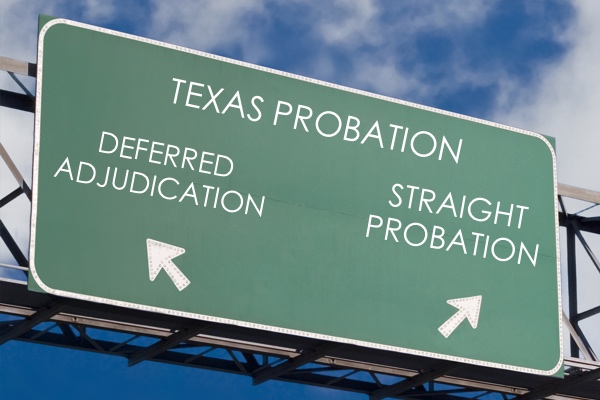
Probation in Texas: Make Sure You are Headed Down the Right Path. What is Deferred Adjudication?
 When we are counseling new clients, we routinely address the punishment range that is available for the charged offense and whether probation is an option in their case. It is important to note that all criminal offenses (except class C citations) are punishable by incarceration. However, first-time offenders and those charged with misdemeanors and non-aggravated felonies will often receive probation when prosecutors, judges, and juries agree that community supervision (probation) is a better alternative to jail time in the given situation. For some offenses, however, probation is not an option (see our previous article on 3g offenses in Texas).
For those of you that prefer the bullet points up front, here is the short answer regarding the difference between straight probation and deferred adjudication:
Straight Probation in Texas
- A person on Straight Probation in Texas must report to probation and complete required terms as set by the judge
- In a straight probation, the case results in a Criminal Conviction
- In straight probation, there is no option have the case expunged or non-disclosed upon completion of probation
- If revoked on a straight probation, the penalty range is limited to the underlying jail term (see more below).
Deferred Adjudication in Texas
- A person on Deferred Adjudication in Texas must report to probation and complete required terms as set by the judge
- A Deferred Adjudication Case Does NOT result in a Criminal Conviction
- In a Deferred Adjudication in Texas, there is an option to have the case non-disclosed upon completion (in most cases)
- Under a Deferred Adjudication, If revoked, the judge may sentence anywhere in the full punishment range for the offense.
Deferred Adjudication vs. Straight Probation
In Texas, there are two types of community supervision in criminal cases: regular community supervision (or what is typically referred to as “straight probation”) and deferred adjudication (or “deferred probation.”) The difference between them is significant. Chapter 42.12 of the Texas Code of Criminal Procedure covers with both types of probation in Texas.
Straight Probation in Texas
Let’s discuss straight probation first. As an example, assume someone is facing a charge for a Class A Misdemeanor. The penalty range is 0-365 days in jail. A straight probation offer from the state might look like this:
180 days in jail probated for 12 months.
If you agree to this offer and decide to take it, at the time of the plea the judge would ask for your plea of guilty, find you guilty and assess punishment at 180 days in jail. However, he would not require you to actually serve the jail time. Rather, he would probate the jail time and place you on community supervision for a period of 12 months. If you successfully complete the straight probation by reporting as directed and abiding by the terms and conditions, you would not be required to serve jail time for the conviction.
Straight Probation Comes With a Criminal Conviction
With straight probation, the most significant consequence is the conviction itself. When you plead guilty, the judge finds you guilty and a conviction is rendered. You avoid jail time by the sentence being probated, but the conviction remains on your record. A conviction, even if probation, can never be expunged from your record (regardless of the passage of time), so it is important to be wise with your decision to take a plea agreement in which straight probation is offered.
If you receive straight probation and fail to comply with the terms and conditions, the state can seek to have your probation revoked. At a revocation hearing or sentencing, the judge’s sentencing ability is limited by the underlying sentence received at the time of your original plea. So, in the above example, if you received a sentence for 180 days in jail probated for 12 months and are later revoked, the judge cannot sentence you beyond the 180 days (even though the penalty range for a class A misdemeanor is up to 365 days.)
Deferred Adjudication in Texas
Chapter 42.12 section 5 offers a different type of probation than the straight probation discussed above. It’s called deferred adjudication. Let’s go back to our example and say your facing a Class A Misdemeanor with a penalty range of 0-365 days. A deferred adjudication offer might look like this:
18 months probation
If you agree to this offer, you would plead guilty at the time of the plea. However, the judge would withhold finding you guilty and instead place you on probation for a period of 18 months. The reporting and terms and conditions would mirror those of a straight probation. If you successfully complete the probation and are discharged, you would not be required to serve jail time and you would not receive a criminal conviction.
Deferred Adjudication Does Not Come With a Criminal Conviction
With deferred adjudication, the most significant benefit is the case is dismissed upon discharge and no conviction rendered. You not only avoid jail time, but a conviction as well. You also may be eligible to file for a non-disclosure after discharge in most cases. Section 411.081 of the Texas Government Code is the law covering when and if you can file for a non-disclosure after discharge from deferred adjudication.
As with straight probation, if you receive deferred adjudication and fail to comply with the terms and conditions, the state can seek to have your probation revoked. However, there are some significant distinctions at a revocation hearing or sentencing on a deferred adjudication case. First, the judge’s sentencing ability is unlimited. This means he can use the entire penalty range. In our example, if you receive deferred adjudication for 18 months for a class A misdemeanor and are later revoked, the judge can sentence you anywhere in the penalty range of 0- 365 days. Also and more importantly, if revoked, the judge will find you guilty resulting in a conviction.
Contact Our Fort Worth Criminal Defense Firm if You Have Questions About Deferred Adjudication or Straight Probation in Texas
This was a rough overview of the different types of probation in Texas on criminal cases. Of course, there are always factors that can effect if and which type of probation is available as an option to you. The attorneys at Barnett Howard & Williams PLLC would be glad to discuss your situation and provide more information about these options. Please feel free to give us a call at (817) 993-9249.
NOTE:
→ DWI offenses are not eligible for deferred adjudication in Texas. If you’d like to see that changed, contact your state representatives’ offices and voice your opinion
The punishment range for a second-degree felony sexual assault is 2-20 years in prison. However, the minimum period of community supervision (i.e. probation) for the same offense is five years. So can a trial court award community supervision if the jury returns a punishment verdict of less than five years? Here’s how this situation played out down in Houston:
A jury found a defendant guilty of the second-degree felony of sexual assault. On sentencing, the jury awarded the defendant the minimum punishment (two years) and further recommended community supervision (a recommendation the trial judge is required to take). The trial judge, however, informed the jury that its verdict was illegal because the minimum period of community supervision is five years. The trial court essentially instructed the jury that if it wanted to recommend community supervision, it must sentence the defendant to at least five years (which would then be probated). Following instructions, the jury went back and returned a verdict of five years with a recommendation for community supervision.
Was the trial court correct in his instructions to the jury?
NO, says the Texas Court of Criminal Appeals in Mayes v. State.
There is nothing in Article 42.12 (Tex. Code Crim. Proc.) that states, or even suggests, that the jury must assess a sentence that equals the minimum period of community supervision, the maximum period, or any particular period in between. The jury does not determine the period of community supervision. It assesses the sentence and recommends that the trial judge place the defendant on community supervision. The judge must follow that recommendation, but he has the discretion to determine the appropriate period of supervision, as long as it within the minimum and maximum statutory period.
The CCA opinion makes clear that the statutory minimums for punishment and community supervision are not inextricably linked.
[A] rule that a jury cannot assess the minimum sentence in a case if it also wants the defendant to serve that sentence on community supervision would lead to an absurd result.
Accordingly, the CCA reversed the judgment of the court of appeals.