
Online Comment US v. Pratt

Prosecutor’s Online Comments Did Not Prejudice the Jury

By Ethics

When should online comments made by prosecutors rise to the level of misconduct, so that a ‘presumption of prejudice’ would likely be granted on appeal?

Online Comment US v. PrattA district court convicted Renee Pratt, a prominent Louisiana politician, of conspiracy to violate the federal Racketeer Influenced and Corrupt Organizations Act (“RICO”). 18 U.S.C. § 1962(d). Pratt’s conviction resulted from a thorough investigation of her long-time friend, Mose Jefferson, a well-known Louisiana community organizer and politician, as well as his family. United States v. Pratt, 728 F.3d 463 (5th Cir. 2013), cert. denied, 134 S. Ct. 1328 (2014). The Jefferson family and Pratt were accused of obtaining community-service grants, and using the money for personal gain. Id. Pratt timely appealed, citing new evidence that several prosecutors from the U.S. Attorney’s Office (“USAO”), made negative and persuasive online comments in public forums, including a local newspaper’s website, regarding her case around the time of trial. Pratt claims that the jury rendered a guilty verdict because of the disparaging and prejudicial comments.

Read the 5th Circuit’s Full Opinion in United States v. Pratt.

Around the time of Pratt’s filing a motion for a new trial, the United States Department of Justice (“DOJ”) conducted an investigation to determine whether attorneys working for the DOJ/USAO were making inappropriate statements online about pending cases. Office of Prof. Resp., Dep’t of Justice, Investigation of Allegations of Professional Misconduct Against Former Assistant Attorneys Salvador Perricone and Jan Mann. OPR Report at 2, (2013). The results of the investigation showed that attorneys from the Louisiana division of the USAO and DOJ “anonymously authored dozens of…online comments…posted on nola.com, the website of the widely-read New Orleans Times- Picayune.” Id. Using several pseudonyms, a senior-level prosecutor, “posted his views…of Louisiana politics…refer[ring] to Pratt’s case.” Id. While Pratt’s trial was pending, the prosecutor commented, “If Pratt walks, it’s the judge’s victory…a sad day for justice.” Id. Post-conviction, a second prosecutor, “proclaimed Pratt’s guilt, defended Pratt’s sentence, and characterized Pratt as driven by greed” on nola.com. OPR Report at 42 (reproducing comments posted in Nov. 2011).

A few months later, the district court that convicted Pratt held a limited evidentiary hearing to “develop a clearer record of any [outside] influence the anonymous comments may have had on Pratt’s trial.” Unlike a standard hearing, this ‘limited hearing’ consisted of a questionnaire submitted to two jurors who had previously identified nola.com as their source of news during jury selection. Both jurors reported no influence by the comments on nola.com. Accordingly, the district court denied Pratt’s motion for a new trial, concluding, “[there is] a lack of evidence that…the jury…was tainted by…the [online] comments.” Pratt appealed to the Fifth Circuit Court of Appeals for relief.

The Court of Appeals must determine whether the online comments made by the high-level attorneys rise to the level of prosecutorial misconduct, so that in Pratt’s case, a presumption of prejudice may be granted, relieving Pratt from the district court’s guilty verdict in her RICO case. The Court considered a Rule 33 Motion for New trial, where a court may “vacate a judgment and grant a new trial if the interest of justice so requires” and in the interest of “fairness of the trial.” Fed. R. Crim. P. 33(a); United States v. Turner, 674 F.3d 420, 429 (5th Cir. 2012) (quoting United States v. Severns, 559 F.3d 274, 280 (5th Cir. 2009); United States v. Williams, 613 F.2d 573, 575 (5th Cir. 1980).

A presumption of prejudice may be made in certain extreme cases or pre-trial publicity. Skilling v. United States, 561 U.S. 358, 381 (2010). There is no ground, however, to presume prejudice based on prosecutorial misconduct alone. In affirming a grant of a new trial, reasons for granting a new trial are “novel and extraordinary.” United States v. Bowen, 799 F.3d 336, 339 (5th Cir. 2015). For a new trial to be warranted, the court must normally find that the misconduct in question actually prejudiced the defense.” Id. at 356; United States v. Bowler, 252 F.3d 741, 747 (5th Cir. 2001).

Here, the Court concludeed that the prosecutorial misconduct—the online comments—is “too far removed from the proceedings to support a presumption of prejudice,” as the attorney who made the comment, “did not prosecute or deal with the Pratt trial,” and because, “no one from the trial team posted the comments…while the trial was underway.” Second, the Court states that rulings on Rule 33 Motions are “necessarily deferential to the trial court” in that the facts must be construed in the light most favorable to the lower court’s verdict. United States v. Wall, 389 F.3d 457, 465 (5th Cir. 2004). Lastly, the Court opined that in “certain extreme cases, pretrial publicity…can manifestly taint a criminal prosecution, [giving] rise to a presumption of prejudice.” Skilling v. United States, 561 U.S. 358, 379 (2010). The Court says that the comments made regarding Pratt’s trial were not extreme, “this is not such an extraordinary case…this…concerns a handful of anonymous, speculative postings…that lacked the kind of blatantly prejudicial information…that might poison public opinion and entitle the defendant to a presumption of prejudice.” United States v. McRae, 795 F.3d 471, 481-82 (5th Cir. 2015). Even though prosecutorial misconduct did in fact occur, the Court affirms the district court’s verdict and denies Pratt’s motion for new trial. According to the 5th Circuit, the online comments were far too attenuated to apply to Pratt’s trial and did not affect the guilty verdict.

All attorneys are bound by specific ethical protocols and procedures, promulgated and enforced by each state’s bar association. In Texas, lawyers must abide by the Texas Disciplinary Rules of Professional Conduct and the Texas Rules of Disciplinary Procedure. Texas Prosecutors are held to an even higher standard under the “Special Responsibilities of a Prosecutor” not to make extrajudicial statements that “in the course of representing a client…a reasonable person would [not] expect to be disseminated by means of public communication if the [prosecutor] knows or reasonably should know that it will have a substantial likelihood of materially prejudicing an adjudicatory proceeding.” Tex. Rules of Disciplinary Procedure §3.09; 3.07(a).
Brian Cuban The Addicted Lawyer

Addiction Issues Are Not Just for Clients

By Drug Crimes

Brian Cuban: The Addicted Lawyer

Brian Cuban The Addicted LawyerBe it alcohol, drugs, or something else, many of our clients struggle with addiction.  We work everyday to counsel them and help them get plugged into the right places that assist in recovery.  But we sometimes forget that addiction issues aren’t limited to our clients.  Many of our friends and colleagues in the legal community struggle with addiction.  Overworked and overstressed, many lawyers turn to alcohol or drugs as an escape.

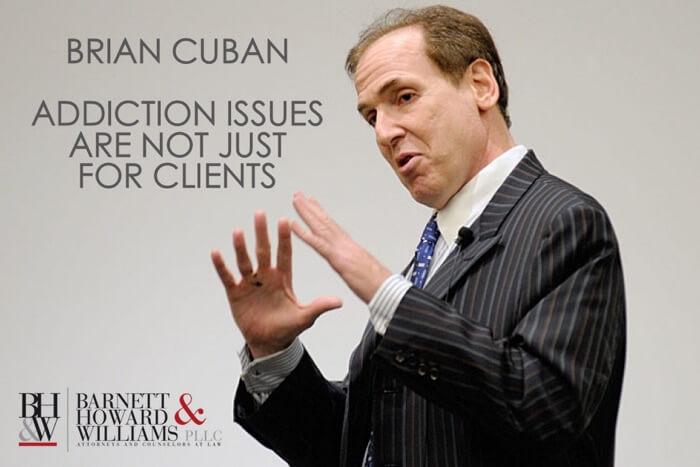
Recently, a friend of mine connected me with Brian Cuban. For those of you who don’t know of Brian Cuban, he is a lawyer, speaker, and activist, and the brother of Mark Cuban (the owner of the Dallas Mavericks).  Brian has been fighting (and winning) his battle against addiction since 2007.  He is also a writer with a new book coming out soon – The Addicted Lawyer.  I asked Brian if he would write a guest blog post about addiction.  The story below is from Brian.  Our hope is that this story will help to remind us to remember to help our colleagues in times of need and be on the lookout for the warning signs of addiction.

Gary Was a Lawyer, A Friend, An Addict

I drove past the same bus-stop every day. To the average person on his/her way to their next “stop” of the day, in life, nothing to set it off from any other.

That morning, I saw one such story I was intimately familiar with. There was Gary waiting for the bus. A lawyer. Undergraduate of Boston College Summa Cum Laude. Near the top of his class at Antioch School of Law. On to a great job with NBC. On to the NYC nightlife and the genetic pull of a family line ripe with alcohol use. Gary was an alcoholic and drug addict long before that bus stop. An addict trying to keep the shreds of his life and legal career together.

I had met Gary years before when we both worked of-counsel to a local Dallas firm. I was trying to hold my life together between addiction and an eating disorder. High functioning was a blessing and a curse. I needed no help. I showed up to court sober. I only did cocaine in the bathroom of the firm when I had no appointments. The pick up I needed after all night cocaine and alcohol benders. It all made perfect sense to me. In my mind, I was not an addict.

I had actually tried my last case with Gary. A bench trial contract matter. He ran the show. He was sober and brilliant. I didn’t want that show. I hated the practice of law. I was not afraid of a courtroom but I was sickened by them. A reminder of how much I hated my life and the career I had chosen for all the wrong reasons. We had a good result. Then Gary disappeared as he had sporadically done over the years since I first met him. I knew what that meant. We all knew. Periods of sobriety and stellar representation of his clients, periods of complaints of neglect and even showing up to client meetings apparently high.

Gary does not see me drive by him at the bus stop. He is looking at the ground. Waiting. My calls to him were never heard as his voicemail was full. I knew what that meant. Most addicts and their families know what that means. I went further down the road and turned around so I could drive up along side him. He got in. He had been to a 12-step meeting and was headed down to the Dallas 24-Hour club where he was a resident. He asked if I knew he had been disbarred. I had seen it in the local legal periodical. As what often happens with lawyers and addiction, clients money never made it to the client. State Bars take a dim view of stealing from clients and addiction is not an excuse. A common story. A common explanation from Gary. It was all a mistake. He had lost everything and was still in denial. I thought back to what my shrink had said to me April 8th 2007, the day I began my sobriety journey. “Brian, you have a law degree but you’re not a lawyer, you’re an addict.”

I drove Gary down to the 24 Hour Club. I bought him lunch. A familiar request for money until “he got back on his feet.” It became our routine. The bus stop. The drive. The excuses. The helplessness. Then he was gone again. The full voicemail. No longer at the transitional living home. He had tested dirty.

August 2013. My cell phone rings. A 516 area code. Long Island. Where some of Gary’s family lived. He had moved back home much as I had moved to Dallas to be with my brothers after finishing Pitt Law deep in alcohol use disorders. My family would save me. If recovery was only that simple. A quick conversation. He said he was sober and working as an attorney. He was also licensed in New York. I hid my annoyance at the fact that he had just been disbarred and yet was right back participating in another jurisdiction that may not know about his past. Was I ethically bound to say something? I struggled with the conflict between my view as a lawyer and as a recovering addict. It was not my recovery. It was his.

The day is finally here! My first book, “Shattered Image” is going to be released. Looking forward to the release party! A Facebook message from Gary. I had not heard from him in a while. The message was cheerful. A photo of a plane ticket to come to Dallas for my book signing. It would be the last time I would hear from Gary.

The message came from his ex-wife. The google explosion of his name told the story.

“Gary Abrams , 54 Fatally Struck By Truck Tractor Trailer” walking along a highway.

It is unknown whether he had been drinking but it does not matter. He is gone. He never “got it” in recovery. It’s not that he didn’t want it. He tried. I miss him and wish he had gotten it. Gary was a lawyer, a friend, a husband, a sibling, an alcoholic. an addict. In his passing, he also helped me. I know my recovery is only as good as today. Thank you Gary.

***************************

Brian Cuban: An authority on body dysmorphic disorder, male eating disorders and addiction(including steroids), Brian Cuban is the author of the best-selling book, Shattered Image: My Triumph Over Body Dysmorphic Disorder. It chronicles his first-hand experiences living with, and recovering from, twenty-seven years of eating disorders, alcoholism, drug addiction and Body Dysmorphic Disorder (BDD).

www.briancuban.com

Interference with 911 Call Fort Worth

Interference with 911 Call Conviction Upheld After Acquittal of Underlying Emergency

By Domestic Violence

Acquitted of the Underlying Assault that Necessitated a 911 Call, Defendant’s Guilty Verdict for Interference with 911 Call Upheld, Says the Second Court of Appeals

Interference with 911 Call Fort WorthIn February 2014, David Schumm and his wife were arguing in their home when she tried to place a 911 call. His wife testified that he prevented her from making the call by taking her cell phone. Fearing an assault, she ran outside, screaming for help. Schumm allegedly followed her outside, dragged her onto their porch and “strangled” her. At trial, Schumm denied all assaultive conduct and denied taking her cell phone. Schumm was charged in two separate cases with Interference with 911 Call and with Assault Family Violence with Impeding Breath. Tex. Penal Code Ann. § 42.062 and § 22.01(b)(2)(B) (West Supp. 2015). Schumm was acquitted of the felony assault charge at trial.



At a separate trial for the Interference with a 911 Call charge, the jury was allowed to hear that Schumm had been accused and tried for felony assault, however, the jury was not allowed to hear that he had been acquitted of the charge. Schumm’s attorney attempted to get a certified judgment of acquittal admitted into evidence, but the State’s relevance objection was upheld—the trial court prevented Schumm from disclosing to the jury his acquittal. Schumm appealed his conviction for Interference with a 911 Call on the ground that the trial court abused its discretion by excluding the evidence of the felony assault acquittal.

Read the court’s opinion in Schumm v. State.

Interference with 911 Call | Interference with an Emergency Call

Under Texas Law, to be found guilty of interfering with an emergency call an (1) individual (2) knowingly (3) prevents or interferes with (4) another individual’s (5) ability to place an emergency call or to request help, including with a cell phone (6) from a law enforcement agency, (7) in an emergency…[“a condition in which an individual is…in fear of imminent assault.”]. Tex. Penal Code Ann. § 42.062(a)-(d).

Appealing to the Second Court of Appeals, Schumm argues that the excluded evidence of his acquittal is relevant to the element of “emergency” (#7 above). He contends that because he was acquitted of “intentionally, knowingly, or recklessly impeding the normal breathing” of his wife, that there was no proof that an emergency actually existed, and that, because no emergency existed, not all of the elements of “interfering with an emergency call” have been fulfilled. In short, there is reasonable doubt that an emergency existed at all because he was acquitted of the underlying assault, and, because the trial testimony is her word against his.

Here, the Second Court of Appeals disagrees with Schumm, “yet the judgment of the acquittal [Schumm] sought to admit did not show that the felony jury had specifically found no emergency.” The jury did not find that Schumm’s wife was not in fear of an imminent assault at the time Schumm allegedly prevented her from using her cell phone. Instead, the felony jury found that the Schumm should be acquitted of the “assault by impeding breathing” charge. The Court notes that “emergency is not an element of assault by impeding breathing” and a “completed assault is not an element of the offense of interference with an emergency call.” Id. In short, the evidence had no bearing on whether Schumm’s wife feared an imminent assault when she tried to call 911; the Court does not address the possibility that there is reasonable doubt that an emergency existed in the first place. The Court affirms the trial court’s judgment of guilty.

Fort Worth Failure to Register as Sex Offender Defense Lawyer

Failure to Register is Not a Separate and Distinct Sex Offense

By Criminal Defense, Sex Crimes

Is Failure to Register as a Sex Offender a Sex Offense Itself?

Fort Worth Failure to Register as Sex Offender Defense LawyerAt his trial, Eric Putnam pleaded guilty for “failure to register as a sex offender,” a violation of 18 U.S.C. § 2250 that “carries a statutory range [of punishment] for supervised release of five years to life.” 18 U.S.C. § 3583(k). A Pre-Sentence Investigation Report (“PSR”), calculated Putnam’s punishment for supervised release at 15 years, treating his conviction of Failure to Register as an additional sex offense under section 5D1.2(b)(2). PSRs are reports used by federal courts to assist the court in measuring a defendant’s punishment under the US Sentencing Guidelines Manual. Courts have discretion in determining type and length of punishment, sometimes deviating from the recommendation of the PSR. For Putnam, the district court adopted the PSR, sentencing him to ten months imprisonment followed by a supervised release term of 15 years.

See the Fifth Circuit’s opinion in United States v. Putnam

Putnam appealed the 15-year term of supervised release, contending the district court erroneously treated his conviction for Failure to Register on the sex offender registry as a separate sex offense in and of itself. Because Putnam failed to object to the length of the sentence at the time of trial, essentially waiving his right to appeal the sentence on the merits, he must show (1) that a “plain error” was made at the sentencing phase of his trial, and, (2) that the “plain error” affected his substantial rights. United States v. Warren, 720 F.3d 321, 332 (5th Cir. 2013); United States v. Escalante-Reyes, 689 F.3d 415, 419 (5th Cir. 2012) (en banc). The “Plain Error Doctrine” refers to Federal Rule of Criminal Procedure 52(b) that permits federal courts of appeals to consider “plain errors” even though they were not brought to the district court’s attention at the time of trial.

Here, the government “concedes that a plain error [did] occur with respect to the Guidelines calculation for the length of…the supervised release term.” In earlier case law, the Fifth Circuit has held, “that failure to register under the Sex Offender Registration and Notification Act does not qualify as a sex offense under section 5D1.2(b)(2) of the Guidelines.” United States v. Segura, 747 F.3d, 323,329-31 (5th Cir. 2014). The Court agrees with the government and with Putnam—that a plain error did in fact occur at trial, and that the recommended sentence on the PSR should have included a supervised release from one to five years, instead of the range of five years to life.

Next, the Court explained, “Putnam has met his burden of showing that the [plain] error affected his substantial rights…[because] but for the district court’s misapplication of the [Sentencing] Guidelines, Putnam would have received a lesser sentence.” United States v. Mudekunye, 646 F.3d 281, 289 (5th Cir. 2011) (per curiam). A defendant meets the burden of showing that plain error affected his substantial rights when:

  1. the district court mistakenly calculates the wrong Guidelines range;
  2. the incorrect range is significantly higher than the true range; and
  3. the defendant is sentenced incorrectly. Id.

Here, Putnam fulfills all three requirements—the district court miscalculated his range of punishment; the range was significantly higher (three times the correct amount); and Putnam was sentenced incorrectly. Although the courts may use discretion in sentencing—sometimes giving a longer sentence to a habitual offender, or someone with a long criminal history—Putnam had only one prior, lesser conviction. The district court did not have a compelling reason to go above the correct sentencing guidelines.

Lastly, the Court determined whether the plain error affected the “fairness, integrity, and reputation of the judicial proceeding.” Courts “often exercise…discretion to correct error when it result[s] in a custodial sentence in excess of the correct Guidelines recommendation.” United States v. Hernandez, 690 F.3d 623, 621-22 (5th Cir. 2012). Here, “miscalculation of a supervised release” is [un]common…but [nevertheless] is a substantial restraint on liberty.” United States v. Segura, 61 F.App’x 119, at *1 (5th Cir. 2003).

In sum, the Court concluded that there was, indeed, an error in Putnam’s case that resulted in a sentence ten years above the correct Guidelines range, “satisfying all the plain error inquiries.” The Court vacated the sentence and remanded to the district court for proper sentencing.

Texas Campus Carry

Explaining the New Campus Carry Law in Texas

By Open Carry

What is the New Campus Carry Law in Texas and What Does it Mean to Me?

Texas Campus CarryWhether you love it or hate it, Campus Carry is coming to a college campus near you, and if you are a CHL holder, you need to know how to comply with the law. After lengthy debates in both houses of the Texas Legislature, Governor Greg Abbott signed Senate Bill 11 (“Campus Carry”) into Texas law on June 1, 2015. Campus Carry will go into effect on August 1, 2016 on the 50th anniversary of the University of Texas sniper shooting— one of the first mass murders on a college campus in the United States.

Who Can Carry a Handgun on a College Campus Under the Campus Carry Law?

Campus Carry permits all Concealed Handgun Licensees who are at least 21 years old, have passed state and federal criminal background checks, have successfully completed a firearms proficiency test and have completed Department of Public Safety-mandated training and education, to carry firearms inside of buildings belonging to public universities and some private institutions of higher education. The new legislation, however, does not mean open carry by anyone, anywhere, any time on all property owned by a public or private university. CHL licensees must take great care to research and to understand the limits of the Campus Carry law and how it impacts the way handguns are carried and stored, or potentially face legal consequences.

Can the Universities in Texas Make Their Own Rules With Campus Carry?

Campus Carry allows institutions of higher education to establish policies governing the storage of handguns by CHLs in dorms and residential facilities. Public universities may also create policies around athletic venues and events, deeming them off-limits to CHL licensees. Under current Texas law, bars, hospitals, churches, and public schools K-12 are off-limits to CHL licensees and will remain off-limits under Campus Carry—and it is important to note that most large public university systems have a teaching hospital, a K-12 practicum experience at public school, a chapel, or are near campus bars. Moreover, schools may create “no-gun zones” or “exclusion zones,” but must provide effective notice about such zones. Therefore, it is extremely important for those with a CHL to know exactly which areas are permitted to have handguns, which are not, and to make plan for storage it if the CHL licensee needs to go into an off-limits area. Students should carefully read their university’s Student Handbook and Campus Code of Conduct for more information.

Campus Carry removes criminal prohibitions in the Texas Penal Code on the possession of concealed handguns by concealed handgun licensees on the campuses. The new law provides institutions of higher education with immunity from liability for actions of CHLs on campus. Campus Carry mandates that an institution of higher education widely distribute the rules to the institution’s students, staff and faculty, including prominently publishing such provisions on the school’s website, and provide effective notice of the areas that are “exclusion zones.” Parents of college students may feel concerned with the new law and campus procedures.

The legislature granted rule-making authority to the presidents of the university system to create campus rules and policies pursuant to S.B. 11, with the only stipulation being that public institutions of higher learning may not “circumvent the intent” of Campus Carry by “imposing administrative bans and sanctions on CHLs on their campuses.” In order to comply with S.B.11, institutions of higher learning must submit a report every other year to the state legislature and to the standing committees that describe the campus rules and policies concerning CHL licensees and the schools must explain the reason the administration has established the provisions. Residents who live in college towns (even if they are not students) should also learn about Campus Carry and the implications of being a CHL at a campus library, sporting event, artistic venue, or even the university hospital.

This is no doubt a very interesting time for policy-making in Texas. Please note that this article is intended for informational purposes only and is subject to change as each public university system and private university determines campus policies based on S.B. 11. This article does not constitute or substitute legal advice. If you need legal advice, please contact our office at (817) 993-9249 for a free consultation.

For more information, see also the full Campus Carry Law, including a Bill Analysis and Fiscal Note or see our Frequently Asked Questions below.

Frequently Asked Questions About Texas Campus Carry

What is Campus Carry?

Campus Carry refers to legislation, Senate Bill 11, signed into law last summer. Campus Carry will make it possible for licensed gun owners, over 21, to carry handguns onto public (and some private) institutions of higher education, in compliance with individual university policies.

When will Campus Carry Take Effect?

Campus Carry will take effect on August 1, 2016—at the beginning of the 2016-2017 academic year.

Do I have to have a Concealed Handgun License (“CHL”) to carry my handgun?

Yes. Campus Carry mandates that all gun owners must:
(1) pass federal and state background checks;
(2) be 21 years old (unless in the military);
(3) complete a firearms proficiency test; and,
(4) complete Department of Public Safety-mandated training and education.

It will be extremely important for every student with a CHL, to know exactly where to go with your handgun and to plan for where you will be able to legally store it if you must go into an off-limits area. Read your Student Handbook and Campus Code of Conduct for more information.

Will Professors be able to carry guns?

Yes. Professors, administrators, faculty, staff and visitors may carry under the Campus Carry law, provided they are in compliance with the law and campus policies.

Does a private school have to follow Campus Carry?

Maybe. Private institutions may establish policies that prohibit CHLs. So far, the following schools have “opted out” of Campus Carry.

  • Rice University
  • Texas Christian University (TCU)

NOTE: This information is subject to change and it is up to each student, to know if your school has opted out.

Can a student at a public university take a gun anywhere on campus?

Not necessarily. Campus Carry allows institutions of higher education to establish policies governing the storage of handguns by CHLs in dorms and residential facilities. The public university may also create policies around athletic venues and events, as off-limits to CHLs. Under current Texas law, bars, hospitals, churches, and public schools K-12 are off-limits to CHLs and will remain off-limits under Campus Carry—and most large public university systems have a teaching hospital, a K-12 practicum experience at public school, a chapel, or are near campus bars. Schools may create “no-gun zones” or “exclusion zones,” but must provide effective notice about such zones.

Fort Worth Criminal Defense Attorneys

Barnett Howard & Williams PLLC is a criminal defense law firm located in Fort Worth, Texas. Our attorneys handle all felony and misdemeanor charges in the Fort Worth, Tarrant County area. If you have questions about this post or need more information about Campus Carry, please contact us at (817) 993-9249.

ISIS and ISIL

What is the Difference Between ISIS and ISIL?

By Veterans

I know this post has nothing to do with Fort Worth Criminal Defense or Texas Criminal Law, but as a Marine officer and Reserve Military Judge, I am often asked about the threats facing our Marines and our nation.  As I was watching President Obama tonight talk about the terrorist attack in San Bernardino and the terror group ISIL, a friend of mine asked, “Why is he saying ISIL? Doesn’t he mean ISIS?”

Is there a difference between ISIS and ISIL?

The answer is yes (kind of).  The President knew exactly what he was saying.  ISIL stands for the “Islamic State of Iraq and the Levant.”  ISIS stands for the “Islamic State of Iraq and Syria.”  ISIL is really the next (and bigger) iteration of ISIS.  The Levant is a large area in the middle east that is being held by ISIL.  However, since ISIS has become a household name, most news agencies continue to say ISIS, when ISIL is the correct name.

Want to Learn More About ISIL’s Ideology and How ISIL Grew to Power?

Check out the video below of a Marine Corps briefing by Dr. Sebastion Gorka, one of the nation’s leading experts on Islamic terrorism. This is an actual brief that was provided to high ranking Marine officers. I will warn you, this video is long. One hour long, to be exact. But as Dr. Gorka points out at the beginning of the video, he teaches a 16-week course on this topic, so one hour is really only the wavetops.  If you are the type who likes to post your opinions about this topic on social media, you should really take the time to watch this video.  Enjoy.

Felony Hindering Apprehension

Hindering Apprehension for a Sealed Federal Charge

By Criminal Defense

“Run, Baby, Run!” Girlfriend’s Warnings, Personal Tattoos, and Attempts to Flee From US Marshals, Do Not Rise to the Level of “Felony Hindering Apprehension” Says the CCA

Felony Hindering ApprehensionKeiona Nowlin and her boyfriend, Demarcus Degrate, were riding in a car when a United States Marshal, executing a sealed, federal warrant on the boyfriend, pulled up behind them. After the Marshal activated the siren and lights, the couple pulled over and Degrate fled on foot. The Marshal chased Degrate. Moments later, as two Marshals arrived at the scene, they observed Nowlin screaming, “Run baby run…get away” while she also fled on foot. The Marshals detained Nowlin “to find out why she was running.” At that point, Nowlin fled the Marshals’ car. Nowlin was placed under arrest for escape.
See the CCA Opinion in Nowlin v. State.

After the arrest, Nowlin said she “knew the cars the Marshals drove…and…did not want Degrate to be arrested…[because] he was out on bond for state charges.” The Marshal noted that Nowlin had Degrate’s name tattooed near her collarbone; the trial court inferred the tattoo as indicative of an intimate relationship. The trial court found Nowlin guilty of third-degree felony hindering apprehension, sentencing her to four years imprisonment.

Nowlin appealed to the court of appeals, arguing that she was not warning Degrate of impending apprehension because “he was already aware of the [Marshal’s] presence.” Nowlin contended that because she did not know the contents of the sealed federal warrant, she could not have known Degrate was charged with a felony. The court of appeals disagreed, holding that her statement at the scene, “run baby run…get away,” provided sufficient evidence of providing a warning to Degrate. The court of appeals pointed to statements made at the scene that she knew “he was out on bond for state charges…and…she did not want her man to get arrested.” The court of appeals added that her tattoo was proof of her close relationship with Degrate, and that she likely knew of the felony-level charges he was facing.

Nowlin appealed to the Court of Criminal Appeals, arguing that because the federal indictment was sealed and secret, she could not have known about the indictment itself; that no evidence exists that she knew of the felony-level charges Degrate faced; and, that her tattoo was not proof of a close relationship where she would have had knowledge of the charges. The State argues that the evidence was sufficient: that the tattoo is evidence of a close relationship that implies she knew intimate details of Degrate’s life; that she knew Degrate faced serious state-level charges, and that her attempt to flee from the US Marshal is evidence of her knowledge of the “serious nature of Degrate’s crimes.” In an interesting turn of events, the State offered an alternative to acquittal–that an alternative charge could be misdemeanor-level hindering apprehension, and the sentence could be amended to reflect a lesser charge.

“In order to show that the evidence presented was legally sufficient to support a conviction of felony hindering apprehension, the State must prove:

  1. the defendant warned another person of impending discovery or apprehension;
  2. the defendant had the intent to hinder that individual’s arrest; and,
  3. the defendant had knowledge that the individual was under arrest for, charged with, or convicted of a felony.

Tex.Penal Code § 38.05(a), (d).

An individual acts with knowledge when he is aware that the circumstances exist. Tex. Penal Code § 6.03(b). In a nutshell, the State must show Nowlin was aware that her boyfriend was under arrest for, charged with, or convicted of a felony. The Court of Criminal Appeals (“CCA”) now decides whether the evidence is sufficient to show that Nowlin knew Degrate was charged with a felony offense.

Here, the CCA does not agree with the trial court and court of appeals. “The state offense that Degrate was on bond for cannot serve as the basis for [Nowlin’s] conviction.” The CCA notes that there was no evidence at trial that named the type and level of the state offense, therefore, the trial court had no way of knowing if the offense was a felony or not. Also, there was no mention of whether Nowlin knew what type of charge her boyfriend was facing. Therefore, because there was insufficient evidence regarding the state offense, the state offense cannot serve as the basis for Nowlin’s conviction.

Further, Degrate’s federal indictment was sealed. There was no way for Nowlin and Degrate to know about the charges before their arrests. “With this mandated secrecy and the lack of evidence that he was told about the indictment during the attempt to arrest him, Degrate could not have known that he was under indictment for felon in possession of a firearm.” It would have been impossible for Degrate to have told Nowlin about the felony charge because he would not have known about it.

Lastly, the inferences made about Nowlin’s close relationship with Degrate—including the tattoo on her collarbone and her attempt to escape the Marshall—do not apply here. “While the inferences that the court of appeals makes would likely be reasonable ones had there been any evidence of Degrate himself having knowledge of the indictment, no such evidence was ever presented.”

The CCA found that the evidence was insufficient to support a felony-level hindering apprehension charge. The CCA reforms Nowlin’s convictions to a misdemeanor hindering apprehension charge, instructing the trial court to conduct a new punishment hearing to reflect the lesser charge.

Accomplice Wtiness Rule Texas

Texas’ Accomplice Witness Rule

By Criminal Defense

Accomplice Wtiness Rule TexasCriminal law disfavors the testimony of an accomplice, for good reason.  The policy behind this is clear – factfinders should be leary of trusting those who have a substantial stake in the litigation, especially those with a direct liberty interest.  A few years back, the 2nd District Court of Appeals (Fort Worth) provided a good synopsis of the Accomplice Witness Rule, which I felt was worth sharing.  The following excerpt is taken from Clark v. State (June 17, 2010).

What is the Accomplice Witness Rule in Texas criminal law?

The accomplice-witness rule is a statutorily imposed sufficiency review andis not derived from federal or state constitutional principles that define the legal andfactual sufficiency standards.  An accomplice is a person who participates before, during, or after the commission of the crime and can be prosecuted for the same offense as the defendant or for a lesser-included offense.  Article 38.14 of the code of criminal procedure provides that “[a] conviction cannot be had upon the testimony of anaccomplice unless corroborated by other evidence tending to connect the defendant with the offense committed; and the corroboration is not sufficient if it merely shows the commission of the offense.”

When evaluating the sufficiency of corroboration evidence under the accomplice-witness rule, we “eliminate the accomplice testimony from consideration and then examine the remaining portions of the record to see if there is any evidencethat tends to connect the accused with the commission of the crime.”  The corroborating evidence need not prove the defendant’s guilt beyond a reasonable doubt by itself.  Nor is it necessary for the corroborating evidence to directly link the accused to the commission of the offense.  Rather, the evidence must simply link the accused insome way to the commission of the crime and show that “rational jurors could conclude that this evidence sufficiently tended to connect [the accused] to theoffense.”  Additionally, “[p]roof that the accused was at or near the scene of the crime at orabout the time of its commission, when coupled with other suspicious circumstances, may tend to connect the accused to the crime so as to furnish sufficient corroboration to support a conviction.”  But “mere presence alone of a defendant at the scene of a crime is insufficient to corroborate accomplice testimony.”

I omitted the citations, so you should click on the link above and go to page 15 of the opinion if you wants the various cites for the law above.

Texas Sex Trafficking Statute

Is Texas’ Sex Trafficking Statute Overbroad?

By Sex Crimes

Appellate Court Raises a Constitutional Eyebrow at Texas’ Sex Trafficking Statute

Texas Sex Trafficking StatuteRobert Francis Ritz met a young girl on an online dating website. She was fourteen years old at the time while Ritz was Forty-four. The two began to meet up in person and began to have a sexual relationship. Ritz would pick the girl up from her parents’ house, drive her back to his house, have sex, and then drop her back off at her house. For this conduct, a jury found appellant Ritz guilty of continuous sex trafficking and assessed punishment at life in prison. Ritz appealed to the 3rd District Court of Appeals in Austin.
See the court’s opinion in Ritz v. State

How Does the Texas Penal Code Define Sex Trafficking?

The Texas Penal Code provides that a person commits continuous trafficking of persons “if, during a period that is 30 or more days in duration, the person engages two or more times in conduct that constitutes an offense under Section 20A.02 [trafficking of persons] against one or more victims.” Tex. Penal Code § 20A.03(a). A person commits trafficking of persons “if the person knowingly . . . traffics a child and by any means causes the trafficked child to engage in, or become the victim of, conduct prohibited by” an enumerated section of the Penal Code. Id. § 20A.02(a)(7). The Penal Code also provides that “‘[t]raffic’ means to transport, entice, recruit, harbor, provide, or otherwise obtain another person by any means.” Id. § 20A.01(4).

Under this broad language, Ritz falls into this category. Ritz argues, however, that he did not traffic this girl and should not be found guilty of human sex trafficking. He argues that the legislature surely did not intend this anti-human-trafficking statute to apply to cases like this where there is no “illegal trade of human beings for profit or for sex trafficking.” Further, he argues that this outcome would lead to “absurd consequences” and increase the punishment range for all sexual offenses involving a minor.

Essentially, Ritz is argued on appeal that this statute was intended for people trading other humans, not for a person driving a girl around so they can have sex together. The Court of Appeals concedes that although this act is “reprehensible,” it is not what is normally thought of as human trafficking because there was no organized crime, prostitution, or forced labor. The court also concedes that the language in the statute may be so broad that nearly every adult who has sex with a minor will be considered a human trafficker.

Nonetheless, the court concludes that as long as this statute is constitutional, then they must enforce it as it was written and not how it should have been written. The court also offers that it could have been possible that the legislature did want to increase the penalties for persons who commit sexual crimes with minors under the “trafficking” umbrella.

Effectively after this case, most every person who has committed a sexual crime with a minor will be eligible to be punished under the trafficking umbrella which faces harsh penalties as seen here. The court noted that Ritz did not challenge the constitutionality of the statute so the court did not look into it. Attorneys facing this same dilemma might raise this constitutional argument to have a better chance on appeal.

Houston Crime Lab Scandal

More Aftermath from the Houston Crime Lab Scandal

By Drug Crimes

CCA Says “No Relief” for Defendant Who Accepted Plea Deal, even though the Court Infers Defendant’s Lab Reports Were Falsified

Houston Crime Lab ScandalSee the CCA opinion in Ex Parte Barnaby 

Setting the Stage: The Houston Crime Lab Scandal

In January of 2012, the Texas Rangers investigated a Department of Public Safety (“DPS”) Crime Laboratory technician, Jonathan Salvador, for allegedly tampering with crime lab evidence. The Rangers questioned DPS technicians and reviewed evidence records, bringing information that pointed to Salvador’s mishandling of lab results to Harris County’s District Attorney’s office. However, after an extensive investigation, the grand jury did not indict the technician. Subsequently, the DPS Office of Inspector General issued a report, stating that Salvador “failed to properly follow laboratory protocols…misidentified substances, and dry-labbed [falsified] samples.” Following the report, Salvador was terminated from his position at the Houston Crime Lab.

The fallout from Salvador’s actions, “call…into question the veracity and reliability of many cases handled by Salvador…[and as a result courts have] granted relief on several writs of habeas corpus, finding that each case involved a presumptive violation of due process.” Ex Parte Turner, 394 S.W.3d 513 (Tex. Crim. App. 2013) (per curiam); Ex Parte Hobbs, 393 S.W.3d 780 (Tex. Crim. App. 2013) (per curiam). The Texas Court of Criminal Appeals (“CCA”) has since “retreated from a presumption that due process was violated in every Salvador case, [instead] requir[ing] a showing of falsity and materiality.” Ex Parte Coty, 418 S.W.3d 597, 605.

How to Demonstrate a Due Process Violation from the Houston Crime Lab Scandal

In order for a defendant to prove that due process has been violated, the defendant must show (1) falsity—that his evidence from the lab or lab report was falsified; and, (2) materiality—that such falsifications/false reports were material to the outcome of the guilty verdict. Ex Parte Weinstein, 421 S.W.3d 656, 665 (Tex. Crim. App. 2014).

Falsity

The defendant bears the initial burden of showing falsity; the CCA “has implemented a five-part protocol to be used when a [defendant] raises an inference of falsity.” Coty, 418 S.W.3d at 605.
A defendant shows falsity when:

  1. The technician in question is a state actor
  2. The technician has committed multiple instances of intentional misconduct in another case or cases;
  3. The technician is the same technician that worked on the [defendant’s] case;
  4. The misconduct is the type of misconduct that would have affected the evidence in the [defendant’s case]; and,
  5. The technician handled and processed the evidence in the [defendant’s] case within roughly the same period of time as the other misconduct.

Materiality

A defendant bears the burden of persuasion with regard to materiality. Id. at 606. Materiality of false evidence is measured by the impact it had on the defendant’s decision to plead guilty. Id. In cases involving plea agreements, the court examines the voluntariness of the plea—whether there is a reasonable likelihood that [the plea] affected the defendant’s decision to plead guilty, [but] not whether it affected the conviction or sentence. Id. The Court ponders questions like, “if the defendant had known that the lab reports were falsified, would he have plead guilty, or would he have gone to trial?” A plea, however, is not involuntary simply because a defendant does not correctly assess every relevant factor entering into his decision [to take the plea]. Ex Parte Evans, 690 S.W.2d 274, 277 (Tex. Crim. App. 1985); Brady v United States, 397 U.S. 742, 757 (1970). The CCA implies that the decision to “go to trial” is an indicator that the false evidence is indeed material; the decision to “take a plea deal” is a soft indicator that the false evidence is not material.

Applying this to Ex Parte Barnaby

On March 13, 2009, Kemos Marque Barnaby was stopped for a traffic offense. During the traffic stop, police smelled an odor of marijuana coming from inside the car. Barnaby was asked to exit the vehicle, and he consented to a pat-down search. With dashboard cameras rolling, a small plastic bag with white rocks, which tested positive for cocaine during a rapid field test, was found in Barnaby’s pants. The bag was delivered to the Houston Crime Lab, where Jonathan Salvador issued a drug analysis report, identifying the white rocks as cocaine. Instead of going to trial, Barnaby plead guilty to four separate offenses of possession of a controlled substance with intent to deliver in exchange for four concurrent fifty-year sentences. Barnaby appeals to the Court of Criminal Appeals, arguing that because of Salvador’s false report, his guilty plea was involuntary, and had an impact on his decision to take the plea deal.

Here, the Court examines falsity to determine whether due process was violated. Using the five-part falsity protocol, the Court says, (1) Salvador was a state actor; (2) Salvador had multiple instances of misconduct; (3) Salvador worked on Barnaby’s case; (4) Salvador’s misconduct is the type of misconduct that would have affected the evidence in Barnaby’s case; and, (5) Salvador handled Barnaby’s evidence in the same time period as the other misconduct at the Houston Crime Lab. The State conceded that Barnaby was able to raise the inference of falsity, and accordingly the Court infers that Salavador’s report in this case is false, carefully noting that an ‘inference of falsity’ is not an affirmative finding of a negative cocaine test result.

Next, the Court examines materiality to determine whether the false lab report was material to the decision to take a plea bargain and whether the value of the undisclosed information was outweighed by the benefit of accepting the plea offer. Ferrara v. United States, 456 F.3d 278, 294 (1st Cir. 2006). Here, the Court says that Barnaby, a habitual offender, was faced with four drug charges, on top of having two prior felony convictions, thus, enhancing sentencing guidelines ranging from 25 to 99 years imprisonment for each charge. On top of that, Barnaby was also charged with three additional charges of possession with intent to deliver in a drug-free zone, all of which were also enhanced to the habitual-offender statute. The plea resolved all four of those charges in exchange for four concurrent fifty-year sentences; “even if the falsity of the laboratory report had come to light…the State could have still prosecuted [Barnaby] for the three other [drug-free zone] cases. “[Barnaby’s] assertion that he would not have plead guilty had he known of the falsity of the laboratory report is unpersuasive in light of the benefit he received from the plea bargain.”

Even though the Court infers “that the laboratory report in [Barnaby’s] case was falsified, [the Court] finds that [such] falsity was not material to [Barnaby’s] decision to plead guilty,” adding that he received a benefit of a lighter prison sentence by choosing to take the plea deal. Accordingly, the Court of Criminal Appeals denies relief to Barnaby.

We’ve recently seen experienced drug lab problems in Fort Worth as well.  The problems have impacted countless drug and DWI cases in Tarrant County.  Any case that involves an outside crime lab must be scrutinized carefully by the criminal defense attorney.  While bad lab techniques (or technicians) might not mean an acquittal, but it could mean considerable relief for the defendant.