Tag

Two Texas CCA Rulings on Warrantless DWI Blood Draws: Weems vs. Cole

Warrantless blood draws comparison graphic featuring Weems v. State with a thumbs down and Cole v. State with a thumbs up, highlighting differing outcomes from Texas Court of Criminal Appeals decisions.

Two New Warrantless Blood Draw Opinions; Two Different Results

ByDWI

CCA’s Divergent Weems & Cole Decisions on Warrantless Blood Draws
Warrantless blood draws comparison graphic featuring Weems v. State and Cole v. State cases, illustrating differing outcomes in DWI legal decisions by Texas Court of Criminal Appeals.Just when we thought the warrantless blood draw issue was starting to reach firm footing in our appellate case law, the Texas Court of Criminal Appeals (CCA) throws a wrench into it. This week the CCA handed down a confounding set of opinions relating to warrantless blood draws in two separate DWI cases—Weems v. State and Cole v. State. Both cases dealt with drivers who were alleged to be intoxicated, both cases involved serious car accidents, both drivers suffered injuries, and, both cases presented law enforcement with the difficult decision to obtain blood samples without a warrant, as the body’s natural metabolic process threatened to destroy evidence over time that could have been used to charge and to prosecute the suspected intoxicated drivers. Procedurally, both Weems and Cole argue that the Texas Transportation Code § 724.012 is at odds with the Fourth Amendment and McNeely. Let’s take a look at the facts of each case and briefly review Texas law to reveal the reasoning behind the surprising conclusions reached by the CCA.

Weems v. State

A Night of Drinking Leads to a Car Accident

FACTS: Daniel Weems drank heavily at a bar for several hours one summer evening in June of 2011. Weems decided to drive home around 11:00pm, and on the way, his car veered off the road and flipped over, striking a utility pole. A passerby stopped to help, but saw Weems exit the car through his window. When asked if he was alright, Weems stumbled around saying that he was drunk. Noticing the smell of alcohol, the passerby called 911 and watched Weems run from the scene. When the first police officer arrived at midnight, Weems was found hiding under a parked car.

Law enforcement noted his bloodshot eyes, slurred speech, and inability to stand without assistance in the police report. Moments later, a second police officer came to the scene and arrested Weems on suspicion of driving while intoxicated (“DWI”). Law enforcement decided against conducting field sobriety tests because Weems suffered injuries and had “lost the normal use of his mental and physical faculties due to alcohol.” TEX. PENAL CODE § 49.01 (2)(A). Weems, however, refused a breathalyzer and a blood test, even after law enforcement informed him of the potential consequences (suspended license, etc.) for refusal. Emergency responders transported Weems to a nearby hospital because Weems complained of neck and back pain.

Arrest Leads to Warrantless Blood Draw

Weems was seen in the hospital’s trauma unit and the second police officer completed the form, requesting a blood draw, while the first police officer remained on duty, but on standby. Weems blood was taken at 2:30 am, over two hours post-arrest, with a result of .18—well above the .08 legal limit. Relying on the Supreme Court case Missouri v. McNeely, where the highest court held that the body’s natural metabolic processing of alcohol in the bloodstream does not create an exigency (emergency) such that an exception to the Fourth Amendment’s warrant requirement is created, Weems sought to have the results of the blood draw suppressed at trial. The trial court did not grant the suppression and jury found Weems guilty of felony DWI, sentencing him to eighty years’ imprisonment. On appeal, Weems argued that his Fourth Amendment rights were violated. Surprisingly, the Fourth Court of Appeals agreed with Weems, holding that in light of McNeely, Texas’s implied consent and mandatory blood draw schemes do not give way to warrant-requirement exceptions, and, that the record established at Weems’s trial did not support admitting the warrantless blood draw results under an exigency exception. The State appealed to the CCA.

Cole v. State

Fatal Car Crash Leads to Arrest

FACTS: On a December evening in 2011, Steven Cole drove his vehicle 110 miles per hour down a busy street, running a red light, and crashing into a pickup truck. The crash caused a large explosion and fire, killing the driver of the pickup truck instantly. When the first police officer arrived at the scene around 10:30pm, he saw Cole shouting for help because he was trapped in his truck in the fire’s path. Shortly thereafter, several police officers arrived and began putting out the multiple fires to secure the area for pedestrians and motorists.

Law enforcement would later testify that “from a law enforcement and safety perspective, they needed as many officers on the scene as they could possibly get” because the raging fires and continued explosions put the public in danger. When the crash occurred, the police were in the middle of a shift change which further complicated securing the scene, conducting the investigation and maintaining public safety. Cole was eventually rescued from his truck and was examined by EMTs, to whom Cole admitted that he had taken some meth. Because of the large debris field that spanned an entire block, fourteen police officers remained at the scene to collect evidence and secure the area, which pushed the limits of the small precinct’s manpower. The debris field was not fully cleared until 6:00am—almost eight hours after the crash. Because of the size of the debris field and dangerousness of the scene requiring multiple officers to secure, only one police officer accompanied Cole to the hospital.

Suspected Intoxication Leads to Warrantless Blood Draw

At the hospital, Cole was observed complaining of pain, but also, “tweaking” and shaking—potential symptoms of suspected methamphetamine intoxication. Under a directive from the superior officer on duty, the police officer arrested Cole at 11:38pm and asked Cole for consent to collect blood and breath samples. When Cole refused, the officer read the statutory consequences for failure to consent. Cole interrupted the officer several times to comment that he had not been drinking, rather, he had taken meth. The officer made a request to the hospital for a blood draw, which was done at 12:20am. The results confirmed that Cole’s blood contained amphetamine and methamphetamine.

Cole moved to suppress the evidence at trial, but the trial court overruled the motion. The jury convicted Cole of intoxication manslaughter, sentencing Cole to a life imprisonment. On appeal, the court of appeals held that the lower court erred in not suppressing Cole’s blood draw results because State v.Villarreal “foreclosed on the State’s reliance on the mandatory blood-draw provision found in the Texas Transportation Code, and that, the trial court record did not establish that an emergency (exigency) existed to justify the warrantless blood draw. Cole v. State, 454 S.W.3d 89, 103 (Tex. App—Texarkana 2014). The State appealed to the CCA.

Law Applicable to Warrantless Blood Draws

The Fourth Amendment

The Fourth Amendment to the United States Constitution provides, “the right of the people to be secure in their persons, houses, papers, and effects, against unreasonable searches and seizures, shall not be violated, and no Warrants shall issue, but upon probable cause.” U.S. CONT. amend. IV. McNeely informs that blood tests are Fourth Amendment searches that implicate a “most personal and deep-rooted expectation of privacy.” McNeely, 133 S. Ct. at 1558-59 (quoting Winston v. Lee, 470 U.S. 753, 760 (1985)). Case law has determined that “a warrantless search is reasonable only if it falls within a recognized exception.” State v. Villarreal, 475 S.W.3d 784, 796 (Tex. Crim. App. 2015), reh’g denied, 475 S.W.3d 817, (Tex. Crim. App. 2015) (per curiam).

One exception to the Fourth Amendment warrant requirement is a warrantless search performed to prevent imminent evidence destruction when there is no time to secure a warrant. Cupp v. Murphy, 412 U.S. 291, 296 (1973); McNeely, 133 S. Ct. at 1559. Whether law enforcement faces an emergency that justifies acting without a warrant calls for a case-by-case determination based upon the totality of the circumstances. Id. In order for courts to determine whether an emergency existed, courts must analyze the totality of the circumstances based on an objective evaluation of the facts reasonably available to law enforcement at the time of a search, and not based on 20/20 hindsight of the facts as they are known after the fact. Brigham City, Utah v. Stuart, 547 U.S. 398, 404 (2006); Ryburn v. Huff, 132 S. Ct. 987, 992 (2012)(per curiam).

Texas Transportation Code § 724.012

Texas Transportation Code § 724.012(a) states, “specimens of a person’s breath or blood may be taken if the person is arrested and at the request of [law enforcement] having reasonable grounds to believe the person was intoxicated while operating a motor vehicle.” § 724.012(b) states, “[Law enforcement] shall require the taking of a specimen of the person’s breath or blood…if the officer arrests the person [for DUI/DWI] and the person refuses the officer’s request to submit to the taking of the specimen voluntarily…[where] any individual has died…an individual other than the person has suffered serious bodily injury.”

The CCA Weighs In—What did the CCA Decide and How Did the Judges Reach The Decisions?

In both Weems and Cole, the Court of Criminal Appeals had to determine whether the warrantless blood draws were justified by exigent (emergency) circumstances under a totality of the circumstances review of the facts. It may be surprising that in one case the CCA upheld the legality of the blood draw and in the other case the CCA held that the blood draw was unlawful.  The charts below shed some light on the relevant facts of each case that the CCA reviewed to determine the holdings in each case. As you can see, the cases are quite similar, yet have some striking differences—differences that distinguished each case just enough for the CCA to arrive at opposite conclusions.

Totality of the Circumstances Analysis
Similarities Between Weems and Cole

WEEMSCOLE
Refused consent to breath and blood tests.Refused consent to breath and blood tests.
Driver caused car crash.Driver caused car crash.
Driver injured in crash.Driver injured in crash.
Admitted to drinking during initial questioning.Admitted to using meth during initial questioning.
Moved to suppress evidence at trial.Moved to suppress evidence at trial.
Warrantless blood draw.Warrantless blood draw.
Law enforcement claimed “exigency/emergency” as reason for warrantless blood draw.Law enforcement claimed “exigency/emergency” as reason for warrantless blood draw.
Law enforcement concerned BAC would fall over time, destroying potential evidence.Law enforcement was concerned intoxication levels would fall over time, destroying potential evidence.

Totality of the Circumstances Analysis
Differences Between Weems and Cole

WEEMSCOLE
Single-vehicle crash.Two-vehicle crash.
Small, rural road.Large, high-traffic intersection.
Two police officers, one who remained on “stand-by”.Entire police department tasked with maintaining and securing the exceedingly dangerous scene.
No deaths as a result of crash.One fatality as a result of crash.
Small debris field.Large “one block long” debris field.
Alcohol was the substance at issue.Meth was the substance at issue.
Alcohol has a ‘known’ dissipation time.Meth has a ‘lesser known’ dissipation time.
Police department’s manpower was not overwhelmed by the crash.Police department’s manpower pushed to the limits by the crash.
Nothing on the record to indicate Weems was going to receive pain medication that would impact the results of a blood test.Hospital was set to give narcotics to Cole because of pain, narcotics that could potentially impact the results of a blood test.

The CCA’s Holding in Weems – Warrantless Blood Draw Improper

In Weems v. State, the CCA concluded that the warrantless blood draw was NOT justified by exigent (emergency) circumstances. The CCA affirmed the holding of the court of appeals that said that § 724.012 of the Texas Transportation Code does not create an exigency exception to the Fourth Amendment and that the trial court did not establish on the record any facts to support a finding of an exigent circumstance. The CCA stated that law enforcement might have had a “temporal disadvantage,” however, the time frame from the crash to the time Weems was transported to the hospital was short and that the police officer who was on standby could have called a magistrate to obtain a warrant, “the hypothetically available officer could have secured a warrant in the arresting officer’s stead.”

Further, even though the hospital took two hours to obtain the sample, such a timeframe would not have been known beforehand by law enforcement, and thus is considered “hindsight.” Hindsight is not factored into the totality of circumstances analyses. Additionally, the police department’s manpower was not completely tied up with the details of Weems’s crash. Lastly, the CCA commented that law enforcement should have protocols in place to process and deal with blood draw warrants in cases where the suspected intoxicated driver is transported to the hospital with injuries, “the record does not reflect what procedures, if any, existed for obtaining a warrant when an arrestee is taken to the hospital.”

The CCA’s Holding in Cole – Warrantless Blood Draw Authorized

In Cole v. State, the CCA held that the trial record established circumstances rendering obtaining a warrant impractical and that the warrantless search was justified under the exigency exception to the Fourth Amendment’s warrant requirement. The case was reversed and remanded to the court of appeals.

The CCA said that the size and severity of the accident scene requiring several police officers to remain on the scene for public safety concerns, the large debris field that required accident investigators extended time to complete the investigation, the fact that someone died in the crash, and the fact that the dissipation rate for methamphetamine is not widely known among law enforcement the way alcohol dissipation in known, are reasons that come together to create a constellation of exigency under a totality of the circumstances analysis.

“Law enforcement was confronted with not only the natural destruction of evidence though natural dissipation of intoxicating substances, but also with the logistical and practical constraints posed by a severe accident involving a death and the attendant duties this accident demanded.” Further, because Cole complained of pain, law enforcement had a legitimate concern that any narcotic drugs administered would impact the outcome of a blood test, rendering the test ineffective for evidence in trial later on.

Justice Johnson did file a dissent in Cole, “I would hold that the circumstances and testimony at trial indicate that a warrant was required.” Justice Johnson says that someone on the police force could have obtained a warrant and had enough time to do so, “this was not a now or never situation that would relieve the state of its burden.”

Where do we go from here?

DNA double helix with overlay text reading "DNA Testing of Biological Evidence Under Texas CCP Section 38.43," relevant to legal discussions on DNA evidence in criminal cases.

DNA Testing of Biological Evidence Under CCP 38.43

ByDNA

Does a defendant charged with capital murder have an absolute right to have all of the biological evidence of the crime tested?

DNA testing of biological evidence under Texas CCP Section 38.43, featuring a stylized DNA double helix with overlay text, relevant to legal discussions on defendants' rights in capital murder cases.Texas Code of Criminal Procedure, Section 38.43 deals with “Biological Evidence,” and outlines the rules and responsibilities for testing such evidence. In the mandamus case summary that follows, the relator (the defendant) is requesting that ALL of the biological evidence be tested, while the trial judge has ruled that only some testing is sufficient.
In Re Solis-Gonzalez (Tex. Crim. App. – Mandamus 2016)

A Triple Homicide and Hundreds of Evidence Samples

Luis Solis-Gonzalez was indicted by a grand jury for capital murder for the 2012 triple murder of his ex-wife, her daughter, and her companion. Before trial, the State moved for DNA testing of over 200 pieces of biological material that was collected at the scene. The trial court granted that the testing be done by the Texas Department of Public Safety forensics laboratory.

A few months later, after the lab had already tested a portion of the samples, the lab communicated to the trial court that testing all of the evidence would be a lengthy process, taking three years to complete. Because of such a delay, the trial court asked the defense to identify any specific articles of biological material that it wanted tested, along with reasons why that material should be tested.

At the pretrial hearing, the State asserted that testing each and every piece of the evidence was unnecessary because the testing that the lab had already completed was sufficient for trial. Solis-Gonzalez claimed that Article 38.43 of the Texas Code of Criminal Procedure created an “absolute right to have all evidence tested.” The trial court found that testing all of the biological evidence was unnecessary, as “Article 38.43 does not mandate that every piece of evidence seized by law enforcement in a capital murder case where the State is seeking the death penalty must be forensically analyzed.” Further, the trial court added, “the defense’s response [does] not legally support further delay of trial.”

Should the Trial Judge Have Ordered Tested of All Biological Evidence?

On a petition for a writ of mandamus, the CCA reviewed the case to determine whether Article 38.43 does, in fact, create an absolute right to have all biological evidence collected at a crime scene, especially when the death penalty is at stake.

Article 38.43 of the Texas Code of Criminal Procedure

Article 38.43(j) states, “if the State and the Defendant agree on which biological materials constitute biological evidence, the biological evidence shall be tested…if the State and the Defendant do not agree on which biological materials qualify as biological evidence, the State or the Defendant may request the court to hold a hearing to determine the issue.” The statute defines biological evidence as the contents of a rape kit, blood, semen, hair, saliva, skin tissue, finger nails, fingernail scrapings, bone, bodily fluids that might establish the identity of a suspect or exculpate (show the innocence of) a potential suspect.

Justice Delivered Swiftly, or Justice Delivered Meticulously?

Here, the CCA defers to the legislative policy rationale behind Article 38.43, saying, “it thus appears that the legislature granted discretion to the trial court to separate the evidentiary wheat from the chaff and prevent delay of the proceedings because of needless testing.” Like the CCA, the trial court stated the evidence submitted and analyzed was sufficient for trial in “substantial compliance with the [legislative] intent of the statute.” It appears that the intent behind the statute is to deliver justice swiftly, not meticulously by testing each and every single piece of biological evidence. Accordingly, the CCA affirmed the decision of the trial court, and denied relief to Solis-Gonzalez.

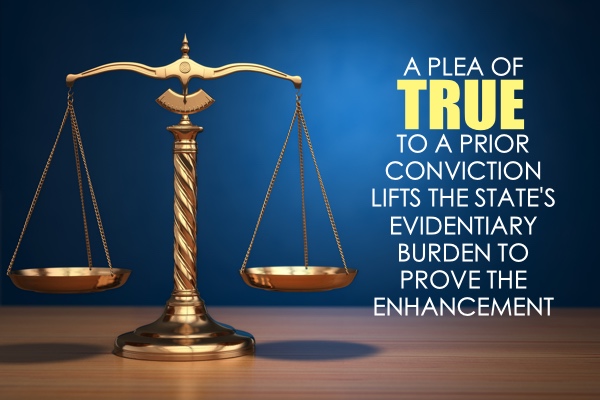
Scales of justice with text highlighting "A plea of TRUE to a prior conviction lifts the state's evidentiary burden to prove the enhancement," relevant to probation revocation legal principles.

A “True” Pleading to Felony Priors Lifts State’s Evidentiary Burden

ByProbation Revocation

Scales of justice with text overlay stating "A plea of TRUE to a prior conviction lifts the state's evidentiary burden to prove the enhancement," relevant to Texas felony enhancement law.What happens when the State omits the year of an offense on a legal document presented before the court for a sentencing enhancement? Well, nothing, so long as the defendant pleads “true” to the priors and the enhancement itself is not improper, according to the latest holding from the Court of Criminal Appeals. The CCA revisits Roberson v. State to explain why it comes to this quirky conclusion.

See the CCA opinion in Hopkins v. State (Tex. Crim. App. 2016).

Defendant Pleads “True” to a Notice Pleading with Incomplete Information

Essie Hopkins was convicted for aggravated robbery for shooting his victim as he ran away with her wallet. During the punishment phase, the State pushed for an enhancement to his sentencing for more prison time under Texas’s habitual offender statute. In the original indictment, the State alleged that the defendant had a prior conviction for aggravated assault with a deadly weapon from 2003. Later, the State alleged in a notice pleading that the defendant had a second aggravated assault conviction, however, the State failed to include the year of the offense in the paperwork. When the State read the enhancement allegations into court record, Hopkins pled “true” to committing and being charged with the prior felonies. Hopkins’ mother also testified, citing knowledge of the two prior felony convictions—one occurring in 2003 and the other in 2009. The State did not provide evidence of the prior aggravated assaults.

On appeal, the Fifth Court of Appeals affirmed the lower court’s conviction, holding, “that [Hopkins’] plea of “true” to both enhancements was sufficient evidence to support a finding on those allegations.” Hopkins v. State, No. 05-14-00146-CR, 015 WL 3413582, *6 (Tex. App.—Dallas May 28, 2015, pet. granted) (mem. op.) (not published). Hopkins appealed to the Criminal Court of Appeals, arguing that because the wording in the notice pleading is not clear, the State was required to present evidence of the felony even though Hopkins pled “true.”

Texas Penal Code Sentencing Enhancement Laws

Under section 12.42(d) of the Texas Penal Code, a defendant’s punishment may be enhanced if “it is shown on the trial [record]…that the defendant has previously been…convicted of two felony offenses…the defendant shall be punished by imprisonment…for any term not more than 99 years or less than 25 years. TEX. PENAL CODE § 12.42(d); Jordan v. State, 256 S.W. 3d 286, 290-291 (Tex. Crim. App. 2008).

If the defendant pleads “true” to an enhancement paragraph, then the State is off the hook to prove up in court the enhancement allegations. Roberson v. State, 420 S.W.3d 832, 838 (Tex. Crim. App. 2013) (citing Mikel v. State, 167 S.W. 3d 556, 559 (Tex. App.—Houston [14th Dist.] 2005, no pet.))

The Court of Criminal Appeals Looks to Roberson v. State

In Roberson, the defendant was convicted of aggravated assault with a deadly weapon and was sentenced to 30 years in prison based on a “true” pleading to prior felony convictions. Id. Because the court record of that case did not affirmatively reflect that the enhancement was improper, the court held that the defendant’s “true” pleading relieved the State’s burden of proving up the felony convictions. Id. at 840. In Roberson, the court record also supported the enhancement allegations. Id.

The CCA stated, “[Hopkins] fail[s] to direct us to any record evidence affirmatively showing that the enhancements were improper, the record actually supports the enhancement allegations.” In sum, if a defendant pleads “true” to a sentencing enhancement during the punishment phase at trial, then the State is absolutely relieved of the evidentiary burden to prove the defendant actually committed and was convicted of the priors, so long as the enhancement itself is not improper.

Failure to maintain a single lane of traffic with a silver car on a highway, highlighting reasonable suspicion for a traffic stop in the context of Leming v. State of Texas, Texas Court of Criminal Appeals - 2016.

Failure to Maintain a Single Lane of Traffic Leads to a DWI Conviction

ByReasonable Suspicion

Does an Officer have “Reasonable Suspicion” to Make a Traffic Stop When Vehicle Weaves Inside a Traffic Lane?

Failure to maintain a single lane of traffic is reasonable suspicion for a stop, Leming v. State of Texas, Texas Court of Criminal Appeals - 2016, car driving on highway at sunset.James Leming was convicted of DWI after erratic driving alarmed fellow motorists to call police. On January 20, 2012, a citizen filed a report of a “swerving Jeep” and Officer Manfred Gilow responded. As the dashboard camera confirmed, the Jeep traveled thirteen miles under the speed limit; Gilow followed the Jeep for several miles. Officer Gilow observed the Jeep, “drifting [within the] lane to the left [with] tires on the stripes… back to the right, almost hit[ting] the curb twice.”
Officer Gilow said he did not stop the Jeep immediately because the heavy traffic made a traffic stop unsafe at the time. He wanted to wait until the Jeep approached “the 3000 block because I knew there’s parking lots where he could pull over [safely].” Gilow justified the warrantless stop under the Community Caretaking Exception, “due to the …[low] speed…and…swerving, it was an indication that the driver [was] somehow either distracted or physically not able to operate [his] motor vehicle carefully.”

Eventually, the officer pulled Leming over, noting on the police report, the smell of liquor. Though Leming denied drinking, he said he had taken some prescription pills. Officer Gilow conducted field sobriety tests and placed Leming under arrest for DWI.

Read the full opinion in Leming v. State.

Leming’s DWI Trial and Motion to Suppress the Stop

Before the trial began, Leming filed a motion to suppress the traffic stop, which was denied. At trial, Leming pled guilty to and was convicted of DWI. Because Leming had two prior DWI convictions (a felony under Texas law), the court assessed punishment at ten years’ imprisonment. Tex. Penal Code § 49.09(b)(2).

The Sixth Circuit Court of Appeals reversed the trial court’s ruling, holding that the trial court should have granted the motion to suppress. Leming v. State, 454 S.W.3d 78 (Tex. App.—Texarkana 2014). The Sixth Circuit concluded that Gilow lacked reasonable suspicion to detain Leming for the offense of failure to maintain a single lane under Section 545.0600(a) of the Texas Transportation Code. The court reasoned “in order for it to have been unlawful, the encroachment must have been made unsafely; [here,] there was no real danger of his colliding with another vehicle in an adjacent lane.” The State’s Prosecuting Attorney petitioned the Court of Criminal Appeals for discretionary review, arguing that the citizen’s report coupled with Officer Gilow’s observations were sufficient for reasonable suspicion that Leming was driving the Jeep under the influence.

The Issue Before the Texas Court of Criminal Appeals Regarding the Traffic Stop

The Court of Criminal Appeals had to determine whether a driver must BOTH fail to maintain a single lane AND not change lanes without checking to assure the maneuver can be accomplished safely, before it may be said that a driver has committed an offense. Such an offense would rise to the level of reasonable suspicion for a constitutionally-sound traffic stop.

What Does the Texas Transportation Code Say About Driving Within a Single Lane?

Section 545.060(a) states that “an operator on a roadway divided into two or more clearly marked lanes for traffic (1) shall drive as nearly as practical entirely within a single lane; and (2) may not move from the lane unless that movement can be made safely.”

The CCA Holds that a Driver Must Maintain a Single Lane AND Must not Leave the Lane Unless it is Safe.

The CCA explains that the fact that both the requirement to stay within a single lane as for as practical and the prohibition to not leave that lane unless it is safe to do so, originally appeared in the same subsection of the statute, does not indicate that the Legislature intended that both must be violated before an offense has occurred. Rather, the CCA believes that the Legislature intended a violation of EITHER part of the statute constitutes separately actionable offenses.

The CCA says that Officer Gilow knew from personal observations, as well as from the citizen’s report, that Leming had some sort of trouble maintaining a steady driving pattern while traveling under the speed limit. “That was sufficient information to justify a temporary detention to investigate whether Leming had actually failed at some point to remain in his dedicated lane of traffic as far as it was practical to do so under the circumstances—it matters not whether that failure was unsafe.” Further, Officer Gilow had an objectively reasonable basis to suspect Leming of driving under the influence.

As a matter of principle, the CCA notes, “it [would be] counterproductive and contrary to common sense to set the reasonable suspicion bar for DWI so high that law enforcement must hesitate to investigate such hazardous driving for fear that the stop will later be invalidated.” In a Concurring Opinion, Judge Richardson adds, “I believe [the community caretaking exception] provided justification for the officer’s stop, where, a reasonable police officer—given the totality of the circumstances-would believe [someone] is in need of help.” Dissenting, Judge Keasler stated, “this is a close case…the majority reaches the wrong result by misconstruing the statute and finds reasonable suspicion on the basis of a single insufficient articulable fact.” Judge Newell also dissented in this case.

Unauthorized verdict graphic with bold text reading "UNAUTHORIZED Verdict" and subtitle "WHAT SHOULD THE JUDGE DO?" surrounded by legal-themed icons, relevant to discussions on jury verdicts and judicial responses in criminal defense cases.

When the Jury Verdict is Not Authorized by Law

ByJury Trial

What Should the Trial Judge Do When the Jury Returns an Unauthorized Verdict?

Unauthorized verdict graphic with bold text, "UNAUTHORIZED Verdict," and subtitle "WHAT SHOULD THE JUDGE DO?" surrounded by legal-themed icons, relevant to discussions on jury verdicts in criminal defense.At the trial of Reginald Nixon for burglary of a habitation and evading arrest, the jury returned a guilty verdict and sentence of 7 years for the burglary and 9 years for the evading. However, the verdict form contained a handwritten note that read: “*To be served consecutively, not concurrently.” A consecutive sentence would mean that the two verdicts are added together to make the actual prison term 16 years. The jury had previously asked the judge whether the sentences would run concurrently and the judge refused to answer them, advising them to simply continue with their deliberations. Without an answer to their question, the jury took the matter into their own hands.


The problem with the jury’s verdict of 7 years and 9 years to run consecutively is that it is not an authorized sentence. Under Texas law, the sentences in Nixon’s case were required to run concurrently rather than consecutively. As a result, the trial judge refused to accept the sentences and reform them to run concurrently (as he was urged to do by Nixon’s counsel). Instead, the judge sent the jury back with a note advising them that the sentences cannot run consecutively. The jury soon returned with new verdicts of 16 years confinement for each offense, which the judge accepted.

Nixon appealed, again urging that the trial judge erred by failing to accept and reform the original jury verdicts. The 2nd Court of Appeals (Fort Worth) affirmed the trial court’s judgments and “reasoned that while the judge may have had the authority to reform the verdict under Article 37.10, he also had the authority to refuse the verdict and return the jury to their deliberations pursuant to this Court’s opinion in Muniz v. State [573, S.W.2d 792 (Tex. Crim. App. 1978)].”

The Texas Court of Criminal Appeals granted review and now reverses the holding of the 2nd Court of Appeals. The CCA highlighted the changes that were made in 1985 when the legislature enacted Section 37.10(b) of the Texas Code of Criminal Procedure. This change distinguished between “informal” and “unauthorized” verdicts. For unauthorized verdicts, Section 37.10(b) provides:

If the jury assesses punishment in a case and in the verdict assesses both punishment that is authorized by law for the offense and punishment that is not authorized by law for the offense, the court shall reform the verdict to show the punishment authorized by law and to omit the punishment not authorized by law.

CCA explained that the lower court’s reliance on Muniz was misplaced since Section 37.10(b) was not enacted at the time Muniz was decided. Further, the verdict form in Muniz was incomplete, unlike the verdict in this case, which was complete but contained an unauthorized portion.

The CCA concluded by holding:

Although the terms of confinement were 45 authorized punishments, the attempted cumulation was punishment unauthorized by law. Article 37.10(b)’s plain language is clear that, when the jury assesses punishment and returns a verdict assessing punishment that is both authorized and unauthorized by law, “the court shall reform the verdict to show the punishment authorized by law and to omit the punishment not authorized by law.” Accordingly, we hold that the judge erred in failing to accept the initial punishment verdicts and omit the jury’s unauthorized attempt to stack the terms of confinement.

Judge Alcala and Judge Yeary dissented.

Airplane graphic with airline tickets and paper airplane, captioned "Theft By Deception for Use of Airline Voucher," relevant to Texas theft law and legal defense information.

Justice of the Peace Convicted of Theft By Deception for Use of Airline Voucher

ByTheft

Theft By Deception?  County Official Uses Airline Flight Voucher (Purchased with Government Charge Card) to Buy a Plane Ticket for his Son.

Airplane illustration with paper airplane, airline tickets, and clouds, highlighting theft by deception involving airline voucher misuse.In Fernandez v. State, the Texas Court of Criminal Appeals considered the case of a Val Verde County Justice of the Peace who used an airline voucher for a flight that was unrelated to a government purpose.  The CCA discusses the offense of Theft by Deception in Texas, explaining what it means and what it doesn’t mean.  It is an interesting case because it seems so petty – the amount was only 300 dollars and some change.  Why didn’t the JP simply purchase a new ticket for his son?  Read more.

Travel Plans Arranged

James Fernandez was charged with “theft by deception” in 2012. Fernandez, serving as a Justice of the Peace in Val Verde County, wanted to travel to Orlando, Florida for a work-related conference in June of that year. After obtaining permission to travel to the conference and to use his government-issued credit card for airfare, Fernandez asked his office clerk to book the flight. The clerk made flight arrangements with Southwest Airlines.

Travel Plans Cancelled

Just before the conference, Fernandez became ill and cancelled his flight itinerary. Per Southwest Airlines’ refund policy, the airline issued a “refund-voucher” to Fernandez, in his name, valid for travel until February 2013. The refund-voucher was valued at $381.60, a dollar-for-dollar match to the amount originally paid for the ticket to Orlando.

In August, Fernandez asked his office clerk for the flight information from the cancelled Orlando trip. Once the clerk located the information, Fernandez told the clerk to give the flight reservation number to his son, Fernandez Jr.. The clerk complied.

Routine Audit Leads to an Investigation

During a routine review of the County’s flight budget, the County Auditor contacted Southwest, attempting to get a full refund of the flight. At that time the Auditor learned that the refund-voucher from the Orlando ticket had been used by Fernandez for a flight to Phoenix, Arizona in August. The auditor also learned that Phoenix flight incurred additional fees, fees that were not paid for by the county. Relying on Val Verde County’s policy that prohibits the use of county property for personal use, the auditor reported the transaction, triggering an investigation by the Attorney General.

Too Late to Repay, Fernandez Goes to Court

Soon after, Fernandez tried to pay for the airline voucher, but the auditor refused to accept his payment. Fernandez was charged with “theft by a public servant by way of deception.” At trial, Fernandez Jr. testified that his father had intended to repay the county, nevertheless, Fernandez was convicted—a conviction upheld by the Fourth Court of Appeals. Fernandez appealed to the Court of Criminal Appeals (“CCA”) for relief, arguing that State failed to prove he induced consent by way of deception at the time he misappropriated the government’s refund-voucher. The CCA must determine whether Fernandez committed “theft by deception” when he purchased online airfare for government-related travel with a government credit card, but canceled, using the refund-voucher for personal travel without “correcting the impression” that the refund-voucher would be used for future government-related travel.

What is Theft by Deception Under Texas Law?

Texas law defines theft as, “the unlawful appropriation of property with the intent to deprive the owner of the property.” Tex. Penal Code § 31.03(a). “Appropriation is unlawful if it is without the owner [of the property’s] effective consent.” Id. § 31.03(b)(1). Consent is defined as, “assent in fact, whether express or apparent,” and is “not effective if it is induced by deception or coercion.” Id. § 1.07(a)(11); §31.01(3)(A). Deception means, “failing to correct a false impression…fact that is likely to affect the judgment of another in the transaction, that the actor previously created…by words or conduct, and that the actor does not now believe to be true.” Id. § 31.01(1)(B). The burden of proof is on the State to prove “that the owner of the misappropriated property was induced to consent to its transfer because of a deceptive act of the defendant.” Geick v. State, 349 S.W.3d 542, 548 (Tex. Crim. App. 2011); Daugherty v. State, 387 S.W.3d 654, 659 (Tex. Crim. App. 2013).

The CCA Decides

Here, the CCA explains that “consent” is a key issue—that the initial consent Fernandez received from his office to use the government credit card to make the flight reservation was not the consent that is the basis of the conviction. Rather, it was the consent Fernandez obtained when he asked his clerk to send the information to his son, “because without the voucher number, Fernandez would have been unable to access the [information]” to book the flight to Phoenix. Further, the county, by way of its agent [the clerk], assented to the refund-voucher’s use because the agent gave the cancelled flight information to Fernandez and his son in August.

Moreover, the CCA says that the consent was obtained through deception. Fernandez established with his office that he would be attending a work-related conference in June, thus creating the impression that county funds were being used for a work-related purpose. Once the flight was cancelled, the refund-voucher that was issued is to be considered the county’s property, “just as the ticket to Orlando had been [considered county property].” Fernandez failed to correct the impression that he was using the ticket/refund-voucher for work-related travel, instead using the refund-voucher for personal travel without telling anyone in the Val Verde County’s business office. “By remaining silent, [Fernandez] left intact the impression he created…that the [refund-voucher] would be used for county-approved travel.” The CCA affirmed the decisions rendered by the trial and appeals courts.

Judge Johnson filed a concurring opinion that simplified the majority’s opinion. “When [Fernandez] failed to…tell the county….that he had not used the original ticket…and [did not] surrender the voucher, [Fernandez] failed to correct the impression of appropriate travel on county business that he had previously created.” This alone was the deception that is required to support the conviction.

_______

Barnett Howard & Williams PLLC is a criminal defense law firm in Fort Worth, Texas.  Our criminal defense attorneys handle all felony and misdemeanor offenses in Tarrant County and surrounding areas.  For more information about our attorneys, visit our Firm Profile page.

Hindering apprehension of a sealed federal charge, law enforcement badge and firearm in holster, relevant to federal criminal defense context.

Hindering Apprehension for a Sealed Federal Charge

ByCriminal Defense

“Run, Baby, Run!” Girlfriend’s Warnings, Personal Tattoos, and Attempts to Flee From US Marshals, Do Not Rise to the Level of “Felony Hindering Apprehension” Says the CCA

Hindering apprehension of a sealed federal charge, close-up of a holster with firearm, law enforcement context, HLAW logo in the corner.Keiona Nowlin and her boyfriend, Demarcus Degrate, were riding in a car when a United States Marshal, executing a sealed, federal warrant on the boyfriend, pulled up behind them. After the Marshal activated the siren and lights, the couple pulled over and Degrate fled on foot. The Marshal chased Degrate. Moments later, as two Marshals arrived at the scene, they observed Nowlin screaming, “Run baby run…get away” while she also fled on foot. The Marshals detained Nowlin “to find out why she was running.” At that point, Nowlin fled the Marshals’ car. Nowlin was placed under arrest for escape.
See the CCA Opinion in Nowlin v. State.

After the arrest, Nowlin said she “knew the cars the Marshals drove…and…did not want Degrate to be arrested…[because] he was out on bond for state charges.” The Marshal noted that Nowlin had Degrate’s name tattooed near her collarbone; the trial court inferred the tattoo as indicative of an intimate relationship. The trial court found Nowlin guilty of third-degree felony hindering apprehension, sentencing her to four years imprisonment.

Nowlin appealed to the court of appeals, arguing that she was not warning Degrate of impending apprehension because “he was already aware of the [Marshal’s] presence.” Nowlin contended that because she did not know the contents of the sealed federal warrant, she could not have known Degrate was charged with a felony. The court of appeals disagreed, holding that her statement at the scene, “run baby run…get away,” provided sufficient evidence of providing a warning to Degrate. The court of appeals pointed to statements made at the scene that she knew “he was out on bond for state charges…and…she did not want her man to get arrested.” The court of appeals added that her tattoo was proof of her close relationship with Degrate, and that she likely knew of the felony-level charges he was facing.

Nowlin appealed to the Court of Criminal Appeals, arguing that because the federal indictment was sealed and secret, she could not have known about the indictment itself; that no evidence exists that she knew of the felony-level charges Degrate faced; and, that her tattoo was not proof of a close relationship where she would have had knowledge of the charges. The State argues that the evidence was sufficient: that the tattoo is evidence of a close relationship that implies she knew intimate details of Degrate’s life; that she knew Degrate faced serious state-level charges, and that her attempt to flee from the US Marshal is evidence of her knowledge of the “serious nature of Degrate’s crimes.” In an interesting turn of events, the State offered an alternative to acquittal–that an alternative charge could be misdemeanor-level hindering apprehension, and the sentence could be amended to reflect a lesser charge.

“In order to show that the evidence presented was legally sufficient to support a conviction of felony hindering apprehension, the State must prove:

  1. the defendant warned another person of impending discovery or apprehension;
  2. the defendant had the intent to hinder that individual’s arrest; and,
  3. the defendant had knowledge that the individual was under arrest for, charged with, or convicted of a felony.

Tex.Penal Code § 38.05(a), (d).

An individual acts with knowledge when he is aware that the circumstances exist. Tex. Penal Code § 6.03(b). In a nutshell, the State must show Nowlin was aware that her boyfriend was under arrest for, charged with, or convicted of a felony. The Court of Criminal Appeals (“CCA”) now decides whether the evidence is sufficient to show that Nowlin knew Degrate was charged with a felony offense.

Here, the CCA does not agree with the trial court and court of appeals. “The state offense that Degrate was on bond for cannot serve as the basis for [Nowlin’s] conviction.” The CCA notes that there was no evidence at trial that named the type and level of the state offense, therefore, the trial court had no way of knowing if the offense was a felony or not. Also, there was no mention of whether Nowlin knew what type of charge her boyfriend was facing. Therefore, because there was insufficient evidence regarding the state offense, the state offense cannot serve as the basis for Nowlin’s conviction.

Further, Degrate’s federal indictment was sealed. There was no way for Nowlin and Degrate to know about the charges before their arrests. “With this mandated secrecy and the lack of evidence that he was told about the indictment during the attempt to arrest him, Degrate could not have known that he was under indictment for felon in possession of a firearm.” It would have been impossible for Degrate to have told Nowlin about the felony charge because he would not have known about it.

Lastly, the inferences made about Nowlin’s close relationship with Degrate—including the tattoo on her collarbone and her attempt to escape the Marshall—do not apply here. “While the inferences that the court of appeals makes would likely be reasonable ones had there been any evidence of Degrate himself having knowledge of the indictment, no such evidence was ever presented.”

The CCA found that the evidence was insufficient to support a felony-level hindering apprehension charge. The CCA reforms Nowlin’s convictions to a misdemeanor hindering apprehension charge, instructing the trial court to conduct a new punishment hearing to reflect the lesser charge.

Laboratory setting depicting a technician in a white coat working at a lab bench, with additional lab personnel in the background, highlighting the Houston Crime Lab scandal.

More Aftermath from the Houston Crime Lab Scandal

ByDrug Crimes

CCA Says “No Relief” for Defendant Who Accepted Plea Deal, even though the Court Infers Defendant’s Lab Reports Were Falsified

Laboratory technician working in a forensic lab setting, highlighting issues related to the Houston Crime Lab scandal and drug crime investigations.See the CCA opinion in Ex Parte Barnaby 

Setting the Stage: The Houston Crime Lab Scandal

In January of 2012, the Texas Rangers investigated a Department of Public Safety (“DPS”) Crime Laboratory technician, Jonathan Salvador, for allegedly tampering with crime lab evidence. The Rangers questioned DPS technicians and reviewed evidence records, bringing information that pointed to Salvador’s mishandling of lab results to Harris County’s District Attorney’s office. However, after an extensive investigation, the grand jury did not indict the technician. Subsequently, the DPS Office of Inspector General issued a report, stating that Salvador “failed to properly follow laboratory protocols…misidentified substances, and dry-labbed [falsified] samples.” Following the report, Salvador was terminated from his position at the Houston Crime Lab.

The fallout from Salvador’s actions, “call…into question the veracity and reliability of many cases handled by Salvador…[and as a result courts have] granted relief on several writs of habeas corpus, finding that each case involved a presumptive violation of due process.” Ex Parte Turner, 394 S.W.3d 513 (Tex. Crim. App. 2013) (per curiam); Ex Parte Hobbs, 393 S.W.3d 780 (Tex. Crim. App. 2013) (per curiam). The Texas Court of Criminal Appeals (“CCA”) has since “retreated from a presumption that due process was violated in every Salvador case, [instead] requir[ing] a showing of falsity and materiality.” Ex Parte Coty, 418 S.W.3d 597, 605.

How to Demonstrate a Due Process Violation from the Houston Crime Lab Scandal

In order for a defendant to prove that due process has been violated, the defendant must show (1) falsity—that his evidence from the lab or lab report was falsified; and, (2) materiality—that such falsifications/false reports were material to the outcome of the guilty verdict. Ex Parte Weinstein, 421 S.W.3d 656, 665 (Tex. Crim. App. 2014).

Falsity

The defendant bears the initial burden of showing falsity; the CCA “has implemented a five-part protocol to be used when a [defendant] raises an inference of falsity.” Coty, 418 S.W.3d at 605.
A defendant shows falsity when:

  1. The technician in question is a state actor
  2. The technician has committed multiple instances of intentional misconduct in another case or cases;
  3. The technician is the same technician that worked on the [defendant’s] case;
  4. The misconduct is the type of misconduct that would have affected the evidence in the [defendant’s case]; and,
  5. The technician handled and processed the evidence in the [defendant’s] case within roughly the same period of time as the other misconduct.

Materiality

A defendant bears the burden of persuasion with regard to materiality. Id. at 606. Materiality of false evidence is measured by the impact it had on the defendant’s decision to plead guilty. Id. In cases involving plea agreements, the court examines the voluntariness of the plea—whether there is a reasonable likelihood that [the plea] affected the defendant’s decision to plead guilty, [but] not whether it affected the conviction or sentence. Id. The Court ponders questions like, “if the defendant had known that the lab reports were falsified, would he have plead guilty, or would he have gone to trial?” A plea, however, is not involuntary simply because a defendant does not correctly assess every relevant factor entering into his decision [to take the plea]. Ex Parte Evans, 690 S.W.2d 274, 277 (Tex. Crim. App. 1985); Brady v United States, 397 U.S. 742, 757 (1970). The CCA implies that the decision to “go to trial” is an indicator that the false evidence is indeed material; the decision to “take a plea deal” is a soft indicator that the false evidence is not material.

Applying this to Ex Parte Barnaby

On March 13, 2009, Kemos Marque Barnaby was stopped for a traffic offense. During the traffic stop, police smelled an odor of marijuana coming from inside the car. Barnaby was asked to exit the vehicle, and he consented to a pat-down search. With dashboard cameras rolling, a small plastic bag with white rocks, which tested positive for cocaine during a rapid field test, was found in Barnaby’s pants. The bag was delivered to the Houston Crime Lab, where Jonathan Salvador issued a drug analysis report, identifying the white rocks as cocaine. Instead of going to trial, Barnaby plead guilty to four separate offenses of possession of a controlled substance with intent to deliver in exchange for four concurrent fifty-year sentences. Barnaby appeals to the Court of Criminal Appeals, arguing that because of Salvador’s false report, his guilty plea was involuntary, and had an impact on his decision to take the plea deal.

Here, the Court examines falsity to determine whether due process was violated. Using the five-part falsity protocol, the Court says, (1) Salvador was a state actor; (2) Salvador had multiple instances of misconduct; (3) Salvador worked on Barnaby’s case; (4) Salvador’s misconduct is the type of misconduct that would have affected the evidence in Barnaby’s case; and, (5) Salvador handled Barnaby’s evidence in the same time period as the other misconduct at the Houston Crime Lab. The State conceded that Barnaby was able to raise the inference of falsity, and accordingly the Court infers that Salavador’s report in this case is false, carefully noting that an ‘inference of falsity’ is not an affirmative finding of a negative cocaine test result.

Next, the Court examines materiality to determine whether the false lab report was material to the decision to take a plea bargain and whether the value of the undisclosed information was outweighed by the benefit of accepting the plea offer. Ferrara v. United States, 456 F.3d 278, 294 (1st Cir. 2006). Here, the Court says that Barnaby, a habitual offender, was faced with four drug charges, on top of having two prior felony convictions, thus, enhancing sentencing guidelines ranging from 25 to 99 years imprisonment for each charge. On top of that, Barnaby was also charged with three additional charges of possession with intent to deliver in a drug-free zone, all of which were also enhanced to the habitual-offender statute. The plea resolved all four of those charges in exchange for four concurrent fifty-year sentences; “even if the falsity of the laboratory report had come to light…the State could have still prosecuted [Barnaby] for the three other [drug-free zone] cases. “[Barnaby’s] assertion that he would not have plead guilty had he known of the falsity of the laboratory report is unpersuasive in light of the benefit he received from the plea bargain.”

Even though the Court infers “that the laboratory report in [Barnaby’s] case was falsified, [the Court] finds that [such] falsity was not material to [Barnaby’s] decision to plead guilty,” adding that he received a benefit of a lighter prison sentence by choosing to take the plea deal. Accordingly, the Court of Criminal Appeals denies relief to Barnaby.

We’ve recently seen experienced drug lab problems in Fort Worth as well.  The problems have impacted countless drug and DWI cases in Tarrant County.  Any case that involves an outside crime lab must be scrutinized carefully by the criminal defense attorney.  While bad lab techniques (or technicians) might not mean an acquittal, but it could mean considerable relief for the defendant.

Man in a maroon suit and bow tie, confidently gesturing in a courtroom setting, illustrating themes of impersonation and legal representation related to DWI cases.

Man Pretends to be a Dallas District Attorney and Receives 2 Years in Prison

ByCriminal Defense

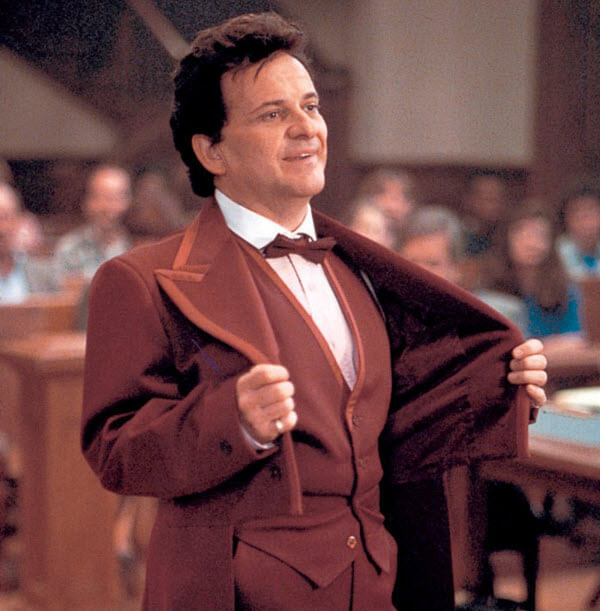
Man in a maroon suit and bow tie, humorously posing in a courtroom setting, referencing impersonation of a public servant in legal context.When I think of someone impersonating an attorney, my mind goes to Joe Pesci and My Cousin Vinny.  In the movie Vincent Gambino only impersonated a criminal defense lawyer (not a public servant) so nobody seemed to care (except the judge), but in Texas, Impersonating Public Servant (including a district attorney) is a serious matter.  Robert Cornwell found this out after he pretended to be a Dallas County Assistant District Attorney in hopes of helping his friend with a DWI case.

In May of 2012, Robert Cornwell called Montgomery County Assistant District Attorney Kourtney Teaff, identifying himself as an assistant district attorney from Dallas County, attempting to “resolve [his friend’s] [DWI] case.” Cornwell claimed access to criminal histories, case files, and fingerprint cards. He mentioned speaking with governmental offices, and prosecuting his nephew for drug possession. Cornwell insisted on using his personal cell phone number because he and Teaff “were on the same team.” Becoming suspicious of the “highly unusual” requests coming from another district attorney, Teaff recorded the conversations. According to the trial court, Cornwell always used his real name, he had never been an attorney in Texas, he never attempted to claim official authority over Teaff, and he intended that “Teaff should consider the requests a personal favor.” Cornwell was sentenced to two years imprisonment for impersonating a public servant.

See the opinion in Cornwell v. State

What does “Impersonating a Public Servant” mean in Texas?

Impersonating a Public Servant is a Third Degree Felony with a punishment range of 2-10 years in prison and up to a $10,000 fine.  A person violates Section 37.11(a)(1) of the Texas Penal Code when the person impersonates a public servant in combination with the requisite intent…[which] can be satisfied with either the submission theory (“with intent to induce another to submit to his pretended official authority”) or the reliance theory (“with the intent to induce another…to rely on his pretended official acts.”).

Cornwell appealed to the Court of Appeals, arguing that the evidence was insufficient to show either theory of intent—submission or reliance—because he did not persuade Teaff to submit to any asserted authority he might have over her. The Court of Appeals rejected Cornwell’s argument, “concluding that the evidence was…sufficient to support a jury finding that he had impersonated a public official with intent to induce another to rely on his pretended official acts—the reliance theory.” Cornwell then petitioned the Court of Criminal Appeals (“CCA”) for discretionary review.

Here, the CCA determines whether the Court of Appeals was incorrect in misconstruing the meaning of the Section 37.11(a)(1) of the Texas Penal Code, as only “a few Texas appellate courts have directly addressed the reliance theory of intent, and specifically, the meaning of pretended official acts.” See Ex Parte Niswanger, 335 S.W.3d at 617 & n.11; Tiller v. State, 362 S.W.3d 125, 128 (Tex. App.—San Antonio 2011, pet. ref’d.); Tovar v. State, 777 S.W.2d 481,489 (Tex. App.—Corpus Christi 1989, pet. ref’d.).

The CCA Clarifies what “Impersonating” means (and doesn’t mean).

The CCA explained that Section 37.11(a)(1) can be broken down into two parts: the culpable act (actus reus, the bad act) and a culpable mental state (mens rea, the guilty mind). To violate the statute, the State must prove:

  1. that the impersonation happened and
  2. that the impersonator had the specific intent to induce another to submit or to rely upon.

“An accused may not be convicted on a simple showing that he falsely held himself out to be a public servant.”

Because it was undisputed that Cornwell did impersonate a public servant—an assistant district attorney from Dallas County—satisfying the first part of the statute, the CCA focused on Cornwell’s mental state, specifically the reliance theory—the evidence that shows Cornwell’s intent to induce another to rely upon his pretended official acts. The CCA explained that Cornwell attempted to persuade Teaff he was “an experienced assistant district attorney by relating various claims of conduct he had undertaken as an assistant district attorney” namely, “putting his nephew in jail, reviewing case files, and investigating matters in the capacity of assistant district attorney.” The CCA is adamant that, “the only reason [Cornwell] could have had for relaying these pretended official acts to Teaff was to enhance the credibility of his claim to be an assistant district attorney.” “By calling and speaking to an assistant district attorney as a member of the same team, [Cornwell]…hoped to gain [Teaff’s] trust and goodwill.” Further, Cornwell did not ask for favor[s] in his capacity as a private citizen or concerned friend, rather, he asked under the guise of being an assistant district attorney. The CCA states, such “purported actions exceed mere false identification as a public servant.” The CCA agreed with the Court of Appeals, affirming Cornwell’s conviction and sentence.

There are no shortcuts to due process. The Texas Penal Code prescribes strict punishment for those impersonating officers of the court. There is no doubt that criminal charges and allegations can make the accused feel panicked and overwhelmed, however, the old adage “desperate times call for desperate measures,” will not hold water in court where impersonation is concerned. If you or a loved one are facing criminal charges, contact an actual Texas attorney who will explain the proper steps in dealing with the legal system. Contact our office today for a free consultation at (817) 993-9249.

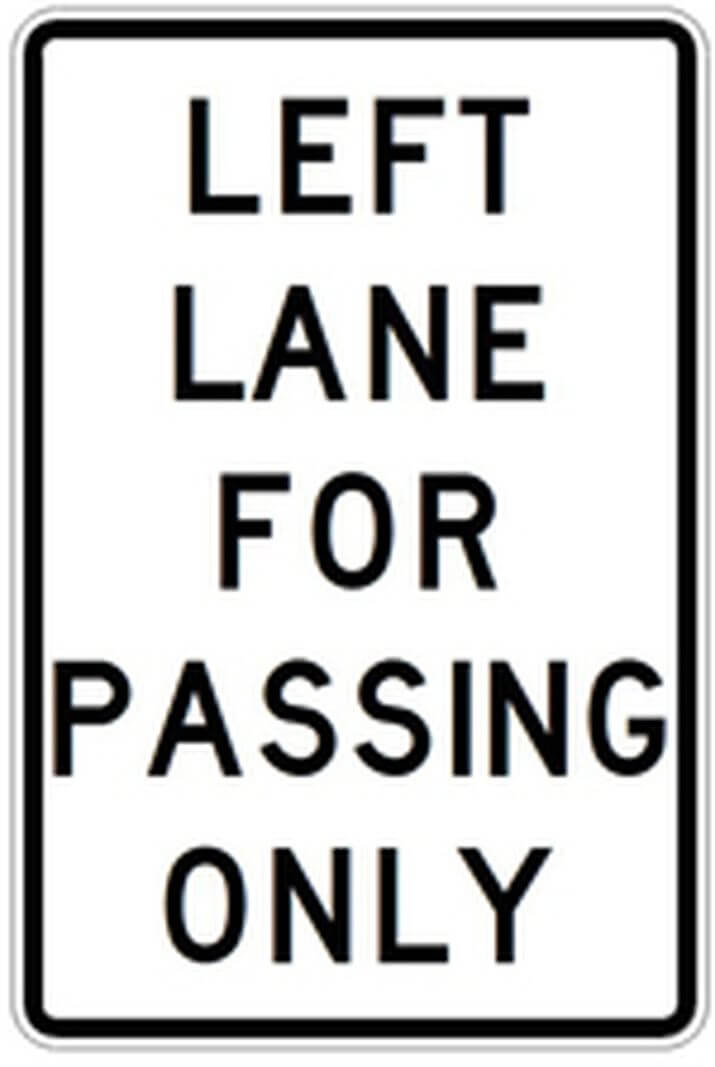
Left lane for passing only traffic sign relevant to reasonable suspicion in Texas traffic stop case analysis.

Warrantless Traffic Stop Upheld for Driving in “Passing Only” Lane

ByDrug Crimes, Reasonable Suspicion

Driving in the “Passing Only” Left Lane for Forty-Five Seconds Creates Reasonable Suspicion for Warrantless Traffic Stop in Texas

Left lane for passing only sign emphasizing traffic laws relevant to warrantless traffic stops in Texas.Jaganathan v. State: Francheska Jaganathan was driving in the left lane of a three-lane Texas highway, just ahead of a police cruiser. Mounted with a dashboard camera, the cruiser accelerated and changed lanes, but stayed behind Jaganathan’s car. A few seconds later, Jaganathan’s car passed a “Left Lane for Passing Only Sign,” yet her vehicle continued in the left lane despite the middle lane being clear of traffic. About forty-five seconds later, the trooper turned on his overhead lights, and conducted a traffic stop of Jaganathan’s car. During the traffic stop, the trooper smelled marijuana, prompting a search of the vehicle. The trooper found marijuana in the trunk, and as a result, Jaganathan was charged with possession of marijuana.

At trial, Jaganathan filed a motion to suppress the evidence, but the court denied the motion. Jaganathan chose a plea agreement where she pled guilty and was placed on deferred adjudication. On appeal, Jaganathan argued that the trooper lacked reasonable suspicion to conduct the traffic stop in the first place. The court of appeals agreed with her, stating that Jaganathan likely stayed in the left lane for safety reasons, that seeing the cruiser may have influenced her decision to stay out of the trooper’s way, and that a few seconds were an insufficient amount of time “to conclude that [Jaganathan] committed a [traffic] violation.”

The Court of Criminal Appeals of Texas disagrees with the court of appeals, citing the reasonable suspicion standard in Texas, and the Texas Transportation Code. The Court of Criminal Appeals also clarifies the issue at hand.

The issue is not whether Jaganathan committed a traffic offense, but whether the trooper had reasonable suspicion to stop the vehicle.

First, “A trooper may make a warrantless traffic stop if the reasonable suspicion standard is satisfied.” Guerra v. State, 432 S.W.3d 905, 911 (Tex. Crim. App. 2014). “Reasonable suspicion exists if the trooper has specific and articulable facts that, when combined with rational inferences from those facts, would lead him to reasonably suspect that a particular person has engaged …in criminal activity.” Abney v. State, 394 S.W.3d 542, 548 (Tex. Crim. App. 2013).

Second, “an operator of a motor vehicle [must] comply with an applicable official traffic-control device, including a sign.” TEX. TRANSP. CODE § 544.004(a); § 541.304(1). “Before a trooper can have reasonable suspicion to believe that a defendant committed the traffic offense of failing to obey a “Left Lane for Passing Only” sign, the trooper must be aware of facts that support a reasonable inference that the defendant drove past the sign before being pulled over.” Abney, 394 S.W.3d at 549.

Here, Jaganathan was driving in the left lane without passing other cars, after driving past a sign that prohibited that conduct. The dashboard camera captured the sign and all of the movements of the car. According to the Court of Criminal Appeals, even if Jaganathan had a defense of necessity—she HAD to be in the left lane for a medical or traffic emergency—the trooper still had reasonable suspicion to conduct a traffic stop. The Court of Criminal Appeals states, “these were only possibilities, and so it was reasonable for [the trooper] to suspect the appellant had violated the law.” Further, the reasonable suspicion standard “accepts the risk that officers may stop innocent people.” Illinois v. Wardlow, 528 U.S. 119, 125 (2000). As a result of the forty-five second traffic violation, the trooper had reasonable suspicion to pull Jaganathan’s car over; and, as a result of smelling marijuana, the trooper was able to search the car without a warrant, resulting in charges against Jaganathan. The Court of Criminal Appeals reversed the judgment of the court of appeals and affirmed the judgment of the trial court.

It is important to note, however, that the ruling has a dissenting opinion. Justice Meyers is adamant that the sign and the Transportation Code supporting it are problematic for the following reasons:

• The Code is unclear on how to comply or not comply with the sign.
• The Code does not state a specific amount of time a driver has to pass and merge back into the non-passing lane.
• The Code does not address passing a string of cars, in the middle lane.
• The Code does not address the need to accelerate to be able to pass, whether intended or unintended (for example if the car being passed speeds up, making passing difficult).
• Proving a driver’s intent to pass another car is difficult.

If you or a loved one are facing traffic violations or drug charges, please contact our office for a free consultation at (817) 993-9249.