
DWI guidance graphic with text "What to Do If You Are Stopped for DWI," featuring a police car's light, relevant to legal representation by Howard Lotspeich Alexander & Williams, PLLC.

Do’s and Don’ts When You’re Pulled Over for a DWI

ByDWI

DWI tips graphic with blue and red police lights, text reading "DWI WHAT TO DO IF YOU ARE STOPPED FOR DWI," featuring Howard Lotspeich Alexander & Williams, PLLC logo for legal guidance on DWI stops in Texas.Finding those blue and red lights in your rearview mirror is never ideal. If it’s a DWI stop, it can feel like your heart is racing twice as fast. But while the nerves are understandable, the key here is knowing what to do—and maybe more importantly, what not to do. Let’s dive into a few tips that might make a difference if you find yourself in this situation.

Stay Calm and Collected if Stopped for DWI

Do: Breathe. Take a moment, gather your thoughts, and remember that keeping calm can really help. When the officer approaches, be respectful and polite. A calm demeanor doesn’t mean you’re admitting guilt; it simply shows maturity and may influence how the officer views you. Even if your pulse is racing, a little “fake it till you make it” can go a long way.

Don’t: React emotionally or aggressively. Panicking or being rude won’t help. It could even escalate the situation. The officer is there to do their job, and unfortunately, this may involve some tough questioning. But stay focused—cool and collected is the goal.

Comply with Basic Requests, But Know Your Rights

Do: Hand over your license, insurance, and registration when asked. This is standard procedure, and providing these essentials without fuss can keep things running smoothly.

Don’t: Overshare. Remember, officers will often ask questions about where you’ve been or how much you’ve had to drink. It may seem like casual conversation, but it’s often their way of gathering information. Instead of diving into a full recap of your evening, keep it simple and to the point. You don’t have to answer beyond basic questions, so politely decline to offer additional details if you feel uncomfortable.

Field Sobriety Tests – The Art of the Polite Refusal

Do: Know your right to say “no.” Field sobriety tests, like the “walk and turn” or the “one-leg stand,” are voluntary in Texas (unless you’re on probation). Politely refusing can be a smart move, as these tests are designed in a way that even sober people can struggle with them—stress, nerves, and uneven ground can all affect the results.

Don’t: Feel pressured to go along just because the officer doesn’t explicitly ask if you’re willing to participate. Officers might assume you’ll comply and jump straight into the tests. So, if you’d rather not do them, a simple, “I prefer not to take these tests” can be your best option. Remember, you’re not obligated to help build the state’s case against you.

Breath and Blood Tests – Understanding the Consequences

Do: Know what’s at stake. Breath and blood tests fall into a slightly different category. In Texas, refusing a breath or blood test can have immediate consequences, like a license suspension, but it’s still within your rights unless an officer presents a warrant.

Don’t: Refuse if a valid warrant is presented. If an officer has obtained a warrant for a blood test, you’re legally required to comply. Failing to do so could lead to additional legal trouble, which might make a bad situation worse. Think carefully, and when in doubt, ask for clarity.

Remain Silent Beyond Basic Information

Do: Use your right to remain silent wisely. Beyond providing identification, you’re not obligated to answer detailed questions. Many people feel the need to explain themselves in these situations, but even seemingly innocent statements could later be used as evidence.

Don’t: Spill the details of your evening. This isn’t the time for full transparency about how much you had to drink or why you may look tired. Politely telling the officer, “I’m not comfortable answering that” is within your rights and can help prevent anything being taken out of context later.

Plan Ahead – Use Alternative Transportation

Do: Make a game plan in advance. Look, no one wants to be in a situation where they’re stopped for DWI. Using rideshare options like Uber or Lyft can save a lot of trouble and maybe even a lot of money. If there’s even a slight chance that you’re over the limit, it’s best to leave the car keys behind.

Don’t: Wait until it’s too late. Last-minute decision-making is stressful, and being proactive is way easier than facing DWI charges. Think of it as a minor investment in your peace of mind—and definitely cheaper than the potential costs of a DWI.

Wrap-Up: Staying Smart and Safe on the Road

Getting pulled over is never a pleasant experience, especially when a DWI is involved. The best steps are often the simplest: stay calm, comply with basic requests, know your rights, and remember the power of a polite refusal. Ultimately, avoiding this situation by planning ahead—calling that Uber—is the smartest move you can make. But if it ever does happen, hopefully, these do’s and don’ts will guide you through with confidence.

Here’s to making smart choices and staying safe on the road.

2024 HLAW Scholarship Winners logo featuring a gold number one, laurel wreath, and a red ribbon with the word "WINNER."

2024 Scholarship Winners

ByScholarship

Barnett Howard & Williams PLLC Announces the Recipients of the 2024 Scholarship Awards

2024 Scholarship Winners emblem featuring a laurel wreath and a red ribbon, highlighting "Winner" and "HLAW Scholarship Winners," representing Howard Lotspeich Alexander & Williams, PLLC's commitment to supporting military veterans and their dependents.BHW is thrilled to continue our two scholarships for 2024. In honor of the sacrifices of our military veterans, our scholarships are connected to military service. The first scholarship is a $500 award for a Military Veteran Law Student and the second scholarship is a $500 award for a Military Dependent undergraduate student. Throughout the year, we received many applications from very deserving students. We appreciate all of the students that took the time to apply for the scholarships and wish them all the best in their studies. For those students that were not selected, we invite you to apply again next year as we plan to continue the scholarship offers as an annual award.
2024 Winner – Military Veteran Law Student Scholarship

The winner of the 2024 Military Veteran Law Student Scholarship is:

DERRICK BRANTLEY

Derrick Brantley is a U.S. Army infantry veteran that served in both Iraq and Afghanistan. Mr. Brantley currently attends Dwayne O. Andreas School of Law – Barry University in Orlando, Florida. Congratulations Derrick Brantley. Best wishes as you continue toward your law degree.

2024 Winner – Military Dependent Scholarship

The winner of the 2024 Military Dependent Undergraduate Scholarship is:

SA’NYA POLO

Sa’Nya Polo is a US Army dependent whose parents both served in the US Army and continue to serve as government employees assisting veterans. Ms. Polo currently attends UCLA and is pursuing a degree in film. Congratulations Sa’Nya Polo. Best wishes as you continue in your studies.

More Information About Our Scholarship Opportunities:

For more information about how to apply for these scholarships in future years, please visit the scholarship pages:

Military Veteran Law Student Scholarship

Military Dependent Scholarship

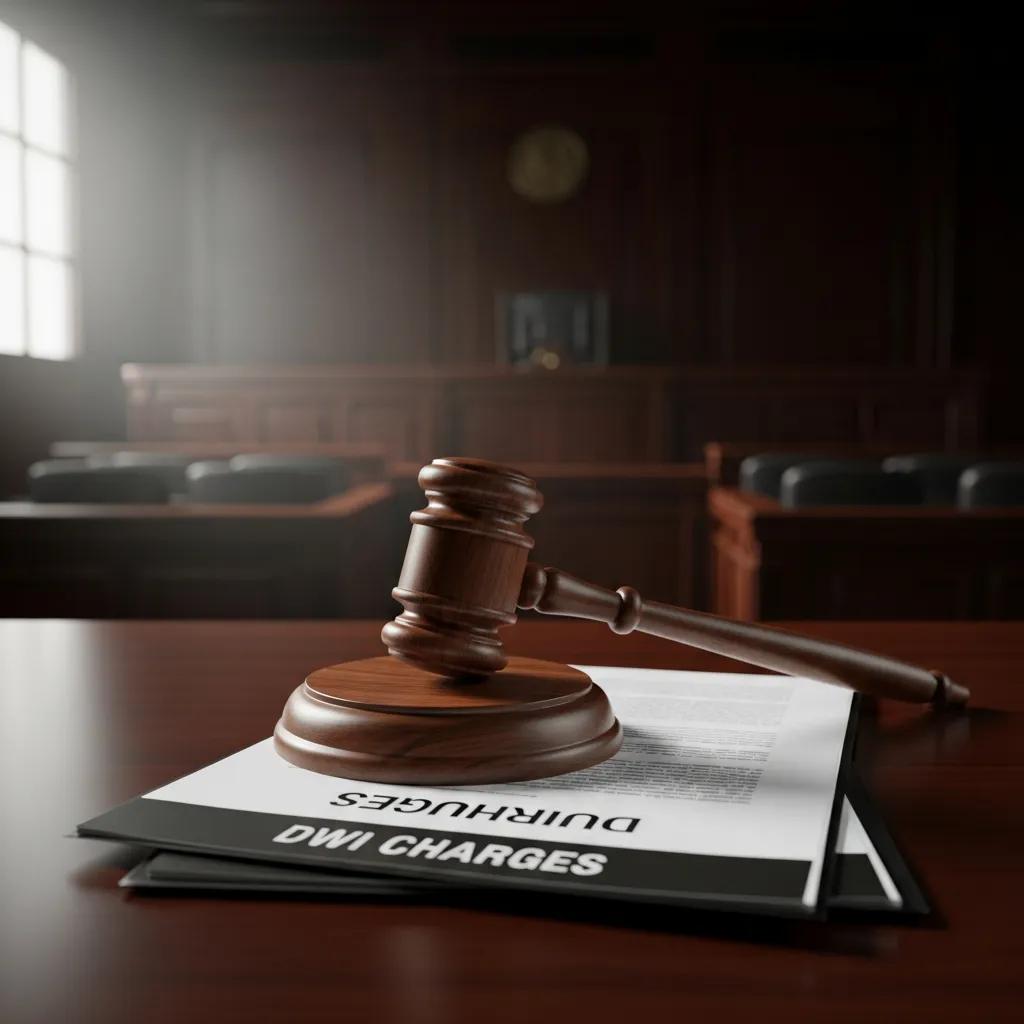
Gavel resting on legal documents labeled "DWI CHARGES" in a courtroom setting, symbolizing the serious legal implications of DWI offenses in Texas.

How a Fort Worth DWI Attorney Can Save Your Future

ByDWI
Gavel resting on legal documents titled "DWI Charges" in a courtroom setting, symbolizing the serious legal consequences of DWI offenses and the importance of legal representation by a Fort Worth DWI attorney.

How a Fort Worth DWI Attorney Can Save Your Future: Expert DWI Defense Lawyer Fort Worth Guidance

Facing a DWI charge in Fort Worth can be a daunting experience, with potential consequences that may impact your future significantly. Understanding the legal landscape surrounding DWI charges is crucial for anyone navigating this challenging situation. This article will explore how a Fort Worth DWI attorney from Howard Lotspeich Alexander & Williams, PLLC (HLAW) can provide essential guidance and representation, ensuring your rights are protected throughout the legal process. We will delve into the nature of DWI charges, the legal penalties involved, and the steps you should take after an arrest. Additionally, we will highlight the importance of seeking professional legal assistance from HLAW, a firm specializing in DWI defense.

What Are DWI Charges in Fort Worth and Texas?

DWI charges, or Driving While Intoxicated, are serious offenses in Texas that can lead to severe legal repercussions. A DWI is defined as operating a motor vehicle while having a blood alcohol concentration (BAC) of 0.08% or higher. This legal threshold is established to ensure public safety and deter impaired driving. The implications of a DWI charge can be far-reaching, affecting not only your driving privileges but also your personal and professional life.

What Defines a DWI in Texas and Fort Worth?

In Texas, a DWI is characterized by the operation of a vehicle under the influence of alcohol or drugs. The law does not formally distinguish between DWI and DUI; rather, “DWI” is the term used for impaired driving offenses regardless of age. The term DUI is not commonly used in Texas law for adult impaired driving offenses. Understanding this is vital, as the penalties for a DWI conviction are generally severe and apply to all adults.

What Are the Legal Penalties for DWI Offenses in Texas?

Gavel resting on legal documents labeled "DWI CHARGES" in a courtroom setting, symbolizing the serious legal implications of DWI offenses in Texas.

The legal penalties for DWI offenses in Texas can vary based on several factors, including prior convictions and the circumstances surrounding the arrest. Common penalties include:

Penalty TypeDescriptionDuration
FinesUp to $2,000 for a first offenseVaries
Jail Time72 hours to 180 days for a first offenseVaries
License Suspension90 days to 1 yearVaries
Community Service24 to 100 hoursVaries

These penalties can have a lasting impact on your life, making it essential to seek legal representation to navigate the complexities of your case.

How Can a Fort Worth DWI Attorney Protect Your Rights?

A Fort Worth DWI attorney from Howard Lotspeich Alexander & Williams, PLLC (HLAW) plays a crucial role in protecting your rights and ensuring you receive a fair trial. They are equipped with the knowledge and experience necessary to challenge the evidence against you and explore potential defenses.

What Legal Defense Strategies Do Fort Worth DWI Lawyers Use?

DWI lawyers at HLAW employ various defense strategies to protect their clients. Some common approaches include:

  • Challenging the Traffic Stop: If the initial stop was unlawful, any evidence obtained may be inadmissible.
  • Questioning BAC Test Results: Issues with the administration of breath or blood tests can lead to inaccurate results.
  • Proving Lack of Impairment: Demonstrating that the driver was not impaired despite a high BAC reading can be a viable defense.

These strategies highlight the importance of having a knowledgeable attorney from HLAW who can navigate the legal system effectively.

Why Choose Howard Lotspeich Alexander & Williams, PLLC (HLAW) for Your DWI Defense?

Howard Lotspeich Alexander & Williams, PLLC (HLAW) specializes in legal defense services with a focus on DWI cases in Fort Worth, Texas. Our experienced attorneys understand the intricacies of DWI laws and are dedicated to providing personalized legal representation. By choosing HLAW, you gain access to a team that prioritizes your rights and works diligently to achieve the best possible outcome for your case.

What Steps Should You Take After a DWI Arrest in Fort Worth?

After a DWI arrest, it is crucial to take immediate action to protect your rights and future. Here are essential steps to consider:

  • Remain Silent: Avoid discussing your case with anyone except your attorney.
  • Document Everything: Keep detailed notes about the arrest and any interactions with law enforcement.
  • Contact a DWI Attorney: Schedule a consultation with a qualified DWI attorney at HLAW as soon as possible.

How to Schedule a Consultation with a Fort Worth DWI Attorney at HLAW?

Scheduling a consultation with a Fort Worth DWI attorney at Howard Lotspeich Alexander & Williams, PLLC (HLAW) is straightforward. You can typically reach out via phone or through our firm’s website. During the consultation, be prepared to discuss the details of your case and any evidence that may be relevant.

What Immediate Actions Can Help Save Your Future After a DWI Charge?

Taking proactive steps after a DWI charge can significantly impact the outcome of your case. Consider the following actions:

  • Gather Evidence: Collect any relevant documents, such as police reports and witness statements.
  • Contact Witnesses: Reach out to individuals who may have witnessed the incident to gather their accounts.
  • Stay Informed: Educate yourself about DWI laws and potential defenses to better understand your situation.

These actions can help build a strong defense and improve your chances of a favorable outcome.

How Have Recent Texas DWI Law Updates Impacted Defense Strategies?

Recent updates to Texas DWI laws have introduced new considerations for defense strategies. Staying informed about these changes is essential for anyone facing DWI charges.

What Are the Key 2024-2026 Texas DWI Law Changes?

Key changes in Texas DWI laws from 2024 to 2026 include increased penalties for repeat offenders and enhanced enforcement measures. However, as of mid-2024, no specific new legislation with effective dates through 2026 has been enacted that significantly alters DWI penalties statewide. It is important to consult with a qualified attorney at HLAW to understand any local or pending legislative changes.

How Do These Updates Affect Your DWI Case in Fort Worth?

The recent law changes can impact your DWI case in Fort Worth. Understanding these updates allows your attorney at Howard Lotspeich Alexander & Williams, PLLC (HLAW) to tailor defense strategies that align with the current legal landscape, potentially improving your chances of a favorable outcome.

Contact HLAW today for a free case evaluation and consultation.

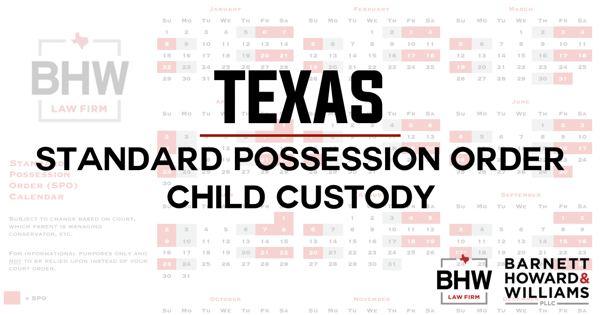
Texas Standard Possession Order calendar for child custody, featuring BHW Law Firm logo and relevant dates highlighted.

Texas Child Custody: Standard Possession and Visitation in Texas

ByChild Custody

Which Parent Gets Custody? The Standard Possession Order for Child Custody in Texas

Texas Standard Possession Order calendar for child custody, featuring structured visitation schedule and law firm branding for Howard Lotspeich Alexander & Williams, PLLC.When parents in Texas divorce or separate, one of the most important issues they face is child custody. Texas law recognizes two types of custody: physical custody, which refers to where the child lives, and legal custody, which refers to the right to make decisions about the child’s upbringing. In cases where parents cannot agree on custody arrangements, the court may order a standard possession order.

A standard possession order is a court-ordered schedule that determines when each parent will have physical custody of the child. The order is designed to provide regular and predictable time for both parents to spend with the child. In Texas, the standard possession order is governed by the Texas Family Code, and it provides a default schedule that can be modified by agreement of the parties or by the court if certain circumstances exist.

Under the standard possession order, for parents residing within 50 miles of each other, the non-custodial parent (referred to as the “possessory conservator” in Texas) has the right to possession of the child on the first, third, and fifth weekends of each month, starting at the time school is dismissed on Friday and ending at the time school resumes on Monday. In addition, the possessory conservator has the right to possession on mid-week during the school year from the time school is dismissed on Thursday until the time school resumes on Friday morning.

The standard possession order, for parents residing within 50 miles of each other, also provides for the possessory conservator to have the child for 30 days in the summer, which can be broken up into two periods of at least seven days each. The order also provides for the possessory conservator to have the child on alternating holidays, such as Thanksgiving, Christmas, and spring break. The exact dates and times for each holiday are specified in the order.

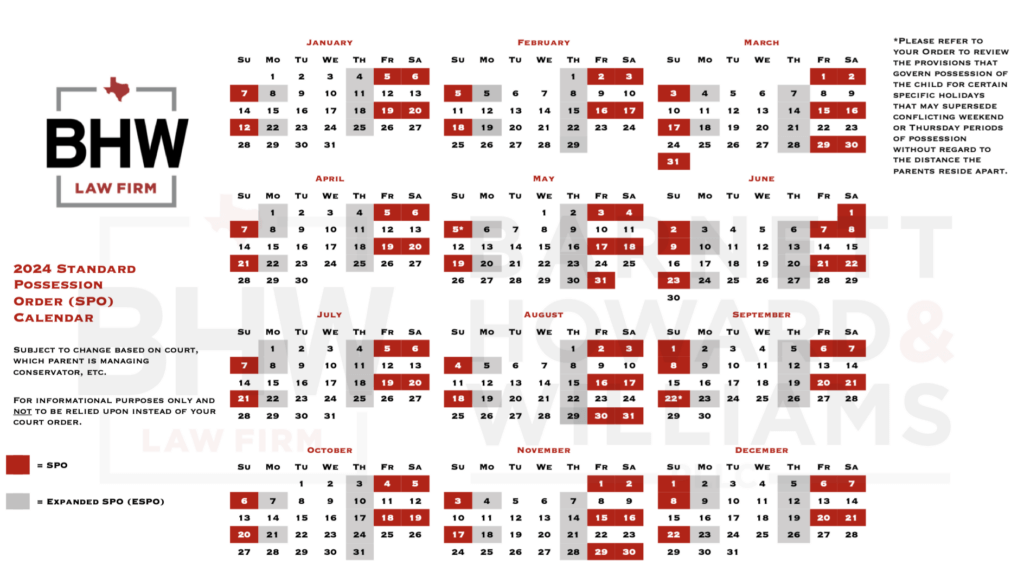
Printable Standard Possession Order for 2024. CLICK HERE

2024 Standard Possession Order (SPO) calendar for child custody, featuring monthly grids with designated weekends, holidays, and notes on court orders, branded with Howard Lotspeich Alexander & Williams, PLLC logo.

Does the SPO Apply if the Parents Live Too Far Away?

In cases where the parent lives more than 50 miles but less 100 miles apart, the non-custodial parent (referred to as the “possessory conservator” in Texas) has the right to possession of the child on the first, third, and fifth weekends of each month, starting at 6:00 pm on Friday and ending at 6:00 pm on Sunday. In addition, the possessory conservator has the right to possession on Thursdays during the school year from 6:00 pm to 8:00 pm.

In cases where the parents live more than 100 miles apart, the standard possession order provides for additional periods of possession to ensure that the non-custodial parent has meaningful time with the child. For example, the non-custodial parent may have the right to possession on one weekend per month instead of the first, third, and fifth weekends. You
should consult with your family law attorney to determine whether this distance consideration impacts your situation.

Can the Standard Possession Order be Modified?

It’s worth noting that the standard possession order is just that – a default schedule that can be modified by agreement of the parties or by the court. Parents who are able to work together to create a schedule that works for their family may be able to deviate from the standard possession order. However, if the parties cannot agree, the court will likely order the standard possession order.

Overall, the standard possession order provides a predictable schedule for both parents to spend time with the child. While it may not work for every family, it is a useful starting point for parents who are unable to agree on a custody schedule.

An Experienced Divorce and Child Custody Lawyer Can Help Determine When Each Parent Has Possession of Their Child

Most of the time, it is best to contact an experienced family law attorney to help explain and establish each of these possession schedules, including any customizations or unique provisions the court finds to be in the best interest of your child. You are often not limited to the standard and expanded standard schedule above–but you may need an experienced attorney to fight for you to have more time with your child. Let our experienced family law attorneys assist you in discussing this schedule with the other parent and the court. Contact BHW Family Law at (817) 993-9249 for a free consultation of your family law matter.

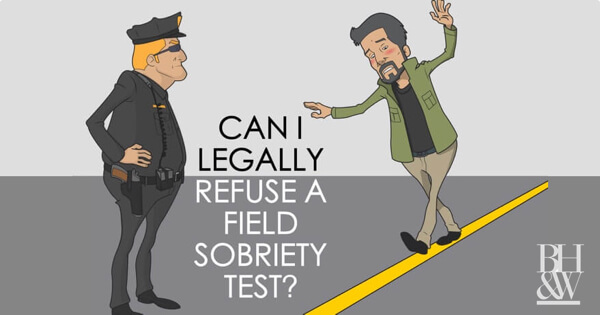
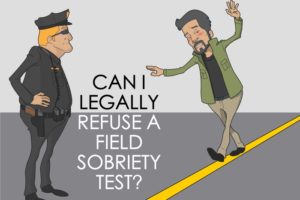
Cartoon illustration of a police officer questioning a man about refusing a field sobriety test, with text "Can I Legally Refuse a Field Sobriety Test?" and HLAW logo, relevant to DWI legal guidance in Texas.

May I Legally Refuse Field Sobriety Tests if Stopped for DWI?

ByDWI

We get this question all the time. People want to know if they can refuse the field sobriety tests when the police ask them to participate

Yes! You may legally refuse field sobriety tests in Texas (unless you are already on probation and it is a condition of your probation that you cannot refuse). This article explains why you should consider refusing the SFSTs.

Standardized Field Sobriety Tests Can Be the Best Evidence for the State in a DWI Trial

Cartoon illustration of a police officer and a man performing a field sobriety test with text asking, "Can I legally refuse a field sobriety test?" relevant to DWI laws in Texas.When a driver is stopped in Texas and the officer suspects that the driver may be intoxicated, the officer will typically run through a standard DWI roadside investigation. This investigation begins by simply observing the driver (bloodshot eyes, odor of alcohol, slurred speech) and asking some questions:

  • “Where are you coming from this evening?”
  • “Have you had anything to drink tonight?”
  • “How many is a couple?”

If the officer sees enough to warrant a further investigation, they will ask the driver to step out of the car.

“Let’s Make Sure that You’re Okay to Drive Tonight.”

Once the driver steps out of the car, the officer’s body worn camera and dash camera are recording so that the footage can capture the interaction (to be used later at trial if needed). The officer will then explain that they are going to do some tests just to “make sure that you’re okay to drive.” Note: The officer WILL NOT NORMALLY ask permission to conduct the
standardized field sobriety tasks.  He will jump right in and hope that you just go along with it.

There are 3 standard tests that are explained in more detail on our DWI page.

The Standardized Field Sobriety Tests are Not Designed for You to Pass

The 3 standard tests are (1) the HGN test (Horizontal Gaze Nystagmus), which is the “eye test,” (2) the Walk and Turn test (also known as the Walk the Line test), and (3) the One Leg Stand test. I don’t have enough time to go into the many problems with the tests, but to list a few:

  • The Eye Test (HGN) – this test requires the officer to be precise with his stimulus device in the field and they often make mistakes in distance and degree. Further, even with updated body worn camera technology, the video rarely shows what the officer claims to observe in the eyes. So we are usually left with officer testimony alone (and juries generally do not trust the “eye test”);
  • The Walk and Turn test – this test is difficult (even for completely sober people – try it yourself sometime) because it requires the person to take challenging heel to toe steps on an imaginary line in all conditions and officers never take into account the person’s stress level, the weather/wind conditions, footwear, fatigue from a long day, etc.; and
  • The One Leg Stand – this test is also difficult. It requires you to balance on one foot for 30 FULL seconds. TAKE NOTE – if the person puts their foot down at 27 seconds it is a strike against them and the officer will use this as evidence that they are indeed intoxicated.

Throughout the years, the tests have been debunked and challenged by experts as unreliable, but the courts are still allowing them as proof of intoxication (they are claimed to be used as evidence of the loss of mental or physical faculties).  In short, these tests exist for the officer to build a case against you in court and we feel ultimately set you up to fail. So what benefit is there for a driver who is suspected of DWI to take the tests if they don’t have to?

You DO NOT Have to Submit to Standardized Field Sobriety Tests in Texas

Even though the officer might act as if you must take the tests, you don’t. If he asks you to exit the vehicle then you must get out of the car. But as soon as he tries to start the HGN (eye test) on you, you can (and probably should) politely refuse to take the test. Take note of what I said…Politely Refuse. Do not be a jerk about it and go into a diatribe about how you read this blog and you know these tests are no good and that you refuse to do them. Remember this is all being captured on audio and video; audio and video that will be exhibit #1 at a trial if it goes that far. Simply inform the officer that you do not wish to participate in the standardized field sobriety tests.

Can I Still be Arrested if I Refuse to Perform the Field Sobriety Tests?

Yes you can (and probably will) be arrested if you refuse to perform the SFSTs. If the officer already felt like he had enough evidence to administer the tests, then he will probably go ahead and arrest you for DWI if you refuse to take them. But hey, you were probably going to get arrested anyway. Now, however, there will be less evidence against you.  You have an absolute right not to give evidence against yourself.  This constitutional right applies equally in the DWI context.

Should I Take the Tests if I Haven’t Had that Much to Drink?

You are an adult, and only you know your own level of coordination, so it is really up to you. But our advice (from over 16 years of handling DWI cases) is NO. You should not perform the standardized field sobriety tests. Your DWI case becomes tougher to defend if you look intoxicated on the video. Even if you haven’t had that much to drink, there are many reasons why you might appear intoxicated on the video. For instance, perhaps:

  • You are extremely nervous and have a high stress level from being pulled out of your car in the middle of the night by a police officer;
  • Your footwear is not ideal for walking and turning (high heels, flip flops, etc);
  • The wind is blowing hard;
  • It is cold outside and you are shivering;
  • You have an old injury that causes you to limp or not walk “normally”; or
  • You have bad balance (even on a good day).

Lastly, these tests are extremely technical. The instructions are long and tedious and can be very confusing for someone who has never attempted these tests before. Officers also like to compound this issue by providing you the instructions very aggressively and rapidly. The officer often sounds like the disclaimer at the end of a pharmaceutical commercial when they are reading you the instructions for the tests. Your failure to comply perfectly with these instructions can be used against you in court.

Next Time, Please Take an Uber

We hope you will listen to our advice regarding DWI field sobriety tests. Better yet, we hope that you’ll just pay the $40 for an Uber or taxi from the bar or restaurant and avoid this altogether. But if you didn’t take our advice and you didn’t call and Uber, call us and we’ll be happy to be your advocates.

*This article did not discuss whether you may legally refuse a Breath Test or a Blood Test. We’ve written on that many times and the answer is YES. You may refuse breath and blood tests UNLESS the officer has a warrant for your blood. If they have a warrant, you may not refuse.

Santa Claus holding a sign labeled "25-12" in front of a height chart, with the text "TOP 5 REASONS FOR HOLIDAY ARRESTS" prominently displayed, relating to criminal defense insights during the Christmas season by Howard Lotspeich Alexander & Williams, PLLC.

Top 5 Reasons for Arrests During the Christmas Holiday Season

ByCriminal Defense

Santa Claus holding a sign labeled "Top 5 Reasons for Holiday Arrests," with a mugshot background, representing holiday-related legal issues in Texas.When you think about the Christmas season, you probably think about family time, presents, good food, and celebration. We think about those things too, but as criminal defense attorneys, we also think about the reasons that some of our clients get arrested during the holiday season. For this article, we took a look at the last 8 years of holiday season arrests (for clients that we represented) and compiled an (anecdotal) list of the top 5 reasons that folks get arrested during the Christmas/New Year’s season. Our goal is that this list will serve as a warning, so that your holiday season can be filled with the good stuff, rather than jail, bail, and calls to our office. Here goes:

5. Shoplifting

Many retailers slash their prices and offer steep discounts in the weeks leading up to Christmas and even bigger discounts after Christmas, but we have yet to see any retailer offer the “five finger discount” for their merchandise. Regardless, we see plenty of shoplifting cases during the Christmas season, making it our #5 reasons that people get arrested during Christmas. Depending on the regular price value of the item (not the discounted price), shoplifting theft charges can range from misdemeanors to felonies. Learn more about Theft law in Texas here.

4. Package Theft

In a similar vein to shoplifting, our #4 reason for holiday arrests is package theft. Many shoppers choose the convenience of online shopping and have their Christmas purchases delivered right to their front door. Some people see this as an easy target, following behind UPS or FedEx trucks to steal those would-be Christmas gifts from the front porch. However, with the increase in doorbell cameras, it is getting easier to catch the porch pirates in the act. Further, some law enforcement agencies have begun using dummy packages to bait thieves into getting caught. Package theft can range from a misdemeanor to a felony depending on what unknown treasure lay inside the brown box.

3. Air Travleing Trouble (Guns, Drugs, and Intoxication)

Going to visit grandma can require air travel for many families. This means that thousands more people than usual flood through DFW Airport between Thanksgiving and New Year’s. It matters not from where these travelers hail. From Maryland to Oregon to France, if a person is arrested at DFW Airport, their case will be filed in Tarrant County, Texas and they will have to travel back to DFW to attend court. During the holidays, we see a surge in airport arrests when people bring items into the airport that are not allowed or when folks over indulge during a layover. Specifically, we see the following airport arrests:

Even if the state from which a traveler is coming has legalized marijuana and the state to which they are traveling has legalized marijuana, if they are caught possessing marijuana in the airport, they will be arrested and charged. The combination of airport gun arrests, airport drug arrests, and airport public intox arrests make these types of cases our #3 reason for holiday arrests.

2. Assault Family Violence

In the movie Christmas Vacation, Clark Griswold showed an enormous amount of restraint when his extended family pushed him to the limit (especially Cousin Eddie), but not everyone is blessed with such a cool head. Christmas time brings added stressors into the family environment that can sometimes lead to verbal or physical altercations between family members, so much so, that these arrests rank at #2 in our book. Depending on the nature of the assault, a domestic violence arrest can be charged as a misdemeanor or a felony. Learn more about Family Violence under Texas law.

1. Driving While Intoxicated

With all of the Christmas and New Year’s parties and the increase in No Refusal Weekends, it is not hard to guess that DWI arrests are #1 on our list. Driving While Intoxicated in Texas can range from a misdemeanor (if it is a first or second offense) to a felony (if there is a child in the car or if the person arrested has been convicted of DWI twice in the past). Our advice is to plan ahead and do not even take your car to a Christmas party when you plan to drink. Catch a ride from a friend or take an Uber or Lyft. That would be a lot cheaper than hiring an attorney and a lot less hassle too. Learn more about Texas DWI law here.

We Hope You Never Need Us, But We’re Here if Your Do.

We wish you a very merry Christmas and a happy New Year. As always, we hope you never need us to represent you or one of your loved ones for a criminal offense. This is even more true during the Christmas season. Hopefully this list will help you avoid trouble that looms during the holiday season. If you do happen to need us, we are only a phone call away at (817) 993-9249.

Grinch character with text "Stealing Packages: How to Spend Christmas in Jail!" and cardboard boxes, highlighting consequences of package theft during the holiday season.

Don’t Be a Grinch: Punishments for Christmas Package Theft in Texas

ByTheft

Grinch character with text "Stealing Packages: How to Spend Christmas in Jail!" and stacked cardboard boxes, emphasizing consequences of package theft during the holiday season.Throughout the year, package thefts occur on a fairly regular basis. But, as Christmas draws near and package delivery increases, so too do the thefts. While packages left on doorsteps and out in the open may seem to be easy targets for thieves, the consequences of getting caught are rarely considered. Would-be porch pirates should certainly think through their intended capers as many houses are equipped with doorbell cameras these days that capture clear video of any movement at or near the doorway.

What Can Happen to Individuals Who Steal Packages?

Grinchy thieves can face stiff penalties for stealing packages. In Texas, theft is classified by the amount of property that is stolen. Depending on the amount of the items stolen, a person caught stealing packages can face anywhere from a Class C misdemeanor punishable by a fine of up to $500 up to a First Degree Felony facing 99 years or life in the penitentiary. The latter would require someone stealing an item worth more than $300,000. While this may be unlikely, a thief wouldn’t know what he or she is stealing until he opens up that box. In addition, if committed within the same criminal episode, the aggregate amount of the items stolen could increase the punishment ranges for the offense as well.

Theft Of Mail In Texas

In 2019, the Texas legislature passed another law aimed at package theft. HB 37 makes it a crime to steal mail (including packages) from mailboxes or homes. The punishment range of this new law is linked to the amount of homes from which mail is taken. If a person takes packages from fewer than 10 homes, the crime is a Class A misdemeanor; 11-30 homes is a State Jail Felony; and 31+ homes is a 3rd Degree Felony. Of course, if the value of the package would make the offense a higher felony, then the state could also choose to file a case for the greater offense.

What Happens When Multiple Individuals Act as a Team to Steal Packages?

The consequences of people acting in a team to steal packages can increase the acts to the offense of Engaging in Organized Criminal Activity. In Texas, a person commits the offense of Engaging in Organized Criminal Activity if with the intent to establish, maintain, or participate in a combination or in the profits of a combination or as a member of a criminal street gang, the person commits or conspires to commit theft. Tex. Penal Code 71.02. This increases the punishment one category higher than the offense originally committed. Most often, these types of cases are filed as 3rd degree felonies which carry a range of punishment of between 2-10 years in prison and up to a $10,000 fine.

Punishments for package theft can be harsh. While a person may be stealing property worth only a few dollars, they may also be stealing property worth thousands. The potential punishment a person faces for package theft may not deter thieves but there are certain other things that citizens can do to prevent these acts from occurring.

How to Prevent Package Thefts

The primary means by which package thefts are being prevented are with the increasing use of video surveillance. Individuals looking to steal packages off of front porches are becoming more and more aware of doorbell cameras and other small home surveillance cameras. The increased media coverage of these incidents and the increased capture of thieves by way of theses surveillance methods is enhancing deterrent efforts. YouTuber Mark Rober also continues to perfect his package theft glitter bomb, which could aid in the deterrence effort.


Despite the fact that security cameras are gaining in popularity (and the media reports on a regular basis of people being caught because of them), package thefts in Texas have not been eliminated. There are still those individuals that choose to ignore the possibility of getting caught and the potential consequences. And, for those folks, maybe it would help to reflect on the words of The Grinch, “Maybe Christmas doesn’t come from a store. Maybe Christmas…perhaps…means a little bit more!”

But for those individuals who persist and ignore the warnings and advice – and reflections from the Grinch – the BHW phone line is always open – just don’t say we never told you so!

Gavel on a wooden desk with text asking if assault by contact is a lesser-included offense of bodily injury assault, representing legal discussions on assault charges in Texas, associated with HLAW.

Assault By Contact NOT an LIO of Assault Bodily Injury

ByAssault

Is the Class C charge of Assault (Offensive Contact) a lesser-included offense of the Class A charge of Assault (Bodily Injury)?

In short, the answer is most likely No.

Is Assault by Contact a lesser-included offense of Bodily Injury Assault? HLAW logo and gavel in law office setting.An offensive-contact assault not a lesser-included offense of a bodily-injury assault because the offenses have different elements.

The Court of Criminal Appeals, whose opinions are controlling in Texas, held that an offensive-contact assault is not a lesser-included offense (“LIO”) of a bodily-injury assault because what the state was required to prove for one offense differed from what the state had to prove for the other (McKithan v. State, 324 S.W.3d 582, 583, 591 (Tex. Crim. App. 2010)). For a Class A misdemeanor bodily-injury assault, the state must prove that bodily injury (or pain) occurred; the statute does not require the state to prove that the contact was offensive or provocative (Tex. Penal Code § 22.01(a)(1), (a)(3)). An offense is not an LIO if the state must prove different elements for each offense (McKithan, 324 S.W.3d at 583, 591). It is not enough that “proof of the charged [] offense may also” show the other offense; the State must be “required to prove these offenses in establishing the charged offenses” (Id. at 593).

Granted, seven years before McKithan, the Court of Criminal Appeals stated that an offensive-contact assault is an LIO “of (a)(1), because [it is] proved by less than all the facts required to prove (a)(1), specifically, physical injury” (Reed v. State, 117 S.W.3d 260, 267 (Tex. Crim. App. 2003)). However, the Court of Criminal Appeals seemed to move away from this categorical view in McKithan.

Additionally, the appeals court presiding over cases in Tarrant County, the Second Court of Appeals, held that an offensive-contact assault “is not, under the circumstances of this case, a lesser-included offense of assault causing bodily injury” (Welsh v. State, 2009 Tex. App. LEXIS 3592, *4-5 (Tex. App—Fort Worth May 21, 2009)). Other courts echo this sentiment. For example, in Norman v. State, the appeals court held that the trial court did not make a mistake when it refused to instruct the jury on offensive-contact assaults as a LIO of bodily-injury assaults because offensive-contact assaults have a unique element (2019 Tex. App. LEXIS 6690, *16-17 (Tex. App—Amarillo August 1, 2019). And one Houston court stated that “[b]ecause offensive-contact assault is not within the proof necessary to establish bodily-injury assault, it is not a lesser-included offense” (Washington v. State, 2019 Tex. App. LEXIS 5409, *12 (Tex. App—Houston June 27, 2019)).

Thus, offensive-contact assaults are not considered LIOs of assaults causing bodily. An assault under § 22.01(a)(3) has elements unique to it, so one cannot prove an assault under § 22.01(a)(1) by establishing the elements of assault under § 22.01(a)(3).

2023 HLAW Scholarship Winners logo featuring a gold number one, laurel wreath, and red ribbon, highlighting the firm's commitment to supporting military veterans and dependents in their educational pursuits.

2023 Scholarship Winners

ByScholarship

Barnett Howard & Williams PLLC Announces the Recipients of the 2023 Scholarship Awards

2023 scholarship winners logo for Howard Lotspeich Alexander & Williams, PLLC, featuring a laurel wreath and a "Winner" banner.BHW is thrilled to continue our two scholarships for 2023. In honor of the sacrifices of our military veterans, our scholarships are connected to military service. The first scholarship is a $500 award for a Military Veteran Law Student and the second scholarship is a $500 award for a Military Dependent undergraduate student. Throughout the year, we received several applications from very deserving students. We appreciate all of the students that took the time to apply for the scholarships and wish them all the best in their studies. For those students that were not selected, we invite you to apply again next year as we plan to continue the scholarship offers as an annual award.

2023 Winner – Military Veteran Law Student Scholarship

The winner of the 2023 Military Veteran Law Student Scholarship is:

ANDREW BACON

Andrew Bacon is a Marine Corps veteran who currently attends the University of Denver Sturm College of Law. Congratulations Andrew Bacon. Best wishes as you continue toward your law degree.

2023 Winner – Military Dependent Scholarship

The winner of the 2023 Military Dependent Undergraduate Scholarship is:

FRANCESCA QUINATA

Francesca Quinata is a US Army dependent whose father enlisted from Guam and served for over 20 years. Francesca currently attends the University of Texas and will be the first member of her family to attend college. Congratulations Francesca! Best wishes as you continue in your studies.

More Information About Our Scholarship Opportunities:

For more information about how to apply for these scholarships in future years, please visit the scholarship pages:

Military Veteran Law Student Scholarship

Military Dependent Scholarship

Fireworks display with colorful rockets and text overlay "FIREWORKS LAWS IN TEXAS" from Howard Lotspeich Alexander & Williams, PLLC, highlighting legal aspects of fireworks use in Texas.

Fireworks Laws in Texas | Could a Sparkler Really Cost You $2,000?

ByCriminal Defense

Do Not Lose Your Liberty on Independence Day

Fireworks display with colorful explosions in the background and text overlay reading "Fireworks Laws in Texas" alongside the logo of Howard Lotspeich Alexander & Williams, PLLC.Independence Day is right around the corner. You will probably start seeing the notices spread across social media from local police departments, warning that setting off fireworks (including sparklers) is illegal inside of city limits. We know that you’re probably going to do it anyway (so are we), but we wanted to let you know what Texas law provides regarding fireworks on the 4th of July.



Texas Fireworks Law | Are Sparklers Illegal Inside of City Limits?

While state law in Texas permits possessing and using fireworks, it’s important to note that where and when a person can possess them is still highly regulated. There are State laws that limit the use and display of fireworks but use is predominantly regulated by way of city ordinances.

Specifically, under state law, a person may not:

  1. Explode or ignite fireworks within 600 feet of any church, a hospital other than a veterinary hospital, an asylum, a licensed child care center, or a public or private primary or secondary school or institution of higher education unless the person receives authorization in writing from that organization;
  2. Sell at retail, explode, or ignite fireworks within 100 feet of a place where flammable liquids or flammable compressed gasses are stored and dispensed;
  3. Explode or ignite fireworks within 100 feet of a place where fireworks are stored or sold;
  4. Ignite or discharge fireworks in or from a motor vehicle;
  5. Place ignited fireworks in, or throw ignited fireworks at, a motor vehicle;
  6. Conduct a public fireworks display that includes Fireworks 1.3G unless the person is a licensed pyrotechnic operator;
  7. Conduct a proximate display of fireworks that includes Fireworks 1.3G or Fireworks 1.4G as defined in NFPA 1126 Standards for the Use of Pyrotechnics Before a Proximate Audience unless the person is a licensed pyrotechnic special effects operator and has the approval of the local fire prevention officer; or
  8. Sell, store, manufacture, distribute, or display fireworks except as provided by this chapter or rules adopted by the commissioner under this chapter.

Texas Occupations Code, Subchapter F, Sec. 2154.251

These violations are Class C Misdemeanors, which can be punishable by a fine up to $500.

Fireworks licensing violations are Class B Misdemeanors which can result in a jail term up to 180 days and a fine not to exceed $2,000.

Fireworks City Ordinances | Local Fireworks Rules in Fort Worth, Keller, and Southlake

In addition to State law, most cities in Texas regulate the use and display of fireworks by way of specific city ordinances. For example, Fort Worth, Texas has enacted an ordinance making the sale, discharge or possession of fireworks within the incorporated city limits a Class C misdemeanor punishable by up to a $2,000.00 fine. Similar ordinances exist in Keller and Southlake, and most other Texas cities.

Before your celebrations, it’s always best to review the above regulations under the Texas Occupations Code and check your local city ordinances online to ensure that you’re legally possessing, using and displaying fireworks.