

Skip to content

News and Insights

Page 50 of 107 · 532 articles

Tarrant County Juvenile Drug Court Program

Help When You Need It Most: Tarrant County Juvenile Drug Court Program

By Christy Dunn · Juvenile

Tarrant County Juvenile Drug Court ProgramLast week I wrote about things that every parent needs to know about kids and drugs. Today, I want to share with you a valuable resource to use if your child has gotten involved in drugs in Tarrant County. If your teenager has been charged in juvenile court with their first drug offense, you need to ask about the Tarrant County Juvenile Drug Court Program.

The Basics of the Program

The Drug Court Program in Tarrant County was launched in 1999. It was the first of its kind in the State of Texas. It is a voluntary program aimed at first time juvenile drug offenders. According to Tom Zaback, a Tarrant County juvenile probation officer and the supervisor of the program, 80% of the participants in Drug Court graduate the program successfully.

Juveniles in the program, and their parents, are required to commit a lot to Drug Court. This commitment to the program leads to a commitment to change, which contributes significantly to juveniles graduating from Drug Court and kicking their drug problem. While in Drug Court, which lasts for six months, juveniles and their parents will work closely with a probation officer and drug counselors in classes and groups that are tailored to meet the individual needs of each child.

The Process of the Juvenile Drug Court Program

Cases are screened automatically by the probation officers assigned to Drug Court to determine kids who may be appropriate for the program. However, if your child has been charged with a drug offense and you feel this may be a good option for him, you can ask your intake probation officer about being considered for inclusion in Drug Court.

Once a juvenile has been identified for the program, one of the Drug Court probation officers will schedule an intake with that child and his parents. During the intake appointment, the probation officer will explain the requirements of the program, get a social history from the family, and have the juvenile to take a drug test. The juvenile must also submit to a drug assessment during the screening process. This assessment will help to determine the level of that child’s drug problem and the recommended level of treatment needed. At the end of the screening, the probation officer will make a recommendation about whether that child should be allowed into Drug Court.

If a juvenile is recommended for Drug Court, the case is then sent to the Tarrant County District Attorney’s Office Juvenile Unit for prosecution. The prosecutor will review the case and file the charges with the court. The Tarrant County Juvenile Court will then schedule the case for a drug court hearing. At that hearing, the juvenile must stipulate, or admit, to the charges. The judge will enter a judgment withheld, which means that the judge will note that there is sufficient evidence to adjudicate the juvenile delinquent (or find him guilty), but will not, at that time, actually adjudicate the juvenile. The judge will then order him into the Drug Court Program.

Every juvenile in the program must come back to court for a judicial review at the 3-month mark and again at the end of the program. The purpose of this judicial review is for the judge to monitor the child’s progress in Drug Court. At the end of the six-month program, if the child has successfully completed all requirements, the judge will deny the prosecutor’s petition and order the child’s offense record to be sealed immediately. This is a huge benefit to the child because it means that he can honestly say to anyone asking in the future that he has not been charged or adjudicated for a drug offense. Sealing one’s record effectively erases it from existence.

The Requirements of the Tarrant County Juvenile Drug Court Program

As I mentioned above, while in Drug Court, a kid will be required to work with a probation officer and drug counselor to resolve any problems that he is facing with regards to drugs. There are other conditions that a juvenile in the program is required to follow, which are similar to the conditions of traditional probation. Some of these conditions are: no drugs, go to school, be honest, and attend treatment regularly. If a kid violates the terms of his Drug Court agreement, a progress report will be sent to the judge. If it is determined that a juvenile has violated the terms of the program to the extent that he is kicked out, he will be required to return to court for a disposition hearing. At this court hearing, the judge will enter a finding that the juvenile is adjudicated of the drug offense and then proceed to determine the appropriate punishment, or disposition, for the drug violation. This may result in the child being placed on traditional probation, being ordered to attend an in-patient drug treatment program, or in extreme cases, being sentenced to the Texas Juvenile Justice Department. Additionally, a driver’s license suspension will usually be ordered.

The Tarrant County Juvenile Drug Court is a wonderful program designed to help kids who are charged with a first-time drug offense. Its purpose is to help juveniles work through their drug problems while giving them a second chance to keep their juvenile record intact. The program is very successful. It requires a high level of commitment from the juveniles and parents who are in it, but that commitment is rewarded with a true change in the behavior, attitude, and lifestyle of that child. If your child is struggling with drugs, it is worth asking whether the Tarrant County Drug Court Program can help.


Read full article
juvenile drug possession texas

Drugs, Kids, and Juvenile Justice in Texas

By Christy Dunn · Juvenile

What Every Parent Needs to Know About Drug Crimes and the Juvenile Justice Process

juvenile drug possession texasOne of the most common way for teenagers to run afoul of the law is with drugs. Between peer pressure, synthetic drugs, and confusion over possession vs. ownership, there are many pitfalls surrounding the topic of drugs for kids. Many times, parents aren’t even aware their child has been exposed to drugs until that child is in trouble. Here are some basic things that every parents needs to know about kids and drugs before it’s too late.
Levels of Drug Offenses and Ranges of Punishment in Texas

In Texas, criminal offenses are divided into two major categories: Felonies and Misdemeanors, with felonies being the more serious. Except for possession of small amounts of marijuana or prescription drugs, all other drug offenses in Texas are felonies. This means that this is a very big deal if your child is arrested for drugs.

In the juvenile system, the punishment for misdemeanors ranges from nothing up to probation until that child’s 18th birthday. This probation can be served out at home. However, if appropriate, the court can order the child to a treatment facility, boys’ ranch, or some other kind of placement as part of the probation.

The punishment options for felonies in the juvenile system, like for misdemeanors, include doing nothing and probation up to a child’s 18th birthday (with or without placement outside of the home). For felonies, however, the court also can commit a child to the Texas Juvenile Justice Department (TJJD), which is the prison system in Texas for kids. A commitment to TJJD can last up until a child’s 19th birthday.

Synthetic Drugs - A Moving Target

Some of the most popular drugs in use today are synthetic or designer drugs. They go by a variety of nicknames including K2, bath salts, and Spice. These particular drugs are especially dangerous for a number of reasons. First, because they are a chemically altered variation of an illegal drug, they are legal in many cases. The legislature is still struggling to write the laws in such a way to criminalize all of these variations. As they make one chemical formula illegal, the chemists making these drugs alter it to escape prosecution. The law is making headway in this field, but it is a slow process. Because of this loophole, many of these synthetic drugs are legally sold in stores and over the internet. This makes it very easy for kids to get their hands on them.

The second reason why these drugs are particularly dangerous is because there is no way for a user to know what exactly is in the dose they are taking due to the rapidly changing chemical alterations that are being made to stay ahead of the law. The K2 your child takes today may be drastically different from the dose he took last week. There is also no way to know what side effects a specific chemical combination will have on a particular person or even the human body generally.

Part of the reason why these drugs are so popular with kids is because it is almost impossible to detect them. Because of the quickly changing chemical makeups of these drugs, it’s difficult to develop a drug test that can detect them all. Additionally, most parents have never heard of these drugs, which makes it easier for kids to get away with using them without their parents realizing what they are doing. This difficulty in detecting these drugs makes it more likely for kids to abuse these particular substances.

Prescription Drugs

Another category of drugs that has risen in popularity with teenagers is prescription drugs. These are used frequently by kids because they are easy to get their hands on. All they have to do is to go to the medicine cabinet at home and help themselves to whatever drugs are on the shelf. It doesn’t matter what the prescription is for or who it belongs to, it can be abused by kids. Teens have been known to sell and/or use pills prescribed for everything from ADD to depression to high blood pressure. When parents are unaware of the potential for kids to take these medicines, they are unlikely to secure them in order to keep them away from their teenagers. There have been several cases recently in Tarrant County where kids have been arrested at school for illegally selling or possessing a prescription drug that they took from their parents.

Ownership vs. Possession

When it comes to the drug laws, many kids are confused about the difference between ownership vs. possession. The law makes it illegal to possess drugs, regardless of who owns them. In fact, because drugs are considered “contraband,” the law doesn’t consider anyone to “own” them. Many kids, when busted for possessing drugs, will say, “But it’s not mine. I was just holding it for my friend.” They don’t understand that this means they are breaking the law, not their friend. Possession is defined as having care, custody, and control of something. This means that if you have the drugs in your pocket, you are in possession of them whether you “own” them or not.

Many “good kids” who wouldn’t dream of committing a crime will get caught holding drugs for their friends. Because they don’t understand that, if caught, they will be the guilty party and not their friend, they agree to hold onto the drugs for their buddy. It’s important that parents talk to their kids and explain this aspect of the law and the effect it can have.

Common Situations Where Kids Encounter Drugs

As I said at the beginning, drugs are a common reason why kids find themselves in the juvenile justice system and in alternative school for a period of time. It is a slippery slope that many teenagers find themselves on before they even realize what has happened. Below are some of the most common places for kids to encounter drugs.

1. School
Our kids spend a good deal of their time at school. By the time a kid gets into middle school and high school, a big chunk of their social circle is centered around school. School is also the place where they are likely to encounter a wide variety of different people. So, it’s no wonder, that it is also the place where many kids first encounter drugs. Not only do the school administrators and teachers have to be on the alert for drugs in school, but parents also need to be aware and be proactive in preparing kids to walk away when they encounter drug activity in the school environment.

2. Friends
When kids are in their preteen and teenage years, peer pressure is a very powerful force. Many kids are first exposed to drugs by their friends. Therefore, it is important, as parents, to know our kids’ friends and to be around them enough to pick up on whether these friends have a problem with drugs before our kids follow the same path. It’s also important for parents to consistently work on having that open communication with their kids so that, when the time comes, your kids can feel comfortable coming to talk to you about drugs and friends. Kids also need to know that if they are ever asked to hold onto to drugs for their friends, that they must say no, even if it means losing a friend over it.

3. Cars
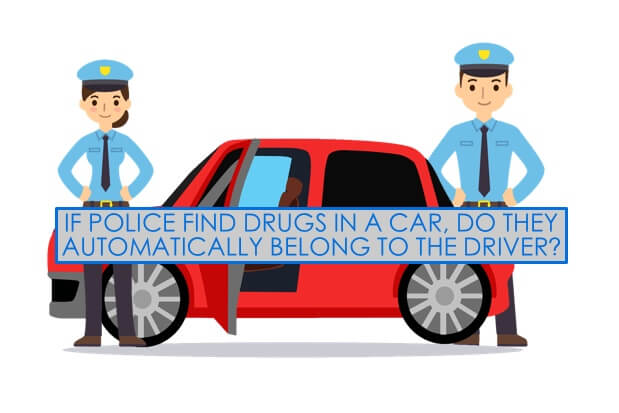
Cars present a tricky scenario for kids when it comes to drugs. If your teen gets into the car with someone who has drugs, it is very possible that your child will get charged with the drugs if they are pulled over by police. When police and prosecutors are looking at who within a car to charge with possession of the drugs, they will many times look to the person who was sitting the closest to the drugs. If someone else in the car drops their stash of drugs near your child, then it may appear that your child was the one in possession.

This is a situation where parents need to talk to their children about how easy it is for them to be in a car with others and be held responsible for the actions of those other people. Kids need to be very careful about who they get into a car with. Parents need to prepare their kids to make the right decision when confronted with whether to get in a car with someone or not.

Conclusion

While it is common for otherwise “good kids” to get in trouble with the law when it comes to drugs, it is not inevitable. If parents take the time to educate themselves and their kids about the pitfalls that drugs can create, they can help their teenagers to avoid getting involved in the juvenile justice system.

About the Author

Christy Dunn is a writer and attorney licensed to practice in Texas. She was a prosecutor for 15 years. The last five years of her prosecutorial career was spent in the Juvenile Division of the Tarrant County District Attorney’s Office. She has tried over 20 juvenile cases in Texas and multiple certification hearings. She was part of the multidisciplinary team that created a Project SAFeR.

Read full article
Drug Found in Car Driver Charged with Possession

Do Drugs Found in a Car Automatically Belong to the Driver?

By Luke A. Williams · Drug Crimes

Between the Driver and Two Passengers, who is in Possession of the Drugs Found in the Middle Compartment in Plain View?

Drug Found in Car Driver Charged with PossessionThe Court of Criminal Appeals recently handed down an opinion dealing with legal sufficiency of evidence in the context of possession of a controlled substance when it was not found in the exclusive possession of the defendant. The issue facing the Court was whether Appellant Tate intentionally or knowingly possessed methamphetamine by exercising “control, management or care” of the methamphetamine and he knew it was methamphetamine. Tex. Penal Code §1.07(a)(39). The Court found that a rational jury could infer that the owner and driver of a vehicle possessed the controlled substance found in the vehicle in plain view even when there were two other passengers.

Tate v. State (Tex. Crim. App. 2016)

The Facts—Trial Court Found Sufficient Evidence

Tate was pulled over by Detective Beckham due to his outstanding warrants. When pulled over Tate had two passengers. Tate explained that he owned the vehicle but did not have any proof of ownership. Tate was arrested after officers confirmed his outstanding warrants. The police searched Tate, the two passengers, and their belongings, but did not find any weapons or contraband. During Officer Beckham’s inventory search of the vehicle, he found a syringe loaded with a substance later identified as .24 grams of methamphetamine. He found the syringe in "plain view" in a compartment underneath the air conditioner and heating controls.

Tate, the owner of the vehicle, was charged with possession of a controlled substance. At trial, Officer Beckham described the compartment as “directly to the right” of Tate, accessible to Tate and the front-seat passenger but not the backseat passenger. He also testified that even though he couldn’t tell exactly what the front-seat passenger was doing, he observed her moving a lot but never towards the compartment. Tate argued that one of the passengers put the syringe there when Tate was talking to Beckham at the rear of the vehicle. The trial court found Tate guilty, relying on Tate’s “self-purported” ownership of the vehicle and his proximity to the syringe.

The Court of Appeals Reversed the Trial Court’s Decision

The Court of Appeals held that there was “insufficient evidence to prove that Tate had intentionally and knowingly possessed methamphetamine.” The court rejected the proximity argument made by the trial court for two reasons:

  1. There was insufficient evidence to show the syringe was in the car before Tate got out.
  2. Officer Beckham observed the front-seat passenger moving a lot but couldn’t tell exactly what she was doing.

Additionally, the court said that since Tate’s ownership could not be proven it was insufficient evidence to prove possession.

The Court of Criminal Appeals Reverses the Court of Appeals—Holding Defendant’s Ownership and Control of Vehicle Where Controlled Substance was Found in Plain View and Within Defendant’s Reach is Sufficient Evidence to Convict for Possession of a Controlled Substance

The CCA held that a rational jury, with these facts, could reasonably infer that the syringe was in the car the entire time. In coming to that decision the Court relied on the fact that the jury believed Beckham’s testimony that he never saw her reach for the compartment, that the back-seat passenger could not reach it, Tate said he owned the vehicle, and that the syringe was found in plain view. Therefore, a rational jury could infer that Tate would be aware of items in his vehicle in plain view, thus find he intentionally or knowingly possessed the methamphetamine in the syringe.

In making this decision the Court relied on the Jackson standard: “Based on the combined and cumulative force of the evidence and any reasonable inferences therefrom, was a jury rationally justified in finding guilt beyond a reasonable doubt?” Jackson v. Virginia, 443 U.S. 307, 318-19 (1979). The Court found that the court of appeals incorrectly applied this standard. The Court pointed to a few links that the jury could reasonably rely on to find Tate guilty, which include:

  1. the contraband was found in the vehicle that Tate owned and was driving;
  2. the contraband was in plain view and conveniently accessible to Tate; and
  3. the jury could reasonably believe Beckham’s testimony that the front-seat passenger did not reach over to the compartment and that the back-seat passenger could not reach the compartment.

Thus, when the standard is applied here a rational jury could find the evidence sufficient to find Tate intentionally or knowingly possessed the methamphetamine beyond a reasonable doubt.

Decision of the Criminal Court of Appeals—Evidence is Legally Sufficient Where a Rational Jury Could Infer Guild Beyond a Reasonable Doubt

The CCA found that the evidence at trial was sufficient for the jury to reasonably find Tate guilty beyond a reasonable doubt and that the court of appeals overstepped its bounds in assessing the legal-sufficiency of the evidence.

Read full article
HL Hunt Mansion Dallas Hill v State

Dallas Oil Family's Dismissal for Vindictive Prosecution Upheld on Appeal

By Brandon Barnett · Criminal Defense, White Collar

How Far Does the Trial Courts Discretion Go in Determining Whether to Hold a Pretrial Evidentiary Hearing?

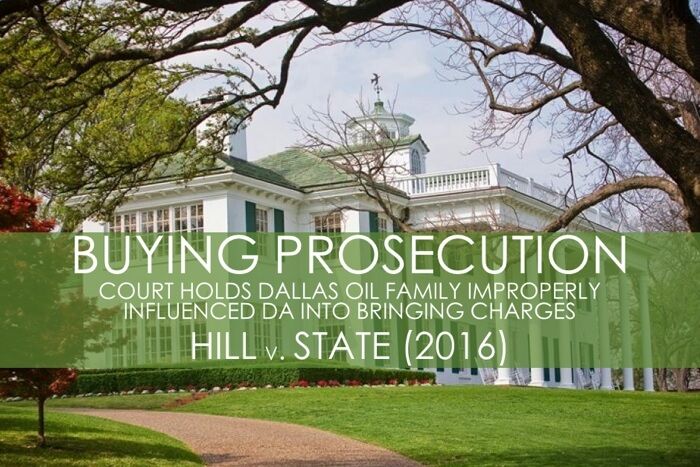
HL Hunt Mansion Dallas Hill v StateOn September 21st the Texas Court of Criminal Appeals issued a decision on the oil tycoon heir Albert Hill III’s criminal appeal. The question the Court faced was whether it was in the trial court’s discretion to conduct a pretrial evidentiary hearing on Hill’s motions to quash and dismiss based on prosecutorial vindictiveness. The Court determined that it was within the trial court’s discretion to conduct such a pretrial evidentiary hearing and that discretion was not limited by the defendant meeting “a certain threshold evidentiary requirement.”


Court Opinion: State of Texas v. Albert Hill (Tex. Crim. App. 2016)

The Facts | Trial Court Finds Dallas DA's Actions Improper

Appellant Hill is the great-grandson of legendary Dallas oil billionaire H.L. Hunt and the events surrounding the indictment dealt with a multi-million dollar trust litigation between Hill and his father. Hill and his wife Erin were indicted in 2011 for making false and misleading statements in order to obtain a $500,000 mortgage from Omni American Bank. The indictment came shortly after Hill won in the trust litigation against his father. Prior to the indictment (but after Albert Hill's victory in the trust litigation) Hill’s father’s attorney, Michael Lynn delivered a memo to the Dallas County District Attorney’s Office which alleged various offenses committed by Hill and his wife. Hill challenged these charges by filing a motion to quash the indictment and a motion to dismiss. Hill argued that the District Attorney, Craig Watkins, was under the influence of his disgruntled father as well as Lisa Blue Baron, one of Hill’s attorneys in the trust litigation case that had just filed a lawsuit against Hill seeking several million dollars in legal fees.

Some items of interest that the court noted were:

  • Lisa Blue Baron exchanged several phone calls and text messages with Watkins leading up to the indictment;
  • Michael Lynn’s law partner donated $48,500 to Watkins’ campaign prior to the indictment;
  • Lisa Blue Baron made a $100,000 donation to SMU LAW in Watkins’ honor after the indictment;
  • Lisa Blue Baron also held a fundraising event for Watkins’ campaign at her house and made a $5,000 donation to the campaign.

The trial court held an evidentiary hearing on Hill’s motions and granted both the motion to quash and the motion to dismiss.

The Court of Appeals Reversed the Trial Court's Decision

The Fifth Court of Appeals reversed the trial court's dismissals holding that the trial court “erred in conducting a hearing on Hill’s motion to dismiss.” The State argued that the trial court should not have held a pretrial evidentiary hearing because Hill failed to prove, with evidence, a prima facie case of prosecutorial misconduct and vindictiveness. The Court of Appeals stated that before a pretrial evidentiary can be held for a defendant claiming a violation of his constitutional rights, the defendant must “present facts sufficient to create a reasonable doubt about the constitutionality of his prosecution.” The Court of Appeals found that Hill did not sufficiently meet this standard.

The Court of Criminal Appeals Disagrees with the Court of Appeals, holds that Trial Courts Have Sound Discretion to Conduct a Pretrial Evidentiary Hearing

1. Article 28.01 - The CCA points to Article 28.01 in determining that the trial court had the discretion to hold a pretrial hearing on Hill’s motions to quash and suppress. Article 28.01 §1 provides that a trial court “may set any criminal case for a pre-trial hearing” and that some of things that the pre-trial hearing shall be to determine is the “pleadings of the defendant,’ ‘exceptions to the form or substance of the indictment,’ or discovery.’” Article 28.01 §1(1), (2), (4), (8). Additionally, while Article 28.01 does not expressly provide for an evidentiary hearing on a motion to dismiss like it does for a motion to suppress, the Court determined that it would be a misapplication of the rules of statutory construction to decide that oral testimony cannot be used in a pretrial hearing to resolve any other issue raised.

2. Case Law - The Court supported its Article 28.01 decision with the Court’s decision in Neal v. State which held that a defendant is required to “preserve a complaint of vindictive prosecution by filing a pretrial motion to quash and dismiss.” 150 S.W.3d 169. With that decision in mind the Court said “it would make no sense to limit the trial court’s discretion to hold an evidentiary hearing on such motion.”

The State pointed to federal case law that provided defendant must make a prima facie case that raised a reasonable doubt. However, these cases dealt with the issue of whether the trial court erred by denying a pretrial hearing. Thus, the Court stated that this case law is not on point in Hill’s case and thus are not controlling on this issue, and do not persuade the Court to hold otherwise.

Decision of the Criminal Court of Appeals | The Trial Court’s Discretion is Not Limited

The CCA determined that Article 28.01 has no limiting factor on the judge’s discretion to hold a pretrial evidentiary hearing based on any threshold evidentiary standard. Accordingly, the trial court did not err in conducting the pretrial evidentiary hearing in Hill’s case but instead acted within its bounds of sound discretion.

Read full article
Evil Clown Scare Texas

Hold Your Fire...Don't Shoot the Clowns! Yet.

By Luke A. Williams · Self-Defense

Evil Clown Scare TexasRecently, a friend asked me if it was legal for individuals to dress as clowns and scare the public. He also wanted to know what would happen if he were frightened by one of these clowns and shot the clown. While not asking the latter in complete seriousness, these questions do bring up potential criminal law issues.

Is it Legal to Dress as a Clown in Public?

There’s no state law that we’re aware of that makes dressing up like a clown in public per se illegal.

The only potential laws that may be applicable to these situations would be individual city ordinances. A search of city codes in a handful of Texas towns around the Metroplex reveals no ordinance specifically prohibiting dressing like a clown in public. The only codes we are able to find related to costumes primarily had to do with a prohibition on costumes which fail to cover private areas in regards to sexually oriented businesses.

While dressing like a clown doesn’t appear to be per se prohibited, there is certainly the risk of breaking other laws while dressed as a clown. In addition, dressing like a clown in public and creating unnecessary alarm or panic could be deemed as disorderly conduct.

Texas Penal Code, Chapter 42 lays out a list of behaviors that could constitute up to a Class B misdemeanor. Class B misdemeanors can carry a penalty of up to 6 months in jail and up to a $2,000 fine. Sec. 42.01 (a)(2) states that a person commits an offense [of disorderly conduct] if he intentionally or knowingly makes an offensive gesture or display in a public place, and the gesture or display tends to incite an immediate breach of the peace. An offense of this nature is a Class C misdemeanor and carries the possibility of up to a $500.00 fine.

Can I use Deadly Force Against the Clown?

Let’s start with the simple answer of “NO”. While individuals may be suffering from coulrophobia (the fear of clowns), this condition does not give you a right to use deadly force – or any force for that matter – against an individual simply because he or she is standing in public dressed as a clown.

The more complex answer of “maybe” would have to do with the use of force for self-defense purposes. Section 9.31 of the Texas Penal Code provides for a justifiable defense at the time of trial for self-defense, so long as the type of force used is reasonable and necessary in the moment to protect against an attacker. Under this law, the actor must reasonably believe that the force is reasonably necessary to protect against the other’s use or attempted use of unlawful force. Simply observing a clown, with no weapon or threat to use a weapon, provides no grounds to use force – much less deadly force – against that clown.

In addition, the Penal Code does establish that force may be used to protect one’s own property. A person in “lawful possession” of real property or personal property is justified in using force if “the actor reasonably believes the force is reasonably necessary to prevent or terminate the other’s trespass on the land…” However, the use of deadly force to protect one’s own property is limited. “A person is justified in using deadly force against another to protect land or property if (1) he is justified under TPC §9.41; (2) he reasonably believes using the force is immediately necessary to prevent commission of arson, burglary, or robbery; and, (3) the actor reasonably believes that the land or property cannot be protected or recovered by any other means [such as by calling law enforcement]. Tex. Penal Code Section 9.42.

Using force for self-defense purposes is a serious response to dangerous and threatening situations – but certainly not an appropriate response to being “creeped” out.

Bottom Line | Do Not Shoot the Clown (Yet)

Dressing up as a clown and causing fear amongst the public is a stupid (and perhaps even illegal) idea. Our attorneys would advise you strongly against it. You certainly place yourself in the position of having your behavior scrutinized by law enforcement for any potential illegal activity. And, if you’re simply afraid of clowns, do your defense attorney a favor and please do not shoot them.  BUT...If the clown lays a hand on you or chases you through a park, all bets are off. You may use force against the clown to avoid an assault.

Read full article

Speak with a Fort Worth attorney

Call (817) 993-9249 or send us a message to discuss your case.