Protect Your Family By Knowing These 3 Car Insurance Acronyms
 Car insurance premiums, like everything else these days, have reached historic highs. You get your renewal notice in the mail and gasp at the increase. So, you make the call to your insurance agent to see what can be done to save you money.
We’ve all seen the commercials – switch to us, bundle this with that, install this in your car, etc. and promises are made to save you money! A lot of times you will receive discounts by doing these things, BUT one of the main ways that insurance companies try to “save you money” is by asking you to reject KEY options in your policy that you’re unfamiliar with.
Here are the acronyms we want to educate you about:
UM – Uninsured Motorist Policy
UIM – Underinsured Motorist Policy
PIP – Personal Injury Protection
Under Texas law, these three options are required to be offered to you by your insurance company. However, you can choose to reject them as part of your car insurance policy if you so choose (Texas Insurance Code Art. 5.06(1) & Sec. 1952.152(b).)
It’s important to note these insurance options are part of YOUR insurance policy that add extra layers of coverage if you or your family are involved in a car wreck. Let’s talk about what these options are and why they are crucial to providing the adequate protection you need.
What is Uninsured Motorist Insurance (UM)?
This one’s pretty straightforward. This Uninsured Motorist insurance provides coverage if you are involved in an accident with another at-fault driver who does NOT have car insurance. Research estimates that around 1,500,000 drivers in Texas are not insured. That’s a lot of folks and the importance of having this insurance cannot be overstated!
What is Underinsured Motorist Insurance (UIM)?
This insurance provides coverage when you are involved in an accident and the at-fault party’s insurance limits aren’t enough to pay for your or your family’s medical bills, lost wages, loss of earning capacity, pain and suffering, etc. Believe it or not Texas’ minimum policy limits for auto insurance is STILL $30,000 per person/$60,000 per accident (Texas Transportation Code 601.072.) Those are the same minimum coverage amounts that existed in 2011! We could go into further discussion regarding why those amounts haven’t increased in 12 years, but we think it’s pretty obvious that the insurance companies have done a good job of making sure our state legislature doesn’t address this issue. When you consider how expensive medical bills have become and how much inflation has occurred over the last 12 years, it becomes apparent that this insurance is extremely necessary, too.
What is Personal Injury Protection (PIP)?
If you are involved in a car wreck, regardless of who is at fault, Personal Injury Protection insurance provides coverage to a certain limit for necessary expenses for:
1) Necessary medical, surgical, x-ray, or dental services, including prosthetic devices, and necessary ambulance, hospital, professional nursing or funeral services
2) Replacement of income lost as the result of the accident (lost wages) and,
3) if not an income or wage producer, reimbursement of necessary and reasonable expenses for essential services ordinarily provided by that person for care and maintenance of the family or household (Texas Insurance Code 1952.151.)
This coverage extends not only to the driver, but also to all occupants in the vehicle driven by you or your family member. It also provides coverage to you or your family member if you or they are a passenger in another vehicle driven by another person with their own insurance.
These three options were created by law to provide solid insurance coverage to protect Texas citizens and their families. For insurance companies, however, it’s not good for their bottom line and profits.
And, unfortunately, Texas law allows a way for insurance companies to avoid offering these options as part of your insurance policy. How do they do it? By getting YOU to agree to reject these options at the time you purchase your car insurance.
Now that you’ve read this and know what these insurance options provide, you would never agree to reject them, right? The reality, however, is that when you’re going through the insurance shopping experience (especially nowadays with current inflation rates) your focus becomes:
“HOW MUCH IS THIS GOING TO COST ME AND ARE THERE WAYS TO SAVE ME MONEY?”
Therein lies the vulnerability that insurance companies love to pounce on.
Your insurance agent or company will offer to save you a nominal amount of money if you agree to reject these options. We use the word nominal because the savings you might see are significantly outweighed by the out-of-pocket costs you will experience if involved in a car wreck and don’t have these coverages.
It’s worth noting that some insurance companies operate in such a way that they’d prefer to not even discuss UM/UIM/PIP and will instead deceptively present rejecting them as an easy option to save money without informing you fully about the consequences of doing so. That is exactly why we are providing you with the information in this article. Most shoppers are savvy these days and want to be informed about their purchases. We hope this article helps educate you about why these insurance options matter and how rejecting them ultimately offers you no real benefit. Don’t let the small amount of increase in your total policy premium deter you from REFUSING to reject UM/UIM/PIP coverage. Simply put – the additional amount you will pay IS WORTH IT.
Things we recommend when shopping for your insurance or when renewing it:
1) CONFIRM with your insurance agent or company that you are NOT rejecting UM/UIM/PIP,
2) READ WHAT YOU SIGN – we know this can be overwhelming and the insurance companies prefer it that way but do your best,
3) LOOK SPECIFICALLY for documentation that indicates you are rejecting UM/UIM/PIP,
4) LOOK SPECIFICALLY at your declarations page and look to see where UM/UIM/PIP coverages are included,
5) PAY ATTENTION to the minimum amounts for each so you know what you’re getting, and
6) IF YOU WANT MORE THAN THE MINIMUM COVERAGE, ask your insurance agent what higher limits they offer.
One more thing to note – if, after reading this article, you look at your policy and discover that you have rejected UM/UIM/PIP as part of your insurance coverage, call your insurance agent or company and inform them you want it added as soon as possible. We often handle cases where the client has rejected UM/UIM/PIP and unfortunately discover the “full coverage” they thought they had is far from it.
We’ll conclude with this – our hope is you have solid insurance coverage and NEVER need to use it. That really is the best case. If, however, you or your family are involved in a car accident, we highly recommend you consult with an attorney. Barnett, Howard & Williams, PLLC offers a free consultation and are here if you need us.
 The simple answer is that it means whatever the jury (not the judge) says it means.
 In Texas, under



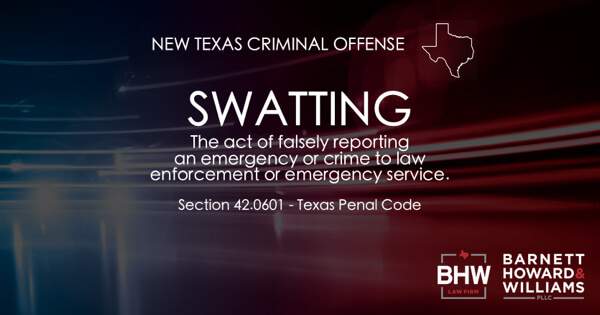
 Texas legislators enacted several new criminal laws in the 2021 legislative session. Below, we highlight one of them – Swatting. Being from Texas, I initially thought this might have something to do with mosquitoes, but, as it turns out, Swatting is the act of falsely reporting a crime or emergency to law enforcement or emergency personnel. This new offense is a Class A misdemeanor unless the prosecutor can show that you’ve been convicted of this same offense in the past.
 The 2021 Texas legislative session has now closed and there were several updates to our criminal statutes. Below are some of the more notable changes or additions to Texas criminal laws that took effect on September 1, 2021:
 In January of this year, the Supreme Court of Texas heard arguments for