
Skip to content

News and Insights

Page 22 of 107 · 532 articles

Texas statute of limitations for criminal offenses

Statute of Limitations in Texas | How Long Does the State Have to Bring Charges?

By Luke A. Williams · Criminal Defense

How Long Does the State Have to Bring a Criminal Case Against Me?

Texas statute of limitations for criminal offensesTexas law sets out the statute of limitations, the period during which formal charges must be brought against a defendant for most offenses. These time periods range from two years to over twenty years, and for some offenses there is no limitation period at all. The applicable limitation period depends on the particular offense that is alleged.

The various statutes of limitation mean that the state must present an indictment or information within said time period or prosecution will be time barred. The presentation of an indictment occurs when the grand jury has made its decision and the indictment is received by the court. Tex. Code Crim. Proc. Ann. Art. 12.06. The presentation of an information occurs when it has been properly filed in court. Tex. Code Crim. Proc. Ann. Art. 12.07. The limitations period is tolled while the case is pending after an information is filed or indictment issued. Tolling means that the time will not be counted against the limitations period.

Generally, the time period is measured based on the date the offense was committed. When computing the time period, the day on which the offense was committed and the day on which the charge was presented are excluded. Tex. Code Crim. Proc. Ann. Art. 12.04. Thus, the clock starts running the day after the offense was committed and is paused when the indictment or information is presented. Additionally, any time the defendant was absent from the state is excluded when computing the time period. Tex. Code Crim. Proc. Ann. Art. 12.05(1).

What Are the Time Periods in the Texas Statutes of Limitations?

TEXAS PERIODS OF LIMITATIONS FOR MISDEMEANOR OFFENSES

Texas law provides that for most misdemeanor offenses there is a standard period of limitations of two (2) years. Tex. Code Crim. Proc. Ann. arts. 12.02. The only exception is for Assault Family Violence allegations, for which the limitation period is 3 years. Thus, for any given misdemeanor charge, the State must bring prosecution within two years from the commission of the crime (or 3 years if the allegation is one of family violence).

TEXAS PERIODS OF LIMITATIONS FOR FELONY OFFENSES

There are several periods of limitations provided for the various felony offenses, as well as a catch all time period of three years for all other felonies not specifically provided for. Tex. Code Crim. Proc. Ann. art. 12.01(7). See the chart below for the time period provided for certain major felony offenses.

PERIOD OF LIMITATIONS FELONY OFFENSE
(A) Five Years


See Tex. Code Crim. Proc. Ann. art. 12.01(4).

  • Theft or Robbery,
  • Kidnapping or Burglary (except as provided in (E)),
  • Injury to Elderly or Disabled (unless 1st Degree),
  • Abandoning or Endangering Child, and
  • Insurance Fraud

(B) Seven Years


See Tex. Code Crim. Proc. Ann. art. 12.01(3).

  • Money Laundering
  • Credit Card or Debit Card Abuse
  • Medicaid Fraud
  • False statement to obtain property or credit; and
  • Fraudulent Use or Possession of Identifying Information

(C) Ten Years


See Tex. Code Crim. Proc. Ann. art. 12.01(2).

  • Theft of any estate by an executor, administrator, guardian, or trustee
  • Theft by a public servant of government property
  • Forgery or uttering, using, or passing of a forged instrument
  • Sexual assault (except as provided in (F)),
  • Injury to an elderly individual or disabled individual (if punishable as a first degree felony), and
  • Arson

(D) Ten Years from the Victim's 18th Birthday


See Tex. Code Crim. Proc. Ann. art. 12.01(6).

  • Injury to a Child

(E) Twenty Years from the Victim's 18th Birthday


See Tex. Code Crim. Proc. Ann. art. 12.01(5).

  • Sexual Performance by a Child younger than 17
  • Aggravated Kidnapping with intent to sexually abuse a victim younger than 17, and
  • Burglary of a Habitation with the intent to sexually abuse a victim younger than 17

(F) No Time Limitation


See Tex. Code Crim. Proc. Ann. art. 12.01(1).

  • Murder or Manslaughter
  • Leaving the Scene of an Accident which Resulted in Death
  • Indecency with a Child
  • Sexual Assault or Aggravated Sexual Assault of a Child
  • Continuous Sexual Abuse of a Child
  • Sexual Assault if DNA testing indicated that the perpetrator’s identity could not be readily determined
  • Sexual Assault if there is probable cause to believe that the defendant has committed the same or similar offense against 5 or more victims

(G) Three Years


See Tex. Code Crim. Proc. Ann. art. 12.01(7).

  • All other Felonies.
  • Misdemeanor Assault Family Violence.

Periods of Limitations for Aggravated Offenses, Attempt, Conspiracy, and Solicitation

The limitation period for criminal attempt is the same as provided for the offense attempted. Tex. Code Crim. Proc. Ann. art. §12.03(a). Additionally, the limitation period for criminal conspiracy or organized crime is that of the most serious offense that is the subject of the conspiracy or organized crime. §12.03(b) Further, the limitation period provided for criminal solicitation is the same as the period of the felony solicited. §12.03(c). Finally, an aggravated offense has the same period of limitation as provided for the primary crime. §12.03(d)

In conclusion, these limitations are set out to protect defendants from having to face charges where evidence is stale and witnesses are unavailable due to the long period of time the State has waited to bring prosecution. The Texas Code of Criminal Procedure is very specific in how it has laid out the periods of limitations so that there will be no question as to the time period for a particular offense and how that time period should be computed.

*Note: The above provided chart is not all-inclusive but instead focuses on only some of the major felony offenses. An exhaustive list can be found in Section 12.01 of the Texas Code of Criminal Procedure.


Read full article
Best Fort Worth DWI Attorney

Do's and Don'ts When You're Pulled Over for a DWI

By Jason H. Howard · DWI

Finding those blue and red lights in your rearview mirror is never ideal. If it’s a DWI stop, it can feel like your heart is racing twice as fast. But while the nerves are understandable, the key here is knowing what to do—and maybe more importantly, what not to do. Let’s dive into a few tips that might make a difference if you find yourself in this situation.

Stay Calm and Collected if Stopped for DWI

Do: Breathe. Take a moment, gather your thoughts, and remember that keeping calm can really help. When the officer approaches, be respectful and polite. A calm demeanor doesn’t mean you’re admitting guilt; it simply shows maturity and may influence how the officer views you. Even if your pulse is racing, a little “fake it till you make it” can go a long way.

Don’t: React emotionally or aggressively. Panicking or being rude won’t help. It could even escalate the situation. The officer is there to do their job, and unfortunately, this may involve some tough questioning. But stay focused—cool and collected is the goal.

Comply with Basic Requests, But Know Your Rights

Do: Hand over your license, insurance, and registration when asked. This is standard procedure, and providing these essentials without fuss can keep things running smoothly.

Don’t: Overshare. Remember, officers will often ask questions about where you’ve been or how much you’ve had to drink. It may seem like casual conversation, but it’s often their way of gathering information. Instead of diving into a full recap of your evening, keep it simple and to the point. You don’t have to answer beyond basic questions, so politely decline to offer additional details if you feel uncomfortable.

Field Sobriety Tests – The Art of the Polite Refusal

Do: Know your right to say “no.” Field sobriety tests, like the “walk and turn” or the “one-leg stand,” are voluntary in Texas (unless you’re on probation). Politely refusing can be a smart move, as these tests are designed in a way that even sober people can struggle with them—stress, nerves, and uneven ground can all affect the results.

Don’t: Feel pressured to go along just because the officer doesn’t explicitly ask if you’re willing to participate. Officers might assume you’ll comply and jump straight into the tests. So, if you’d rather not do them, a simple, “I prefer not to take these tests” can be your best option. Remember, you’re not obligated to help build the state’s case against you.

Breath and Blood Tests – Understanding the Consequences

Do: Know what’s at stake. Breath and blood tests fall into a slightly different category. In Texas, refusing a breath or blood test can have immediate consequences, like a license suspension, but it’s still within your rights unless an officer presents a warrant.

Don’t: Refuse if a valid warrant is presented. If an officer has obtained a warrant for a blood test, you’re legally required to comply. Failing to do so could lead to additional legal trouble, which might make a bad situation worse. Think carefully, and when in doubt, ask for clarity.

Remain Silent Beyond Basic Information

Do: Use your right to remain silent wisely. Beyond providing identification, you’re not obligated to answer detailed questions. Many people feel the need to explain themselves in these situations, but even seemingly innocent statements could later be used as evidence.

Don’t: Spill the details of your evening. This isn’t the time for full transparency about how much you had to drink or why you may look tired. Politely telling the officer, “I’m not comfortable answering that” is within your rights and can help prevent anything being taken out of context later.

Plan Ahead – Use Alternative Transportation

Do: Make a game plan in advance. Look, no one wants to be in a situation where they’re stopped for DWI. Using rideshare options like Uber or Lyft can save a lot of trouble and maybe even a lot of money. If there’s even a slight chance that you’re over the limit, it’s best to leave the car keys behind.

Don’t: Wait until it’s too late. Last-minute decision-making is stressful, and being proactive is way easier than facing DWI charges. Think of it as a minor investment in your peace of mind—and definitely cheaper than the potential costs of a DWI.

Wrap-Up: Staying Smart and Safe on the Road

Getting pulled over is never a pleasant experience, especially when a DWI is involved. The best steps are often the simplest: stay calm, comply with basic requests, know your rights, and remember the power of a polite refusal. Ultimately, avoiding this situation by planning ahead—calling that Uber—is the smartest move you can make. But if it ever does happen, hopefully, these do’s and don’ts will guide you through with confidence.

Here’s to making smart choices and staying safe on the road.

Read full article
Scholarship Winners BHW 2024

2024 Scholarship Winners

By Brandon Barnett · Scholarship

Barnett Howard & Williams PLLC Announces the Recipients of the 2024 Scholarship Awards

Scholarship Winners BHW 2024BHW is thrilled to continue our two scholarships for 2024. In honor of the sacrifices of our military veterans, our scholarships are connected to military service. The first scholarship is a $500 award for a Military Veteran Law Student and the second scholarship is a $500 award for a Military Dependent undergraduate student. Throughout the year, we received many applications from very deserving students. We appreciate all of the students that took the time to apply for the scholarships and wish them all the best in their studies. For those students that were not selected, we invite you to apply again next year as we plan to continue the scholarship offers as an annual award.


2024 Winner - Military Veteran Law Student Scholarship

The winner of the 2024 Military Veteran Law Student Scholarship is:

DERRICK BRANTLEY

Derrick Brantley is a U.S. Army infantry veteran that served in both Iraq and Afghanistan. Mr. Brantley currently attends Dwayne O. Andreas School of Law - Barry University in Orlando, Florida. Congratulations Derrick Brantley. Best wishes as you continue toward your law degree.


2024 Winner - Military Dependent Scholarship

The winner of the 2024 Military Dependent Undergraduate Scholarship is:

SA'NYA POLO

Sa'Nya Polo is a US Army dependent whose parents both served in the US Army and continue to serve as government employees assisting veterans. Ms. Polo currently attends UCLA and is pursuing a degree in film. Congratulations Sa'Nya Polo. Best wishes as you continue in your studies.


More Information About Our Scholarship Opportunities:

For more information about how to apply for these scholarships in future years, please visit the scholarship pages:

Military Veteran Law Student Scholarship

Military Dependent Scholarship

Read full article
Gavel and legal documents representing the serious penalties of DWI offenses

How a Fort Worth DWI Attorney Can Save Your Future

By Jason H. Howard · DWI

How a Fort Worth DWI Attorney Can Save Your Future: Expert DWI Defense Lawyer Fort Worth Guidance

Facing a DWI charge in Fort Worth can be a daunting experience, with potential consequences that may impact your future significantly. Understanding the legal landscape surrounding DWI charges is crucial for anyone navigating this challenging situation. This article will explore how a Fort Worth DWI attorney from Howard Lotspeich Alexander & Williams, PLLC (HLAW) can provide essential guidance and representation, ensuring your rights are protected throughout the legal process. We will delve into the nature of DWI charges, the legal penalties involved, and the steps you should take after an arrest. Additionally, we will highlight the importance of seeking professional legal assistance from HLAW, a firm specializing in DWI defense.

What Are DWI Charges in Fort Worth and Texas?

DWI charges, or Driving While Intoxicated, are serious offenses in Texas that can lead to severe legal repercussions. A DWI is defined as operating a motor vehicle while having a blood alcohol concentration (BAC) of 0.08% or higher. This legal threshold is established to ensure public safety and deter impaired driving. The implications of a DWI charge can be far-reaching, affecting not only your driving privileges but also your personal and professional life.

What Defines a DWI in Texas and Fort Worth?

In Texas, a DWI is characterized by the operation of a vehicle under the influence of alcohol or drugs. The law does not formally distinguish between DWI and DUI; rather, "DWI" is the term used for impaired driving offenses regardless of age. The term DUI is not commonly used in Texas law for adult impaired driving offenses. Understanding this is vital, as the penalties for a DWI conviction are generally severe and apply to all adults.

What Are the Legal Penalties for DWI Offenses in Texas?

Gavel and legal documents representing the serious penalties of DWI offenses

The legal penalties for DWI offenses in Texas can vary based on several factors, including prior convictions and the circumstances surrounding the arrest. Common penalties include:

Penalty Type Description Duration
Fines Up to $2,000 for a first offense Varies
Jail Time 72 hours to 180 days for a first offense Varies
License Suspension 90 days to 1 year Varies
Community Service 24 to 100 hours Varies

These penalties can have a lasting impact on your life, making it essential to seek legal representation to navigate the complexities of your case.

How Can a Fort Worth DWI Attorney Protect Your Rights?

A Fort Worth DWI attorney from Howard Lotspeich Alexander & Williams, PLLC (HLAW) plays a crucial role in protecting your rights and ensuring you receive a fair trial. They are equipped with the knowledge and experience necessary to challenge the evidence against you and explore potential defenses.

What Legal Defense Strategies Do Fort Worth DWI Lawyers Use?

DWI lawyers at HLAW employ various defense strategies to protect their clients. Some common approaches include:

  • Challenging the Traffic Stop: If the initial stop was unlawful, any evidence obtained may be inadmissible.
  • Questioning BAC Test Results: Issues with the administration of breath or blood tests can lead to inaccurate results.
  • Proving Lack of Impairment: Demonstrating that the driver was not impaired despite a high BAC reading can be a viable defense.

These strategies highlight the importance of having a knowledgeable attorney from HLAW who can navigate the legal system effectively.

Why Choose Howard Lotspeich Alexander & Williams, PLLC (HLAW) for Your DWI Defense?

Howard Lotspeich Alexander & Williams, PLLC (HLAW) specializes in legal defense services with a focus on DWI cases in Fort Worth, Texas. Our experienced attorneys understand the intricacies of DWI laws and are dedicated to providing personalized legal representation. By choosing HLAW, you gain access to a team that prioritizes your rights and works diligently to achieve the best possible outcome for your case.

What Steps Should You Take After a DWI Arrest in Fort Worth?

After a DWI arrest, it is crucial to take immediate action to protect your rights and future. Here are essential steps to consider:

  • Remain Silent: Avoid discussing your case with anyone except your attorney.
  • Document Everything: Keep detailed notes about the arrest and any interactions with law enforcement.
  • Contact a DWI Attorney: Schedule a consultation with a qualified DWI attorney at HLAW as soon as possible.

How to Schedule a Consultation with a Fort Worth DWI Attorney at HLAW?

Scheduling a consultation with a Fort Worth DWI attorney at Howard Lotspeich Alexander & Williams, PLLC (HLAW) is straightforward. You can typically reach out via phone or through our firm's website. During the consultation, be prepared to discuss the details of your case and any evidence that may be relevant.

What Immediate Actions Can Help Save Your Future After a DWI Charge?

Taking proactive steps after a DWI charge can significantly impact the outcome of your case. Consider the following actions:

  • Gather Evidence: Collect any relevant documents, such as police reports and witness statements.
  • Contact Witnesses: Reach out to individuals who may have witnessed the incident to gather their accounts.
  • Stay Informed: Educate yourself about DWI laws and potential defenses to better understand your situation.

These actions can help build a strong defense and improve your chances of a favorable outcome.

How Have Recent Texas DWI Law Updates Impacted Defense Strategies?

Recent updates to Texas DWI laws have introduced new considerations for defense strategies. Staying informed about these changes is essential for anyone facing DWI charges.

What Are the Key 2024-2026 Texas DWI Law Changes?

Key changes in Texas DWI laws from 2024 to 2026 include increased penalties for repeat offenders and enhanced enforcement measures. However, as of mid-2024, no specific new legislation with effective dates through 2026 has been enacted that significantly alters DWI penalties statewide. It is important to consult with a qualified attorney at HLAW to understand any local or pending legislative changes.

How Do These Updates Affect Your DWI Case in Fort Worth?

The recent law changes can impact your DWI case in Fort Worth. Understanding these updates allows your attorney at Howard Lotspeich Alexander & Williams, PLLC (HLAW) to tailor defense strategies that align with the current legal landscape, potentially improving your chances of a favorable outcome.

Contact HLAW today for a free case evaluation and consultation.

Read full article
Texas Standard Possession Order child custody calendar

Texas Child Custody: Standard Possession and Visitation in Texas

By Laura B. Alexander · Child Custody

Which Parent Gets Custody? The Standard Possession Order for Child Custody in Texas

When parents in Texas divorce or separate, one of the most important issues they face is child custody. Texas law recognizes two types of custody: physical custody, which refers to where the child lives, and legal custody, which refers to the right to make decisions about the child's upbringing. In cases where parents cannot agree on custody arrangements, the court may order a standard possession order.
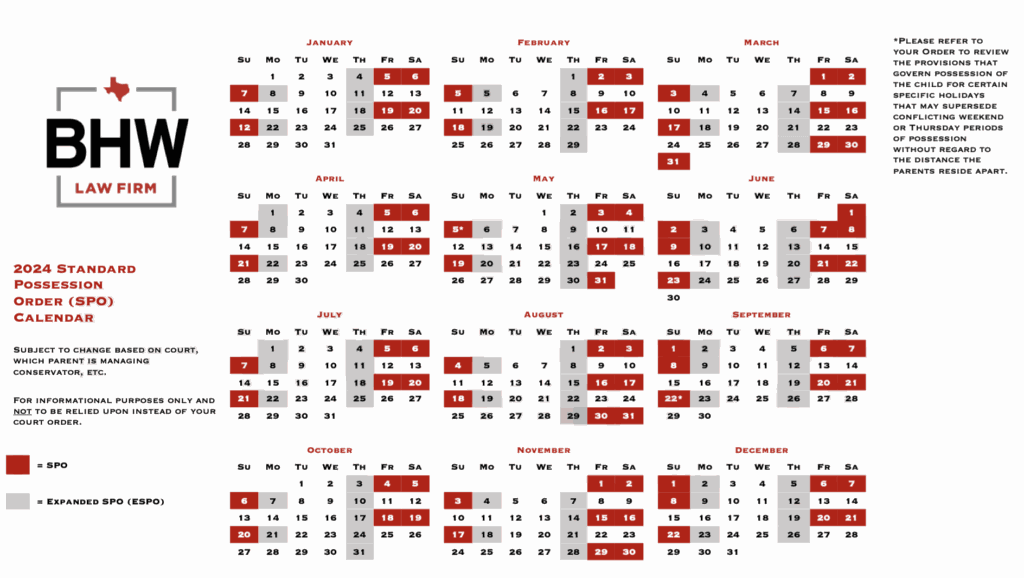
A standard possession order is a court-ordered schedule that determines when each parent will have physical custody of the child. The order is designed to provide regular and predictable time for both parents to spend with the child. In Texas, the standard possession order is governed by the Texas Family Code, and it provides a default schedule that can be modified by agreement of the parties or by the court if certain circumstances exist.

Under the standard possession order, for parents residing within 50 miles of each other, the non-custodial parent (referred to as the "possessory conservator" in Texas) has the right to possession of the child on the first, third, and fifth weekends of each month, starting at the time school is dismissed on Friday and ending at the time school resumes on Monday. In addition, the possessory conservator has the right to possession on mid-week during the school year from the time school is dismissed on Thursday until the time school resumes on Friday morning.

The standard possession order, for parents residing within 50 miles of each other, also provides for the possessory conservator to have the child for 30 days in the summer, which can be broken up into two periods of at least seven days each. The order also provides for the possessory conservator to have the child on alternating holidays, such as Thanksgiving, Christmas, and spring break. The exact dates and times for each holiday are specified in the order.

Printable Standard Possession Order for 2024. CLICK HERE

Texas Standard Possession Order 2024 Child Custody

Does the SPO Apply if the Parents Live Too Far Away?

In cases where the parent lives more than 50 miles but less 100 miles apart, the non-custodial parent (referred to as the "possessory conservator" in Texas) has the right to possession of the child on the first, third, and fifth weekends of each month, starting at 6:00 pm on Friday and ending at 6:00 pm on Sunday. In addition, the possessory conservator has the right to possession on Thursdays during the school year from 6:00 pm to 8:00 pm.

In cases where the parents live more than 100 miles apart, the standard possession order provides for additional periods of possession to ensure that the non-custodial parent has meaningful time with the child. For example, the non-custodial parent may have the right to possession on one weekend per month instead of the first, third, and fifth weekends. You
should consult with your family law attorney to determine whether this distance consideration impacts your situation.

Can the Standard Possession Order be Modified?

It's worth noting that the standard possession order is just that - a default schedule that can be modified by agreement of the parties or by the court. Parents who are able to work together to create a schedule that works for their family may be able to deviate from the standard possession order. However, if the parties cannot agree, the court will likely order the standard possession order.

Overall, the standard possession order provides a predictable schedule for both parents to spend time with the child. While it may not work for every family, it is a useful starting point for parents who are unable to agree on a custody schedule.

An Experienced Divorce and Child Custody Lawyer Can Help Determine When Each Parent Has Possession of Their Child

Most of the time, it is best to contact an experienced family law attorney to help explain and establish each of these possession schedules, including any customizations or unique provisions the court finds to be in the best interest of your child. You are often not limited to the standard and expanded standard schedule above–but you may need an experienced attorney to fight for you to have more time with your child. Let our experienced family law attorneys assist you in discussing this schedule with the other parent and the court. Contact BHW Family Law at (817) 993-9249 for a free consultation of your family law matter.

Read full article

Speak with a Fort Worth attorney

Call (817) 993-9249 or send us a message to discuss your case.