Short answer: Since September 1, 2025, Texas law makes driving while intoxicated in a school crossing zone a state jail felony when the State proves the driver was in the zone "during the time the reduced speed limit applies." A state jail felony carries 180 days to two years in a state jail and a fine of up to $10,000, compared with a Class B misdemeanor for a typical first DWI. The enhancement depends on specific facts, including whether the zone was properly designated and whether the reduced speed limit was in effect at that moment, so those details are often central to the defense.
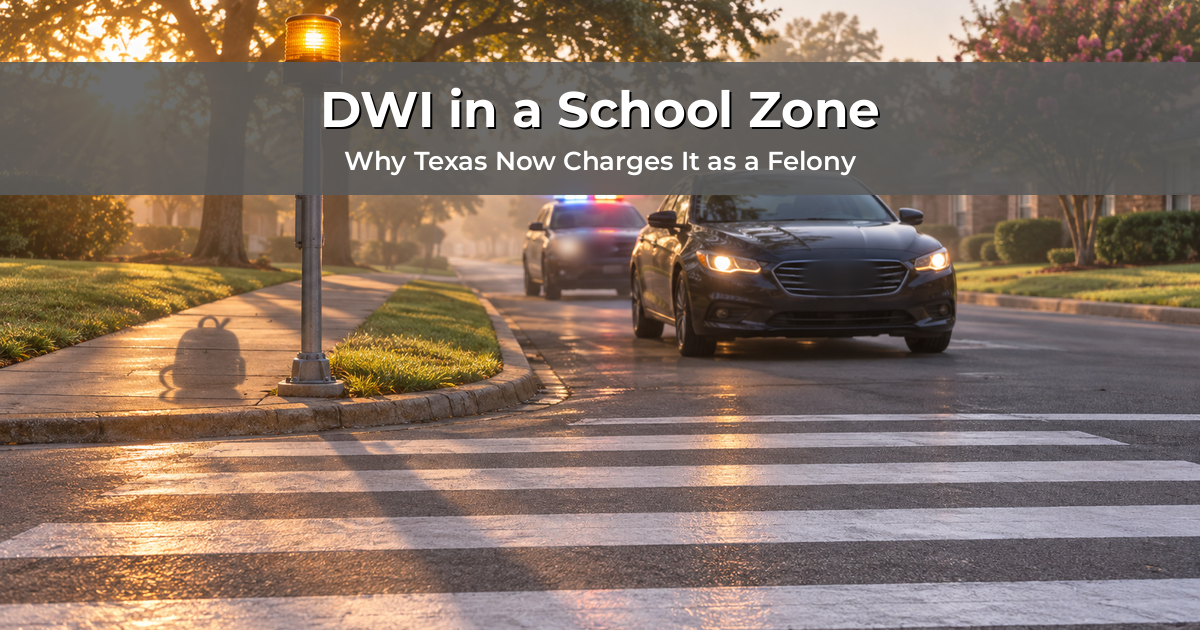
Every school day in Dallas-Fort Worth, thousands of drivers pass through school zones on their way to work, often on major roads near neighborhood schools in Fort Worth, Arlington, Keller, Frisco, and Denton. A DWI arrest at 7:30 in the morning or 3:30 in the afternoon can now carry far more serious consequences than the same arrest a block away or an hour later.
At Howard Lotspeich Alexander & Williams, PLLC (HLAW), our Fort Worth DWI attorneys defend people charged with DWI in Tarrant, Dallas, Denton, Collin, Johnson, and Parker counties. This guide explains the school crossing zone DWI law, what the State must prove, the possible penalties, and how these cases are defended.
Key Takeaways
- It is a felony. Under Texas Penal Code §49.04(e), a DWI committed while "operating the motor vehicle in a school crossing zone during the time the reduced speed limit applies to the zone" is a state jail felony (Tex. Penal Code §49.04).
- The law is new. Senate Bill 826 added the provision, took effect September 1, 2025, and applies prospectively (S.B. 826, 89th Leg.; Senate Research Center bill analysis).
- Timing matters. The enhancement applies only when the reduced speed limit is in effect, not at all hours (Tex. Penal Code §49.04(e)).
- The zone must be legally designated. A "school crossing zone" is a reduced-speed zone "designated on a street by a local authority" for children going to or leaving school (Tex. Transp. Code §541.302).
- Punishment ranges from 180 days to two years. A state jail felony carries 180 days to two years in a state jail and up to a $10,000 fine, though a court may impose misdemeanor-level confinement in some cases (Tex. Penal Code §§12.35, 12.44).
- The license deadline still applies. You generally have 15 days after receiving notice of a license suspension to request an administrative hearing (Tex. Transp. Code §724.041).
What Does the Texas School Zone DWI Law Say?
Texas Penal Code §49.04(a) makes it an offense to be "intoxicated while operating a motor vehicle in a public place." A first DWI is ordinarily a Class B misdemeanor with a minimum of 72 hours of confinement. Subsection (e), added in 2025, reads:
"If it is shown on the trial of an offense under this section that at the time of the offense the person was operating the motor vehicle in a school crossing zone during the time the reduced speed limit applies to the zone, the offense is a state jail felony."
The statute adopts the Transportation Code's definition of "school crossing zone" (Tex. Penal Code §49.04). Under §541.302 of that code, a school crossing zone is "a reduced-speed zone designated on a street by a local authority to facilitate safe crossing of the street by children going to or leaving a public or private elementary or secondary school during the time the reduced speed limit applies" (Tex. Transp. Code §541.302).
Why did the Legislature pass S.B. 826?
According to the Senate Research Center's analysis, the bill's supporters said school zones "are meant to be safe areas where young students can walk, bike, and be dropped off or picked up without the heightened threat of impaired drivers," and the bill "enhances a DWI that occurs in a school zone to a state jail felony" (Senate Research Center). The enrolled bill states that it "takes effect September 1, 2025" (S.B. 826 enrolled).
What Must Prosecutors Prove for a School Zone DWI?
To convict someone of the felony version, the State generally must prove all of the ordinary DWI elements plus the school zone facts. In practical terms, that includes:
- Intoxication. The person did not have the normal use of mental or physical faculties because of alcohol or drugs, or had an alcohol concentration of 0.08 or more.
- Operating a motor vehicle. The person was driving or otherwise operating the vehicle.
- In a public place. Public roads near schools usually qualify.
- Within a school crossing zone. The location was a reduced-speed zone designated by a local authority, such as a city or county, for children going to or leaving school.
- During the reduced speed limit period. The reduced speed limit actually applied at the time of the offense.
Because §49.04(e) says the fact must be "shown on the trial," the school zone element is something the State must prove with evidence, not simply allege. Elements four and five are new, and they can raise questions that do not exist in a typical DWI case.
When Does the Reduced Speed Limit Apply?
The answer is local. School zones in DFW are set by cities and counties, and the hours often depend on the school's schedule. Many zones use flashing beacons during posted morning and afternoon periods, while others use signs listing specific times. Some zones apply only on school days.
That means the same intersection may be a felony location at 7:45 a.m. on a Tuesday in October and an ordinary misdemeanor location at 10:00 p.m. on a Saturday in July. Evidence that can matter includes:
- The city or county ordinance or traffic order that designated the zone.
- The posted hours on the signs and whether beacons were flashing.
- The school calendar for that day, including holidays, teacher workdays, and early release days.
- Dash camera and body camera video showing the location and the signs.
- The exact time of driving, which may differ from the time of the stop or arrest.
What Are the Penalties for DWI in a School Zone?
The table below compares the school zone offense with other common Texas DWI levels.
| Charge | Offense level | Confinement range | Maximum fine | Source |
|---|---|---|---|---|
| First DWI | Class B misdemeanor | 72 hours to 180 days | $2,000 | Penal Code §49.04(b), §12.22 |
| First DWI, 0.15 or more | Class A misdemeanor | Up to 1 year | $4,000 | Penal Code §49.04(d), §12.21 |
| DWI in a school crossing zone | State jail felony | 180 days to 2 years | $10,000 | Penal Code §§49.04(e), 12.35 |
| Third DWI | Third-degree felony | 2 to 10 years | $10,000 | Penal Code §49.09(b), §12.34 |
Under §12.35, a person "adjudged guilty of a state jail felony shall be punished by confinement in a state jail for any term of not more than two years or less than 180 days," and may also be fined up to $10,000 (Tex. Penal Code §12.35).
Can a school zone DWI be reduced to a misdemeanor?
Texas law provides two possible paths. Under §12.44(a), a court may impose Class A misdemeanor confinement for a state jail felony if, after considering the circumstances and the defendant's history and rehabilitative needs, the court finds that such punishment "would best serve the ends of justice." Under §12.44(b), at the prosecutor's request, the court "may authorize the prosecuting attorney to prosecute a state jail felony as a Class A misdemeanor" (Tex. Penal Code §12.44). Neither is automatic, and both depend on the facts and the prosecutor's and court's discretion.
Is probation or deferred adjudication available?
Community supervision (probation) may be available depending on the case. For deferred adjudication, Article 42A.102 excludes DWI cases in which the defendant held a commercial driver's license or had an alcohol concentration of 0.15 or more, as well as DWIs enhanced under §49.09 (Tex. Code Crim. Proc. art. 42A.102). The statute does not separately list the school crossing zone provision, but whether deferred adjudication is offered in a particular case is a question to discuss with your lawyer. Our article on DWI deferred adjudication in Texas explains how it works.
If probation is granted after a DWI conviction, the court may require an ignition interlock device, and must require one in certain cases, such as when a test showed 0.15 or more (Tex. Code Crim. Proc. art. 42A.408).
How Is a School Zone DWI Different From DWI With a Child Passenger?
They are separate offenses. DWI with a child passenger under Penal Code §49.045 applies when a passenger is younger than 15, regardless of where the vehicle is. A school zone DWI applies based on location and time, even if no child is in the car. Both are state jail felonies, and in some cases both may be alleged. See our guide to DWI with a child passenger in Texas.
What About My Driver's License?
A school zone DWI arrest can trigger the same administrative license suspension process as any other DWI. If you refused a breath or blood test, the Department of Public Safety generally will suspend your license for 180 days for a first refusal (Tex. Transp. Code §724.035). You generally have 15 days after receiving notice of the suspension to request a hearing (Tex. Transp. Code §724.041). Read more in our guide to the ALR hearing 15-day deadline and our article on Texas DWI license suspensions and occupational licenses.
How Do Lawyers Defend a School Zone DWI?
A school zone DWI is defended like any DWI, with additional issues specific to the enhancement:
- Was the stop lawful? The officer needed reasonable suspicion to make the traffic stop.
- Is the intoxication evidence reliable? Field sobriety tests, breath tests, and blood tests can all be challenged.
- Was the location a legally designated school crossing zone? The State may need to show the zone was designated by a local authority.
- Did the reduced speed limit apply at that time? The posted hours, flashing beacons, and school calendar can matter.
- Where was the car when it was being operated? If the driving occurred outside the zone and the stop happened inside it, or the reverse, the location of the driving can become an issue.
- Does the law apply to the date of the offense? S.B. 826 applies prospectively, so offenses before September 1, 2025, are governed by prior law.
Because the school zone fact raises the case from a misdemeanor to a felony, each of these questions can significantly change the outcome. For context on how Texas treats felony DWI more generally, see our article on a third DWI in Texas, and for high test results, see our guide to 0.15 BAC DWI charges.
Frequently Asked Questions
Is DWI in a school zone a felony in Texas?
Yes, for offenses on or after September 1, 2025, if the State proves the driver was in a school crossing zone during the time the reduced speed limit applied. It is a state jail felony under Penal Code §49.04(e).
Does the school zone law apply at night or on weekends?
The enhancement applies only "during the time the reduced speed limit applies to the zone." Many school zones are active only during posted morning and afternoon hours on school days, so a DWI at night or on a weekend in the same location may not qualify.
What if no children were present?
The statute does not require that children be present. The key facts are the designated zone and whether the reduced speed limit was in effect.
Can a school zone DWI be charged as a misdemeanor instead?
Possibly. Under Penal Code §12.44(b), the court may authorize the prosecutor to prosecute a state jail felony as a Class A misdemeanor at the prosecutor's request. This depends on the case and is not guaranteed.
Will I lose my license after a school zone DWI arrest?
You may face an administrative license suspension, especially after a test refusal or a test result of 0.08 or more. You generally have 15 days after notice to request a hearing to contest it.
What should I do after a school zone DWI arrest in DFW?
Request your ALR hearing within the deadline, write down the time and location of the stop, avoid discussing the case, and talk to a DWI defense lawyer quickly so evidence about the zone, such as signage and beacon status, can be preserved.
Talk to a Fort Worth DWI Defense Lawyer
A school zone DWI can turn an ordinary misdemeanor arrest into a felony case. The details of the zone, the time, and the evidence matter, and early action can help preserve them.
Call HLAW at (817) 993-9249 or contact us online for a free consultation about a DWI charge in Dallas-Fort Worth.
This article is for general informational purposes only and is not legal advice. Reading it does not create an attorney-client relationship. Laws change, and every case depends on its specific facts.