Short answer: In Texas, an apartment owner can be held liable when a tenant or guest is assaulted, robbed, or otherwise hurt by a criminal on the property, but only in limited situations. Generally, the owner must have known or had reason to know of an unreasonable and foreseeable risk of that kind of crime, usually shown by similar prior crimes on or near the property, and must have failed to take reasonable steps to reduce it. Separately, the Texas Property Code requires landlords to provide specific locks and security devices and to rekey units between tenants. These claims are generally subject to a two-year deadline to file suit.
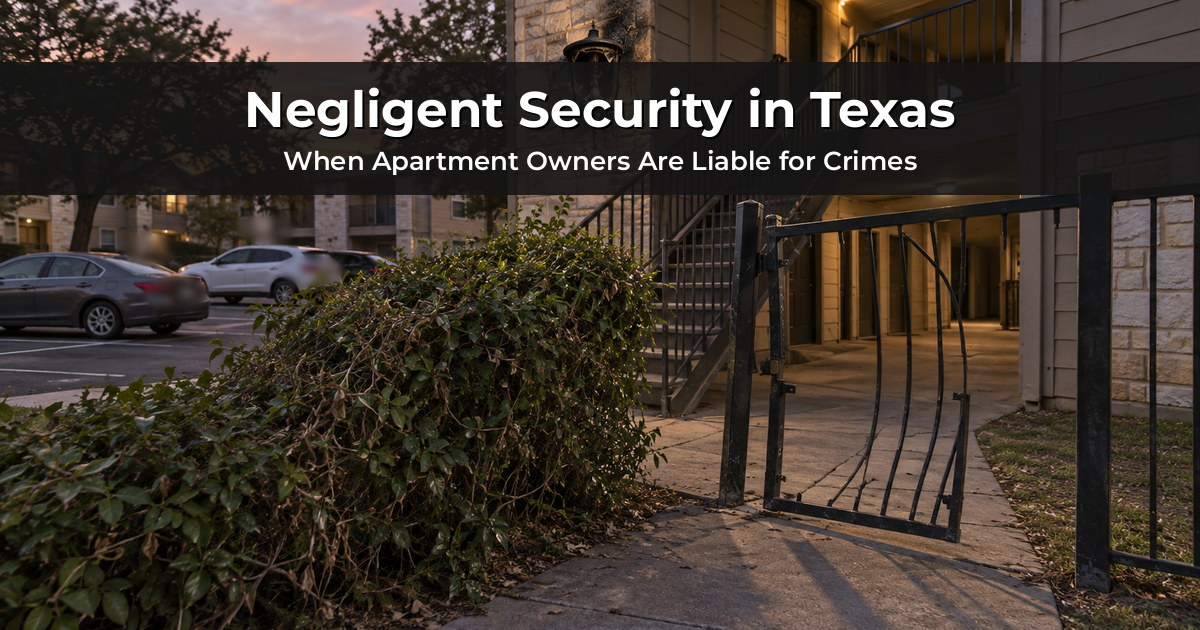
Being attacked where you live is frightening, and it is natural to ask whether the property should have done more. Broken gates, dark parking lots, missing deadbolts, and repeated break-ins that management ignored can all be part of a negligent security claim. Texas law, however, sets demanding rules for these cases, and the details matter.
At Howard Lotspeich Alexander & Williams, PLLC (HLAW), our Fort Worth personal injury lawyers represent injured people and families throughout Tarrant, Dallas, Denton, Collin, Johnson, and Parker counties. This guide explains how negligent security claims work in Texas, what the Texas Supreme Court requires, and what evidence tends to matter most.
Key Takeaways
- The general rule favors property owners. The Texas Supreme Court has said that "generally, a premises owner has no duty to protect invitees from criminal acts by third parties," with an exception when the owner "knows or has reason to know of a risk of harm to invitees that is unreasonable and foreseeable" (Del Lago Partners v. Smith, Tex. 2010).
- Prior crimes usually drive foreseeability. Courts weigh five Timberwalk factors: proximity, recency, frequency, similarity, and publicity of prior crimes (Timberwalk Apartments v. Cain, Tex. 1998).
- Foreseeable is not enough by itself. In a 2017 case involving a shooting in an apartment visitor lot, the Texas Supreme Court held that a risk must be "both foreseeable and unreasonable," which also weighs the burden of preventing it (UDR Texas Properties v. Petrie).
- Texas law requires specific security devices. Without a tenant having to ask, a rental dwelling must have window latches, a doorknob lock or keyed dead bolt, sliding door pin locks and bars or handle latches, and a keyless bolting device and door viewer on each exterior door (Tex. Prop. Code §92.153).
- Locks must be rekeyed between tenants. Landlords must rekey key, card, or combination devices within seven days after each tenant turnover (Tex. Prop. Code §92.156).
- The criminal's share of fault counts. A defendant can ask the jury to assign responsibility to the attacker, even an unknown "John Doe," which can reduce what the property owner pays (Tex. Civ. Prac. & Rem. Code ch. 33).
- Two years is the usual deadline. Personal injury suits generally must be filed "not later than two years after the day the cause of action accrues" (Tex. Civ. Prac. & Rem. Code §16.003).
What Is a Negligent Security Claim in Texas?
A negligent security claim is a type of premises liability case. The injured person argues that the owner or manager of a property failed to use reasonable care to protect people on the property from a foreseeable crime, and that this failure was a cause of the injury.
These claims often arise from:
- Assaults or robberies in apartment parking lots, breezeways, stairwells, and laundry rooms
- Break-ins and home invasions where locks were missing, broken, or never rekeyed
- Attacks through broken or propped-open access gates
- Shootings or assaults at complexes with a known history of similar violence
- Assaults in hotels, parking garages, bars, and retail centers
The person who committed the crime is always responsible for it. A negligent security claim asks a different question: whether the property owner also carries part of the responsibility because it ignored a risk it knew about or should have known about.
When Is a Texas Apartment Owner Responsible for a Crime on the Property?
Texas courts start from the rule that a property owner is generally not responsible for the criminal acts of others. Liability turns on whether the owner owed a legal duty in the situation, and that depends heavily on foreseeability.
The Timberwalk foreseeability factors
In Timberwalk Apartments, Partners, Inc. v. Cain, a Texas Supreme Court case involving the sexual assault of an apartment tenant, the court explained that "foreseeability of an unreasonable risk of criminal conduct is a prerequisite to imposing a duty of care" on someone who owns or controls premises (Timberwalk). Courts consider "whether any criminal conduct previously occurred on or near the property, how recently it occurred, how often it occurred, how similar the conduct was to the conduct on the property, and what publicity was given the occurrences."
| Factor | What courts look at | Examples of helpful evidence |
|---|---|---|
| Proximity | Crimes on the property or in its immediate vicinity | Police reports for the complex address and adjacent properties |
| Recency | How recently prior crimes happened | Incidents in the months before the attack |
| Frequency | How often crimes occurred | A pattern of repeated incidents in a short period |
| Similarity | Whether prior crimes put the owner on notice of the specific danger | Prior assaults, robberies, or break-ins, not just minor property crimes |
| Publicity | Whether the owner knew or should have known | Tenant complaints, incident reports, emails to management, news coverage |
The court added that these factors "must be considered together." It also explained that prior crimes do not need to be identical: a string of assaults and robberies can make other violent crimes foreseeable, while unreported crimes that no one knew about are not evidence of foreseeability. Courts have also said that property owners have no duty to regularly check criminal records for their area, though widely publicized crimes can show knowledge (Jai Jalaram v. LeRibeus, Tex. App. 2006).
The risk must also be unreasonable
In UDR Texas Properties v. Petrie (2017), a visitor was robbed and shot in the knee in the public visitor parking lot of a Texas apartment complex. The Texas Supreme Court reversed a judgment for the visitor and explained: "We have consistently said that a risk must be both foreseeable and unreasonable to impose a duty on a property owner" (UDR Texas Properties v. Petrie). Because the visitor offered no evidence about the burden of preventing or reducing the risk, the court rendered judgment for the complex.
The practical lesson is that a strong case needs two kinds of proof: evidence that the crime was foreseeable, and evidence that reasonable, available steps (such as repairing a gate, fixing lighting, or responding to repeated reports) could have reduced the risk.
When danger is imminent
Foreseeability can also come from what is happening in the moment. In Del Lago Partners v. Smith, the court upheld a verdict against a resort bar that "had actual and direct knowledge that a violent brawl was imminent between drunk, belligerent patrons and had ample time and means to defuse the situation" (Del Lago). The court stressed that the duty "arose not because of prior similar criminal conduct but because it was aware of an unreasonable risk of harm at the bar that very night," and that it was not announcing a general rule.
What Security Devices Must Texas Landlords Provide?
Separate from the general negligence rules, Subchapter D of Chapter 92 of the Texas Property Code sets specific security device requirements for residential rentals (Tex. Prop. Code ch. 92).
Under §92.153, unless an exception applies, and without a tenant having to ask, a dwelling must have:
- A window latch on each exterior window
- A doorknob lock or keyed dead bolt on each exterior door
- A sliding door pin lock on each exterior sliding glass door
- A sliding door handle latch or security bar on each exterior sliding glass door
- A keyless bolting device and a door viewer on each exterior door
Other key rules include:
- Rekeying: Under §92.156(a), security devices operated by a key, card, or combination must be rekeyed at the landlord's expense "not later than the seventh day after each tenant turnover date."
- Repairs: Under §92.158, a landlord must repair or replace a security device on request or notice that it is inoperable.
- Timing: Under §92.161, repair and rekeying requests are presumed due within seven days, but within 72 hours if the tenant told the landlord about an unauthorized entry in the unit, an attempted or actual entry in another unit in the past two months, or a crime of personal violence at the complex in the past two months.
If a landlord does not comply with §92.153 or §92.156(a), §92.164 lets a tenant seek remedies including actual damages. The statute's attorney's fee provisions do not apply in suits for personal injuries or wrongful death. In practice, a missing or broken required lock is often powerful evidence in a broader negligence claim, especially when the tenant reported it in writing.
How Does the Attacker's Fault Affect the Claim?
Texas uses proportionate responsibility. Under Chapter 33 of the Civil Practice and Remedies Code, the jury assigns a percentage of responsibility to each claimant, defendant, settling person, and designated "responsible third party" (Tex. Civ. Prac. & Rem. Code §33.003).
That matters in negligent security cases because:
- The attacker can be on the verdict form. Even if the attacker was never identified, §33.004(j) allows a defendant to designate an unknown person as a responsible third party if it timely pleads facts showing a reasonable probability that the person's act was criminal.
- A defendant generally pays only its own share. Under §33.013(a), a liable defendant is generally responsible for its own percentage, unless its share is greater than 50 percent, in which case it is jointly and severally liable under §33.013(b)(1).
- The injured person's own fault can reduce or bar recovery. Under §33.001, a claimant cannot recover if his or her percentage of responsibility is greater than 50 percent. Our guide to how fault works in Texas personal injury cases explains these rules in more detail.
What Evidence Matters in a DFW Negligent Security Case?
Because these cases turn on what the owner knew before the attack, evidence often disappears quickly. Useful evidence can include:
- Police call and incident records for the complex and nearby properties, often obtained through public information requests to the local police department
- Management records such as incident reports, tenant complaints, work orders for gates, lights, and locks, and emails or portal messages
- Your lease and any lease addenda, including security device and crime-related notices
- Photos and video of broken gates, burned-out lights, damaged locks, or overgrown landscaping, taken as soon as possible
- Surveillance video, which many properties record over within days or weeks
- Security contracts and patrol logs, if the property used a guard or courtesy officer service
- Witness information from neighbors who reported prior problems
A prompt written request to preserve video and records can be important. Insurance carriers for apartment owners often investigate quickly; our article on insurance adjuster tactics in Fort Worth explains what to watch for.
What Should You Do After Being Assaulted at an Apartment Complex?
- Get to safety and call 911. A police report documents the crime and its location.
- Get medical care right away, and keep records of every visit. Injuries such as head trauma and emotional harm may not be fully apparent at first.
- Report the incident to management in writing and keep a copy.
- Photograph the scene, including gates, lighting, locks, and doors, before repairs are made.
- Write down what you remember and the names of anyone who saw what happened or reported earlier problems.
- Avoid giving recorded statements to the property's insurer before getting legal advice, and be careful about what you post on social media.
- Talk with a lawyer early, so evidence can be requested before it is lost and the two-year filing deadline is protected.
If a loved one was killed in a crime at a property, the family may have a wrongful death claim. See our wrongful death practice page.
Frequently Asked Questions
Can I sue my apartment complex if I was robbed in the parking lot?
Possibly. You would generally need to show that the complex knew or should have known of an unreasonable and foreseeable risk of that kind of crime, often through similar prior crimes on or near the property, and that it failed to take reasonable steps that would have reduced the risk. Each case depends on its facts.
Does a single prior crime make an attack foreseeable?
Usually not by itself. The Texas Supreme Court has said that "the complete absence of previous crimes, or the occurrence of a few crimes over an extended time period, negates the foreseeability element," while a significant number of crimes in a short time strengthens it (Timberwalk). The more similar the prior crimes, the fewer may be needed.
Is a broken gate or burned-out light enough to win a case?
Not on its own. A broken gate or dark area can be important evidence that reasonable precautions were not taken, but Texas courts also require proof that the crime was foreseeable and that the risk was unreasonable. Written reports to management about the problem can strengthen the claim.
Can guests and visitors bring negligent security claims?
Yes, guests and other invitees can bring these claims. The visitor in Petrie was in a complex's visitor lot. The same foreseeability and unreasonableness rules apply.
Does it matter that the attacker was never caught?
A claim can proceed even if the attacker is unknown. The defendant may ask to designate the unknown person as a responsible third party under §33.004(j), and the jury may then assign that person a percentage of responsibility.
How long do I have to file a negligent security lawsuit in Texas?
Generally two years from the date of the injury under §16.003. Exceptions can apply, such as for minors, so it is best to get advice promptly.
Do these rules apply to hotels, bars, and stores too?
Yes. The Timberwalk foreseeability factors are applied to many kinds of commercial property, and Del Lago involved a resort bar. Our article on parking lot and sidewalk injuries in Texas covers other premises claims.
Talk to a Fort Worth Premises Liability Lawyer
Negligent security cases are fact-intensive and often hard-fought. Early investigation into prior crimes, complaints, and repairs can make a significant difference.
Call HLAW at (817) 993-9249 or contact us online for a free consultation about an injury at a Dallas-Fort Worth apartment complex or other property.
This article is for general informational purposes only and is not legal advice. Reading it does not create an attorney-client relationship. Laws change, and every case depends on its specific facts.