Injured as a Guest at Someone's Home in Texas? Homeowner Liability, Social Hosts, and Insurance
By Luke A. Williams · Personal Injury
Short answer: In Texas, a social guest injured at someone else's home is usually treated as a "licensee," not an invitee. To recover, the guest generally must prove that the homeowner actually knew about a dangerous condition that the guest did not know about, and failed to warn of it or make it reasonably safe. Texas does not impose general "social host" liability on hosts who serve alcohol to adult guests, but an adult who knowingly provides alcohol to a minor under 18 can be liable under the Alcoholic Beverage Code.
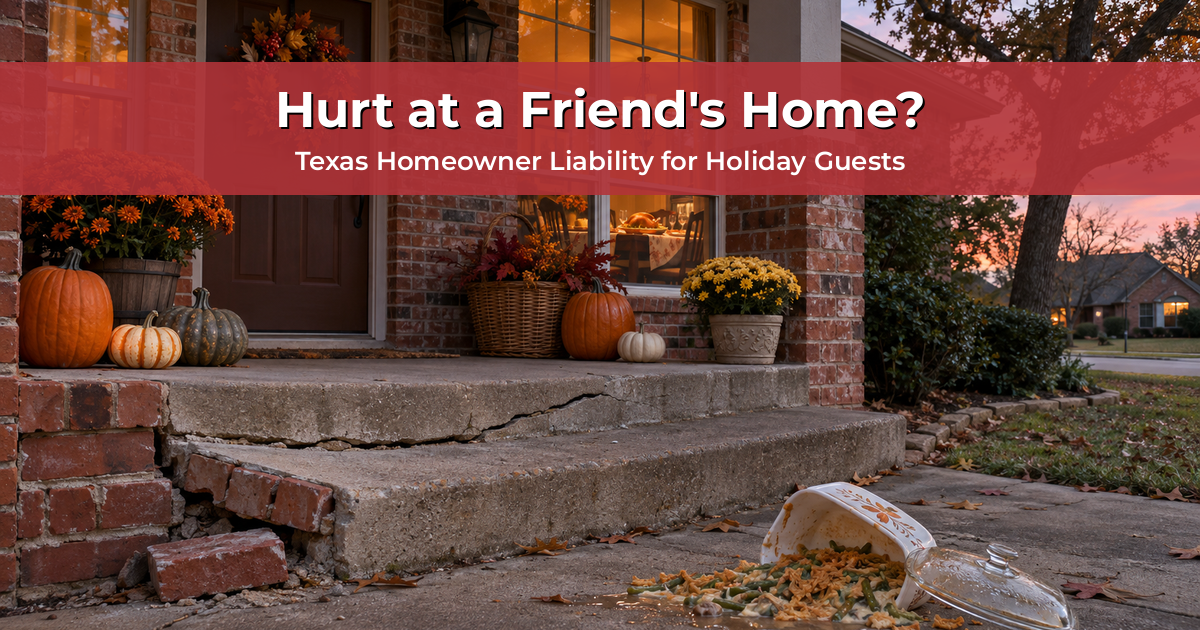
Thanksgiving and the holiday season fill DFW homes with family, friends, and neighbors. Most gatherings end with leftovers and football, but every year some guests are hurt by a broken porch step, a dark stairway, a loose railing, an unfenced pool, or a family dog. When that happens, the injured person and the homeowner are often close, which makes the legal questions feel personal.
At Howard Lotspeich Alexander & Williams, PLLC (HLAW), our Fort Worth personal injury lawyers help injured people in Tarrant, Dallas, Denton, Collin, Johnson, and Parker counties understand their options. This guide explains how Texas law treats injuries to houseguests, what a guest has to prove, how alcohol and dog bite rules fit in, and why homeowners insurance usually matters more than the host's own finances.
Key Takeaways
- Social guests are licensees. Texas courts classify a social guest as a licensee (Knorpp v. Hale, Texarkana Court of Appeals 1998).
- Actual knowledge is required. A licensee must prove the owner "actually knew of the condition," and "[a]ctual knowledge, rather than constructive knowledge of the dangerous condition is required" (Sampson v. University of Texas at Austin, Tex. 2016).
- The guest's own knowledge matters. The owner's duty to warn or make safe applies to dangers the owner knows about and the guest does not.
- No general social host liability. The Supreme Court of Texas declined to impose a duty on hosts who serve alcohol to adult guests who later drive (Graff v. Beard, Tex. 1993).
- Minors are an exception. An adult 21 or older who knowingly provides alcohol to a minor under 18 (other than the minor's parent, guardian, or spouse) can be liable for damages caused by the minor's intoxication (Tex. Alco. Bev. Code § 2.02(c)).
- Insurance often pays. Homeowners policies commonly include personal liability and medical payments coverage (Texas Department of Insurance).
- Two-year deadline. Most Texas personal injury suits must be filed within two years (Tex. Civ. Prac. & Rem. Code § 16.003).
Are Guests at a Texas Home Invitees or Licensees?
Texas premises liability law sets the homeowner's duty based on the injured person's status. The Supreme Court of Texas has explained that "a premises-liability plaintiff's status is a question of law, though it can be a question for the jury when facts relevant to the legal standard are in dispute" (Catholic Diocese of El Paso v. Porter, Tex. 2021).
There are three main categories:
| Status | Who it usually covers | Duty owed by the owner |
|---|---|---|
| Invitee | Customers in a store, people on the property for the owner's business benefit | Reasonable care to protect against dangerous conditions the owner knew of or should have discovered |
| Licensee | Social guests, friends, family visiting for dinner or a party | Warn of or make reasonably safe dangers the owner actually knows about and the guest does not; no willful, wanton, or grossly negligent injury |
| Trespasser | Someone on the property without permission | Generally only to avoid willful, wanton, or grossly negligent injury |
Most holiday guests fall into the licensee category. In Knorpp v. Hale, the Texarkana Court of Appeals stated plainly: "In Texas, a 'social guest' is classified as a licensee." The guest in that case was a frequent visitor with his own key to the home, and he was still a licensee.
The status can change based on why someone is there. A contractor hired to repair the roof, a caterer, or a plumber working at the home may be an invitee because the visit benefits the owner's business or property. The difference can affect whether the injured person must prove actual knowledge or only that the owner should have known.
What Must an Injured Guest Prove?
In Sampson v. University of Texas at Austin, the Supreme Court of Texas restated the elements a licensee must prove, absent willful, wanton, or grossly negligent conduct:
- A condition of the premises created an unreasonable risk of harm to the licensee;
- The owner actually knew of the condition;
- The licensee did not actually know of the condition;
- The owner failed to exercise ordinary care to protect the licensee from danger; and
- The owner's failure was a proximate cause of injury to the licensee.
The owner's duty, quoting the Court's earlier decision in State Department of Highways & Public Transportation v. Payne (Tex. 1992), is "to warn a licensee of, or to make reasonably safe, a dangerous condition of which the owner is aware and the licensee is not."
What does "actual knowledge" mean?
Actual knowledge is a high bar. According to Sampson, it "requires knowledge that the dangerous condition existed at the time of the accident, as opposed to constructive knowledge which can be established by facts or inferences that a dangerous condition could develop over time." A homeowner who should have noticed a rotting deck board is not enough. The guest generally needs evidence that the homeowner actually knew.
Evidence of actual knowledge in a home injury case can include:
- The homeowner's own statements, such as "I've been meaning to fix that step";
- Text messages or emails about a broken railing or loose rug;
- Prior falls or near-misses by family members on the same stairs;
- Repair estimates, hardware store receipts, or a contractor's prior visit; and
- Warnings the homeowner gave other guests but not the injured person.
What if the guest knew about the danger too?
Because the duty is limited to dangers the guest did not know about, a guest who knew of the hazard may have no claim under the licensee standard. Texas courts look at what the guest actually knew, including conditions the guest could perceive. That is why the facts of each fall, including lighting, warnings, and the guest's familiarity with the home, matter so much.
Common Holiday Injuries at Someone Else's Home
The licensee rules apply to many kinds of injuries at DFW homes:
- Falls on stairs and porch steps with broken treads, loose railings, or no lighting;
- Deck and balcony collapses from rotted wood or failing connections;
- Tripping hazards such as torn carpet, uneven pavers, or extension cords;
- Pool and spa injuries, including drownings involving children (see our guide to pool drowning and injury claims in Texas);
- Dog bites and attacks, which have their own rules discussed below; and
- Burns and fires, including fryer, fire pit, and fireplace incidents.
Whether a claim exists depends on the homeowner's knowledge, the guest's knowledge, and the cause of the injury. For a broader look at fall cases, see our slip and fall injury page.
Is a Texas Host Liable If a Drunk Guest Causes a Crash?
Generally no, if the guest is an adult. In Graff v. Beard, 858 S.W.2d 918 (Tex. 1993), a guest drank at a party, drove away, and hit a motorcyclist. The Supreme Court of Texas declined "to impose a common-law duty on a social host who makes alcohol available to an intoxicated adult guest who the host knows will be driving," and rendered a take-nothing judgment. The Court explained that "the common law's focus should remain on the drinker as the person primarily responsible for his own behavior."
That does not mean the injured motorist has no claim. The drunk driver remains responsible, and commercial providers such as bars and restaurants may face liability under the Texas dram shop statute. Our article on Texas dram shop laws explains those rules.
The exception for minors
The Legislature created a specific rule for underage guests. Under Alcoholic Beverage Code § 2.02(c), an adult 21 or older "is liable for damages proximately caused by the intoxication of a minor under the age of 18" if the adult is not the minor's parent, guardian, or spouse (or a court-appointed custodian) and the adult knowingly:
- "served or provided to the minor any of the alcoholic beverages that contributed to the minor's intoxication"; or
- "allowed the minor to be served or provided any of the alcoholic beverages that contributed to the minor's intoxication on the premises owned or leased by the adult."
This rule can apply to holiday parties where teenagers are present. A host who knowingly lets other people's children drink at the host's home may face civil liability for resulting injuries, in addition to any criminal exposure.
What About Dog Bites at a Friend's House?
Dog bite claims follow different rules from ordinary premises defects. Texas cases typically turn on whether the owner knew the dog was dangerous or was negligent in handling or restraining it. Holiday gatherings can be stressful for dogs, with crowds, food, and children. We explain these claims in our article on Texas dog bite law and dangerous dogs.
Will Suing a Friend or Relative Ruin Them Financially?
This is often the first worry injured guests raise. In many cases, the claim is paid by the homeowner's insurance company, not the homeowner personally. The Texas Department of Insurance home insurance guide explains that personal liability coverage "pays medical bills, lost wages, and other costs for people that you're legally responsible for injuring" and "pays your court costs if you're sued because of an accident." It also describes medical payments coverage, which "pays the medical bills of people hurt on your property."
Coverage depends on the specific policy, its limits, and its exclusions. Renters policies may also include liability coverage. An attorney can request the policy information and deal with the insurer so the injured guest does not have to negotiate directly with a friend or family member.
How Does Shared Fault Affect a Guest's Claim?
Texas follows proportionate responsibility. Under Civil Practice and Remedies Code § 33.001, "a claimant may not recover damages if his percentage of responsibility is greater than 50 percent." If the guest is 50 percent or less responsible, § 33.012 reduces the damages by the guest's percentage. Insurers in home injury cases often argue that the guest had been drinking, was not watching where they were going, or ignored a warning.
What Should You Do If You Are Hurt at Someone's Home?
- Get medical care. Falls and dog bites can cause injuries that worsen over time, including head injuries and infections.
- Photograph the scene. Take pictures of the step, railing, lighting, rug, or other condition before it is repaired.
- Write down what the homeowner said. Statements like "that railing has been loose for months" can be important evidence of actual knowledge.
- Identify witnesses. Other guests may have seen the fall or heard prior warnings.
- Ask whether the homeowner has insurance. Many hosts want to report the incident to their insurer, which is often the right first step.
- Avoid recorded statements until you get advice. The insurer's adjuster represents the insurance company.
- Keep track of the deadline. Most personal injury suits must be filed within two years under § 16.003. See our guide to time limits for personal injury claims in Texas.
Frequently Asked Questions
Can I sue a friend if I fell at their house in Texas?
You may have a claim if the friend actually knew about a dangerous condition that you did not know about and failed to warn you or make it reasonably safe (Sampson). In many cases, any recovery comes from the friend's homeowners insurance.
Is a family member visiting for Thanksgiving an invitee or a licensee?
Usually a licensee. Texas courts classify social guests as licensees, even frequent visitors (Knorpp v. Hale). Status can differ if the person was there to perform work that benefits the owner.
Does the homeowner have to inspect for hidden dangers?
Under the licensee standard, the owner's duty is tied to dangers the owner actually knows about. Constructive knowledge, meaning what the owner should have discovered, is generally not enough for a social guest.
Is a host liable if an adult guest drinks too much and causes a wreck?
Generally no. In Graff v. Beard, the Supreme Court of Texas declined to create social host liability for serving adult guests. The drunk driver and, in some cases, a commercial alcohol provider may be responsible.
What if the host gave alcohol to my teenager?
An adult 21 or older who knowingly provides alcohol to a minor under 18, or knowingly allows it on premises the adult owns or leases, can be liable for damages caused by the minor's intoxication, unless the adult is the minor's parent, guardian, or spouse (§ 2.02(c)).
Does homeowners insurance cover injuries to guests?
Many policies include personal liability and medical payments coverage, according to the Texas Department of Insurance. The details depend on the specific policy.
Talk With a Fort Worth Personal Injury Lawyer
An injury at a friend's or relative's home raises legal and personal concerns. A lawyer can evaluate the claim, identify insurance coverage, and handle communications so relationships are protected as much as possible. HLAW represents injured people across Tarrant, Dallas, Denton, Collin, Johnson, and Parker counties.
Call (817) 993-9249 or contact us online for a free consultation.
This article provides general information about Texas law and is not legal advice. Reading it does not create an attorney-client relationship. Every case depends on its specific facts, and past results do not guarantee a similar outcome.