Short answer: If a road rage driver injures you in Texas, you can bring a personal injury claim against that driver for negligence, gross negligence, or an intentional assault. The hard part is often insurance: a standard Texas auto policy excludes liability coverage for anyone who "intentionally causes bodily injury," so the other driver's insurer may deny the claim. In that situation, your own personal injury protection (PIP) and uninsured/underinsured motorist (UM/UIM) coverage, the Texas Crime Victims' Compensation Program, and the other driver's personal assets may all become part of the recovery.
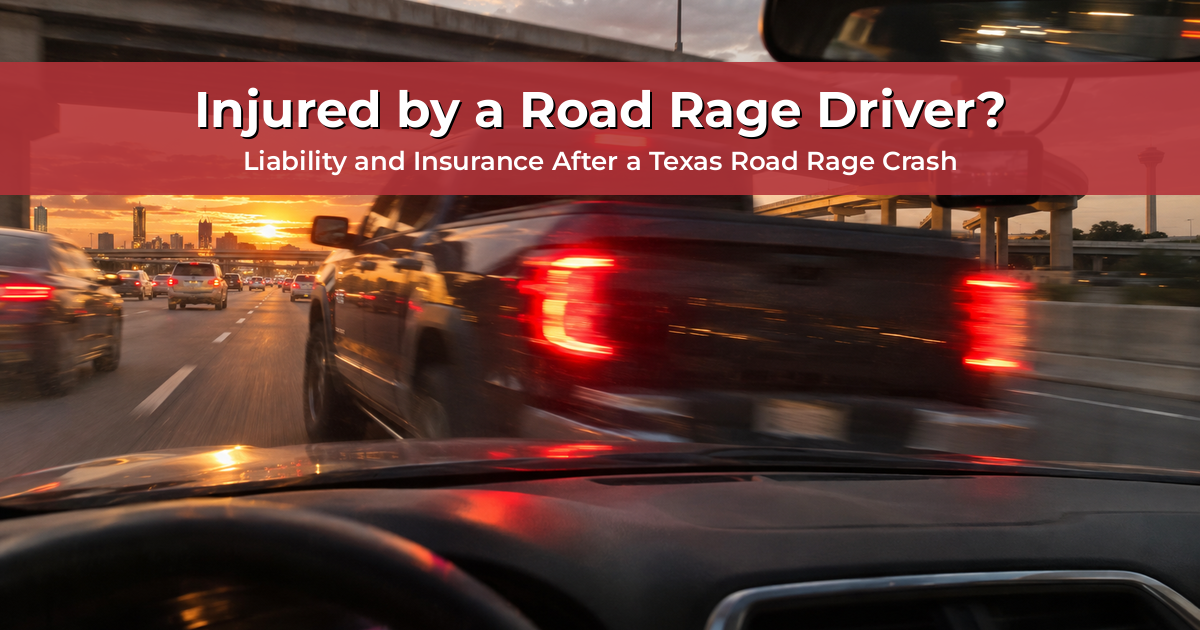
Aggressive driving is part of daily life on I-35W, I-30, Loop 820, and the LBJ Express. Most tailgating and horn-blowing ends with nothing more than frustration. But when a driver deliberately brake-checks, sideswipes, runs someone off the road, or gets out of the car to confront another motorist, the result can be serious injuries and a legal claim that works differently from an ordinary fender bender. At Howard Lotspeich Alexander & Williams, PLLC (HLAW), our Fort Worth personal injury lawyers help injured drivers and passengers work through the liability and insurance questions that road rage cases raise.
This guide explains who can be held responsible, why insurers treat intentional crashes differently, where else money can come from, and what to do after a road rage incident in Dallas-Fort Worth.
Key Takeaways
- Intentional harm is usually excluded from the other driver's liability coverage. The Texas Department of Insurance lists "Damages that you caused intentionally" among the things most auto policies do not cover (Texas Department of Insurance).
- "Accident" depends on intent and foreseeability. The Supreme Court of Texas has held that "both the actor's intent and the reasonably foreseeable effect of his conduct bear on the determination of whether an occurrence is accidental" (Mid-Century Ins. Co. of Texas v. Lindsey, Tex. 1999).
- Your own UM/UIM and PIP coverage may help. Texas insurers must include both unless you rejected them in writing (Tex. Ins. Code ch. 1952). The UM/UIM intentional-acts exclusion required by statute applies to "the intentional acts of the insured," meaning you, not the other driver.
- Crime victim compensation can cover intentional vehicle crimes. The program generally excludes motor vehicle incidents, but not conduct "intended to cause personal injury or death," aggravated assault, deadly conduct, or reckless driving resulting in injury (Tex. Code Crim. Proc. art. 56B.003).
- The punitive damages cap may not apply. Texas caps exemplary damages, but the cap does not apply to claims based on knowingly or intentionally committed felony aggravated assault (Tex. Civ. Prac. & Rem. Code § 41.008(c)).
- Two years to sue. Most Texas personal injury suits must be filed within two years (Tex. Civ. Prac. & Rem. Code § 16.003).
What Counts as Road Rage Under Texas Law?
Texas does not have a single "road rage" statute. Instead, the same conduct can fall under several laws, and the label matters for both the civil claim and the insurance claim.
- Aggressive or reckless driving. Tailgating, weaving, and speeding to "teach someone a lesson" may be negligent or grossly negligent. Driving "in wilful or wanton disregard for the safety of persons or property" is reckless driving under Transportation Code § 545.401.
- Deliberate collisions. Intentionally ramming, sideswiping, or forcing a car off the road can be aggravated assault with a deadly weapon, because Texas courts have long recognized that a motor vehicle can be a deadly weapon depending on how it is used.
- Confrontations outside the car. A driver who stops, gets out, and attacks someone may face assault charges, and the victim has a civil claim for assault.
From a civil standpoint, an injured person can usually plead more than one theory, such as negligence, gross negligence, and intentional assault, and let the evidence sort out which one fits.
Who Can Be Held Responsible After a Road Rage Crash?
The aggressive driver is the obvious defendant. Depending on the facts, others may share responsibility:
- An employer, if the driver was on the job in a company vehicle or making deliveries. Our guide to delivery driver accidents in Texas explains how employment status affects these claims.
- A vehicle owner who knowingly lent the car to a dangerous or unlicensed driver.
- Other drivers whose own careless driving contributed to a chain-reaction crash.
Texas uses proportionate responsibility. Under Civil Practice and Remedies Code § 33.001, a claimant cannot recover if their share of responsibility is greater than 50 percent, and any recovery is reduced by their percentage. That matters in road rage cases, because insurers often argue the injured driver "started it" by cutting someone off, brake-checking, or gesturing. Video and witness accounts are often the best answer to that argument.
Will the Other Driver's Insurance Pay for a Road Rage Crash?
Sometimes, but often not without a fight. Most Texas auto policies cover damages the insured becomes legally responsible for because of an auto accident, and they exclude intentional harm. The Texas Department of Insurance lists "Damages that you caused intentionally" under what most policies "don't cover" (TDI auto insurance guide).
Whether a particular crash was an "accident" for insurance purposes is not always clear. In Mid-Century Ins. Co. of Texas v. Lindsey, the Supreme Court of Texas explained that an injury caused by voluntary and intentional conduct is not an accident just because "the result or injury may have been unexpected, unforeseen and unintended," but also that the mere fact that "an actor intended to engage in the conduct that gave rise to the injury" does not mean the injury was not accidental. Instead, "both the actor's intent and the reasonably foreseeable effect of his conduct bear on the determination."
In practical terms, that leaves room for argument in many road rage cases:
| What happened | Likely insurance position | Why it matters |
|---|---|---|
| Driver tailgated and rear-ended you while angry | Often treated as negligent driving | Liability coverage is more likely to respond |
| Driver swerved toward you to scare you and lost control | Disputed: intent to scare vs. intent to hit | Facts about speed, distance, and statements matter |
| Driver deliberately rammed your car | Insurer likely invokes intentional-acts exclusion | Your UM/UIM and PIP coverage become more important |
| Driver got out and punched you | Auto liability may not apply; homeowners policies often exclude intentional acts too | Claim may depend on the driver's assets and crime victim funds |
This is one reason injured people should be careful about how they describe the incident to an insurance adjuster. Accurate facts matter, and the legal theory should be chosen with the available coverage in mind.
Can I Use My Own Uninsured Motorist Coverage After Road Rage?
Often, yes, if you have it. Texas requires insurers to include UM/UIM coverage in every auto liability policy unless "any insured named in the insurance policy rejects the coverage in writing" (Tex. Ins. Code § 1952.101). The coverage protects insureds who are legally entitled to recover from owners or operators of uninsured or underinsured motor vehicles.
Two points are especially important in road rage cases:
- The statutory intentional-acts exclusion is about you. Section 1952.104 requires UM/UIM policies to exclude damages "resulting from the intentional acts of the insured." It does not require an exclusion for the other driver's intentional acts.
- A denial by the other insurer may open UM coverage. Many Texas policies define an uninsured vehicle to include one whose liability insurer denies coverage. Your own policy language controls, so it should be reviewed early.
Your insurer may still raise its own arguments, including whether the injury was "caused by an accident" or arose from the use of a vehicle, especially when the injury happened after the other driver got out of the car. Courts in other states have split on these issues, and the specific facts and policy wording matter.
If the road rage driver fled and cannot be identified, UM coverage generally requires "actual physical contact" between the unknown vehicle and you or your property (§ 1952.104(3)). Our guides to uninsured driver accidents in Fort Worth and hit-and-run crashes explain those claims in more detail.
What about PIP?
All Texas auto policies include personal injury protection unless rejected in writing (TDI). PIP pays reasonable medical expenses and lost income arising from an accident, up to your policy limit (Tex. Ins. Code § 1952.151). It is often the fastest source of money for early medical bills.
Can Crime Victims' Compensation Help After a Road Rage Attack?
It may. Texas's Crime Victims' Compensation Program, run by the Office of the Attorney General, generally does not cover incidents that "arise out of the ownership, maintenance, or use of a motor vehicle." But the statute makes exceptions for conduct "intended to cause personal injury or death," reckless driving under Transportation Code § 545.401 that results in bodily injury or death, failure to stop and render aid, and Penal Code offenses including aggravated assault and deadly conduct (Tex. Code Crim. Proc. art. 56B.003).
Key limits:
- Applications generally must be filed within three years of the crime (art. 56B.052).
- Awards generally may not exceed $50,000 in the aggregate, with up to $75,000 more for certain catastrophic injuries resulting in total and permanent disability (art. 56B.106).
- The program is generally a payer of last resort, so insurance and other sources are typically considered first.
Can I Get Punitive Damages Against a Road Rage Driver?
Possibly. Texas allows exemplary (punitive) damages only if the claimant proves by clear and convincing evidence that the harm resulted from fraud, malice, or gross negligence (Tex. Civ. Prac. & Rem. Code § 41.003). Deliberately using a vehicle to injure someone can meet the malice standard.
Texas normally caps exemplary damages at the greater of two times economic damages plus up to $750,000 in noneconomic damages, or $200,000 (§ 41.008(b)). But under § 41.008(c), the cap does not apply to a claim based on felony conduct described in certain Penal Code sections, including § 22.02 (aggravated assault), when the conduct was committed knowingly or intentionally. Our guide to punitive damages in Texas explains these rules in more depth.
Insurance generally will not pay punitive damages for intentional conduct, so the practical value of a large award often depends on the defendant's assets.
What Evidence Matters Most in a Road Rage Case?
Because intent and fault are often disputed, evidence collected in the first days is critical:
- Dashcam and phone video. Your own camera, other drivers' footage, and rideshare cameras can show who was aggressive. See our article on dashcam footage after a Texas car accident.
- 911 recordings. Calls made during the incident often capture real-time descriptions of the other driver's behavior.
- Business and traffic cameras. Gas stations, stores, and toll systems may record over footage within days, so preservation requests should go out quickly.
- The crash report and any criminal case file. If police charged the other driver with assault or deadly conduct, the charging documents and witness statements can support the civil case. Our guide to Texas car wreck police reports explains how to obtain one.
- Vehicle data and damage patterns. Event data recorders and the location of damage can show whether a collision was a sudden swerve or a deliberate impact.
- Medical records. Prompt treatment connects your injuries to the incident.
What Should I Do After a Road Rage Incident in DFW?
- Get to safety first. Do not engage, follow, or confront the other driver. Lock your doors and drive to a public place or police station if you are being followed.
- Call 911. Report the plate number, vehicle description, location, and direction of travel.
- Get medical care. Some injuries, including concussions and soft tissue injuries, may not be obvious right away.
- Preserve video and identify witnesses. Save your dashcam files and write down names and numbers of anyone who stopped.
- Report the claim to your own insurer. Prompt notice protects your PIP and UM/UIM rights. Ask any insurer that denies coverage to put the denial in writing.
- Be careful with recorded statements. Stick to facts. Do not guess about the other driver's intent or speculate about your own fault.
- Talk to a lawyer before the two-year deadline. Under § 16.003, most personal injury suits must be filed within two years. See our guide to time limits for personal injury claims in Texas.
Frequently Asked Questions
Can I sue a road rage driver if police did not file criminal charges?
Yes. A civil injury claim does not depend on a criminal conviction or charge. The civil case uses a lower burden of proof, generally a preponderance of the evidence, although punitive damages require clear and convincing evidence.
What if the other driver says I caused the road rage?
Texas proportionate responsibility rules apply. Your recovery is reduced by your percentage of fault, and you cannot recover if you are more than 50 percent responsible (§ 33.001). Video, 911 calls, and independent witnesses are often the best evidence on who was the aggressor.
Does my own UM coverage apply if the other driver hit me on purpose?
It may. The UM/UIM intentional-acts exclusion required by Texas law applies to the intentional acts of the insured, not the other driver (Tex. Ins. Code § 1952.104). Your insurer may raise other policy defenses, so the policy language should be reviewed.
Will my insurance rates go up if I file a UM claim after road rage?
Rating practices vary by insurer. Ask your insurer directly, and keep in mind that UM and PIP are coverages you paid for to protect yourself in exactly these situations.
Can a passenger in my car bring a claim?
Yes. Passengers may have claims against the road rage driver and may be able to use PIP and UM/UIM coverage under the policy for the car they were riding in or their own household policy.
How long do I have to apply for crime victims' compensation?
Generally three years from the date of the crime, with certain exceptions and possible extensions for good cause (art. 56B.052).
Talk With a Fort Worth Personal Injury Lawyer
Road rage crashes in Tarrant, Dallas, Denton, Collin, Johnson, and Parker counties often involve insurance denials, disputed fault, and parallel criminal cases. HLAW can help identify every available source of recovery, preserve the evidence, and deal with the insurers. Learn more about our car wreck practice and personal injury lawyers, or contact us for a free consultation at (817) 993-9249.
This article is for general information only and is not legal advice. Reading it does not create an attorney-client relationship. Results depend on the facts of each case.