
Skip to content
Tag

Insurance

Page 1 of 2 · 10 articles

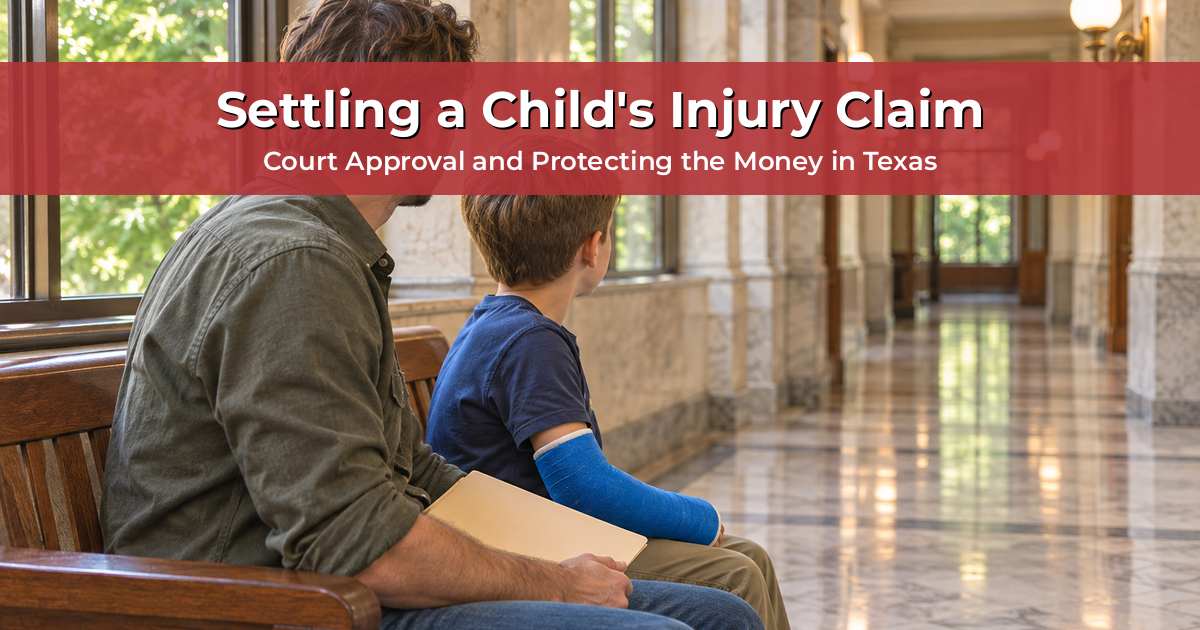
Father and young son with a blue arm cast waiting on a bench in a Texas courthouse hallway

Settling a Child's Injury Claim in Texas: Court Approval, Guardian Ad Litem, and Where the Money Goes

By Luke A. Williams · Personal Injury

Short answer: In Texas, a parent generally cannot simply sign a release and accept a check to settle a child's injury claim in a way that permanently binds the child. To make a settlement of a minor's claim final, the case is usually filed in court by a parent acting as "next friend," and the judge must approve the settlement after a hearing, often with a court-appointed guardian ad litem advising whether the deal is in the child's best interest. The child's share of the money is then protected until adulthood, often in the court registry, a court-created trust, or a structured settlement. Separately, the deadline for the child's own claim generally does not begin to run until the child turns 18, though waiting carries real risks.

Father and young son with a blue arm cast waiting on a bench in a Texas courthouse hallway

When a child is hurt in a car wreck, a dog attack, a fall, or another accident in Dallas-Fort Worth, parents often hear from an insurance company about settling quickly. Many are surprised to learn that a child's settlement follows special rules designed to protect the child, and that a release signed only by a parent may not end the child's claim.

At Howard Lotspeich Alexander & Williams, PLLC (HLAW), our Fort Worth child injury lawyers help families in Tarrant, Dallas, Denton, Collin, Johnson, and Parker counties through the full process, from the claim to court approval. This guide explains how minor settlements work in Texas, who protects the child's interests, and where the money goes.

Key Takeaways

  • Court approval makes a minor's settlement binding. Under Texas Rule of Civil Procedure 44, a next friend "may with the approval of the court compromise suits," and approved compromises "shall be forever binding and conclusive" on the child (Tex. R. Civ. P. 44).
  • A hearing and evidence are required. Courts have held that a judgment approving a minor's settlement "cannot be rendered without a hearing and evidence that the settlement serves the minor's best interest" (Byrd v. Woodruff, as quoted by a federal court).
  • A guardian ad litem often reviews the deal. When a settlement is proposed, a guardian ad litem has "the limited duty to determine and advise the court whether the settlement is in the party's best interest" (Tex. R. Civ. P. 173.4(c)).
  • The money is protected until adulthood. Texas Property Code Chapter 142 allows a child's funds to be invested through the court clerk, placed in a court-created trust, or paid through a structured settlement (Tex. Prop. Code ch. 142).
  • Smaller, uncontested amounts can go to the court registry. Texas Estates Code Chapter 1355 allows payment into the court registry, without a guardianship, of $250,000 or less owed to a minor when the right to the money is liquidated and uncontested (Tex. Est. Code ch. 1355).
  • The child's own deadline is generally paused until 18. A person younger than 18 is under a "legal disability," and "the time of the disability is not included in a limitations period" (Tex. Civ. Prac. & Rem. Code §16.001).

Why Do Child Injury Settlements Need Court Approval in Texas?

A minor cannot sign a binding contract to release a legal claim, and Texas law does not give parents unlimited power to give away a child's claim. Rule 44 of the Texas Rules of Civil Procedure provides that minors without a legal guardian "may sue and be represented by 'next friend,'" and that the next friend or the next friend's attorney "may with the approval of the court compromise suits and agree to judgments." When a court approves the compromise, it "shall be forever binding and conclusive upon the party plaintiff in such suit" (Tex. R. Civ. P. 44).

That court approval is what gives the person paying the settlement, usually an insurance company, the finality it wants, and it is also what protects the child. Without it, a release signed only by a parent may not prevent the child from bringing the claim later. For that reason, insurers and their lawyers commonly insist on court approval before paying a significant settlement of a child's claim.

How Does the Minor Settlement Process Work?

The process often goes like this:

  1. The claim is investigated and negotiated. As with any injury claim, the child's medical treatment, prognosis, and damages are documented, and the lawyer negotiates with the insurer. Our guide on what your personal injury case may be worth explains the factors involved. Mediation is common; see our guide to mediation in personal injury cases.
  2. A lawsuit is filed, often as a "friendly suit." If the case settles before a lawsuit is filed, the parties commonly file a suit so the court can approve the agreement. The parent sues as next friend of the child.
  3. The court may appoint a guardian ad litem. If the next friend appears to have an interest adverse to the child, such as when a parent and child are both receiving money from the same limited insurance policy, the court must appoint a guardian ad litem under Rule 173.2, and courts frequently do so in minor settlements.
  4. The guardian ad litem reviews the settlement. The ad litem evaluates the injuries, the settlement amount, how the money is divided, and how the child's share will be managed, and then reports to the court.
  5. The court holds a hearing. Often called a "prove-up" or "minor settlement hearing," the judge hears testimony, usually from the parent and the guardian ad litem, about the settlement and whether it is fair to the child.
  6. The court signs a judgment. The judgment approves the settlement, allocates the funds, approves attorney's fees and expenses, and orders how the child's share will be held until adulthood.

Many DFW minor settlement hearings are short, but the paperwork behind them is detailed, and the judge must be satisfied that the child is protected.

What Does a Guardian Ad Litem Do in a Child's Settlement?

A guardian ad litem is a person, usually a lawyer, appointed by the court to protect the child's interests in specific situations. Under Rule 173, a guardian ad litem serves as an officer and advisor to the court. When an offer has been made to settle the claim of a child represented by a next friend, the ad litem "has the limited duty to determine and advise the court whether the settlement is in the party's best interest" (Tex. R. Civ. P. 173).

According to the Corpus Christi-Edinburg Court of Appeals, the ad litem's duty includes "evaluating the damages suffered by the minor, the adequacy of the settlement, the proposed apportionment and manner of distribution of the settlement proceeds, and the amount of attorney's fees charged by the plaintiff's attorney" (Tex. App. Corpus Christi 2021).

Who pays the guardian ad litem?

Rule 173.6 allows a guardian ad litem to be reimbursed for reasonable expenses and "paid a reasonable hourly fee for necessary services performed." The court "must not consider compensation as a percentage of any judgment or settlement," and it "may tax a guardian ad litem's compensation as costs of court." In practice, the settlement agreement often addresses which party pays the ad litem's fee. Texas appellate courts have stressed that the ad litem's role is limited (Columbia Rio Grande Healthcare v. De Leon).

Where Does a Child's Settlement Money Go?

Texas law provides several ways to protect a child's money until adulthood. The court decides which option fits the case.

Option Legal source How it works Often used for
Court registry (Estates Code) Tex. Est. Code ch. 1355 Money is paid to the county clerk and invested for the child; it can generally be withdrawn when the child's disability ends Uncontested amounts of $250,000 or less
Court-ordered investment Tex. Prop. Code §142.004 Funds invested by the clerk on court order, or by the next friend in restricted accounts, including certain college savings plans, prepaid tuition programs, and ABLE accounts Many small and mid-size settlements
Section 142 trust Tex. Prop. Code §142.005 A court-created trust managed by a trustee, usually a financial institution, for the child's health, education, support, or maintenance Larger settlements or children with ongoing needs
Structured settlement Tex. Prop. Code §142.008 Periodic payments funded by a qualifying annuity or U.S. government obligation Long-term income planning
Guardianship of the estate Texas Estates Code A court-appointed guardian manages the funds under court supervision Situations where other options do not fit

The 142 trust in more detail

A trust under Property Code §142.005 must name the child as "the sole beneficiary of the trust." The trustee may make distributions it finds "reasonably necessary for the health, education, support, or maintenance of the beneficiary." For a minor who is not considered disabled for Supplemental Security Income purposes, the trust ends at the child's death, at an age stated in the trust, or "on the 25th birthday of the beneficiary, whichever occurs first." If the child is disabled under those federal rules, the trust ends at the child's death. Where the trust principal is more than $50,000, the court may appoint someone other than a financial institution as trustee only if no financial institution is willing to serve and the appointment is in the child's best interest (Tex. Prop. Code §142.005).

If your child receives or may need government benefits such as Medicaid or SSI, the way the money is held can matter. The statute allows the court to modify trust terms when necessary for the child to remain eligible for public benefits. Our article on how a personal injury settlement can affect government benefits explains these concerns.

Can parents use the settlement money?

Generally, the child's share belongs to the child, not the parents, and the court controls how it is used before the child reaches adulthood. A 142 trust can allow distributions for the child's health, education, support, or maintenance. Parents should not expect to use a child's funds for general household expenses.

How Are Medical Bills and Liens Handled?

A child's settlement often must account for medical bills and liens before the remaining funds are protected. Hospitals may file liens under Texas law, and health insurers or Medicaid may have reimbursement rights. These amounts are usually resolved as part of the settlement and disclosed to the court at the hearing. Our guide on hospital liens and your DFW injury settlement explains how liens work.

Parents may also have their own claims arising from the child's injury, such as for medical expenses they paid, and those claims can have different deadlines than the child's claim. A lawyer can help identify each claim and how it should be handled in the settlement.

How Long Do You Have to File a Claim for a Child's Injury in Texas?

Most Texas personal injury claims must be filed within two years under Civil Practice and Remedies Code §16.003. For minors, §16.001 provides that a person "younger than 18 years of age" is under a legal disability, and "the time of the disability is not included in a limitations period" (Tex. Civ. Prac. & Rem. Code §16.001). In general, that means the two-year period for the child's own claim does not begin to run until the child turns 18.

There are important cautions:

  • Some claims have different rules. Health care liability claims and claims against governmental entities can have their own deadlines and notice requirements, sometimes much shorter.
  • Parents' claims may not be paused. Claims belonging to the parents may be subject to the normal two-year deadline.
  • Evidence fades. Witnesses move, video is erased, and records become harder to obtain.

See our guide to time limits for personal injury claims in Texas for more.

Frequently Asked Questions

Can I just sign the insurance company's release for my child?

You should be cautious. Under Rule 44, a compromise of a minor's suit becomes "forever binding and conclusive" on the child when approved by the court. Without court approval, a parent-signed release may not bind the child, and signing it could affect your own claims. Talk with a lawyer before signing.

Does every child settlement need a lawsuit and a hearing?

Not always, but court approval is the standard way to make the settlement binding on the child, and insurers commonly require it for significant settlements. Smaller, uncontested payments to minors can sometimes be deposited in the court registry under Estates Code Chapter 1355.

Will my child have to testify at the settlement hearing?

Often not. The parent and the guardian ad litem usually provide the testimony. Some judges may want to see or hear from an older child, and practices vary by court.

When can my child get the money?

That depends on how the funds are held. Money in the court registry is generally available when the child turns 18. A 142 trust may continue until an age set in the trust, up to the child's 25th birthday for a child who is not disabled under federal SSI rules. Structured settlements pay on the schedule approved by the court.

How are attorney's fees handled in a child's settlement?

The court reviews and approves attorney's fees and expenses as part of the settlement, and a guardian ad litem may evaluate them. The fees must be disclosed and approved before the settlement is final.

What if both a parent and a child were hurt in the same crash?

When a parent and child share limited insurance coverage, their interests may conflict over how the money is divided. Rule 173 requires the court to appoint a guardian ad litem if the next friend appears to have an interest adverse to the child.

Talk to a Fort Worth Child Injury Lawyer

A child's injury claim involves more than negotiating a number. It requires careful documentation, court approval, and a plan to protect the money for your child's future. Our firm can help you understand each step.

Call HLAW at (817) 993-9249 or contact us online for a free consultation about a child's injury in Dallas-Fort Worth.

This article is for general informational purposes only and is not legal advice. Reading it does not create an attorney-client relationship. Laws change, and every case depends on its specific facts.
Read full article
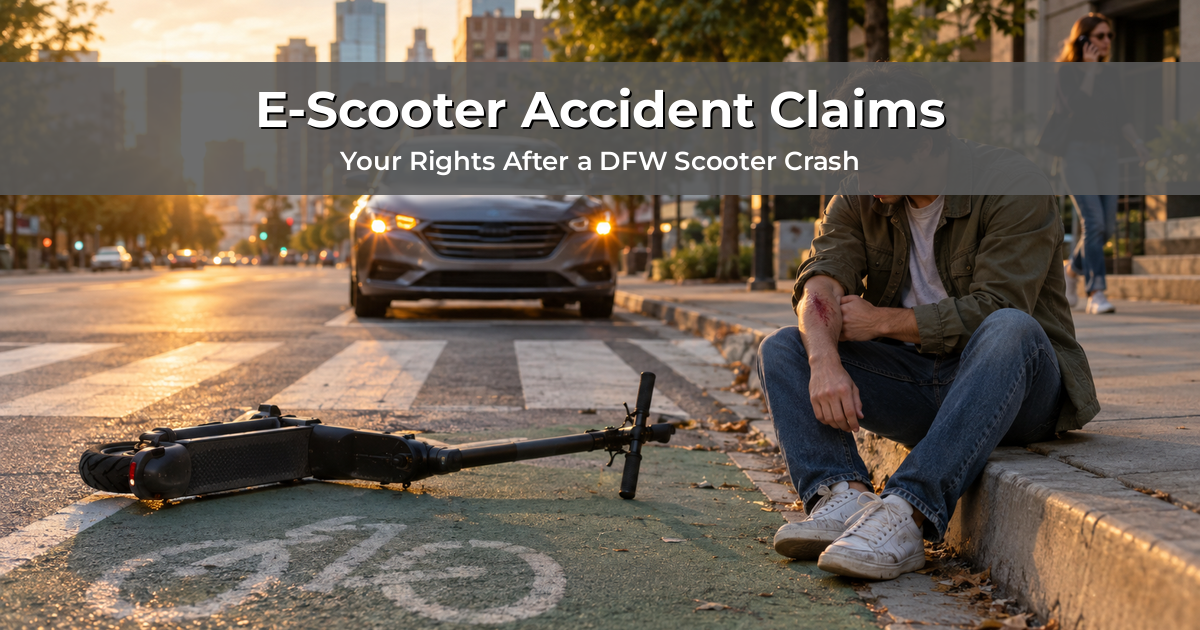
Injured rider sitting on a downtown curb beside a fallen electric scooter in a bike lane, with a stopped car nearby

Hurt on an Electric Scooter in Dallas-Fort Worth? Texas E-Scooter Accident Laws and Your Rights

By Luke A. Williams · Personal Injury

Short answer: If you were hurt on an electric scooter in Dallas-Fort Worth because a driver, property owner, or city was negligent, you can generally bring a Texas personal injury claim. You can recover as long as you were not more than 50 percent responsible, and your recovery is reduced by your share of fault. Texas law treats a motor-assisted scooter much like a bicycle, not a motor vehicle. Where you were allowed to ride, whether city rules were followed, and which insurance applies often decide these cases. Claims against a city can require written notice within six months or less, and most lawsuits must be filed within two years.

Injured rider sitting on a downtown curb beside a fallen electric scooter in a bike lane, with a stopped car nearby

Electric scooters are now part of daily traffic in Deep Ellum, downtown Fort Worth, Arlington's entertainment district, and college areas across the Metroplex. They are convenient, but a rider has almost no protection in a collision with a car or a fall caused by a pothole. The legal rules are also less familiar than those for a typical car wreck.

At Howard Lotspeich Alexander & Williams, PLLC (HLAW), our Fort Worth trial lawyers handle personal injury claims across Tarrant, Dallas, Denton, Collin, Johnson, and Parker counties. This guide explains how Texas law applies to e-scooter crashes, who may be responsible, and what to do to protect a claim.

Key Takeaways

  • Scooters follow bicycle rules, not motor vehicle rules. Under Texas Transportation Code §551.352, bicycle provisions generally apply to a motor-assisted scooter, and "a provision of this title applicable to a motor vehicle does not apply to a motor-assisted scooter" (Tex. Transp. Code §551.352).
  • State law limits scooters to streets with posted speed limits of 35 mph or less, though riders may cross faster roads at intersections. Cities can add their own restrictions.
  • Dallas bans sidewalk riding. The City of Dallas says scooters "may not be ridden on or in: sidewalks, trails, parks, plazas, on roads with a speed limit of 35 MPH or higher," with a 20 mph citywide speed limit (City of Dallas).
  • Fault is shared under the 51 percent bar. A claimant "may not recover damages if his percentage of responsibility is greater than 50 percent," and any recovery is reduced by the claimant's percentage (Tex. Civ. Prac. & Rem. Code ch. 33).
  • Claims against a city have short notice deadlines. The Texas Tort Claims Act requires notice within six months, and city charters can set shorter periods (Tex. Civ. Prac. & Rem. Code §101.101).
  • Injuries are rising nationally. The CPSC estimates 380,000 emergency department visits involving e-scooters from 2017 through 2024 (CPSC micromobility report).

What Does Texas Law Say About Electric Scooters?

Texas regulates motor-assisted scooters in Chapter 551 of the Transportation Code. A "motor-assisted scooter" is a self-propelled device with at least two wheels, a braking system, a gas or electric motor, a deck designed for the rider to stand or sit, and "the ability to be propelled by human power alone" (Tex. Transp. Code §551.351). Most rental and privately owned stand-up e-scooters in DFW fall into this category.

The key operating rules are in §551.352 (Tex. Transp. Code §551.352):

  • A scooter "may be operated only on a street or highway for which the posted speed limit is 35 miles per hour or less," but may cross a faster road at an intersection.
  • A person may ride "on a path set aside for the exclusive operation of bicycles or on a sidewalk," unless a city or county prohibits it.
  • A county or city may prohibit scooters on a street, highway, or sidewalk "in the interest of safety."
  • Rules for bicycles generally apply to scooters, while rules for motor vehicles do not.

That last point matters in an injury case. A scooter rider generally has the rights and duties of a bicyclist on the road. Drivers owe scooter riders the same care they owe cyclists. For more on those rules, see our guide to bicycle accident claims in DFW.

How Do Dallas and Fort Worth Rules Differ?

Local rules vary across the Metroplex, and they can affect both safety and fault.

Issue Texas state law City of Dallas City of Fort Worth
Sidewalk riding Allowed unless a city or county prohibits it Not allowed, except to start or end a ride Generally follows state law; riders may use sidewalks and paths unless posted otherwise
Road speed limit Streets posted 35 mph or less Not on roads posted 35 mph or higher Streets posted 35 mph or less
Scooter speed No speed cap stated in §551.352 20 mph citywide; 10 mph in slow-ride zones City code does not directly address e-scooters
Rental age Not addressed in §551.352 No rentals to people under 16 City code does not directly address e-scooters

Sources: Tex. Transp. Code §551.352; City of Dallas Dockless Vehicle Program; Fort Worth Star-Telegram; Government Technology.

In Dallas, the city also lists no-ride zones, including parks, plazas, and most trails, and says riders who break the rules can be fined up to $200 under Section 28-41.1.1 of the Dallas City Code (City of Dallas). The Fort Worth Star-Telegram reported that Fort Worth police say e-scooters "can be ridden on bike paths and sidewalks, but they are restricted to streets with a posted speed limit of 35 mph or less" (Star-Telegram). Arlington, Denton, Plano, Irving, and other cities have their own rules, so the location of a crash matters.

Who Is Liable for an E-Scooter Accident in Texas?

Most scooter injury claims fall into one of four categories.

A driver who hit the rider

The most serious scooter injuries often involve cars. CPSC staff have reported that "the top hazards in e-scooter and e-bike fatalities were incidents with motor vehicles and user-control issues" (CPSC). Common scenarios include right hooks at intersections, left turns across a bike lane, drivers opening doors into a rider's path, and drivers backing out of driveways or parking spaces. A claim against the driver is a negligence claim, usually paid through the driver's liability insurance.

A property owner or business

Falls on private property, such as a parking garage, apartment complex, or shopping center, may involve premises liability if a dangerous condition caused the crash. Our article on parking lot and sidewalk injuries in Texas explains how those claims work.

A city or other government entity

Potholes, broken pavement, missing signs, and road construction can cause serious scooter falls. Claims against a city fall under the Texas Tort Claims Act, which has special rules. For a premise defect, the government generally owes only the duty a private person owes a licensee, but that limit does not apply to the duty to warn of "special defects such as excavations or obstructions on highways, roads, or streets" (Tex. Civ. Prac. & Rem. Code §101.022). The Act also caps a city's liability at $250,000 per person for bodily injury. If a city vehicle hit you, see our guide to government vehicle accident claims in DFW.

The scooter company or manufacturer

Brake failures, throttle malfunctions, battery fires, and other defects can support a product liability or negligence claim against a manufacturer or operator. Rental apps usually require riders to accept terms of service, which may include arbitration clauses or liability waivers. Whether those terms are enforceable depends on their wording and the facts, so they should be reviewed before you assume a claim is barred.

Can You Recover if You Were Partly at Fault?

Often, yes. Texas uses proportionate responsibility. Under Civil Practice and Remedies Code §33.001, a claimant "may not recover damages if his percentage of responsibility is greater than 50 percent." If you are 50 percent or less at fault, §33.012 reduces your damages by your percentage of responsibility (Tex. Civ. Prac. & Rem. Code ch. 33).

Insurers often argue that a scooter rider was at fault for riding on a Dallas sidewalk, riding on a road posted above 35 mph, riding at night without lights, carrying a passenger, or wearing headphones. These facts can reduce a claim, but they do not automatically defeat it. A driver who runs a red light or turns into a rider's path still bears responsibility. Our guide to how fault works in Texas personal injury cases explains how juries allocate responsibility.

What Insurance Pays for a Scooter Accident?

Insurance in a scooter case can come from several sources:

  1. The at-fault driver's liability coverage. Texas requires minimum limits of $30,000 per person for bodily injury (Texas Department of Insurance).
  2. Your own auto policy. Personal injury protection (PIP) is defined by statute as coverage for the named insured, "members of the insured's household," and authorized operators or passengers of the insured's vehicle for medical expenses and lost income arising from an accident (Tex. Ins. Code §1952.151). Whether your policy covers a scooter crash depends on its specific language, so review it before assuming it does not apply.
  3. Uninsured/underinsured motorist coverage. If the driver who hit you had no insurance or not enough, your own UM/UIM coverage may help. See our guide to UM/UIM and PIP auto insurance.
  4. Health insurance. Health insurance may pay medical bills, but it may claim reimbursement from any settlement.
  5. Homeowner's, renter's, or business policies, in some cases involving private property or a commercial defendant.

If the driver left the scene, our article on hit-and-run crashes in Texas explains next steps.

What Should You Do After an E-Scooter Crash in DFW?

  1. Get medical care right away. CPSC reports that fractures, followed by contusions and abrasions, are the most common micromobility injuries, and that the head and neck are among the most frequently injured areas (CPSC). Some head injuries are not obvious at first.
  2. Call the police if a vehicle was involved or anyone was hurt, and ask for the report number.
  3. Photograph everything: the scooter, the vehicle, the road surface, the lane markings, posted speed limit signs, and your injuries.
  4. Screenshot the rental app. Save the ride history, the start and end times, and the route. Rental companies may keep GPS and speed data that can show where and how fast you were riding.
  5. Keep the scooter if you own it, and do not repair it. If it was a rental, report the crash to the operator in writing and ask them to preserve the device and its data.
  6. Collect witness names and look for cameras. Businesses, buses, and doorbell cameras often capture crashes, but footage may be overwritten quickly.
  7. Be careful with insurance adjusters. Do not give a recorded statement about fault before you understand your rights.
  8. Note the deadlines. Notice to a city may be due within six months or less, and most personal injury lawsuits must be filed within two years. See our guide to the Texas statute of limitations.

What Compensation Is Available After a Scooter Injury?

Depending on the facts, a scooter rider may seek medical expenses, lost wages and loss of earning capacity, physical pain and mental anguish, physical impairment, disfigurement, and property damage. Because riders have little protection, scooter crashes can cause broken wrists and arms, facial injuries, dental injuries, and traumatic brain injuries. These injuries can require surgery and long recovery periods.

Frequently Asked Questions

Is it legal to ride an electric scooter on the sidewalk in Texas?

State law allows scooters on sidewalks and bike paths, but cities can prohibit sidewalk riding. Dallas prohibits riding scooters on sidewalks except to start or end a ride. Fort Worth police have said scooters can be ridden on sidewalks and bike paths. Check the rules for the city where you are riding.

Can I sue if a car hit me while I was riding a rental scooter?

Generally, yes. A driver who causes a crash through negligence, such as failing to yield or turning into a bike lane, can be held responsible. The claim usually goes through the driver's liability insurance. Your own fault, if any, can reduce the recovery under Texas's proportionate responsibility rules.

Does a scooter rental waiver stop me from suing?

Not necessarily. A rental company's terms may limit claims against the company, and some require arbitration. Those terms generally do not protect a negligent driver or property owner who is not a party to the agreement. Whether a waiver applies to a claim against the company depends on its language and the facts.

What if a pothole caused my scooter crash?

You may have a claim against the city or other government entity responsible for the road, but the Texas Tort Claims Act limits these claims. You must give notice within six months, or less under some city charters, and there are damage caps and special rules for road defects.

Do I need to wear a helmet on an e-scooter in Texas?

The state scooter statute, §551.352, does not include a helmet requirement. Some cities set their own rules for children; for example, a Dallas ordinance makes it an offense for a parent to allow a child to ride a scooter without a helmet (Dallas Ordinance 20-0468). Not wearing a helmet may be raised by an insurer, but it does not by itself bar a claim against a negligent driver.

How long do I have to file a scooter accident claim in Texas?

Most personal injury lawsuits must be filed within two years. Claims against a government entity require much earlier notice, often within six months. It is best to talk to a lawyer as soon as possible.

Talk to a Fort Worth Scooter Accident Lawyer

If you or a family member was hurt in an electric scooter crash in Dallas-Fort Worth, HLAW can help you identify who was responsible, which insurance applies, and which deadlines matter.

Call HLAW at (817) 993-9249 or contact us online for a free consultation.

This article is for general informational purposes only and is not legal advice. Reading it does not create an attorney-client relationship. Laws change, and every case depends on its specific facts.
Read full article
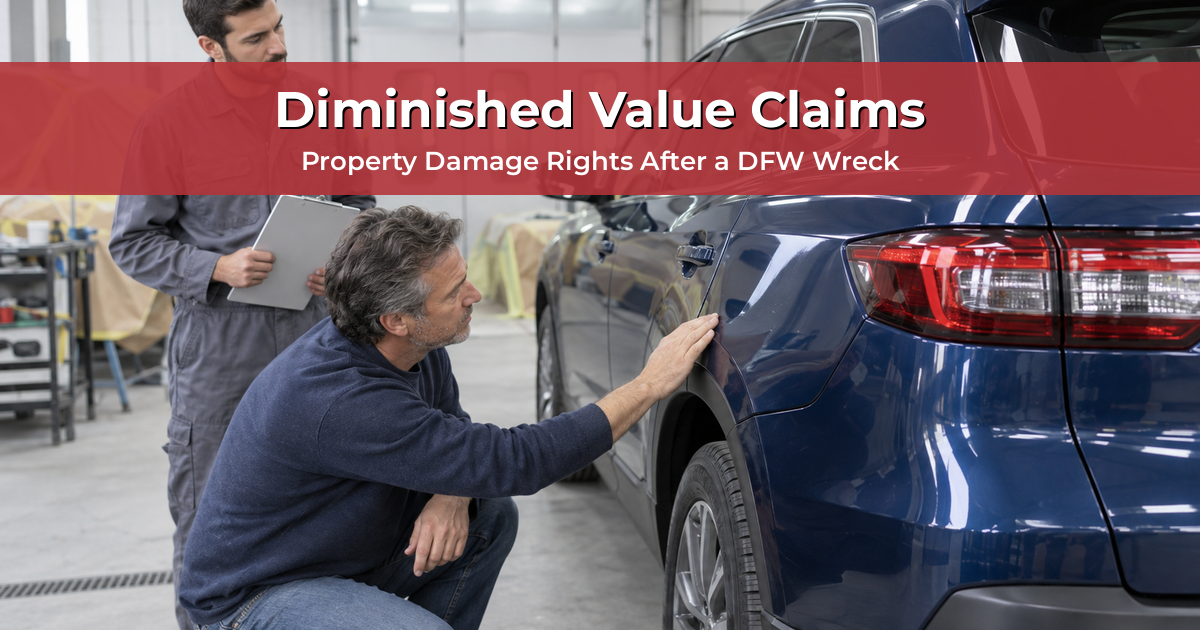
Car owner running his hand along a freshly repaired SUV panel in a body shop while a technician holds a clipboard

Car Repaired but Worth Less? Diminished Value and Property Damage Claims After a DFW Wreck

By Jesse Lotspeich · Personal Injury

Short answer: In Texas, if another driver caused your wreck, you can generally seek diminished value from that driver's liability insurance. Diminished value is the loss in your car's market value even after it is fully repaired. Your own insurance policy is different. The Texas Supreme Court held in 2003 that the standard Texas personal auto policy does not require your insurer to pay diminished value when the car is fully and adequately repaired. Texas law also allows loss-of-use damages, such as a rental car, even when a vehicle is totaled. A property damage lawsuit generally must be filed within two years.

Car owner running his hand along a freshly repaired SUV panel in a body shop while a technician holds a clipboard

After a wreck on I-30, I-35W, or Highway 121, most people in Dallas-Fort Worth focus on getting the car repaired and back on the road. But a vehicle with an accident history often sells or trades in for less than an identical car that was never damaged, even when the repair is excellent. That gap is real money, and many people never ask for it.

At Howard Lotspeich Alexander & Williams, PLLC (HLAW), our Fort Worth trial lawyers handle car wreck and personal injury claims throughout Tarrant, Dallas, Denton, Collin, Johnson, and Parker counties. This guide explains what Texas law allows you to recover for damage to your vehicle, and how to document a diminished value and loss-of-use claim.

Key Takeaways

  • Third-party diminished value claims are allowed in Texas. The Texas Department of Insurance has stated that an insurer "may be obligated to pay a third party claimant for any loss of market value of the claimant's automobile, regardless of the completeness of the repair" (TDI Bulletin B-0027-00).
  • Your own collision coverage generally does not pay diminished value. In American Manufacturers Mutual Insurance Co. v. Schaefer, 124 S.W.3d 154 (Tex. 2003), the Texas Supreme Court held the standard policy "does not require payment for diminished value when a vehicle has been fully and adequately repaired" (Schaefer opinion).
  • UM/UIM coverage may be different. TDI's bulletin says an insurer may be obligated to pay its own policyholder for loss of market value under uninsured/underinsured motorist coverage, "regardless of the completeness of the repair."
  • Loss-of-use damages are recoverable even for a totaled car. The Texas Supreme Court held in 2016 that an owner of totally destroyed property "may recover loss-of-use damages in addition to the fair market value of the property immediately before the injury" (J&D Towing v. American Alternative Insurance Corp.).
  • You choose the body shop. An insurer settling a third-party property damage claim "may not require the third-party claimant to have repairs made by a particular repair person or facility" (Texas Insurance Code §1952.301).
  • The deadline is two years. Suits for injury to property generally must be filed within two years (Tex. Civ. Prac. & Rem. Code §16.003).

What Is Diminished Value?

Diminished value is the difference between what your vehicle was worth immediately before the wreck and what it is worth after repairs. Buyers and dealers often pay less for a vehicle with a reported accident, especially one with structural or frame damage, airbag deployment, or major body work.

There are generally three ways people describe it:

  • Inherent diminished value: the loss in market value caused by the accident history itself, even after a complete and proper repair. This is the most common type of claim.
  • Repair-related diminished value: additional lost value caused by poor or incomplete repairs, such as mismatched paint or parts that do not fit correctly.
  • Immediate diminished value: the drop in value right after the crash, before repairs. This mostly matters in calculating a total loss or a settlement before repair.

Texas courts have long measured damage to personal property using market value. When property is partially damaged, the general rule is "the difference in the market value immediately before and immediately after the injury to such property at the place where the damage was occasioned," as the Texas Supreme Court summarized in J&D Towing (opinion).

Who Pays Diminished Value in Texas?

Who pays depends on whose insurance you are claiming against.

Type of claim Is diminished value available? Source
Claim against the at-fault driver's liability insurance (third-party claim) Generally yes, regardless of the completeness of the repair TDI Bulletin B-0027-00
Claim under your own collision or comprehensive coverage (first-party claim) Generally no, when the car is fully and adequately repaired Schaefer (Tex. 2003)
Claim under your own UM/UIM coverage when the at-fault driver is uninsured or underinsured May be available, regardless of the completeness of the repair TDI Bulletin B-0027-00

Why your own collision coverage usually will not pay

In Schaefer, the policyholder's car was repaired and he did not dispute the quality of the repairs, but he claimed it was still worth $2,600 less. The Texas Supreme Court looked at the policy's "Limit of Liability" language, which caps the insurer's obligation at the lesser of the vehicle's actual cash value or the amount needed "to repair or replace" it. The court held that "repair" connotes "something tangible, like removing dents or fixing parts," and does not include compensation for "the market's perception that a damaged but fully and adequately repaired vehicle has an intrinsic value less than that of a never-damaged car" (Schaefer opinion).

The court left open other situations. It noted that if repairs were faulty, incomplete, or inadequate, the insurer might be liable for breaching its obligations under the policy. TDI's bulletin similarly says loss of market value can still be used to settle a dispute where a vehicle "was repaired properly but the vehicle still does not function as it did before the accident."

Why the at-fault driver's insurer is different

A claim against the at-fault driver is not a contract claim under your policy. It is a negligence claim, and the at-fault driver is responsible for the full harm caused to your property. That is why TDI's position is that a liability insurer may owe a third-party claimant for loss of market value "regardless of the completeness of the repair." In practice, many adjusters will not offer diminished value unless you ask for it and support it with evidence.

If you are still sorting out who caused the crash, our guide to how fault works in Texas personal injury cases explains the comparative fault rules that also apply to property damage.

Can You Get Paid for a Rental Car or Loss of Use?

Yes. Loss-of-use damages compensate you for the time you cannot use your vehicle. They are often measured by the reasonable cost of a comparable rental, or by lost income for a work vehicle.

For years, many Texas courts said loss-of-use damages were available only when a vehicle could be repaired, not when it was totaled. The Texas Supreme Court rejected that rule in J&D Towing, LLC v. American Alternative Insurance Corp., 478 S.W.3d 649 (Tex. 2016). The court held that "the owner of personal property that has been totally destroyed may recover loss-of-use damages in addition to the fair market value of the property immediately before the injury" (J&D Towing opinion).

The court also set limits. Loss-of-use damages must be foreseeable and directly traceable to the wreck, they cannot be speculative, and a plaintiff may not recover them for a period longer than reasonably needed to repair or replace the vehicle. As the court put it, permitting these damages "is not a license for unrestrained raids on defendants' coffers."

TDI's auto insurance guide explains how this usually works in practice: if another driver caused the accident, that driver's insurance company will pay for you to rent a car for the time it believes is reasonable for repairs, and "if the company totals your car, it might stop paying for the rental a few days after telling you." Tell the adjuster about parts delays or newly discovered damage, because the company may extend the rental.

What If Your Car Is Totaled?

If the cost to repair is close to or more than the car's value, the insurer will usually declare it a total loss. In a total loss, the measure is generally the fair market value immediately before the wreck, plus reasonable loss-of-use damages under J&D Towing. TDI explains that insurers pay actual cash value, which reflects depreciation, so a 10-year-old car is valued as a 10-year-old used car (TDI auto insurance guide).

To push back on a low total-loss valuation, gather listings for comparable vehicles in the DFW market with similar year, mileage, trim, and options. Also gather records of recent upgrades, new tires, or major maintenance. If you want to keep the car, TDI notes that the insurer will subtract its salvage value from the settlement.

How Do You Prove a Diminished Value Claim?

Insurers rarely pay diminished value without documentation. The strongest claims usually include:

  1. The final repair invoice, showing the extent of the damage and the parts replaced. Structural, frame, or airbag repairs tend to support larger claims.
  2. Photos of the damage before repair, from multiple angles.
  3. A written appraisal from an independent vehicle appraiser who explains the pre-accident value, the post-repair value, and how the difference was calculated.
  4. Dealer statements or trade-in offers showing what dealers will pay for the vehicle now compared with a similar vehicle without accident history.
  5. The vehicle's history report, if it shows the accident.
  6. The police crash report, to establish fault. Our article on how to get and use a Texas car wreck police report explains the process.

Send a written demand to the at-fault driver's insurer with these documents, and keep copies of every communication. If the adjuster uses a formula that produces a very low number, ask how it was calculated and respond with your own evidence. Our guide to insurance adjuster tactics in Fort Worth covers common approaches insurers use.

Do You Have to Use the Insurance Company's Body Shop?

No. Texas law protects your choice. In settling a third-party property damage claim, an insurer "may not require the third-party claimant to have repairs made by a particular repair person or facility" or require particular parts (Texas Insurance Code §1952.301(b)). For your own policy, §1952.302 prohibits an insurer or adjuster from stating or suggesting that you "must use a specific repair person or facility" or one on a preferred list for the repair to be covered.

Choosing a shop that documents its work thoroughly can also help a later diminished value claim, because detailed repair records show exactly what was damaged and replaced.

What Are the Deadlines for a Property Damage Claim in Texas?

A lawsuit for injury to property generally must be filed within two years after the claim accrues (Tex. Civ. Prac. & Rem. Code §16.003). The same two-year period applies to personal injury claims from the same wreck. Claims against government entities can involve much shorter notice deadlines. Our guide to the Texas statute of limitations explains the exceptions.

Insurers also have deadlines. TDI explains that a company must acknowledge your claim within 15 days, accept or reject it within 15 business days after receiving everything it needs (with up to 45 more days if it explains why), and pay within five business days after agreeing to pay (TDI auto insurance guide).

Should You Settle Your Property Damage Claim Separately From Your Injury Claim?

Often, yes. Many people resolve the vehicle claim first so they can get back on the road, while their injury claim continues as medical treatment progresses. Before signing anything, read the release carefully. A property damage release should be limited to property damage and should not release bodily injury claims. If the at-fault driver has only minimum coverage, the property damage limit is $25,000 under Texas's 30/60/25 requirement (TDI), and your own UM/UIM coverage may need to fill the gap.

Frequently Asked Questions

Can I claim diminished value from my own insurance company in Texas?

Generally not under collision or comprehensive coverage when the car is fully and adequately repaired. The Texas Supreme Court held in Schaefer (2003) that the standard Texas personal auto policy does not require it. A claim under your UM/UIM coverage may be different, and disputes over faulty or incomplete repairs are treated differently.

How much is a diminished value claim worth?

It depends on the vehicle's age, mileage, pre-accident value, and the severity of the damage. Newer, higher-value vehicles with structural damage tend to lose the most value. An independent appraisal and dealer trade-in comparisons are the best evidence of the actual loss.

Does the at-fault driver's insurance have to pay for my rental car?

If the other driver caused the wreck, that driver's insurer typically pays for a rental for the time reasonably needed to repair the car. Under J&D Towing, loss-of-use damages are also available when a vehicle is totaled, but only for a reasonable period to replace it.

What if the repair shop did a bad job?

Poor or incomplete repairs can increase your loss. In a first-party claim, Schaefer noted that an insurer might be liable for breaching its policy obligations if repairs are faulty, incomplete, or inadequate. Document the problems with photos and a second shop's written evaluation.

Do I need a lawyer for a property damage claim?

Many vehicle-only claims are resolved without a lawyer. If you were also injured, if the insurer denies fault, or if the vehicle had high value or serious damage, a lawyer can help coordinate the property and injury claims and make sure a release does not give up more than it should.

How long do I have to file a diminished value claim in Texas?

A lawsuit generally must be filed within two years of the wreck under Civil Practice and Remedies Code §16.003. It is best to start the claim right away, while repair records and appraisals are fresh.

Talk to a Fort Worth Car Wreck Lawyer

If another driver damaged your vehicle and hurt you or your family, you may be entitled to more than the repair bill. That can include lost market value, loss of use, and compensation for your injuries.

Call HLAW at (817) 993-9249 or contact us online for a free consultation about your Dallas-Fort Worth car wreck claim.

This article is for general informational purposes only and is not legal advice. Reading it does not create an attorney-client relationship. Laws change, and every case depends on its specific facts.
Read full article
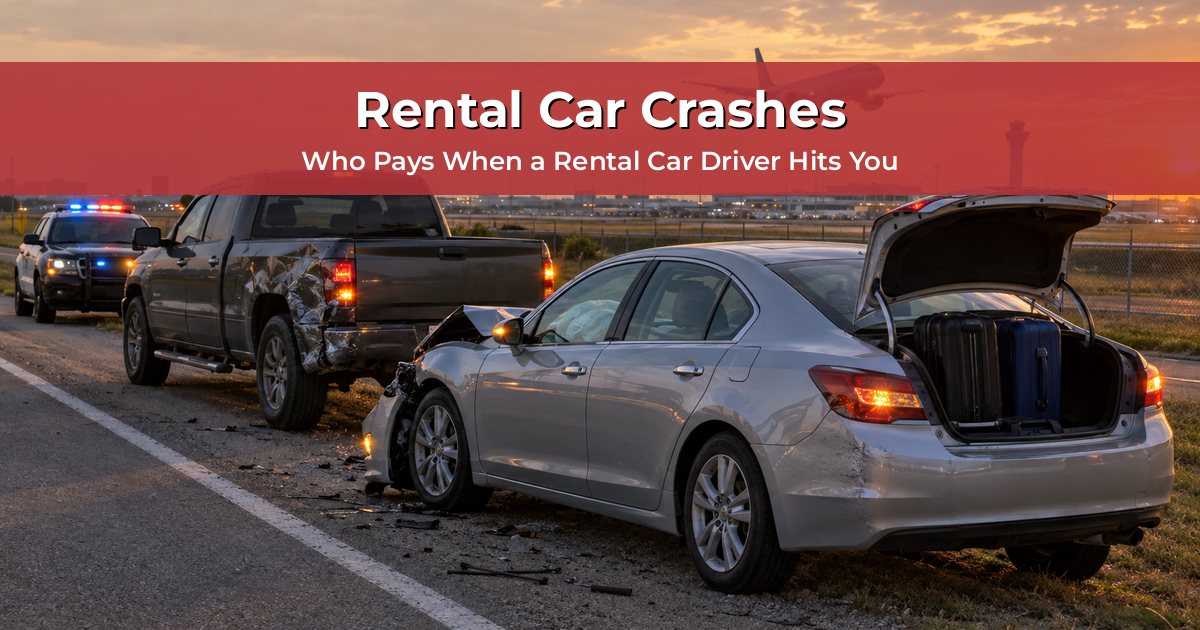
Silver rental sedan with luggage in the open trunk after a rear-end crash with a pickup near a DFW airport

Hit by a Rental Car Driver in DFW? Who Pays After a Rental Car Crash in Texas

By Jesse Lotspeich · Personal Injury

Short answer: If a driver in a rental car hits you in Texas, the claim usually runs against the driver and the insurance that covers the driver, not the rental company. A federal law known as the Graves Amendment bars holding a rental company liable just because it owns the car. Rental companies can still be liable for their own negligence, such as renting a car with known defects. Texas law also gives you a way to sue an out-of-state renter who has already flown home.

Silver rental sedan with luggage in the open trunk after a rear-end crash with a pickup near a DFW airport

With two major airports, DFW International and Dallas Love Field, Dallas-Fort Worth sees a steady stream of out-of-town drivers on unfamiliar roads like the airport's spur highways, Highway 114, Highway 183, and I-635, often tired and relying on GPS. When one of them causes a crash, injured people usually face the same questions: Who pays? Does the rental company's insurance apply? What if the driver lives in another state?

At Howard Lotspeich Alexander & Williams, PLLC (HLAW), our Fort Worth trial lawyers handle personal injury claims throughout Tarrant, Dallas, Denton, Collin, Johnson, and Parker counties. This guide explains how rental car crash claims work in Texas, whether you were hit by a renter or were driving a rental yourself.

Key Takeaways

  • The Graves Amendment generally shields rental companies from owner-based liability. A company in the rental business "shall not be liable... by reason of being the owner of the vehicle" for harm arising from the renter's use, if there is "no negligence or criminal wrongdoing" by the company (49 U.S.C. §30106).
  • Direct negligence is a different story. Federal courts in Texas have held that the Graves Amendment bars vicarious liability but "does not preempt theories of direct liability" (N.D. Tex. 2025 opinion).
  • Texas minimum liability coverage is 30/60/25: $30,000 per person, $60,000 per crash for bodily injury, and $25,000 for property damage (Tex. Transp. Code §601.072).
  • Out-of-state drivers can still be sued here. The chair of the Texas Transportation Commission is the agent for service of process on a nonresident in a suit arising from a Texas collision (Tex. Civ. Prac. & Rem. Code §17.062).
  • Your own coverage may matter most. UM/UIM and PIP can fill gaps when the renter's coverage is low or missing.

Who Is Liable When a Rental Car Driver Hits You in Texas?

The starting point is the same as any Texas car wreck: the driver who caused the crash is responsible for the harm caused by their negligence. Texas assigns fault by percentage, and you can recover as long as you're not more than 50% responsible. Our guide to how fault works in Texas personal injury cases explains those rules.

What's different in a rental car case is the question of who else might be responsible, and whose insurance pays.

What the Graves Amendment says

Before 2005, some states made rental companies liable for their customers' crashes simply because the companies owned the cars. Congress ended that with the Graves Amendment. It provides that an owner that rents or leases a vehicle "shall not be liable under the law of any State... by reason of being the owner of the vehicle... for harm to persons or property that results or arises out of the use, operation, or possession of the vehicle during the period of the rental or lease," as long as the owner is "engaged in the trade or business of renting or leasing motor vehicles" and "there is no negligence or criminal wrongdoing on the part of the owner" (49 U.S.C. §30106(a)).

Courts in Texas apply this rule regularly. In a 2025 Dallas federal case involving a leased trailer, the court held that the Graves Amendment barred the plaintiff's vicarious liability and respondeat superior claim against the leasing company, while noting that the statute "does not preempt theories of direct liability, like negligent hiring and training" (N.D. Tex. 2025).

The law also has a carve-out for financial responsibility. It doesn't override state laws "imposing financial responsibility or insurance standards on the owner of a motor vehicle," or liability on rental businesses "for failure to meet the financial responsibility or liability insurance requirements under State law" (§30106(b)).

When Can a Rental Car Company Be Held Responsible?

Because the Graves Amendment protects only against liability based on ownership, a rental company can still be responsible for its own negligence. Potential claims include:

  • Negligent maintenance. Renting out a car with bad brakes, bald tires, or a known defect, including an unrepaired safety recall.
  • Negligent entrustment. Renting to someone the company knew, or should have known, was unlicensed, incompetent, or reckless.
  • Criminal wrongdoing by the company or its employees.

These claims are hard to win. Under Texas law, negligent entrustment requires proof of "(1) entrustment of a vehicle by the owner; (2) to an unlicensed, incompetent, or reckless driver; (3) that the owner knew or should have known to be unlicensed, incompetent, or reckless; (4) that the driver was negligent on the occasion in question; and (5) that the driver's negligence proximately caused the accident" (O'Donnell v. Diaz, N.D. Tex.). Federal courts applying Texas law have also said a company that entrusts a vehicle "has no duty to investigate a driver's competency when a valid, unrestricted driver's license is presented" (Marr v. Croxton, W.D. Tex.).

Causation is another hurdle. In Allways Auto Group v. Walters, the Supreme Court of Texas held that a dealership that gave a customer a loaner car wasn't liable when the customer drove drunk and caused a crash eighteen days later, because the loan was not a proximate cause of the crash (Tex. 2017).

In practice, the rental company is most often a defendant when there's evidence of a mechanical failure. That makes it critical to preserve the vehicle and its maintenance records before the company repairs, resells, or returns the car to the fleet.

Whose Insurance Pays After a Rental Car Crash?

Several layers of coverage may be involved, and the order in which they apply depends on the policies and the rental contract. Common sources include:

Coverage source What it may cover Notes
Renter's personal auto policy Liability for injuries the renter causes Many personal policies extend to rental cars; check the policy language
Rental company coverage Liability up to the limits the company provides Often limited; Texas minimums are 30/60/25 (§601.072)
Supplemental liability insurance bought at the counter Additional liability limits Only if the renter purchased it
Your own UM/UIM coverage Your injuries when the at-fault driver has no or too little insurance See our UM/UIM and PIP guide
Your own PIP Medical bills and lost income regardless of fault Covers the named insured, household members, and authorized drivers and passengers of the named insured's vehicle (Tex. Ins. Code §1952.151)
Credit card rental benefits Usually damage to the rental car itself Generally not a source of payment for your injuries

Because rental crashes often involve minimum or uncertain coverage, your own UM/UIM policy can become the most important coverage in the case. If the renter fled the scene or had no valid coverage, see our article on what to do after an uninsured driver accident in Fort Worth.

What If the Rental Car Driver Lives in Another State?

Many renters at DFW and Love Field are visitors who are back home within days. That doesn't put them beyond the reach of a Texas court. Under Section 17.062 of the Civil Practice and Remedies Code, the chair of the Texas Transportation Commission is an agent for service of process on a nonresident "in any suit against the person or agent that grows out of a collision in which the person or the person's agent is involved while operating a motor vehicle in this state." The same rule applies to a driver who lived in Texas at the time of the crash and later moved away.

Section 17.063 sets out the mechanics: a certified copy of the process must be served on the chair at least 20 days before the return date, and the chair then mails the papers to the nonresident by registered or certified mail (§17.063). In other words, an out-of-state renter can be sued in Tarrant or Dallas County, close to where the crash happened, rather than forcing you to file in another state.

International renters raise added issues, such as foreign insurance and serving papers abroad. Those cases call for early legal advice.

What If I Was Driving the Rental Car When I Got Hurt?

If you were driving or riding in a rental car and someone else caused the crash, your claim is against the at-fault driver, just like any other wreck. A few rental-specific issues often come up:

  • Damage to the rental car. The rental company may bill you or your insurer for repairs, loss of use, and administrative fees. Don't sign anything admitting responsibility for the crash.
  • The rental company's own crash report. Rental counters often ask you to fill out an incident form. Stick to the facts and keep a copy.
  • Your PIP and UM coverage. Depending on the policy terms, your own PIP and UM/UIM coverage may apply even though you were in a rental. Read the policy or have a lawyer review it.
  • Rideshare rentals. If you rented a car to drive for a rideshare app, different coverage rules may apply. See our guide to Uber and Lyft accidents.

What Should You Do After a Crash With a Rental Car in DFW?

  1. Call 911 and get a police report. In a crash with an out-of-town driver, the police crash report is often the best record of who was involved and their insurance.
  2. Photograph the rental car's identifiers. Photograph the plate, VIN sticker, and any barcode or fleet number, plus the renter's driver's license and insurance information.
  3. Get the renter's home address and phone number, and ask whether they bought coverage at the counter.
  4. Write down the rental company and location (for example, the airport rental center or a neighborhood branch).
  5. See a doctor promptly, even if you feel fine. Our article on seeing a doctor after a minor car accident explains why.
  6. Send a preservation letter early if a mechanical defect may have played a role, so the rental company keeps the car and its maintenance records.
  7. Be cautious with multiple adjusters. You may hear from the renter's insurer, the rental company's claims administrator, and your own carrier. Read about insurance adjuster tactics before giving a recorded statement.
  8. Watch the deadline. Most Texas injury lawsuits must be filed within two years. See our Texas statute of limitations guide.

Frequently Asked Questions

Can I sue the rental car company if its customer hit me?

Usually not just because the company owns the car. The Graves Amendment bars ownership-based liability for companies in the rental business, but it doesn't protect a company from liability for its own negligence or criminal wrongdoing (49 U.S.C. §30106). Evidence of poor maintenance or a known defect can support a direct claim.

Does the rental company's insurance cover my injuries?

It may, depending on the coverage the company provides and the rental agreement. Coverage is often limited, and Texas minimum liability limits are $30,000 per person and $60,000 per crash for bodily injury (Tex. Transp. Code §601.072). The renter's own auto policy or a supplemental policy bought at the counter may also apply.

The driver who hit me flew home to another state. Can I still sue in Texas?

Yes. Texas law makes the chair of the Texas Transportation Commission the agent for service of process on nonresident drivers involved in collisions in Texas (CPRC §17.062).

Is a rental company liable for renting to a bad driver?

Only in limited situations. A negligent entrustment claim requires proof that the company knew or should have known the driver was unlicensed, incompetent, or reckless (O'Donnell v. Diaz), and courts have said there is no duty to investigate further when a valid, unrestricted license is presented (Marr v. Croxton).

What if the renter didn't have enough insurance?

Your own uninsured/underinsured motorist coverage may pay the difference, up to your policy limits. PIP can also pay medical bills and lost income regardless of fault (Tex. Ins. Code §1952.151).

How long do I have to file a claim?

Most Texas personal injury claims must be filed within two years of the crash. Claims involving government vehicles can have much shorter notice deadlines.

Talk to a Fort Worth Car Wreck Lawyer

Rental car crashes add layers of insurance, out-of-state drivers, and federal law to an already stressful situation. HLAW can identify every available policy, preserve the vehicle evidence, and serve a driver who has already left Texas. Call (817) 993-9249 or contact us online for a free consultation.

This article is for general informational purposes only and is not legal advice. Reading it does not create an attorney-client relationship. Every case depends on its specific facts, and the laws discussed here may change.

Read full article
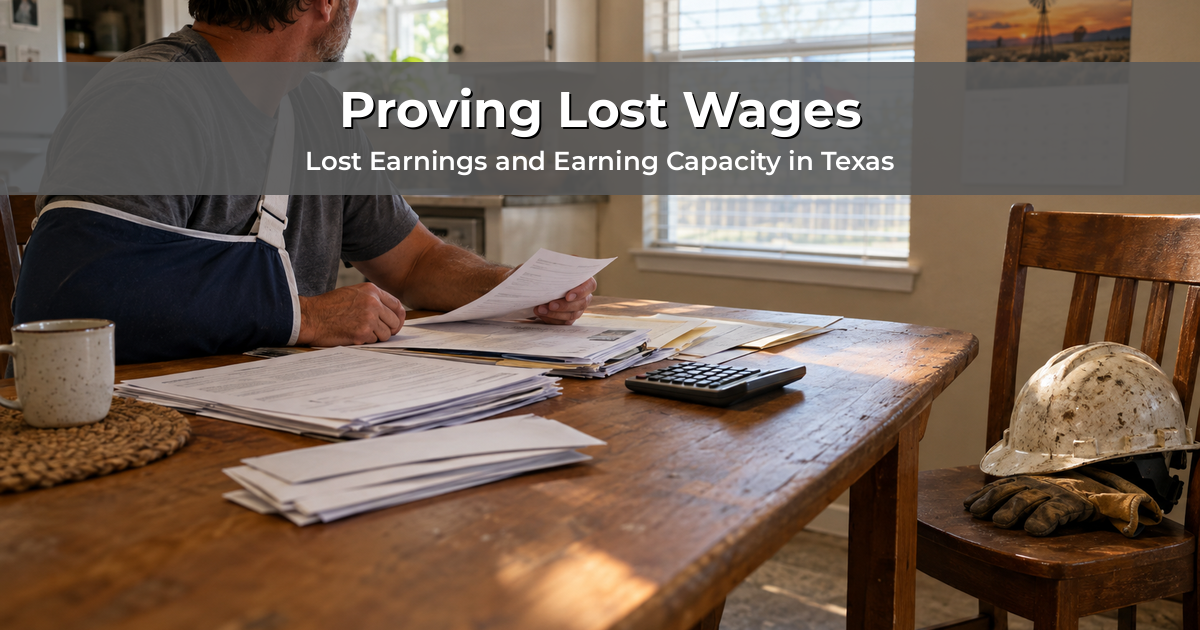
Injured worker with his arm in a sling reviewing pay records and bills at a kitchen table, hard hat on a nearby chair

Missed Work After a DFW Injury? How to Prove Lost Wages and Lost Earning Capacity in Texas

By Jesse Lotspeich · Personal Injury

Short answer: In a Texas personal injury case, you can recover the wages you've already lost and the loss of your future capacity to earn, but you have to prove both with evidence, not estimates. Texas law requires lost earnings to be presented as a net loss after federal income taxes. Courts let juries consider your past earnings, stamina, efficiency, ability to work with pain, and work-life expectancy when measuring future losses. Pay stubs, tax returns, employer statements, medical work restrictions, and, in bigger cases, vocational and economic experts are what turn a lost paycheck into a recoverable claim.

Injured worker with his arm in a sling reviewing pay records and bills at a kitchen table, hard hat on a nearby chair

After a wreck on I-30 or a fall at a Fort Worth job site, the bills that hurt most are often not the medical bills. They're the missed paychecks. Missed shifts, used-up PTO, a lost promotion, or a career you can no longer do are all real economic losses under Texas law, but insurance companies routinely discount them when they aren't documented well.

At Howard Lotspeich Alexander & Williams, PLLC (HLAW), our Fort Worth trial lawyers handle personal injury cases throughout Tarrant, Dallas, Denton, Collin, Johnson, and Parker counties. This guide explains how Texas law treats lost wages and lost earning capacity, what evidence works, and the mistakes that shrink these claims.

Key Takeaways

  • Two different claims. Past lost earnings cover income you've already missed. Loss of earning capacity covers your diminished ability to earn in the future, even if you were paid the same or more after the injury.
  • Net, after taxes. Evidence of lost earnings or earning capacity "must be presented in the form of a net loss after reduction for income tax payments" under federal income tax law (Tex. Civ. Prac. & Rem. Code §18.091).
  • Reasonable measurement in dollars. You must give the jury evidence "sufficient to permit a jury to reasonably measure earning capacity in monetary terms" (Big Bird Tree Service v. Gallegos, Tex. App.—Dallas 2012).
  • Lost wages are economic damages. Texas defines economic damages as compensation for "actual economic or pecuniary loss" (CPRC §41.001(4)).
  • PIP can help right away. Personal injury protection coverage pays "replacement of income lost as the result of the accident" for income producers, regardless of fault (Tex. Ins. Code §1952.151).

What Is the Difference Between Lost Wages and Lost Earning Capacity?

Texas law treats these as related but distinct damages.

Past lost earnings (lost wages) are the income you actually lost between the injury and trial or settlement: missed hours, missed shifts, unpaid leave, lost overtime, lost commissions, and lost bonuses that were reasonably certain.

Loss of earning capacity looks at something broader: your ability to earn money. Texas courts describe it as an assessment of the plaintiff's capacity to earn a livelihood before the injury and the extent to which the injury impaired that capacity. It "is not measured by what a person actually earned before an injury, but by the person's capacity to earn, even if he had never worked in that capacity in the past" (Tex. App.—Houston [1st Dist.] 2013).

That second point matters. Courts "have consistently upheld judgments for reduced earning capacity, even though the plaintiff was making as much or even more money after the injury than before," where pain, weakness, or diminished functional ability impaired the person's capacity to get and hold a job, or the duration, consistency, or efficiency of their work (Kelsey-Seybold Medical Group v. Roberts, Tex. App.—Houston [1st Dist.] 2024).

Past lost earnings Loss of future earning capacity
Time period Injury to trial or settlement After trial, for the rest of your work life
What it measures Income actually lost Diminished ability to earn
Typical proof Pay stubs, W-2s, tax returns, employer letter, timesheets Medical restrictions, vocational testimony, economist, past earnings history
Tax rule Net after federal income tax (§18.091) Net after federal income tax (§18.091)

How Do You Prove Lost Wages in a Texas Injury Claim?

For an hourly or salaried employee, the proof is usually straightforward, but it has to be complete:

  1. A doctor's work restriction. A note or record showing you were taken off work or placed on light duty, and for how long. Without it, insurers will argue you chose not to work.
  2. Pay records. Recent pay stubs and W-2s showing your rate, typical hours, and overtime history.
  3. An employer verification letter. A letter from HR or a supervisor confirming your position, pay rate, the dates you missed, and any lost overtime, bonuses, or promotion.
  4. Tax returns. Usually two to three years, especially if your income varies.
  5. PTO and sick leave records. If you used paid leave to cover missed days, document it.

What if I'm self-employed or a gig worker?

Self-employed claims require more proof, but they're recoverable. Courts recognize that "when the plaintiff seeks special damages for loss of earning capacity in a particular business, the amount of his earnings or the value of his services in that business must be shown with reasonable certainty" (Perez v. Perez, Tex. App.—Corpus Christi 2013). Useful evidence includes:

  • Schedule C or business tax returns for several years
  • 1099 forms and app earnings statements for rideshare and delivery drivers
  • Bank deposits, invoices, and canceled contracts or jobs you had to turn down
  • The cost of hiring someone to cover your work while you recovered
  • Testimony from regular customers or business partners

When income has been irregular, an accountant or economist can help show average earnings and what you would likely have earned during your recovery.

How Do Texas Courts Measure Lost Future Earning Capacity?

Future losses are uncertain by nature, and Texas law accepts that. "Proof of loss of earning capacity is always uncertain and is left largely to the discretion of the jury" (Big Bird Tree Service v. Gallegos). But the jury's award must rest on evidence, not speculation. Courts have said an award "must be based on something more than mere conjecture" (Durham Transportation Co., Tex. App.).

The Dallas Court of Appeals lists non-exclusive factors juries may consider: "evidence of past earnings, the plaintiff's stamina, efficiency, and ability to work with pain, and the plaintiff's work-life expectancy" (Big Bird Tree Service). Other Texas courts add "the weaknesses and degenerative changes that will naturally result from the plaintiff's injury" (Durham Transportation).

In practice, strong future-earnings claims usually include:

  • Treating doctor testimony on permanent restrictions (for example, no lifting over 20 pounds, no repetitive overhead work).
  • A vocational expert who explains which jobs you can still do and what they pay in the DFW labor market.
  • An economist who calculates the difference over your expected work life, adjusts for taxes as §18.091 requires, and reduces future amounts to present value.
  • Your own testimony and co-workers' testimony about how the injury affects your stamina and performance.

Will My Lost Wage Award Be Taxed?

Generally, damages for personal physical injuries aren't taxable as income under federal law, which is the reason for Texas's net-of-tax rule. Section 18.091(b) also requires the court to "instruct the jury as to whether any recovery for compensatory damages sought by the claimant is subject to federal or state income taxes" (CPRC §18.091). The practical effect: your lost earnings must be calculated on take-home pay, not gross pay. Tax questions about a specific settlement should go to a tax professional.

Can PIP Pay My Lost Income After a Car Wreck?

Yes, if you have it. Texas personal injury protection coverage pays, for an income producer, "replacement of income lost as the result of the accident," for expenses incurred within three years of the accident (Tex. Ins. Code §1952.151). Insurers aren't required to offer more than $2,500 per person in PIP, though many people buy more (§1952.153). The insurer must pay benefits no later than the 30th day after it receives satisfactory proof of the claim (§1952.156).

PIP applies regardless of fault, so it can help cover the gap while the liability claim is pending. Our guide to UM/UIM and PIP coverage explains how these policies fit together.

If you were hurt on the job, the rules may be different. Workers' compensation, or the lack of it with a non-subscriber employer, changes how lost income is handled. See our page on workplace accidents.

What Mistakes Hurt Lost Wage Claims?

  • Returning to work against medical advice, then trying to claim the time later.
  • Gaps in treatment, which insurers use to argue you were well enough to work.
  • Unreported cash income. If income wasn't reported on tax returns, it's very difficult to prove and can create other problems.
  • Posting on social media about physical activities or side jobs while claiming you can't work.
  • Giving the adjuster a recorded statement that downplays your limitations. Read about insurance adjuster tactics in Fort Worth.
  • Settling before you know your restrictions. If a surgeon hasn't released you, you may not yet know whether you can return to your trade.
  • Missing the deadline. Most Texas injury lawsuits must be filed within two years. See our Texas statute of limitations guide.

Lost earnings are only part of the picture. Our article on what compensation is available in a Texas personal injury lawsuit covers medical expenses, pain and suffering, and other damages. Noneconomic damages are defined separately in Texas law and include "physical pain and suffering, mental or emotional pain or anguish... physical impairment," and similar losses (CPRC §41.001(12)).

Frequently Asked Questions

Can I recover lost wages if I used PTO or sick days?

It may be possible. Paid leave you were forced to use because of the injury is a benefit you can no longer use for other purposes, and it is commonly presented as part of the earnings claim. Whether it is recoverable depends on the facts, so keep the payroll records showing the leave you used and the dates.

Can I claim lost earning capacity if I went back to the same job?

Possibly. Texas courts have upheld earning-capacity awards even when the plaintiff earned as much or more after the injury, where pain or diminished function impaired the ability to get and hold work or to work consistently and efficiently (Kelsey-Seybold v. Roberts).

Do I need an expert to prove future lost earnings?

Not always, but in cases involving permanent injury or a career change, a vocational expert and an economist are often the most persuasive way to give the jury a reasonable dollar measure, which the law requires (Big Bird Tree Service).

Are lost wages calculated before or after taxes in Texas?

After. Section 18.091 requires lost earnings and earning-capacity evidence to be presented as a net loss after federal income taxes (CPRC §18.091).

I'm self-employed. How do I prove what I lost?

Use tax returns, 1099s, invoices, bank deposits, and evidence of jobs you lost or turned down. The earnings or value of your services must be shown with reasonable certainty (Perez v. Perez).

Will my own insurance pay lost income while I wait?

If your auto policy includes PIP, it covers lost income for income producers regardless of fault, and the insurer must pay within 30 days of satisfactory proof (Tex. Ins. Code §§1952.151, 1952.156).

Talk to a Fort Worth Personal Injury Lawyer

If an injury has cost you paychecks, or your career, the way that loss is documented can make a substantial difference in what you recover. HLAW can gather your employment records, work with your doctors on restrictions, and bring in vocational and economic experts when needed. Call (817) 993-9249 or contact us online for a free consultation.

This article is for general informational purposes only and is not legal advice. Reading it does not create an attorney-client relationship. Every case depends on its specific facts, and the laws discussed here may change.

Read full article

Speak with a Fort Worth attorney

Call (817) 993-9249 or send us a message to discuss your case.
