Short answer: When you are released on bond after a Texas DWI arrest, the magistrate can attach conditions to that bond, and the most common ones in Dallas-Fort Worth are an ignition interlock device, alcohol monitoring, and reporting to a pretrial supervision office. Texas law requires an interlock as a bond condition for a second or later DWI and for certain other intoxication offenses, such as DWI with a child passenger, intoxication assault, and intoxication manslaughter, unless the magistrate finds that requiring it "would not be in the best interest of justice." A judge can revoke your bond if you violate a condition, so understanding the order on day one matters as much as getting out of jail.
Most people focus on the bond amount after a DWI arrest. The conditions attached to that bond often affect daily life more: whether you can drive to work, what you pay each month, and how often you have to report. At Howard Lotspeich Alexander & Williams, PLLC (HLAW), our Fort Worth DWI defense lawyers review bond orders early in a case so clients know exactly what is required and whether a condition can be challenged or modified.
This guide explains which DWI bond conditions Texas law requires, which ones are up to the judge, what interlock and alcohol monitoring look like in Tarrant and Dallas Counties, how a bond interlock affects your driver's license, and what happens if a condition is violated.
Key Takeaways
- Some interlock orders are mandatory. A magistrate "shall require" an ignition interlock on release for a subsequent DWI and for DWI with a child passenger, intoxication assault, and intoxication manslaughter, unless the magistrate finds it "would not be in the best interest of justice" (Tex. Code Crim. Proc. art. 17.441).
- You have 30 days to install. When an interlock is required under article 17.441, it must be installed "at the defendant's expense, before the 30th day after the date the defendant is released on bond."
- Judges can add other conditions in first-offense cases. A magistrate "may impose any reasonable condition of bond related to the safety of a victim of the alleged offense or to the safety of the community" (art. 17.40).
- Violations can put you back in jail. If a magistrate finds by a preponderance of the evidence that you violated a safety condition, the magistrate "shall revoke the defendant's bond" and order you returned to custody (art. 17.40(b)).
- A bond interlock follows you into the license process. If you are under an interlock order "imposed as a condition of bond," a judge granting an occupational license must generally restrict you to an interlock-equipped vehicle (Tex. Transp. Code § 521.246).
What Are Bond Conditions in a Texas DWI Case?
Bond is your promise to come back to court. Conditions are the rules you must follow while the case is pending. Under article 17.15 of the Code of Criminal Procedure, bail "and any conditions of bail shall be sufficient to give reasonable assurance that the undertaking will be complied with," but the power to require bail "is not to be used to make bail an instrument of oppression." The magistrate must also consider your ability to make bail, the nature of the offense, your criminal history, and "the future safety of a victim of the alleged offense, law enforcement, and the community."
In practice, a DWI bond order in Tarrant, Dallas, Denton, Collin, Johnson, or Parker County may include:
- An ignition interlock device on the vehicle you own or drive most
- Continuous alcohol monitoring or a portable breath device
- Drug or alcohol testing
- Reporting to a pretrial or bond supervision office
- No consumption of alcohol
- Paying monitoring and supervision fees
Conditions are set when you see the magistrate after arrest, and the court where your case is pending can change them later. If you are still deciding how to post bond, our bail bonds guide for Fort Worth arrests explains surety, cash, and personal bonds.
When Is an Ignition Interlock Required as a Bond Condition?
Article 17.441 lists the cases where an interlock is the default. The magistrate must require it on release for a defendant charged with a subsequent offense under Penal Code sections 49.04, 49.05, 49.06, or 49.061 (DWI, flying while intoxicated, boating while intoxicated, and assembling or operating an amusement ride while intoxicated), or with an offense under section 49.045 (DWI with a child passenger), 49.07 (intoxication assault), or 49.08 (intoxication manslaughter).
The order has two parts. You must have the device installed "on the motor vehicle owned by the defendant or on the vehicle most regularly driven by the defendant," and you may "not operate any motor vehicle unless the vehicle is equipped with that device." That second part is the one people miss. Borrowing a friend's car or driving a family member's truck without an interlock can be a violation even if your own car has one.
There is one statutory exception: the magistrate "may not require the installation of the device if the magistrate finds that to require the device would not be in the best interest of justice." That finding is case specific. A defense lawyer can raise facts that support it, but there is no guarantee a court will make it.
If you are facing a repeat charge, see our guides on a third DWI as a felony in Texas and DWI with a child passenger.
Can a judge order an interlock on a first DWI?
Yes, even though article 17.441 does not make it mandatory. Article 17.40 lets a magistrate impose "any reasonable condition of bond related to the safety of a victim of the alleged offense or to the safety of the community." Local practice varies by court and by facts. A high test result, a crash, or a prior arrest may make a judge more likely to order an interlock or alcohol monitoring on a first offense. Our article on high BAC DWI charges covers the 0.15 Class A enhancement.
What Does an Interlock Bond Condition Involve Day to Day?
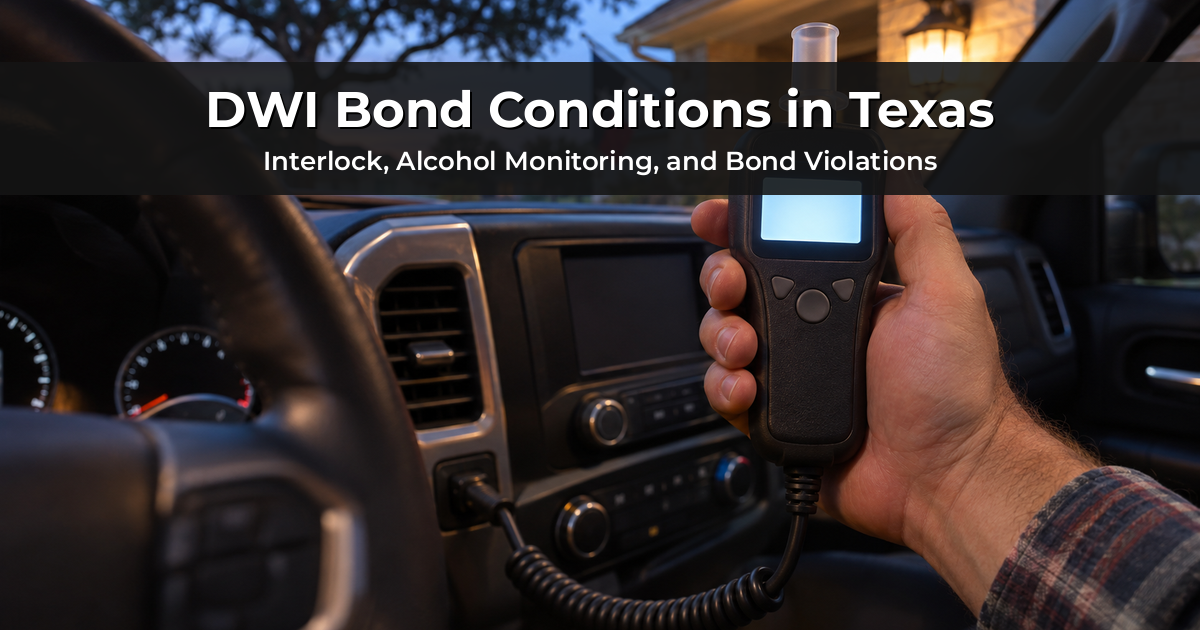
An ignition interlock is a breath-testing unit wired into your vehicle's ignition. Texas law describes it as a device that "uses a deep-lung breath analysis mechanism to make impractical the operation of a motor vehicle if ethyl alcohol is detected in the breath of the operator" (art. 17.441). According to Dallas County Pretrial Services, the driver must provide a breath sample to start the engine, and if the alcohol concentration exceeds the device's startup set point, the vehicle will not start.
Here is what the process typically requires:
- Pick an approved device and provider. The Texas Department of Public Safety states that all court-ordered installations must be performed by department-certified service centers. DPS publishes a list of approved ignition interlock devices.
- Install within 30 days. For an article 17.441 order, installation is due before the 30th day after release.
- Report proof of installation. The magistrate may designate an agency to verify installation and monitor the device. In Dallas County, people released with an interlock order report to Pretrial Services on an assigned date with proof of installation.
- Pay the fees. You pay for the device itself. If an agency monitors it, the monthly reimbursement fee under article 17.441(d) is set by the magistrate "in an amount not to exceed $10." Dallas County lists a $10 monthly monitoring fee.
- Keep up with calibration and reporting. Dallas County requires monthly reporting with verification of calibration after the first visit.
- Do not tamper with the device. Dallas County's conditions of bond for alcohol monitoring prohibit attempting to adjust, tamper with, circumvent, or bypass the device or removing it without written permission of the court.
What Other Alcohol Monitoring Can a Judge Order?
An interlock only tests you when you drive. Some judges want broader monitoring. Dallas County Pretrial Services lists the devices its Alcohol Monitoring Unit uses: the ignition interlock, SCRAM, Soberlink (portable), an alcohol patch, and urinalysis for drugs, alcohol, or both.
In Tarrant County, pretrial supervision runs through the Community Supervision and Corrections Department. Its Bond Supervision program serves felony and misdemeanor pretrial defendants, and the county states that "most of the offenders in this program are court-ordered to report and submit to drug and alcohol screening."
Other statutes give magistrates additional tools:
- Home confinement and electronic monitoring. Under article 17.44, a magistrate may require home confinement and electronic monitoring or weekly testing for controlled substances, and the cost may be ordered paid by the defendant.
- Testing on a personal bond. When setting a personal bond on a finding of drug or alcohol abuse related to the offense, the court "shall require" testing for alcohol or a controlled substance and participation in a treatment or education program if that condition "will serve to reasonably assure the appearance of the defendant for trial" (art. 17.03(c)).
Can my bond test results be used against me at trial?
For testing ordered under Chapter 17, article 17.03(d) says the State "may not use the results of any test conducted under this chapter in any criminal proceeding arising out of the offense for which the defendant is charged." That does not make a failed test harmless. A positive or missed test can still be reported to the court and used to seek a bond revocation or stricter conditions.
Mandatory vs. Discretionary DWI Bond Conditions
| Condition | Legal source | Mandatory or discretionary | Notes |
|---|---|---|---|
| Ignition interlock, repeat DWI or listed intoxication offense | Art. 17.441 | Mandatory unless "not in the best interest of justice" | Install within 30 days at your expense; monitoring fee up to $10 a month |
| Ignition interlock, first DWI | Art. 17.40 | Discretionary | Must be a reasonable condition tied to victim or community safety |
| Alcohol or drug testing and treatment on a personal bond | Art. 17.03(c) | Required when the listed findings are made | Results cannot be used in the criminal case for the charged offense |
| Home confinement, electronic monitoring, weekly drug tests | Art. 17.44 | Discretionary | Cost may be charged to the defendant |
| Personal bond fee | Art. 17.42 | Applies when released on a personal bond office recommendation | $20 or 3% of bail, whichever is greater; court may waive or reduce for good cause |
How Does a Bond Interlock Affect My Driver's License?
A bond condition is separate from the administrative license suspension that can follow a breath test refusal or failure, but the two overlap.
First, when DPS receives a court order restricting you to an interlock-equipped vehicle, Transportation Code § 521.2465 requires DPS to notify you that your license "expires on the 30th day after the date of the notice." On application and payment of a $10 fee, DPS issues a special restricted license showing you may operate only a vehicle with an interlock. DPS says it allows about 21 business days to process interlock license requests.
Second, if you need an occupational license during a suspension, section 521.246 says the judge "shall restrict" you to an interlock vehicle if you are "currently under an order restricting the person to the operation of a motor vehicle equipped with an ignition interlock device, including an order imposed as a condition of bond." The court may waive that requirement only if it finds the interlock "is not necessary for the safety of the community and the waiver is in the best interest of justice." One benefit: under section 521.248(d), a person restricted to an interlock may not be subject to the usual occupational license limits on hours, reasons, or routes of travel.
Our guides on the ALR hearing deadline and license suspensions and occupational licenses explain the administrative side.
What Happens If I Violate a DWI Bond Condition?
A violation does not automatically mean you go back to jail, but it can. Under article 17.40(b), at a hearing limited to whether you violated a safety condition, "the magistrate may revoke the defendant's bond only if the magistrate finds by a preponderance of the evidence that the violation occurred." If the magistrate makes that finding, the statute says the magistrate "shall revoke the defendant's bond and order that the defendant be immediately returned to custody."
Under article 17.44(c), a magistrate may also revoke bond and order your arrest if you violate home confinement or electronic monitoring, refuse a controlled substance test or test positive, or fail to pay an ordered monitoring fee when the magistrate determines you are not indigent and are able to pay.
More broadly, article 17.09, section 3 allows the judge in whose court the case is pending to order you rearrested and require a new bond if the court finds the bond "insufficient in amount" or "for any other good and sufficient cause." That is how a missed check-in or a failed device test can lead to a higher bond or stricter conditions.
Common problems we see include:
- Missing the 30-day installation deadline because of cost or vendor scheduling
- Driving a vehicle without an interlock, such as a work truck or a spouse's car
- Missed or late breath tests on the device, which can be logged and reported
- Missing a scheduled report or failing to pay monitoring fees
- Mouthwash, food, or other products causing a low positive reading that needs explanation
If something goes wrong, call your lawyer before the next court date, while vendor records and appointment proof are easy to gather.
Can DWI Bond Conditions Be Changed?
Often, yes. Because the court where the case is pending controls bond, your lawyer can file a motion asking the court to modify conditions. Reasons can include:
- The interlock is not mandatory in your case under article 17.441
- A condition is not reasonably related to victim or community safety, as article 17.40 requires
- A long record of full compliance with the device or monitoring
- Inability to pay, which article 17.15 requires the court to consider
- A job, medical, or travel need that the current order does not account for
Removing an interlock from your driving record also takes paperwork. DPS states the requirement can only be removed on receipt of a court order with a court seal or a vendor removal form signed by a judge or county clerk.
If you have been held in jail because the State is not ready for trial, our guide to article 17.151 release explains a separate path to a personal bond or reduced bail.
Frequently Asked Questions
Is an ignition interlock mandatory for a first DWI in Texas?
Not under article 17.441, which covers subsequent DWIs and certain other intoxication offenses. A magistrate may still order one on a first offense as a reasonable safety condition under article 17.40.
How long do I have to install an interlock after release?
For an article 17.441 order, the device must be installed before the 30th day after release on bond. Your bond order may set a specific reporting date, so read it closely.
Who pays for the interlock and monitoring?
The defendant generally pays for installation and the device. When a designated agency verifies and monitors it, the monthly reimbursement fee under article 17.441 may not exceed $10.
Can I drive someone else's car while on an interlock bond?
Article 17.441 requires that you not operate any motor vehicle unless it is equipped with the device. Driving a car without one risks a violation and possible revocation of your bond.
Can a bond condition be removed before my case ends?
The court where your case is pending can modify bond conditions on a proper request. Results depend on the facts, the offense charged, and your compliance record.
Talk With a Fort Worth DWI Defense Lawyer
If you were released on a DWI bond in Tarrant, Dallas, Denton, Collin, Johnson, or Parker County, the conditions in your bond order can affect your job, your license, and your freedom while the case is pending. HLAW reviews bond orders, explains each requirement, and asks the court to modify conditions when the law and facts support it. Learn more about our Fort Worth DWI attorneys and ignition interlock requirements, or contact us for a free consultation at (817) 993-9249.
This article is for general information only and is not legal advice. Reading it does not create an attorney-client relationship. Results depend on the facts of each case.