Skip to content

News and Insights

Page 49 of 107 · 532 articles

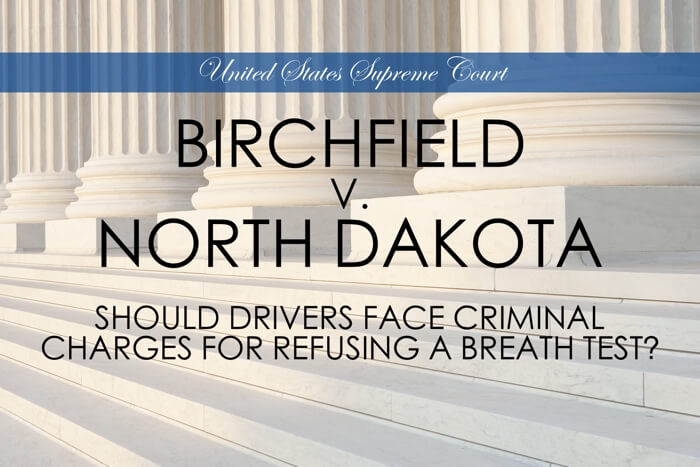
Birchfield v. North Dakota Supreme Court Breath Test

Criminal Penalties for Refusing a Breath Test—Are They Coming to Texas?

By Brandon Barnett · DWI

Can Texas Charge a Person with a Crime for Refusing a Breath or Blood Test During a DWI Stop?

In Texas, when a person refuses to provide a breath or blood specimen when being arrested for alleged drunk driving offense, their driver’s license is typically suspended. But, can a state have a law that additionally makes it a crime to refuse a breath or blood test? In Birchfield v. North Dakota, the United States Supreme Court held that a state can attach a criminal penalty to those that refuse to submit to a warrantless breath test but they cannot for those that refuse to submit to a warrantless blood test.

In a previous blog post we discussed the oral arguments that took place in this case and briefed the three cases facing the court, Birchfield , Bernard and Beylund.  Birchfield had been criminally prosecuted for refusing a warrantless blood draw; Bernard had been criminally prosecuted for refusing a warrantless breath test; and Beylund, while not criminally prosecuted for refusing a test, submitted to a blood test after the officer told him the law required it. Birchfield v. North Dakota 579 U.S. ____ (2016).

U.S. Supreme Court Issues Opinion in Birchfield Upholding Criminal Penalty for Breath Test Refusal (But Not Blood)

SUPREME COURT DECISION - Birchfield v. North Dakota

First, the Court determined whether warrantless breath and blood tests were proper searches incident to arrest for drunk driving. The Court held that since “breath tests are significantly less intrusive than blood tests” and in most cases adequately serve law enforcement interests, the Fourth Amendment permits a warrantless breath test but not blood test as a search incident to arrest for drunk driving.

Next, the Court addressed the argument that when making the decision to drive on a public road, drivers are deemed to have given consent to submit to a blood test. Applying the Fourth Amendment reasonableness standard, the Court held that “motorists cannot be deemed to have consented to submit to a blood test on pain of committing a criminal offense.” Birchfield, 579 U.S. ____ (2016).

Finally, the Court applies these legal conclusions to the three cases.  In Birchfield, the Court held that the judgment affirming his conviction must be reversed because the warrantless blood draw was not a justified search incident to arrest and he was thus, threatened with an unlawful search. In Bernard, the Court held that Bernard had no right to refuse the breath test because it was a proper search incident to arrest. In Beylund, the Court vacated the judgment and remanded the case to the state court to reconsider Beylund’s consent given the partial inaccuracy of the officer’s statement that “the law required it.”

In conclusion, the Supreme Court held that States may enact laws that attach criminal penalties to the refusal to submit to a breath test but they may not enact such laws that will apply to refusal to submit a blood test. So what does this mean for Texas? Well, while we do not currently have laws in place that attaches a criminal penalty to refusal of a breathalyzer, the State could enact a law that makes it a crime to refuse to provide a warrantless breath test incident to arrest of drunk driving.

Read full article
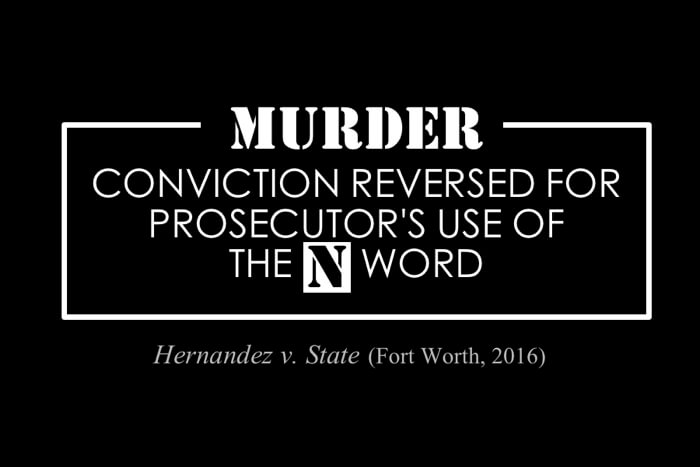
Hernandez Racial Slur Error 2016

Murder Conviction Reversed for Prosecutor's Use of Racial Slur

By Brandon Barnett · Jury Trial, Trial Advocacy

Texas Prosecutor Uses the "N" Word During Closing Argument. Court of Appeals Reverses the Conviction.

Hernandez Racial Slur Error 2016In December of 2014, Appellant Luis Miguel Hernandez was convicted of the murder of Devin Toler, an African-American man. During the trial, Appellant claimed self-defense, arguing that Toler attacked him and that by killing him, he was defending himself from the attack. The prosecution, however, presented evidence that Appellant provoked Toler by his words, some of them racial slurs. The actual words of the alleged racial slurs were never presented to the jury in the testimony of any witness or otherwise. However, during closing argument, the prosecutor said the following:

"What were the words of provocation? I’ll tell you what the words of provocation were. [Appellant] called Devin and his family 'niggas.' That’s what it was."

The defense attorney promptly objected to the prosecutor's use of the racial slur as it was inflammatory and outside the evidence in the case. Ultimately, (after a heated bench conference) the judge sustained the objection and instructed the jury to disregard the counsel's comment, but did not specify which counsel or what comment the jury was to disregard. The defense did not move for a mistrial. The jury returned a verdict of guilty and sentenced Appellant to 14 years in prison.

See the majority opinion in Hernandez v. State (2nd Court of Appeals - Fort Worth, 2016)

What is a Proper Jury Argument?

On appeal to the Second Court of Appeals (Fort Worth), the Appellant challenged the judge's failure to declare a mistrial after the prosecutor's use of the "N" word. The court explained:

Proper jury argument falls into one of four areas: (1) summation of the evidence; (2) reasonable deduction from the evidence; (3) an answer to the argument of opposing counsel; and (4) a plea for law enforcement. Generally, error resulting from improper jury argument is subject to a harm analysis.

The appellate court held that not only were the prosecutor's comments in using the "N" word error, but that the prosecutor's comments constituted an "incurably prejudicial argument;" one that required a mistrial.

Is the "Incurably Prejudicial Argument" Waived if the Defendant Does Not Move for a Mistrial?

Texas courts have consistently held that to preserve error for an improper argument, the defendant must do 3 things:

  1. Make a timely and specific objection;
  2. Request and instruction to disregard if the objection is sustained; and
  3. Move for a mistrial if the instruction to disregard is granted.

Cockrell v. State, 933 S.W.2d 73, 89 (Tex. Crim. App. 1996), cert. denied, 520 U.S. 1173 (1997)

In this case, the defense satisfied 1 and 2, but did not move for a mistrial. The appellate court was then presented with the issue of whether the improper jury argument objection is waived if the defense does not move for a mistrial.  Texas precedent says the issue can be waived for failure to move for a mistrial. But the court does not find this to be wise.

"Logically, this position makes no sense. An incurably prejudicial argument requires a mistrial. If the trial court does not grant the mistrial, the court has committed error that requires setting aside the conviction and re-trying the case. Respectfully, if the argument is so prejudicial that it has deprived the defendant of a fair trial, the injury is fundamental."

The court provides further reasoning to depart from precedent, citing the tenuous political atmosphere surrounding race relations in America at the time of the trial.

The impact of the improper statement by the prosecuting attorney must be viewed in the context of the political atmosphere at the time of trial. The trial took place in early December 2014. On February 26, 2012, George Zimmerman, whose mother was from Peru, killed Trayvon Martin. Emotional discussions of Zimmerman’s ethnicity filled news commentary. Other killings made headlines. Among them was the death of Eric Garner while he was selling loose cigarettes in New York on July 17, 2014. The officer who killed him was Daniel Pantaleo. On August 9, 2014, Michael Brown was killed in Ferguson, Missouri. On August 11, 2014, Ezell Ford was killed in Los Angeles by two police officers, one of whom was Hispanic. And on November 23, 2014, twelve-year-old Tamir Rice was killed in Cincinnati, Ohio. Additionally, the Black Lives Matter organization was formed in 2013 in response to the acquittal of George Zimmerman in his trial for the murder of Trayvon Martin and was actively involved in protests nationwide.

With that, the Second Court held that the improper jury argument was not cured (and could not have been cured) by the judge's "perfunctory" instruction to disregard and that the error was preserved for appeal. The court then reversed the case and remanded back to the trial court.

Dissent Agrees that the Error Was Prejudicial, But Would Not Depart From Precedent

Justice Sudderth dissented. She is not willing to depart from Court of Criminal Appeals' precedent regarding the formal requirement to move for a mistrial. She writes:

Of all of the words in modern American English usage, including the slang and the vulgar, the “n-word” is of such infamy that it is generally referenced and understood only by its first letter. And with very few exceptions, such racially charged inflammatory language has no place in jury argument.

This is certainly the case when a prosecutor, using that language to secure a conviction, goes outside of the record to introduce it. Therefore, I agree with the majority that the prosecutor’s behavior was improper. It was inexcusable. It cannot be condoned. And the trial judge committed error in permitting it. Nevertheless, because we are constrained by precedent of the court of criminal appeals requiring preservation of this type of error, I am compelled to dissent.

It will be interesting to see whether the Court of Criminal Appeals will stick to their previous precedent or take this opportunity to change the law when it comes to an "incurably prejudicial argument" involving racial slurs.

Read full article
Juvenile Intake Tarrant County

The Juvenile Justice Intake Process in Tarrant County, Texas

By Christy Dunn · Juvenile

Juvenile Intake Tarrant CountyIn Tarrant County, the Juvenile Probation Department is the intake agency for the county. This means that when a police officer files a case against a juvenile, it goes to Juvenile Probation before being sent to the District Attorney’s Office. The common practice is for cases to be referred by law enforcement officers without making an arrest. When this happens, there is a specific process in place with certain tasks that the juvenile intake officers must perform before a case is referred to the prosecutor. This article will walk you through this often-misunderstood process and explain why those juvenile probation officers do what they do.

Overview of the Juvenile Intake Process in Tarrant County, Texas

When a case is first received by the Tarrant County Juvenile Probation Department, it is assigned to an intake unit. There are three intake units within the department. Once it is received by the intake unit supervisor, it is assigned to a court intake officer. The court intake officer is responsible for completing several tasks prior to court, including: conducting an intake appointment, administering assessments, making sure the juvenile is fingerprinted and photographed, and preparing a social history. The intake officer must also make a decision about what the next step in the process should be.

The Intake Appointment

The intake appointment is, arguably, the most important piece of the intake process in Tarrant County. It is also the part that is the most confusing to families and defense attorneys alike. While families and attorneys can, and do, refuse to participate in the intake appointment, nothing good comes from refusing. To the contrary, in some cases, cooperating with the probation officer by showing up for the intake appointment can help resolve the case without a referral to the prosecutor or court action. The defense attorney can be at the intake appointment if he wishes, but is not required to be.

During the intake appointment, the probation officer will explain the process to the juvenile and his family. They will also explain the charges and sometimes read a summary of the police report. They are not allowed to give a copy of the police report to the family. The intake officers do not ask the juvenile about the offense. Next, the officer will get some background information from the family. This information will include a family history, school history, and information on any other agencies that the family has been involved with. The officer will also ask about substance abuse, mental health, any prior hospitalizations, current and past medications, behavior at school and home, and family criminal history. The purpose in gathering all this information is to put together a social history, which is a comprehensive report, on the child that will guide the court and the attorneys involved when making decisions about the juvenile and the case.

Juvenile Assessments - PACT & MAYSI

During the intake appointment, the probation officer will also administer a couple of assessments to the juvenile. These are required, but the defense attorney can decline the assessments. The two assessments, which are given are called the PACT and the MAYSI.

The purpose of the PACT assessment is to determine the child’s risks to reoffend and needs for services. The results of the PACT assessment are included in the social history that is given to the court and attorneys. The MAYSI is designed to screen for problems with mental health, substance abuse, and/or suicide. If the results of the MAYSI show a concern for suicide, a no-harm contract will be completed with the child, and the officer will refer that child for services to help with the suicidal tendencies.

Fingerprinting and Photographing

The Texas Department of Public Safety (DPS) requires anyone who is charged with a crime, juvenile or adult, to be fingerprinted and photographed. This information is submitted to DPS and is included in the person’s juvenile or criminal history. When a person is arrested, these two things are done as a part of the book in process. However, when a juvenile case is referred to the Tarrant County Juvenile Probation Department without an arrest, the probation officer is required to get the fingerprinting and photographing done. This is usually done during the intake appointment. It entails the officer walking the child to the juvenile detention center where the fingerprint and photograph office is located and having it done. This is one part of the process, which cannot be waived or refused. It is required by the State of Texas in every case.

Probable Cause Decision Regarding the Case

The last aspect of the intake process is for the probation officer to make a probable cause determination on the case and decide what to do with the case. There are certain offenses that are considered “mandatory referrals” in Tarrant County. This means that the probation officer is required to refer the case to the prosecutor for review. The mandatory referral offenses are the more serious offenses and are usually felonies.

For offenses that are not mandatory referrals, the probation officer is responsible for making a decision about what to do with the case. The officer can, of course, refer a case to the prosecutor for review even if it is not a mandatory referral. However, they have other choices too. They can dismiss a case or offer the juvenile Deferred Prosecution Program (DPP), which is an informal probation period without charges being filed. In some cases, the officer may determine that if the child pays restitution, then the case can be closed out without any further action. If the child and family does not cooperate with the intake process, the officer is required to refer the case to the prosecutor. However, if the family does participate, they may find that they can take care of their case during the meeting with the intake officer, which is definitely to the child’s benefit.

Additionally, the officer may, and many times will, make referrals for services to the family based on their needs. These referrals could be for any number of resources available in the community. They could include referrals to MHMR, school programs, and counseling, to name a few.

The Tarrant County Juvenile Probation Department’s intake process is misunderstood many times by families and attorneys. It is not an adversarial process. The intake officers are neutral parties charged with gathering information, preparing social history reports, and making referrals for services. They are required by law to perform a few tasks, such as fingerprinting. However, their primary purpose is to help the child and the family navigate a system which may be unfamiliar and confusing. If you and your child are contacted about meeting with an officer for an intake appointment, it is preferable for you to cooperate so that you may have access to all possible options in your child’s case.

About the Author

Christy Dunn is a writer and attorney licensed to practice in Texas. She was a prosecutor for 15 years. The last five years of her prosecutorial career was spent in the Juvenile Division of the Tarrant County District Attorney’s Office.  She has tried over 20 juvenile cases in Texas and multiple certification hearings.

Read full article
Texas Burglary Own Home

Can You Burglarize Your Own Residence?

By Brandon Barnett · Burglary

Can a Roommate Who is Not on the Lease be Convicted of Burglary of His or Her Own Residence?

Texas Burglary Own HomeThe Court of Criminal Appeals recently held that a roommate, who is not a co-tenant on the lease, could be convicted of burglary into his or her own residence. The key issue facing the Court was whether Appellant Dewan Morgan was an owner of the apartment he was residing in at the time of the criminal act.


In order to commit a Burglary of a Habitation, a person “without the effective consent of the owner (a) enters a habitation with intent to commit an assault or (b) enters a habitation and commits or attempts to commit an assault.” Tex. Penal Code § 30.02(a)(1). An “‘owner’ means a person who has title of the property, possession of the property, or a greater right to possession of the property than the person charged.” Tex. Penal Code § 1.07(a)(35).

Morgan v. State (Tex. Crim. App. 2016)

The Facts – Trial Court Found Appellant was NOT Considered an Owner

Dewan Morgan moved in with his girlfriend, Regina, in November of 2012. Regina gave Dewan Morgan a key to the apartment, but did not add his name to the lease. She mostly paid the bills and expenses with occasional help from Appellant. Additionally, Appellant kept his personal items at the apartment.

On June 20, 2013, Morgan and Regina got into an argument. Regina did not want Morgan back in the apartment, so she locked the deadbolt from inside the apartment so that Morgan could not get in with his key. He knocked on the door and rang the doorbell, but Regina did not open the door. Morgan threw a rock into a side window, which broke the window, and then began kicking in the door. He was able to gain entry into the apartment, and when he went inside he grabbed Regina, pushed her to the bed, bit her on the side of her left breast, punched her, and choked her. The police arrived and arrested Morgan. The jury found Morgan guilty of Burglary of a Habitation - a 2nd Degree Felony.

The Court of Appeals Reversed and Found Appellant was an Owner and Could Not Commit Burglary

The Second Court of Appeals held that there was “no evidence of the absence of ‘the owners’ consent” because Appellant was a co-tenant, thus an owner of the apartment. The court erroneously relied on Texas Code of Criminal Procedure, Article 21.08, which provides a definition of an owner for indictment purposes. Under that definition, the court held that because Appellant lived in the apartment and kept his belongings inside it, he was also an owner of the apartment. Additionally, there was no evidence that his tenancy was terminated, thus he had the right to occupy and control his apartment.

The Court of Criminal Appeals Reverses — Holds Appellant was Not an Owner and Did Not Have Effective Consent to Enter the Apartment

The CCA followed the Freeman standard to determine ownership: “A person’s ‘right to possession’ must be measured at the time of the accused’s alleged criminal act.” Freeman v. State, 707 S.W.2d 597 (Tex. Crim. App. 1986). The Court also extended this application to effective consent and concluded that “if a person’s status as ‘owner’ is measured at the time of the criminal act, then so is giving, or removing, of the effective consent to enter.” Essentially, the Court takes a snapshot of the criminal action and determines effective consent in only that instance.

The CCA first analyzed who the owner of the apartment was. It quickly rejected reliance on Article 21.08 because it is “only applicable in evaluating the sufficiency of an indictment.” Instead, the Court looked to the Penal Code’s definition that was included in the jury charge, as noted above. The Court said the “Penal Code’s definition of ‘owner’ clearly indicates that a defendant who has some, but less, right to control a habitation than the alleged owner may be prosecuted for burglary.”

The key concern for the Court was whether Regina’s right to possess the property was greater than Appellant's at the time of the criminal act. The Court considered that only Regina’s name was on the lease, that she paid the rent, and that she gave Appellant a key and she could take it away. Ultimately, Regina’s possession of the apartment was greater than Appellant’s, which did not give Appellant equal ownership rights. The Court held that at the time of the offense, Regina’s right to possess the apartment trumped Appellant’s and that only she was the owner at the time of the criminal act.

The CCA next analyzed whether there was no effective consent to enter. Again, the Court analyzed effective consent only in the snapshot of when the criminal act occurred. Even though Regina testified at trial that she did not intend to permanently withhold consent to enter and it was only temporary, the Court found that the temporary revocation of consent during the criminal act was “sufficient to establish the absence of effective consent.” When Regina locked Morgan out of the apartment during their argument, the Court found it clear that Regina did not want Morgan to enter the apartment. Thus, the CCA held that Morgan did not have effective consent to enter the apartment.

The CCA’s Snapshot Analysis – Evidence is Legally Sufficient to Support the Jury’s Guilty Verdict

The CCA considered the factors during the time of the crime and held that the jury was authorized to find that Regina was the owner of the apartment because she had a greater right to possession of the apartment than Appellant, and at the time Appellant entered the apartment, he did so without the effective consent of Regina and with the intent to assault her.

Read full article
Emergency Aid Police Arrest Texas

Does the Emergency Aid Exception Apply to Vehicle Stops?

By Luke A. Williams · Warrantless Search

Officers Are Justified in Stopping Vehicles to Render Emergency Aid Making Evidence Found in the Process Fair Game

Emergency Aid Police Arrest TexasThe Fifth Circuit Court of Appeals recently handed down an opinion dealing with the emergency-aid warrant exception and whether that exception extends to vehicular stops. The issue facing the court was whether a traffic stop of Appellant Toussaint to warn him that a gang member had ordered a hit on him was justified under the emergency aid exception to the Fourth Amendment. The court reversed the suppression order from the trial court holding that the emergency aid exception did justify the stop because this was a proper exigent circumstance.

US v. Toussaint (5th Circuit - 2016)

The Facts—Trial Court Found the Exigent Circumstances Had Expired

An FBI agent monitoring a wiretap overheard a suspected gang-member order his associate to kill Toussaint who could be found in a specific neighborhood driving a specific car, a silver Infiniti. Immediately the agent contacted a local police officer who met with several other officers to determine the plan to locate and warn Toussaint of the hit. The officers drive to the specified neighborhood and search for silver Infinities until they find one with an occupant leaving the neighborhood. The officers follow the vehicle, observe the driver, Toussaint, speeding and pull him over. Once pulled over Toussaint flees the officers on foot until he was caught and placed under arrest. During a search of Toussaint incident to arrest officers found a pistol and a bag of crack cocaine. The amount of time between the FBI agent overhearing the initial threat and Toussaint’s arrest was about 45 minutes.

Toussaint was charged with drug and firearm violations. Toussaint filed a motion to suppress the evidence obtained from the stop arguing that the stop was not justified. The trial court granted Toussaint’s motion to suppress finding that the exigency of the emergency had expired by the time the officers stopped Toussaint.

The Court of Appeals Reversed the Trial Courts Decision—Holding the Emergency-Aid Exception Applied in this Case and the Exigency Had Not Expired

The court held that the emergency-aid exception extends to vehicular stops when under the circumstances of the need to assist persons with serious injuries or threatened with serious injury. The emergency aid exception allows officers to conduct warrantless searches or seizures when there is a need to assist persons with serious injuries or threatened with a serious injury. Stuart, 547 U.S. 398 at 483. Under this exception, officers can enter areas they otherwise are not allowed in order to help someone. While the majority of such cases involve warrantless entries into homes, the court determined that there is no logical reason to not extend the exception to vehicular stops. Additionally, looking to reasonableness, “the ultimate touchstone of the Fourth Amendment,” the court stated “the benevolent act of trying to notify a driver that his life is in danger epitomizes reasonableness.” Thus, the court held that the emergency aid exception can be used to justify a traffic stop under proper exigent circumstances.

Then, the court held that the exception applied in this case and officers were justified in stopping Toussaint. The court stated that trial courts must examine objective facts of the circumstance in determining whether there was an objectively reasonable basis for believing exigency actually existed. The officers’ subjective motivations are never relevant in the determination. When the officers received what all parties agreed was a credible threat against Toussaint, who was located in a specific neighborhood and driving a specific vehicle, the court held it was reasonable for the officers to believe there was a serious threat on Toussaint’s life. Further, that exigency still existed at the time of the stop because the threat on Toussaint’s life had not ended within the 45 minutes it took officers to locate him and warn him. Since the stop was justified the search was proper and evidence was legally obtained because it would be contrary to the needs of law enforcement to force officers to ignore evidence found when they stop vehicles to render emergency aid.

In conclusion, the court held that the emergency aid exception extends to vehicular stops and that here, the stop of Toussaint was justified under this exception because there was a serious threat on his life. Accordingly, the court reversed the suppression order because the trial court was improper in granting the motion.

Read full article

Speak with a Fort Worth attorney

Call (817) 993-9249 or send us a message to discuss your case.